Key takeaways
- Omnia tracks AI brand visibility across ChatGPT, Perplexity, and Google AI Overviews, but it's primarily a monitoring tool with limited support for multi-client agency workflows
- Agencies need more than dashboards: white-label reporting, multi-site management, content gap analysis, and the ability to actually fix visibility problems matter as much as tracking them
- Promptwatch is the strongest all-around alternative for agencies, combining AI visibility tracking with content generation, crawler logs, and traffic attribution across 10+ AI models
- Other solid picks include AgencyAnalytics for client reporting, Otterly.AI for budget-conscious teams, and Scrunch AI for mid-market brands
- The right tool depends on whether your agency needs monitoring only, or a full optimization loop from gap analysis to content creation to results tracking
Omnia does one thing reasonably well: it shows you where your clients' brands appear (or don't) in AI search responses. If you're running a single brand and just want a visibility score, it gets the job done.
But agencies managing five, ten, or twenty clients have a different problem. They need to track visibility across all those clients at once, generate reports that actually look professional, identify what's causing the visibility gaps, and then do something about it. Monitoring dashboards alone don't cut it.
This guide covers seven alternatives worth considering in 2026, with honest notes on what each one is actually good at and where it falls short.
What agencies actually need from an AI visibility tool
Before getting into the list, it's worth being clear on what separates a tool built for agencies from one built for individual brands.
| Feature | Why it matters for agencies |
|---|---|
| Multi-site management | Managing clients one at a time doesn't scale |
| White-label reporting | Clients want reports that look like they came from you |
| Content gap analysis | Knowing what's missing is only useful if you can act on it |
| AI content generation | Creating content that gets cited is the actual deliverable |
| Crawler logs | Understanding how AI bots interact with client sites |
| Traffic attribution | Connecting AI visibility to actual revenue |
| Prompt intelligence | Volume and difficulty data to prioritize which prompts to target |
| Multi-model coverage | ChatGPT, Perplexity, Gemini, Claude — clients care about all of them |
Most tools in this space cover the first two rows and stop there. The ones worth paying for go further.
The 7 best Omnia alternatives for agencies in 2026
1. Promptwatch — best for agencies that want to actually fix visibility, not just track it
Promptwatch is the most complete option on this list for agencies that want to move beyond monitoring. Where Omnia shows you a visibility score, Promptwatch shows you the score and then helps you close the gap.

The core workflow is built around three steps: find the gaps, create content that fills them, then track whether it worked. The Answer Gap Analysis shows exactly which prompts competitors appear for that your clients don't — down to the specific topics and questions that AI models want answered but can't find on the client's site. From there, the built-in AI writing agent generates articles, listicles, and comparisons grounded in 880M+ citations analyzed, not generic SEO filler.
For agencies specifically, the multi-site setup (up to 5 sites on the Business plan, custom for agencies) and page-level tracking make it practical to manage multiple clients without losing your mind. Crawler logs show which AI bots are hitting client pages and whether they're encountering errors — something most competitors don't offer at all. Traffic attribution via GSC integration, a code snippet, or server log analysis closes the loop between AI visibility and actual revenue, which is the number clients actually care about.
Coverage spans 10 AI models: ChatGPT, Perplexity, Google AI Overviews, Google AI Mode, Claude, Gemini, Meta/Llama, DeepSeek, Grok, Mistral, and Copilot. Reddit and YouTube tracking surfaces discussions that directly influence AI recommendations — a channel most tools ignore entirely.
Pricing starts at $99/month (Essential, 1 site, 50 prompts) and goes to $579/month (Business, 5 sites, 350 prompts, 30 articles). Agency and enterprise pricing is available on request.
The honest caveat: if your clients genuinely only want a monthly visibility report and nothing else, Promptwatch has more capability than you'll use. But for agencies that want to show clients measurable improvement, not just a dashboard, it's the strongest option available.
2. AgencyAnalytics — best for white-label client reporting
AgencyAnalytics has been the go-to for agency reporting for years, and it's added AI search tracking to its suite. The core strength is white-label dashboards that look like your agency built them from scratch — clients get a branded portal, you get a centralized view across all accounts.
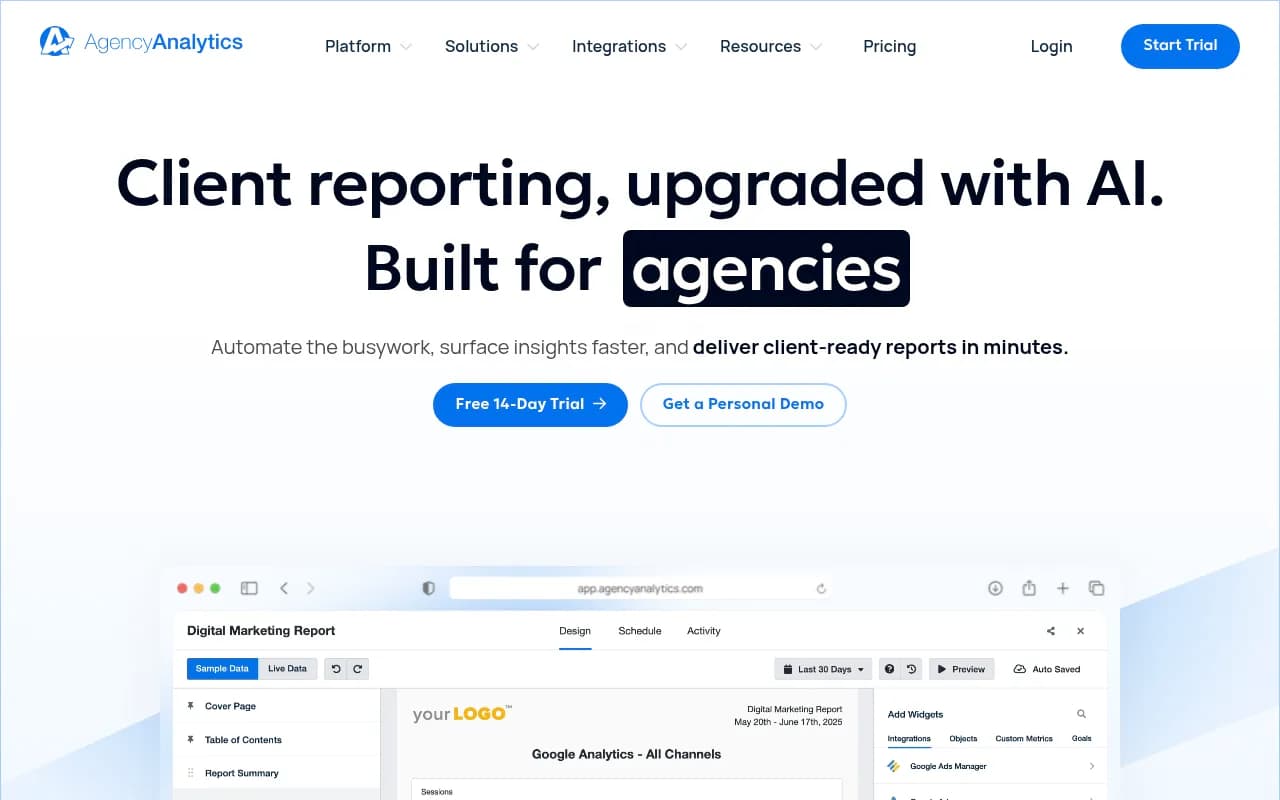
It's not primarily an AI visibility tool. The SEO, PPC, social, and analytics integrations are the main draw, and the AI search tracking is more of an add-on than a core feature. But if your agency already uses AgencyAnalytics for traditional SEO reporting and wants to layer in AI visibility data without switching platforms, it's a reasonable choice.
Where it falls short: no content generation, no crawler logs, and the AI visibility features are less granular than dedicated GEO platforms. It's a reporting tool first.
3. Otterly.AI — best for agencies on a tighter budget
Otterly.AI is one of the more affordable options in the AI visibility space, and it covers the basics well: brand mention tracking across ChatGPT, Perplexity, and a handful of other models, with prompt monitoring and basic reporting.

For agencies managing clients with smaller budgets, or for teams that are just starting to add AI visibility to their service offering, Otterly.AI is a low-friction way to get started. The interface is clean and the setup is quick.
The limitations are real, though. There's no content generation, no crawler logs, no traffic attribution, and the prompt intelligence is fairly shallow. It's a monitoring tool, not an optimization platform. If clients start asking "okay, so what do we do about this?", you'll need something else to answer that question.
4. Scrunch AI — best for mid-market brands with content teams
Scrunch AI positions itself as a monitor-and-optimize platform, with features for tracking AI citations and identifying content opportunities. It's a step up from pure monitoring tools and has decent coverage across major AI models.
The content optimization side is more developed than most competitors, which makes it useful for agencies whose clients have in-house content teams that can act on recommendations. The reporting is solid and the interface is reasonably intuitive.
Where it gets complicated for agencies: multi-client management isn't as streamlined as you'd want, and the pricing can add up quickly when you're managing a large client roster. It's better suited to agencies with a handful of mid-market clients than those running high-volume, lower-budget accounts.
5. Profound — best for enterprise-level clients
If your agency works with large enterprise brands, Profound is worth knowing about. It's built for organizations with complex visibility needs across multiple markets and languages, with strong analytics and competitive benchmarking.
The data depth is impressive, and the platform handles multi-region, multi-language tracking well. For enterprise clients who want detailed competitive analysis and executive-level reporting, Profound delivers.
The catch is price and complexity. It's not built for agencies managing ten small clients — it's built for agencies managing one or two very large ones. The onboarding is heavier, and the cost reflects the enterprise positioning. If that matches your client profile, it's a serious contender. If not, it's overkill.
6. Slate — built specifically for agency workflows
Slate is one of the newer entrants in this space, and it's designed with agencies in mind from the ground up. Multi-client management, white-label options, and a clean interface for tracking AI visibility across accounts are the core features.
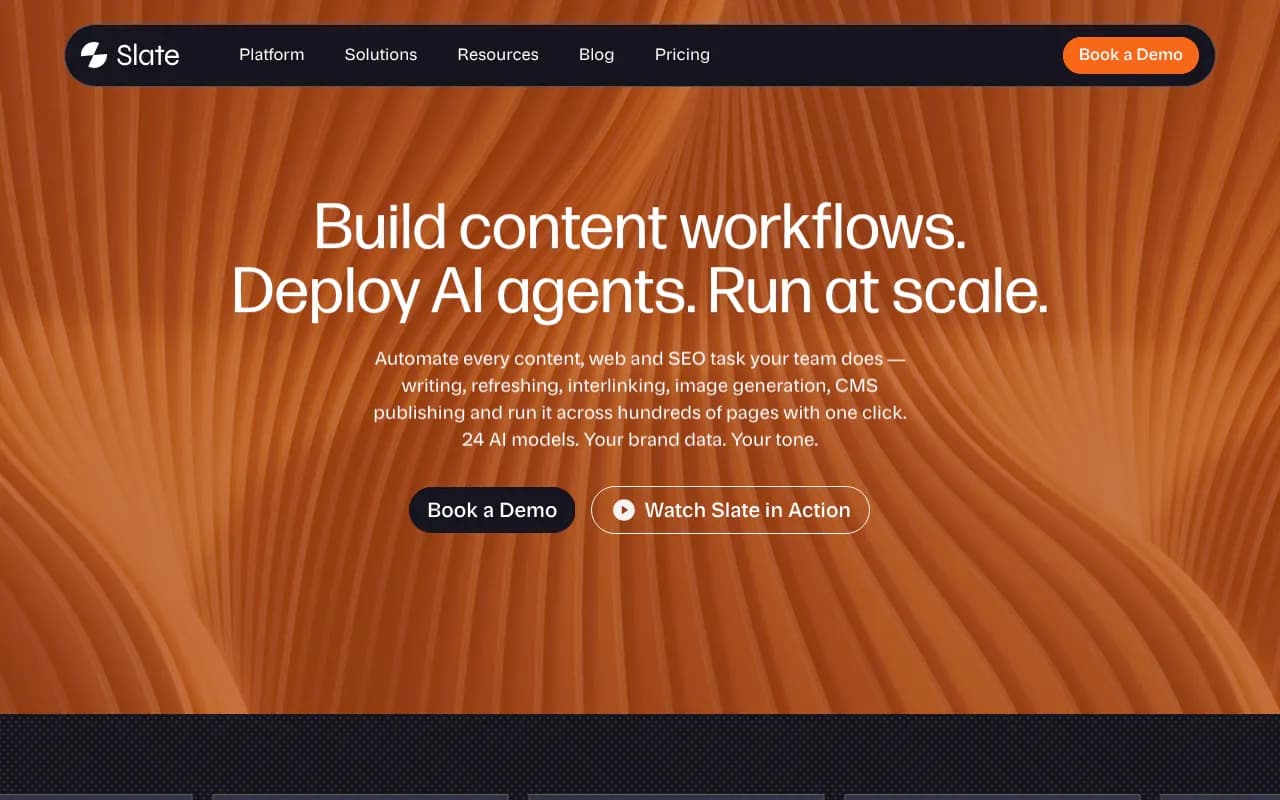
It's worth watching. The agency-first positioning means the workflow actually makes sense for teams managing multiple clients, and the onboarding is faster than most enterprise-grade tools. The AI model coverage is growing, and the team has been adding features at a reasonable pace.
The honest limitation right now is depth. Compared to Promptwatch or Profound, the analytics are less granular and the content optimization features are still developing. It's a good fit for agencies that want something purpose-built for their workflow and are willing to accept some feature gaps in exchange for simplicity.
7. Cairrot — best for budget-conscious agencies tracking multiple LLMs
Cairrot is a newer, affordable option that tracks brand visibility across five or more LLMs and is priced with agencies in mind. It's not trying to be the most feature-rich platform on the market — it's trying to be the most accessible.
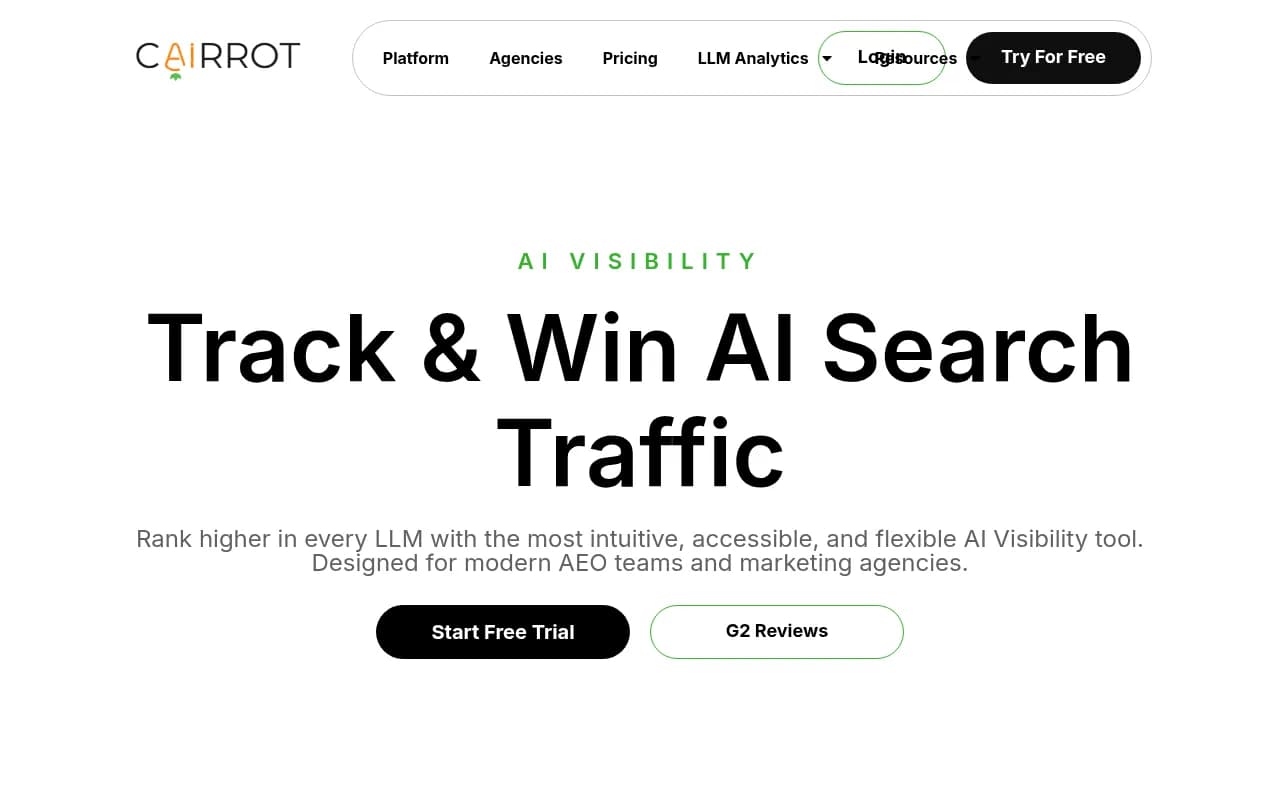
For agencies that need to show clients basic AI visibility data across multiple models without a significant budget commitment, Cairrot fills that gap. The multi-client setup is straightforward, and the reporting is easy enough to share with clients who are new to the concept of AI search visibility.
The limitations are similar to Otterly.AI: no content generation, limited prompt intelligence, and no traffic attribution. It's a starting point, not an endpoint.
How these tools compare
Here's a side-by-side view of the key features that matter for agencies:
| Tool | Multi-client | Content generation | Crawler logs | Traffic attribution | AI models covered | Best for |
|---|---|---|---|---|---|---|
| Promptwatch | Yes (up to 5 sites, custom for agencies) | Yes (built-in AI writer) | Yes | Yes (GSC, snippet, logs) | 10 | Full optimization loop |
| AgencyAnalytics | Yes (unlimited clients) | No | No | Partial (via integrations) | Limited | White-label reporting |
| Otterly.AI | Limited | No | No | No | 4-5 | Budget monitoring |
| Scrunch AI | Partial | Partial | No | No | 6+ | Mid-market brands |
| Profound | Yes (enterprise) | No | No | No | 6+ | Enterprise clients |
| Slate | Yes | No | No | No | 4-5 | Agency-first workflows |
| Cairrot | Yes | No | No | No | 5+ | Budget multi-LLM tracking |
What's actually missing from Omnia
Omnia's own blog positions it as a competitor tracker for AI search, and it does that reasonably well. The interface is clean, the coverage includes ChatGPT, Perplexity, and Google AI Overviews, and the competitive benchmarking is useful for showing clients where they stand.
But for agencies, the gaps are significant:
- No content generation or optimization tools — you see the gap but can't fill it from within the platform
- Limited multi-client management — it's designed for brands, not agencies managing many brands
- No crawler logs — you can't see how AI bots are interacting with client sites
- No traffic attribution — you can't connect AI visibility improvements to actual revenue
- No Reddit or YouTube tracking — two channels that heavily influence AI recommendations
These aren't minor omissions. They're the difference between a monitoring dashboard and an actual agency tool.
Which one should you pick?
The honest answer depends on what your agency actually needs to deliver.
If you're building out an AI visibility practice and want to offer clients a full service from gap analysis to content creation to results tracking, Promptwatch is the strongest option. The action loop — find gaps, generate content, track results — is what clients are actually paying for, and it's the only platform in this comparison that covers all three steps natively.
If your agency already has strong content capabilities and just needs better reporting, AgencyAnalytics is a practical add-on to your existing stack.
If budget is the primary constraint and clients just want to see where they stand, Otterly.AI or Cairrot will get you started without a significant investment.
For enterprise clients with complex needs, Profound is worth the conversation. For agencies that want something purpose-built for their workflow without enterprise complexity, Slate is worth trialing.
The AI search visibility space is moving fast. Whatever tool you pick, make sure it's one that can show clients not just where they are, but what to do next.