Key takeaways
- Scrunch is a solid AI visibility monitor, but it stops at showing you data -- it doesn't help you create content to improve your rankings in ChatGPT, Perplexity, or Gemini.
- The tools on this list all include some form of built-in content generation or optimization, not just dashboards.
- Promptwatch is the most complete option if you want a full loop: find gaps, generate content grounded in citation data, and track results.
- Writesonic doubles as a content platform with GEO tracking built in -- a good fit if you're already using it for writing.
- Relixir and AirOps are worth considering if your team is more technical and wants workflow-level control over content production.
- Price ranges vary widely: from ~$99/month for entry-level to $500+ for enterprise-grade platforms.
The core frustration with Scrunch isn't that it's bad. It's that it leaves you stranded.
You can see that a competitor is getting cited by ChatGPT for a prompt you care about. You can see that your brand isn't appearing. And then... you're on your own. No guidance on what content to create, no tools to create it, no way to close the loop between the data and the fix.
As one practitioner put it on Reddit: "I've tried a couple and they all kind of blur together. Some are decent for tracking, but I'm still waiting to find one that actually helps make better decisions, not just dump data."
That's the gap this guide addresses. The five tools below all go beyond monitoring. Each one includes some form of content generation, content gap analysis, or optimization workflow that helps you actually improve your AI search visibility -- not just measure it.
What "built-in content generation" actually means here
Before getting into the list, it's worth being specific about what qualifies. "Content generation" in the GEO context isn't just having an AI writing button. The tools that genuinely move the needle do at least one of these:
- Identify which prompts or topics you're missing coverage for (answer gap analysis)
- Generate articles, listicles, or comparison pages grounded in real citation data -- content that AI models actually want to cite
- Suggest on-page optimizations based on what's working for competitors in AI responses
- Track whether newly published content starts getting cited
Tools that only show you a visibility score and leave the rest to you don't make this list.
The 5 best Scrunch alternatives with content generation
1. Promptwatch -- best for the full optimization loop
Promptwatch is the most complete option on this list, and the one most directly built around the problem Scrunch users run into.

The core difference is what Promptwatch calls the action loop. Most platforms stop at step one (showing you where you're invisible). Promptwatch continues into step two (helping you create content to fix it) and step three (tracking whether that content gets cited).
The Answer Gap Analysis feature shows you exactly which prompts competitors are visible for that you're not -- with the specific topics and angles your site is missing. That alone is more actionable than anything Scrunch surfaces. But the part that separates Promptwatch from almost every other tool in this space is the built-in AI writing agent.
It generates articles, listicles, and comparison pages grounded in real citation data -- over 880 million citations analyzed. This isn't generic SEO content. It's written to match the patterns AI models actually cite, informed by prompt volumes, competitor analysis, and persona targeting.
On the tracking side, Promptwatch monitors 10 AI models (ChatGPT, Claude, Gemini, Perplexity, Grok, DeepSeek, Copilot, Meta AI, Mistral, and Google AI Overviews), with page-level tracking that shows exactly which pages are being cited, how often, and by which model. The AI Crawler Logs feature -- which most competitors lack entirely -- shows you in real time which pages AI crawlers are reading and where they're hitting errors.
Pricing starts at $99/month for the Essential plan (1 site, 50 prompts, 5 articles). The Professional plan at $249/month adds crawler logs, city/state tracking, and 15 articles per month. Business is $579/month for 5 sites and 30 articles. A free trial is available.
The honest limitation: if you only need basic monitoring for a single brand and have no interest in content production, Promptwatch is more platform than you need. But for teams that want to actually improve their AI visibility rather than just watch it, it's the most complete option available.
2. Writesonic -- best for teams already invested in AI writing
Writesonic started as an AI writing tool and has since built GEO tracking directly into the platform. That origin story matters: the content generation here is genuinely good, not bolted on.
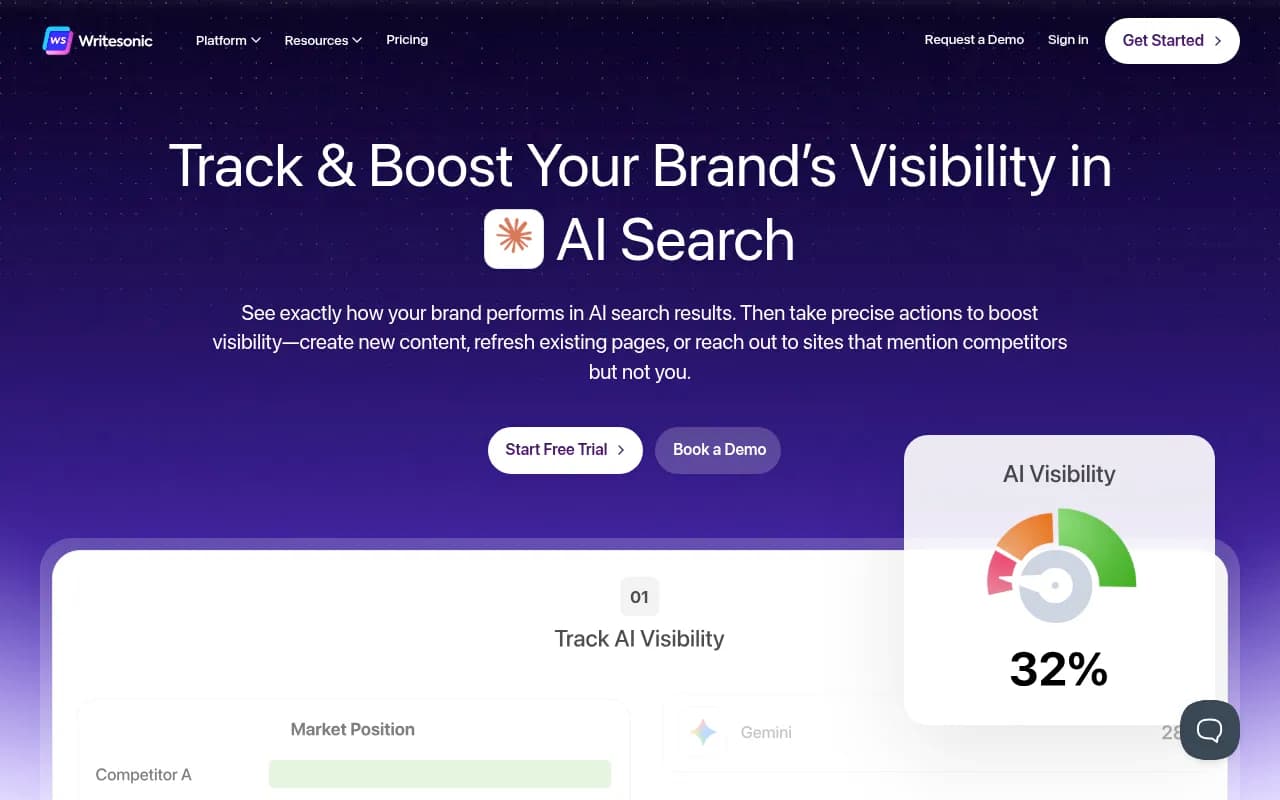
The AI visibility tracking covers ChatGPT, Perplexity, Gemini, and others, with brand mention monitoring and competitor comparison. Where it gets interesting is the integration between tracking and writing -- you can identify a topic where you're underperforming in AI search and move directly into content creation without switching tools.
For teams that already use Writesonic for blog content or marketing copy, this is a natural extension. The GEO features feel like a logical addition to an existing workflow rather than a separate product you need to learn.
The limitation compared to Promptwatch is depth. Writesonic's AI visibility tracking is solid but doesn't go as deep on citation analysis, crawler logs, or prompt intelligence. It's a better fit for content-first teams than for SEO or analytics-heavy teams who want granular data.
3. Relixir -- best for teams that want AI content at scale
Relixir positions itself as an all-in-one GEO platform with AI content generation and analytics combined. It's worth a look if your primary bottleneck is content volume -- getting enough pages published to compete across a wide range of AI prompts.
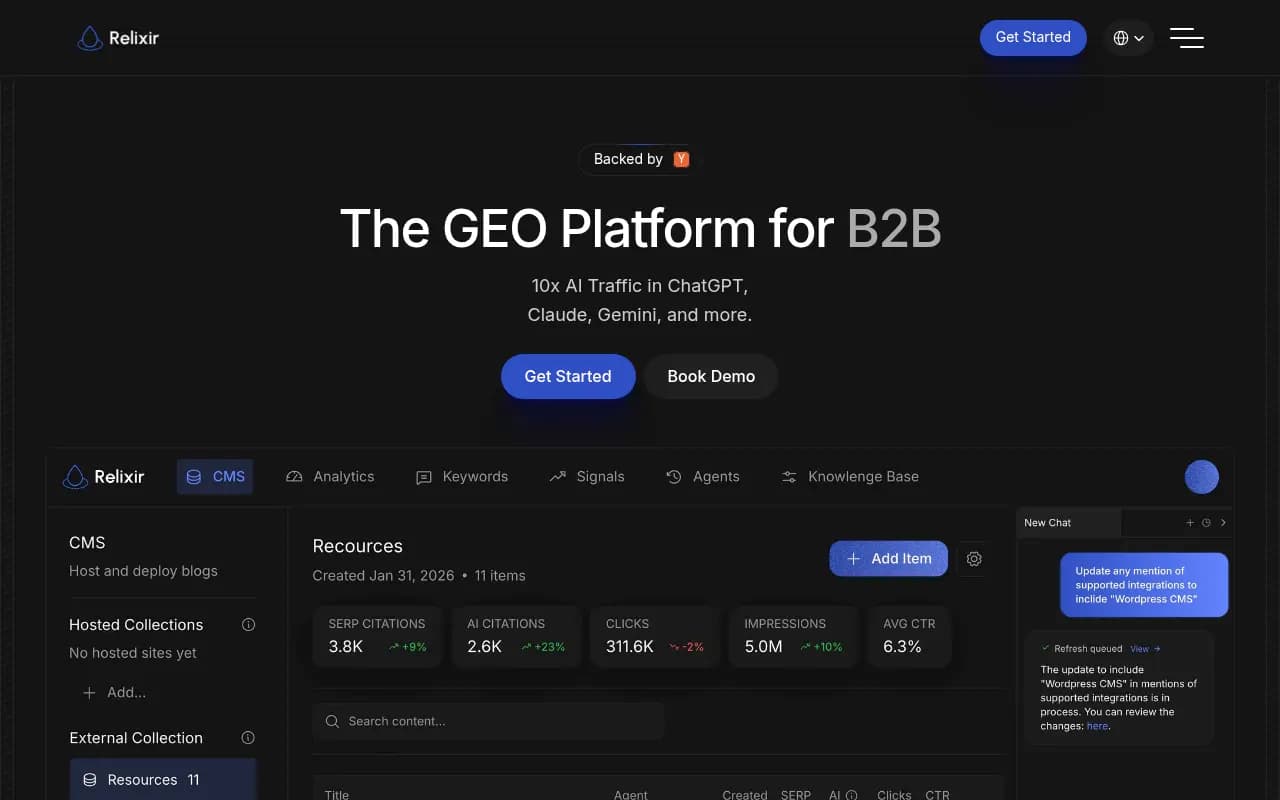
The platform analyzes where competitors are getting cited, identifies the content gaps, and then generates content designed to fill those gaps. The workflow is more automated than Promptwatch's, which can be an advantage if you're managing a large site and need to produce content quickly.
The trade-off is control. More automation means less ability to fine-tune the output or apply persona-level targeting. Teams with a strong editorial voice may find the content needs more editing than they'd like.
Relixir is a reasonable middle ground between a pure monitoring tool and a full-service content operation.
4. AirOps -- best for technical teams building custom GEO workflows
AirOps takes a different approach. Rather than a pre-built platform, it's closer to an AI workflow tool that you configure for GEO use cases -- including content generation, brief creation, and optimization at scale.
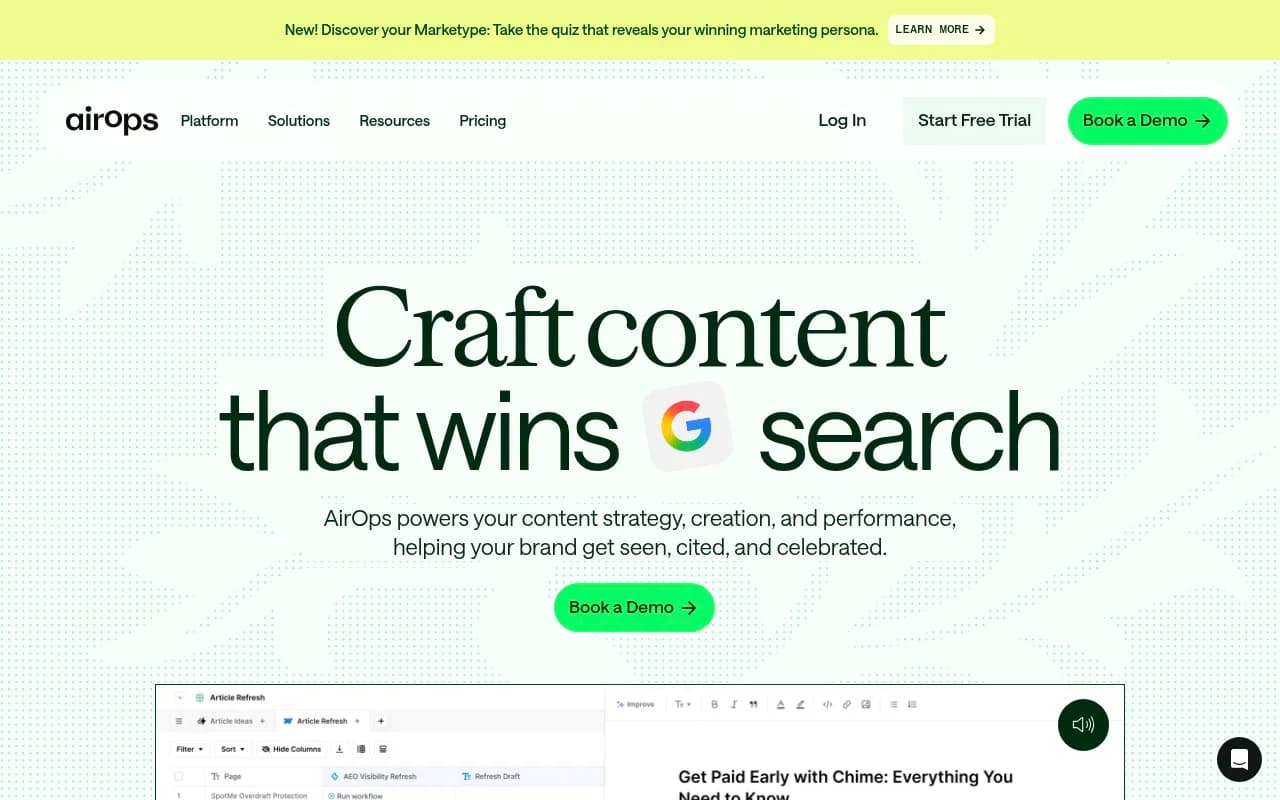
If your team is comfortable building workflows and wants precise control over how content is generated, researched, and published, AirOps gives you that flexibility. You can connect it to your existing data sources, CMS, and analytics stack in ways that more opinionated platforms don't allow.
The downside is that it requires more setup. You won't get out-of-the-box AI visibility dashboards or prompt tracking the way you would with Promptwatch or Writesonic. AirOps is a tool for teams that know exactly what they want to build and have the technical capacity to build it.
For agencies managing multiple clients with different workflows, or enterprise teams with dedicated marketing ops resources, that flexibility is genuinely valuable.
5. SearchAtlas LLM Visibility -- best for teams that want SEO and GEO in one place
SearchAtlas has expanded its traditional SEO platform to include LLM visibility tracking and content optimization. The appeal here is consolidation -- if you're already using an SEO platform and want to add AI search visibility without adopting an entirely new tool, SearchAtlas is worth evaluating.

The content generation side is tied to their broader SEO content tools, which means you get keyword research, content briefs, and AI writing alongside the GEO tracking. It's not as specialized as Promptwatch's citation-grounded content engine, but for teams that think about AI search as an extension of traditional SEO rather than a separate discipline, the integrated approach makes sense.
The LLM visibility features are newer than the core SEO product, so expect some rough edges compared to purpose-built GEO platforms.
How these tools compare
| Tool | Content generation | Prompt/citation tracking | Crawler logs | Starting price | Best for |
|---|---|---|---|---|---|
| Promptwatch | Yes -- citation-grounded AI writing agent | Deep (10 models, page-level) | Yes | $99/mo | Full optimization loop |
| Writesonic | Yes -- integrated with writing platform | Solid (major models) | No | ~$99/mo | Content-first teams |
| Relixir | Yes -- automated at scale | Yes | Limited | Custom | High-volume content production |
| AirOps | Yes -- configurable workflows | Limited out-of-box | No | Custom | Technical teams, agencies |
| SearchAtlas | Yes -- SEO-integrated | Growing | No | ~$99/mo | SEO + GEO consolidation |
What Scrunch does well (and why you might still use it)
To be fair: Scrunch covers a lot of AI platforms, including ChatGPT, Claude, Gemini, Perplexity, and newer models like DeepSeek and Grok. Its monitoring breadth is genuinely strong, and the interface is clean.
If your primary need is brand monitoring across many AI models -- tracking sentiment, mentions, and competitor presence -- Scrunch does that competently. The frustration comes when you want to act on what you see. Scrunch doesn't share prompt volume data, its trend features are limited, and there's no content creation path built in.
For teams with a separate content operation that just needs a monitoring layer, Scrunch might be sufficient. But if you're trying to improve your AI visibility, not just measure it, you'll hit a ceiling quickly.
How to choose
The right tool depends on what's actually blocking you.
If the bottleneck is knowing what content to create and then creating it, Promptwatch is the most direct solution. The gap analysis tells you what's missing, the writing agent generates it, and the tracking shows you whether it worked.
If you're already a Writesonic user and want to add GEO tracking without adopting a new platform, the integrated approach there makes sense.
If you need to produce content at high volume and want more automation, Relixir is worth evaluating.
If you have technical resources and want to build a custom workflow, AirOps gives you that flexibility.
If you're trying to consolidate your SEO and GEO tools into one platform, SearchAtlas is the most natural fit.
The common thread across all five: they don't leave you staring at a dashboard wondering what to do next. That's the real gap Scrunch leaves open, and any of these tools will close it better than staying put.