FullEnrich Review 2026
Aggregates data from multiple providers to find verified email addresses and phone numbers, maximizing contact coverage for outbound campaigns.
Summary
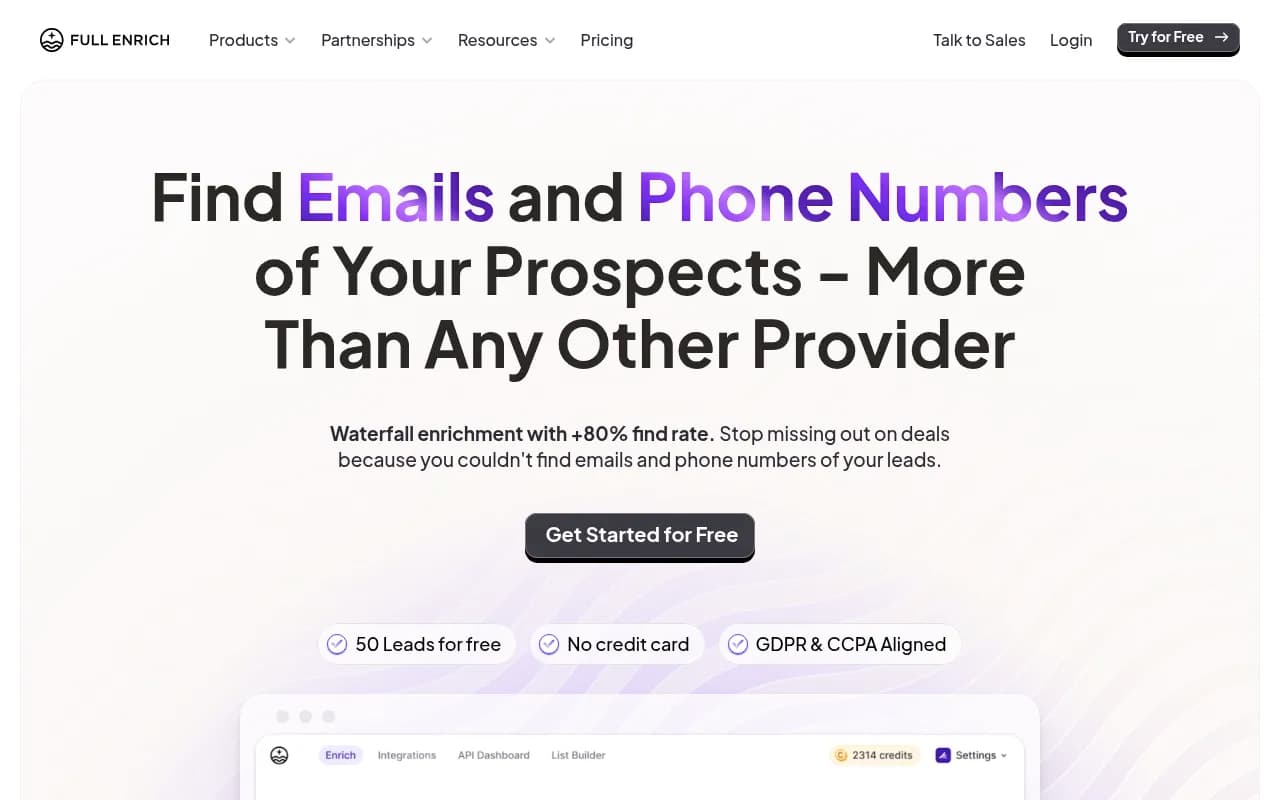
- Best-in-class find rates: 80%+ email coverage and 86% phone coverage (US/Canada) by querying 20+ data vendors in sequence until a match is found
- Waterfall approach saves money: Access Apollo, Lusha, Kaspr, Wiza, and 16+ other providers through one subscription instead of paying for each separately (saves $600+ per month)
- Quality over quantity: Triple email verification, catch-all validation, mobile-only phone numbers, and advanced phone line ownership matching
- Limitations: No prospecting database (bring your own leads), credit-based pricing can get expensive at scale, limited to contact enrichment (no firmographic data or intent signals)
- Best for: Outbound sales teams with 5-50 reps who already have lead lists from LinkedIn, Apollo, or Clay and need to maximize reachable contacts
FullEnrich launched as a solution to a problem every B2B sales team knows too well: you spend hours building a list of perfect-fit prospects, then discover half of them have no contact info in your data provider. You're paying for ZoomInfo or Lusha or Cognism, but they're only finding 40-50% of the emails and phone numbers you need. The other half of your pipeline just evaporates.
The company's answer is waterfall enrichment -- a concept borrowed from programmatic advertising. Instead of querying one data vendor and accepting whatever coverage they offer, FullEnrich queries 20+ providers in sequence until it finds a verified email or phone number. If Apollo doesn't have it, try Lusha. If Lusha doesn't have it, try Kaspr. Keep going until you hit gold or exhaust all sources. The result: 80%+ find rates for emails globally, 86% for US/Canada phone numbers, and 71-78% for phones in EMEA, LATAM, and APAC.
FullEnrich is built for sales teams, SDR teams, and agencies running high-volume outbound campaigns. If you're doing account-based outreach, cold email sequences, or phone prospecting and your current provider is leaving gaps in your contact coverage, this is the tool designed to fill them. It's not a prospecting database -- you bring your own leads from LinkedIn Sales Navigator, Apollo, Clay, or wherever you source them. FullEnrich's job is to enrich those leads with contact data that actually works.
How the waterfall works in practice
You upload a CSV with names, companies, and LinkedIn URLs (or just names and companies). FullEnrich runs each lead through its network of 20+ data providers -- Apollo, Lusha, Kaspr, Wiza, Dropcontact, Datagma, ContactOut, and others. It queries them in sequence based on which vendors perform best for that lead's geography and industry. The moment it finds a verified email or phone number, it stops and returns the result. You only pay one credit per enriched contact, regardless of how many vendors were queried.
The platform shows you which vendor supplied each data point, so you can see exactly where your best coverage is coming from. For US leads, Apollo and Lusha tend to dominate. For European contacts, Kaspr and Dropcontact often win. For phone numbers, the mix shifts again. The waterfall adapts based on your leads' locations to maximize find rates.
This approach solves two problems at once. First, you get dramatically higher coverage than any single vendor can provide. User testimonials on the site report 3x more phone numbers found compared to standalone tools, and comparisons show FullEnrich finding 73 leads where Kaspr found 22 on the same list. Second, you avoid paying for multiple subscriptions. Buying Apollo, Lusha, Kaspr, and Wiza separately would cost $600+ per month. FullEnrich starts at $29/month and gives you access to all of them through one interface.
Triple email verification and catch-all handling
High bounce rates kill email deliverability. Send to a list with 5%+ bounces and your domain reputation tanks, your emails land in spam, and your entire outbound program suffers. FullEnrich addresses this with triple verification: every email is validated through three separate verification engines before being returned. If all three confirm it's deliverable, you get it. If any one flags it as risky, it's filtered out.
Catch-all emails are a special case. These are domains configured to accept mail for any address, whether it exists or not. Most enrichment tools either skip them entirely or return them without verification, leaving you to guess. FullEnrich verifies up to 80% of catch-all emails by cross-referencing them against known valid patterns, SMTP responses, and historical delivery data. This unlocks a segment of prospects most sales teams can't safely reach.
The result: bounce rates under 1% according to the company's claims. Users report being able to send to FullEnrich-provided emails with confidence, which is critical when you're running sequences at scale.
Mobile-first phone validation
For phone numbers, FullEnrich takes a mobile-first approach. You only pay credits for mobile numbers. Landlines are returned for free if found, but they don't count against your credit balance. The reasoning: cold calling a landline at a company switchboard is low-value. Calling a decision-maker's mobile is where deals happen.
For US and Canada numbers, FullEnrich goes a step further with advanced phone validation. It compares the phone line's registered owner name against your lead's name to confirm it's actually their number, not a shared office line or someone else's mobile. This feature is US/Canada only due to data availability, but it's a meaningful quality filter when you're paying reps to make calls.
Find rates for phones: 86% in US/Canada, 71% in EMEA, 67% in LATAM, 66% in APAC. These numbers are significantly higher than what single-vendor tools report, and they're the main reason sales teams switch to FullEnrich.
Integrations and workflow automation
FullEnrich integrates with 1,000+ apps via Zapier, Make, and native connections. The most common workflows:
- CRM sync: Enrich new leads in HubSpot, Salesforce, or Pipedrive automatically when they're added to a list or stage
- Outbound automation: Push enriched contacts directly into Lemlist, Instantly, Smartlead, or other cold email platforms
- Spreadsheet workflows: Enrich Google Sheets or Airtable tables on a schedule
- Clay integration: Use FullEnrich as a waterfall enrichment step inside Clay tables for advanced lead generation workflows
The platform also offers an API for developers who want to build custom enrichment pipelines or embed contact data into their own products. API access is available on all paid plans. Rate limits and concurrency depend on your plan tier.
For teams using Clay (the data enrichment and automation platform), FullEnrich is a popular integration. Clay users often run multiple enrichment providers in parallel or sequence, and FullEnrich's waterfall approach fits naturally into that workflow. You can use Clay to scrape LinkedIn, then pass leads to FullEnrich for contact enrichment, then route enriched contacts to your outbound tool -- all automated.
CSV upload and bulk enrichment
The core interface is a CSV uploader. You drag in a file with your leads, map the columns (name, company, LinkedIn URL, etc.), and hit enrich. FullEnrich processes the list and returns a new CSV with emails and phone numbers appended. Processing time depends on list size -- a few hundred leads take minutes, a few thousand can take 20-30 minutes.
You can also enrich leads one at a time using the Chrome extension (available for LinkedIn) or by pasting a LinkedIn profile URL directly into the app. The extension is useful for quick lookups when you're browsing profiles, but bulk enrichment is where the platform shines.
Results show which vendor provided each data point, the confidence level, and whether the email passed verification. You can filter results to show only verified emails, only mobile numbers, or only leads where both email and phone were found. Export options include CSV, Google Sheets, and direct pushes to integrated tools.
Pricing and credit system
FullEnrich uses a credit-based model. One credit = one enriched contact (email or phone). If both email and phone are found, it still costs one credit. If neither is found, you're not charged.
Pricing tiers (as of 2026):
- Starter: $29/month for 100 credits (effectively $0.29 per enriched contact)
- Growth: $99/month for 500 credits ($0.20 per contact)
- Pro: $249/month for 1,500 credits ($0.17 per contact)
- Scale: $579/month for 4,000 credits ($0.14 per contact)
- Enterprise: Custom pricing for 10,000+ credits per month
Annual billing offers a discount (typically 20% off). One-time credit packs are also available if you have a one-off project and don't want a subscription.
The free trial includes 50 credits with no credit card required. This is enough to test the platform on a small list and compare find rates against your current provider.
How does this compare to competitors? Lusha starts at $49/month for 350 credits (emails only), Apollo charges $49/month for 500 email credits, Kaspr runs $49/month for 350 credits. If you were to subscribe to three of these to replicate FullEnrich's waterfall, you'd pay $150+/month and still have to manually check each tool. FullEnrich at $99/month for 500 credits is cheaper and faster.
The catch: if you're enriching tens of thousands of leads per month, the credit costs add up. At $0.14-0.29 per contact, a 10,000-lead list costs $1,400-2,900. For high-volume teams, negotiating an enterprise deal or using FullEnrich selectively (only for high-priority leads) makes more sense.
Who should use FullEnrich
FullEnrich is built for:
- Outbound sales teams (5-50 reps) running cold email and cold calling campaigns who need to maximize contact coverage on their target account lists
- SDR teams at B2B SaaS companies, agencies, or services firms where pipeline depends on reaching decision-makers directly
- Sales agencies managing outbound for multiple clients and need a single enrichment tool that works across industries and geographies
- Growth teams using Clay, Apify, or other data tools to build custom lead generation workflows and need a reliable enrichment layer
- Solo founders and consultants doing high-touch outbound to a small number of high-value prospects and can't afford to miss anyone
It's particularly strong for teams targeting:
- US and Canada: 86% phone find rate and advanced validation make it the best option for North American outbound
- EMEA markets: 84% email find rate and strong coverage from European data providers (Kaspr, Dropcontact)
- Mid-market and enterprise accounts: Where finding the right contact is worth paying a premium per lead
Who should NOT use FullEnrich:
- Teams that need a prospecting database: FullEnrich doesn't provide leads -- you bring your own. If you need to search for companies or people by criteria (industry, revenue, tech stack), use Apollo, ZoomInfo, or Cognism for prospecting, then enrich with FullEnrich.
- High-volume cold emailers on a tight budget: If you're sending 50,000+ emails per month and need rock-bottom cost per contact, a single provider like Apollo ($49/month for 500 credits) or a scraped list might be more economical. FullEnrich's quality comes at a higher per-contact cost.
- Teams that need firmographic or intent data: FullEnrich only provides contact info (email, phone, LinkedIn). It doesn't give you company revenue, employee count, tech stack, funding, or intent signals. For that, you need ZoomInfo, Clearbit, or 6sense.
Strengths
- Highest find rates in the market: 80%+ email coverage and 86% phone coverage (US/Canada) beat every single-vendor tool. User testimonials consistently report 2-3x more contacts found compared to Lusha, Kaspr, or Apollo alone.
- Cost savings vs multi-vendor subscriptions: Replaces $600+/month in separate subscriptions with a single $99-579/month plan. For agencies or teams that would otherwise buy multiple tools, the ROI is immediate.
- Quality filters that actually work: Triple email verification, catch-all validation, and mobile-only phone numbers result in bounce rates under 1% and higher connect rates on calls. This is critical for deliverability and rep productivity.
- Geographic coverage: Strong performance across US, EMEA, LATAM, and APAC. Most competitors are US-heavy and weak internationally. FullEnrich's vendor selection adapts by region to maintain high find rates globally.
- Integrations and API: Works with HubSpot, Salesforce, Clay, Lemlist, Instantly, and 1,000+ other tools. API access on all plans makes it easy to automate or embed into custom workflows.
Limitations
- No prospecting database: You can't search for leads inside FullEnrich. You have to bring a list from LinkedIn, Apollo, or another source. This makes it a second-step tool, not an all-in-one prospecting solution.
- Credit costs add up at scale: At $0.14-0.29 per enriched contact, a 10,000-lead list costs $1,400-2,900. For high-volume teams, this is expensive compared to flat-rate tools like Apollo ($49/month unlimited emails) or ZoomInfo (flat annual fee). FullEnrich is best for targeted, high-value outbound, not spray-and-pray campaigns.
- No firmographic or intent data: FullEnrich only enriches contact info. If you need company size, revenue, tech stack, funding, or buying intent signals, you'll need a separate tool like Clearbit, ZoomInfo, or 6sense.
- Processing time for large lists: Bulk enrichment of 5,000+ leads can take 30-60 minutes because the platform is querying 20+ vendors per contact. This isn't a dealbreaker, but it's slower than tools that only check their own database.
Bottom line
FullEnrich is the best contact enrichment tool for B2B sales teams that already have a lead list and need to maximize the number of reachable contacts. If you're losing 40-50% of your pipeline to missing emails and phone numbers, this is the tool that fixes it. The waterfall approach delivers 80%+ find rates by aggregating 20+ data sources, and the quality filters (triple verification, catch-all validation, mobile-only phones) ensure the data actually works.
Best use case in one sentence: Outbound sales teams with 5-50 reps running cold email and cold calling campaigns who need verified contact data for high-value target accounts and can't afford to miss anyone.
Tags:
Similar and alternative tools to FullEnrich