Key takeaways
- Bluefish AI is built squarely for Fortune 500 enterprises -- deep data control, custom segmentation, infosec-ready. Meridian targets a slightly broader audience with a managed-service angle and hands-on execution support.
- Neither platform offers transparent pricing. Both require a demo call, with Bluefish estimated at $4,000+/month. Budget accordingly.
- Meridian's "expert-led, agent-powered" model means you're buying execution support alongside software. Bluefish is more purely a platform -- you bring your own team.
- Neither tool includes built-in AI content generation. If you need to create content that actually gets cited by AI models (not just track whether you're cited), you'll need to look elsewhere.
- Bluefish has a notable edge in AI commerce tracking -- its "Collections" feature measures ROI of digital marketing campaigns in the AI channel, which Meridian doesn't appear to match.
- Meridian covers 9 AI models publicly and shows multi-language/multi-region examples in its UI. Bluefish's model coverage is comparable but less explicitly documented on the public site.
Overview
Bluefish AI
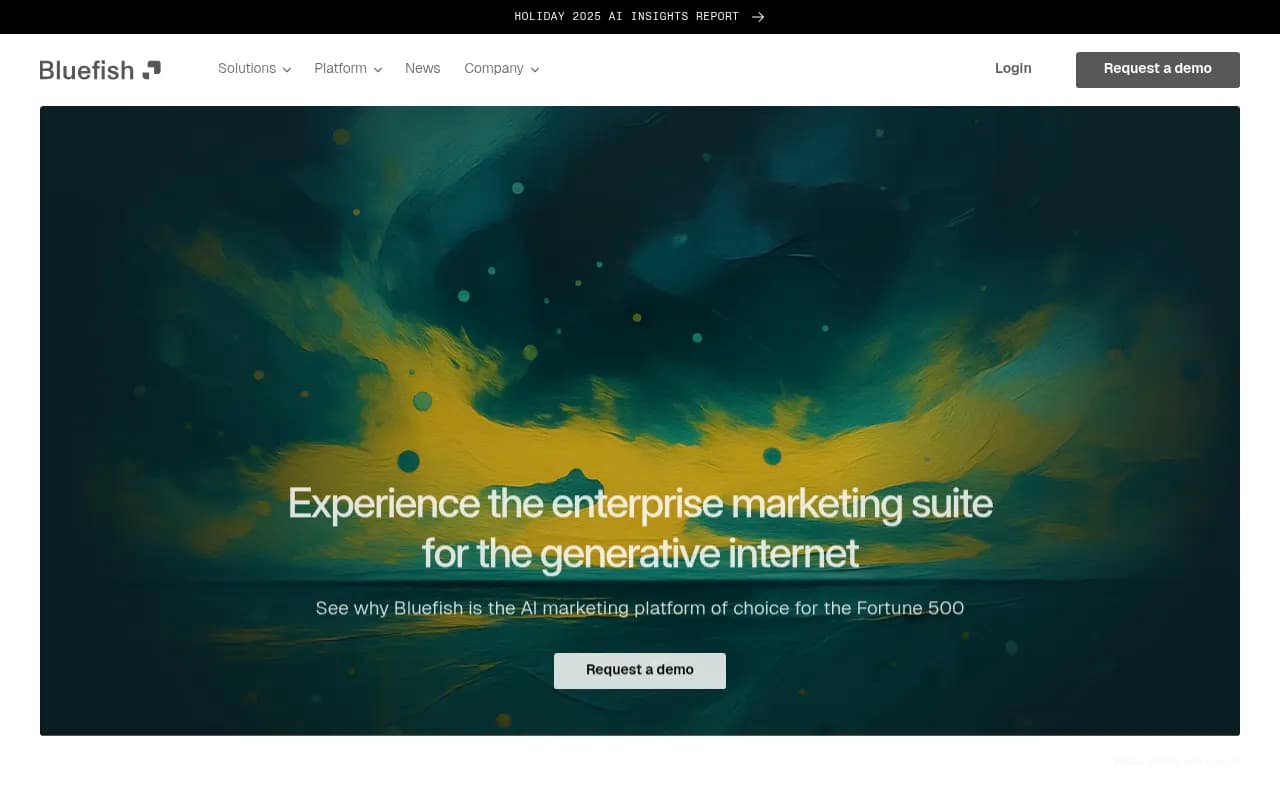
Bluefish AI markets itself as the AI marketing platform for Fortune 500 brands. The pitch is authority and control: not just tracking where your brand appears in AI responses, but understanding how AI models "think" about your category and influencing that. The platform covers AI monitoring, GEO optimization, GEO measurement, and AI commerce -- and it recently launched "Collections," which claims to measure the ROI of traditional digital marketing campaigns (like Super Bowl ads) on AI channel performance. That's a genuinely interesting angle that most competitors haven't touched.
The trade-off is access and cost. Bluefish is enterprise-only, demo-gated, and estimated at $4,000+/month. There's no self-serve option, no free trial, and no public pricing. You're buying into a high-touch enterprise relationship.
Meridian
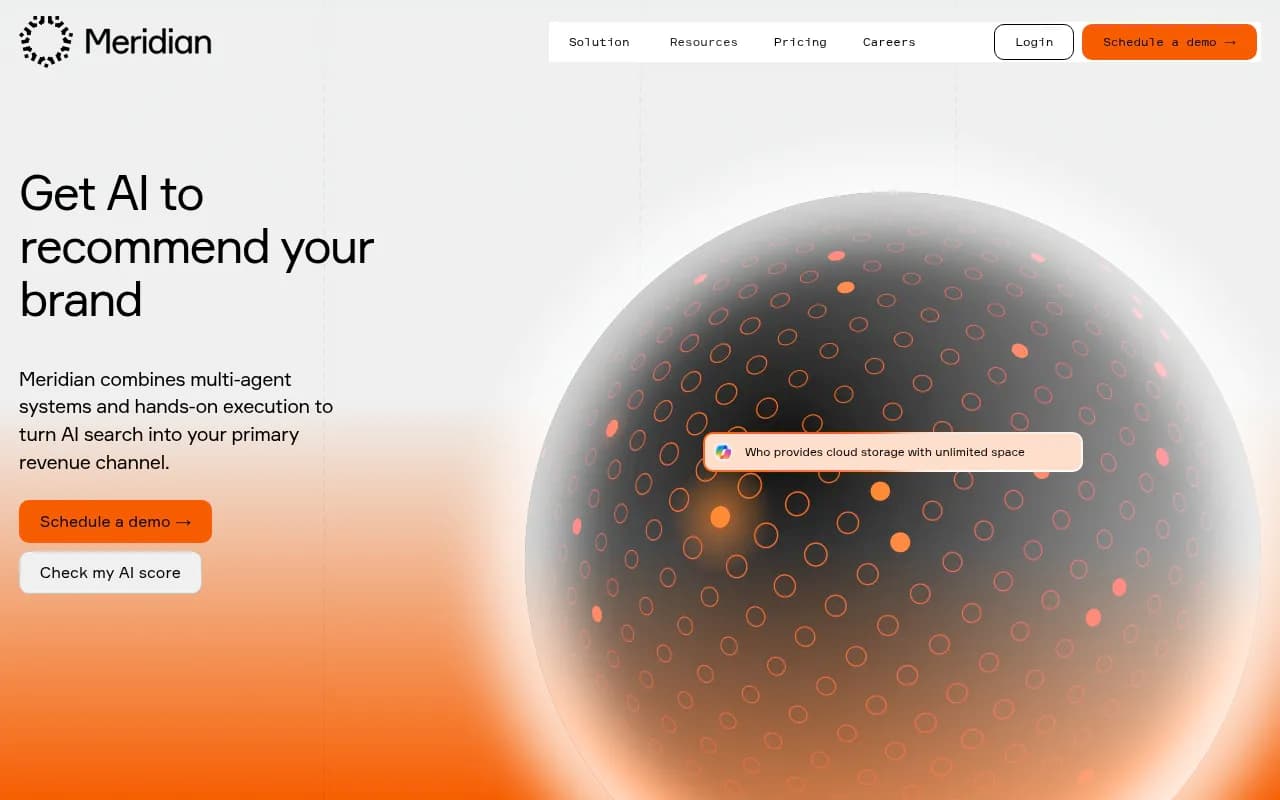
Meridian describes itself as "expert-led, agent-powered growth systems." The goal is the same -- help brands win in generative search -- but the delivery model is different. Meridian combines software monitoring with hands-on execution support, positioning it somewhere between a pure SaaS platform and a managed service. Their UI shows visibility scores, sentiment tracking, position rankings, and competitive mentions across ChatGPT, Perplexity, Gemini, Google AI, Claude, Meta AI, Copilot, Grok, and DeepSeek.
The multi-language examples on their site (Japanese queries, Canadian market tracking) suggest genuine multi-region support. Like Bluefish, pricing is custom and demo-required. Meridian also offers a free "AI score check" on their homepage -- a small but useful entry point that Bluefish doesn't provide.
Side-by-side comparison
| Feature | Bluefish AI | Meridian |
|---|---|---|
| Target audience | Fortune 500 / large enterprise | Enterprise + mid-market |
| Pricing model | Custom, ~$4,000+/mo estimated | Custom, demo required |
| Free tier | No | No (free AI score check available) |
| Free trial | No | No |
| AI models covered | Major AI channels (exact count not public) | 9 (ChatGPT, Perplexity, Gemini, Google AI, Claude, Meta AI, Copilot, Grok, DeepSeek) |
| AI monitoring | Yes | Yes |
| Sentiment analysis | Yes | Yes |
| Citation tracking | Yes | Yes |
| Competitive benchmarking | Yes | Yes |
| AI commerce tracking | Yes (Collections feature) | Not confirmed |
| Content generation | No | No |
| AI crawler logs | Not confirmed | Not confirmed |
| Multi-language/region | Yes | Yes (shown in UI) |
| Managed execution support | No (platform only) | Yes (expert-led model) |
| Infosec / enterprise compliance | Yes (explicitly mentioned) | Not confirmed |
| Self-serve setup | No | No |
| API access | Not confirmed | Not confirmed |
Head-to-head feature deep-dive
Monitoring and visibility tracking
Both platforms track brand mentions, share-of-voice, and citation frequency across major AI models. Meridian's UI is more transparent about what this looks like in practice -- their website shows visibility scores (0-100), sentiment scores, position rankings, and a list of competing brands mentioned alongside yours. It's a clean, intuitive display.
Bluefish's monitoring goes deeper on the analysis side. The platform claims to help marketers understand how AI "thinks" -- not just what it says. That's a meaningful distinction if you're trying to influence AI model behavior rather than just observe it. Whether that translates to actionable insights in practice is hard to verify without a demo, but the framing is more sophisticated than standard share-of-voice dashboards.
Verdict: Meridian wins on transparency and UI clarity. Bluefish wins on analytical depth, at least in theory.
Optimization capabilities
This is where both platforms are somewhat vague. Bluefish talks about "automated optimization workflows" and "tailored measurement frameworks," but specifics are thin on the public site. Meridian's agent-powered model suggests automated optimization actions, but again, the details live behind a demo wall.
Neither platform offers the kind of content gap analysis or AI writing tools that would let you directly create content optimized for AI citation. They can tell you you're losing visibility -- they don't generate the content to fix it. For teams that need that full loop (find gaps, create content, track results), tools like Promptwatch are worth looking at alongside either of these.

Verdict: Draw -- both are vague on optimization specifics. Neither closes the content creation loop.
AI commerce and campaign measurement
Bluefish has a clear edge here. Their "Collections" feature, launched in early 2026, measures the ROI of digital marketing campaigns in the AI channel. They published research showing that Super Bowl ads influence AI recommendations -- and Collections is the tool that measures that effect. For large brands running multi-channel campaigns, this is genuinely useful: you can see whether your TV spend is moving the needle in ChatGPT responses.
Meridian doesn't appear to have an equivalent feature. Their focus is on organic AI visibility rather than paid/campaign attribution.
Verdict: Bluefish wins clearly for brands that need to connect campaign spend to AI channel performance.
Managed service vs. self-serve platform
This is probably the biggest practical difference between the two tools. Bluefish is a platform -- you get the software, you run the workflows, your team does the work. It's built for enterprise marketing teams with the headcount to use it.
Meridian's "expert-led" model means you're getting human support alongside the software. For teams that don't have a dedicated GEO specialist (which is most teams in 2026), that's a real advantage. You're not just buying a dashboard; you're buying execution capacity.
The flip side: managed service models can be slower to iterate, and you're dependent on Meridian's team's priorities and bandwidth. Bluefish gives you more direct control.
Verdict: Depends on your team. Meridian is better if you're resource-constrained. Bluefish is better if you have a strong in-house team and want full control.
Enterprise readiness and compliance
Bluefish explicitly calls out enterprise compliance: "We consistently pass infosec reviews with ease." For Fortune 500 procurement processes, that's a meaningful statement. Large enterprises often spend months on security reviews before approving new vendors, and Bluefish has clearly been through that process enough times to make it a selling point.
Meridian doesn't address infosec or compliance on their public site. That doesn't mean they fail those reviews -- it just means it's not a documented strength.
Verdict: Bluefish wins for enterprise procurement teams that need documented compliance credentials.
Multi-language and multi-region support
Meridian's website shows examples in Japanese (Tokyo hotel queries) and Canadian market tracking, which is a good signal that multi-language support is real and tested. Bluefish mentions custom audiences and tailored prompts, which implies regional customization, but doesn't show specific language examples publicly.
Verdict: Slight edge to Meridian based on visible evidence of multi-language support.
Pricing comparison
Neither platform publishes pricing. Both require a demo before you can access the product or get a quote.
| Plan | Bluefish AI | Meridian |
|---|---|---|
| Free tier | None | None |
| Free entry point | None | Free AI score check |
| Starter / SMB | Not available | Not confirmed |
| Enterprise | ~$4,000+/mo (estimated) | Custom (demo required) |
| Pricing transparency | None | None |
| Contract type | Enterprise contract | Not confirmed |
The lack of pricing transparency from both platforms is frustrating for buyers doing initial research. If budget is a concern, be prepared for sticker shock on both sides. Bluefish's $4,000+/month estimate puts it firmly in the "CFO approval required" category.
Pros and cons
Bluefish AI
Pros:
- Deep analytical capabilities beyond basic share-of-voice
- AI commerce tracking (Collections) is a unique feature in the GEO space
- Strong enterprise compliance credentials
- Custom segmentation and data control for large teams
- Research-backed insights (Super Bowl ad influence study)
Cons:
- No pricing transparency whatsoever
- No free trial or self-serve access
- No built-in content generation
- Requires a large, capable in-house team to get value
- Likely overkill for anything below Fortune 500 scale
Meridian
Pros:
- Expert-led execution support -- you're not just buying software
- Clean, intuitive UI with visible metrics (scores, positions, sentiment)
- Multi-language and multi-region support clearly demonstrated
- Free AI score check as a low-friction entry point
- Covers 9 AI models publicly documented
Cons:
- No pricing transparency
- No content generation capabilities
- Managed service model means less direct control
- Infosec/compliance credentials not publicly documented
- Newer platform with less established track record than Bluefish
Who should pick which tool
Choose Bluefish AI if:
- You're at a Fortune 500 company with a dedicated marketing technology team
- You need to connect campaign spend (TV, digital, events) to AI channel performance
- Enterprise compliance and infosec review is a hard requirement
- You want maximum data control and custom segmentation
- You have the budget for $4,000+/month and the team to use a complex platform
Choose Meridian if:
- You want monitoring plus hands-on execution support, not just a dashboard
- Your team doesn't have a dedicated GEO specialist
- You need multi-language or multi-region AI visibility tracking
- You're a mid-market brand that doesn't need Fortune 500-level complexity
- You want to start with a free AI score check before committing to a demo
Neither tool is right if:
- You need transparent, predictable pricing (both are opaque)
- You need built-in content generation to fix the gaps you find
- You're a small business or startup -- both are priced for enterprise
Final verdict
Bluefish AI and Meridian are solving the same problem but for slightly different buyers. Bluefish is the more powerful platform for large enterprises that need deep data control, campaign attribution, and compliance credentials -- and are willing to pay for it. Meridian is the better fit for teams that want expert support alongside the software, or for mid-market brands that find Bluefish's enterprise complexity excessive.
The honest limitation of both: they're monitoring and analysis tools. Neither helps you create the content that would actually improve your AI visibility. If you find yourself tracking a gap and then staring at a blank page wondering what to write, that's where the real work begins -- and neither platform closes that loop.