Key takeaways
- Siftly is a YC-backed AI search visibility platform built for B2B SaaS, with prompt tracking, citation tracking, AI crawler traffic monitoring, and an agent that drafts fixes. Its pricing runs from a free tier to $599/mo (Scale), with custom Enterprise above that.
- If you want a comparable feature set with a longer track record, Promptwatch is the strongest overall alternative: it covers the full stack from crawler logs to CMS publishing, has 1,840+ customers, and starts at $95/mo.
- If budget is the deciding factor, Otterly.AI ($29/mo) and Peec AI (~€70/mo annual) are the cheapest credible options, but both are monitoring-first with limited or no execution.
- If you need enterprise-grade analytics and can pay for it, Profound and Scrunch AI sit at the top of the market, though both gate their best features behind higher tiers.
- If you want execution depth (agents that write and ship content, not just dashboards), Writesonic is the most aggressive competitor in that lane, and Promptwatch and Siftly both play there too.
Siftly is one of the newer entrants in the AI search visibility space. It's a Y Combinator-backed GEO platform aimed squarely at B2B SaaS companies and the agencies that serve them, and its pitch is straightforward: track how AI engines describe and cite your brand, watch the AI crawler traffic hitting your site, and use an agent to draft the fixes that close visibility gaps.
That's a solid pitch. The problem is that "AI visibility platform" stopped being a differentiator somewhere in 2025, because now there are two dozen tools doing versions of the same thing. Some do it better, some do it cheaper, and some do more of the work for you. If you're evaluating Siftly, you should probably be evaluating at least a few of these alternatives too.
One thing worth knowing upfront: Siftly is honest about its own weak spots. Its comparison pages admit it's "a newer product without the same volume of public reviews yet" and that it loses on entry-price affordability and market recognition. That kind of candor is rare and I respect it, but it also means you're taking on some platform-maturity risk that you don't have with the bigger players.
What Siftly does well
Before we get into alternatives, it's fair to spell out what Siftly actually offers, because the feature list is competitive:
- AI brand monitoring across ChatGPT, Gemini, Perplexity, and Google AI Overviews, with visibility, rank, and share-of-voice metrics
- AI prompt tracking that sweeps buyer questions daily
- AI citation tracking showing which sources the engines actually trust
- AI crawler traffic monitoring, so you can see when GPTBot and friends read your site
- The Siftly Agent, which finds a visibility gap, drafts the fix, and tries to prove the lift
- GEO content and outreach drafting, plus social visibility tracking for threads and feeds engines quote
- API and MCP access, CMS integrations, and a set of free tools
Pricing runs from a free tier (10 prompts, 2 engines, 30-day history) through Starter at $79/mo, Growth at $249/mo, and Scale at $599/mo, with custom Enterprise above that. Engine coverage tops out at eight engines on Scale, with Claude appearing to be an Enterprise-only addition.
That's a genuinely complete feature set for a young product. The question is whether an alternative gives you more of it, more reliably, or for less money.
The best Siftly alternatives in 2026
Promptwatch

Promptwatch is the closest thing to a like-for-like Siftly alternative, except older, bigger, and with a deeper data set. It tracks brand visibility across ChatGPT, Claude, Gemini, Perplexity, Grok, Google AI Overviews, Google AI Mode, and a long tail of other engines, and it covers the same three layers Siftly does: monitoring (prompt tracking, citation trends), diagnosis (AI crawler logs showing exactly which pages bots read and where they hit errors), and execution (Content Agents that plan, write, and publish GEO-optimized content straight to Webflow, Framer, or WordPress).
Where Promptwatch pulls ahead is scale and proof. Its data set covers more than 4.5 billion citations, clicks, and prompts analyzed, with 100M+ new data points per day, and it's used by 1,840+ brands and agencies including Duolingo, Yelp, Typeform, and Monks. It's rated 4.7/5 on G2. Siftly has nothing comparable to point to yet, which matters when you're trying to get budget sign-off.
Promptwatch also has capabilities Siftly doesn't advertise: Reddit and YouTube citation tracking, ChatGPT Shopping and Ads Radar (seeing which competitors bid on your prompts), sentiment analysis over time, query fan-outs showing how AI expands a prompt into sub-queries, and visitor analytics that track actual traffic and conversions from AI platforms rather than just mentions. That last one is the whole ballgame if you're trying to connect AI visibility to pipeline, which is literally Siftly's stated positioning.
Pricing is comparable to Siftly's: Essential at $95/mo (1 site, 50 prompts, all engines, API and MCP included), Professional at $245/mo (adds crawler logs and automated content), Business at $579/mo. Agency plans run $199–$799/mo with unlimited projects. There's a 7-day free trial and a free tier for kicking the tires.
The honest downside: Promptwatch is a bigger, denser product, and if you're a two-person startup that just wants to know whether ChatGPT mentions you, it might feel like more than you need. But if Siftly's agent-driven "find the gap, ship the fix" pitch appeals to you, Promptwatch does that with a longer track record and more data behind it.
Otterly.AI
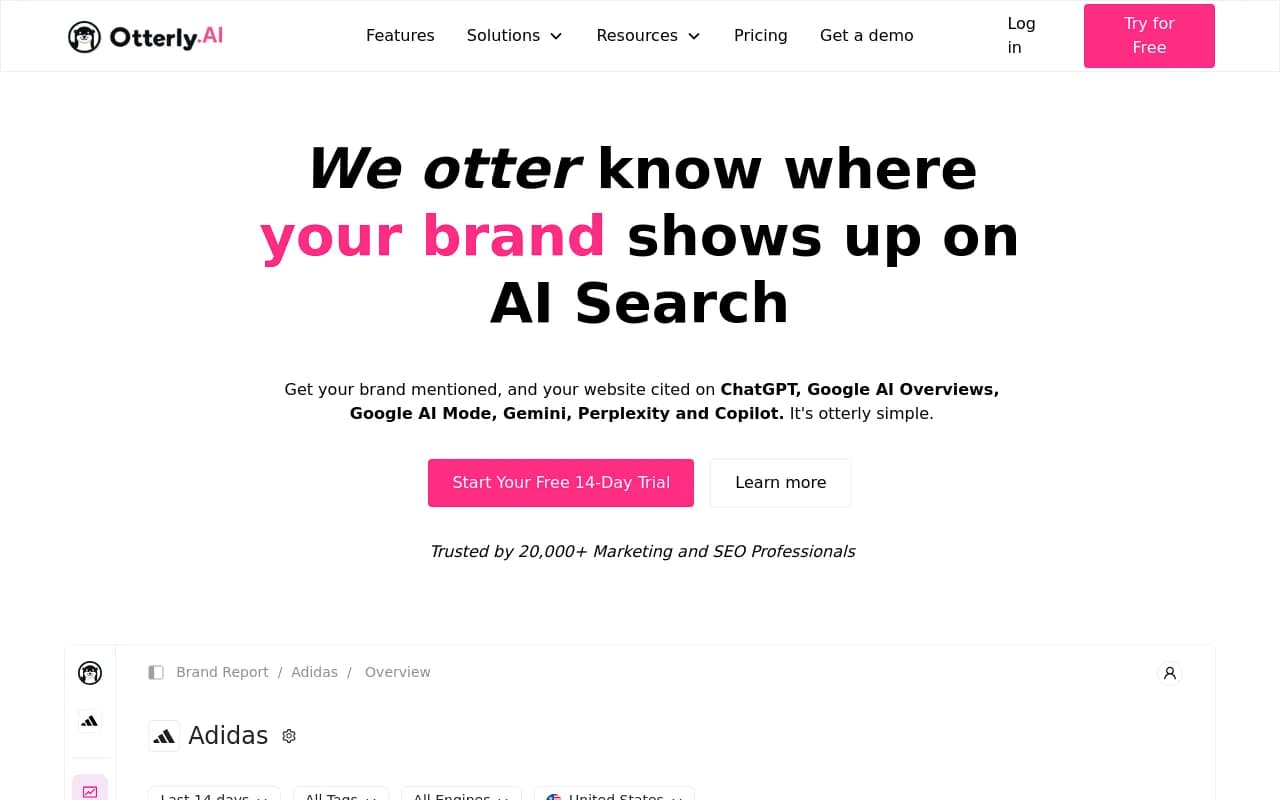
If Siftly's pricing feels steep and you mostly need monitoring, Otterly.AI is the budget default in this category. Lite starts at $29/mo (15 prompts), Standard is $189/mo (100 prompts, unlimited workspaces, API/MCP access), and Premium is $489/mo. Annual billing knocks about 15% off.
Otterly tracks brand mentions, citations, and share of voice across ChatGPT, Perplexity, Google AI Overviews, and Microsoft Copilot, with Gemini, Google AI Mode, and Claude available as paid add-ons. It's a Gartner Cool Vendor 2025, claims 30,000–40,000+ users, and has a 4.8/5 average rating. For pure monitoring credibility, it's ahead of Siftly.
The catch is the same one Siftly's own comparison pages point out: Otterly doesn't generate content or run outreach. It's a tracker and auditor, full stop. You get the dashboard, you find the gap, and then you go do the work somewhere else. Siftly wins on execution; Otterly wins on price and maturity. If your team already has strong content operations and just needs eyes on AI visibility, Otterly is the cheaper, safer bet.
Peec AI
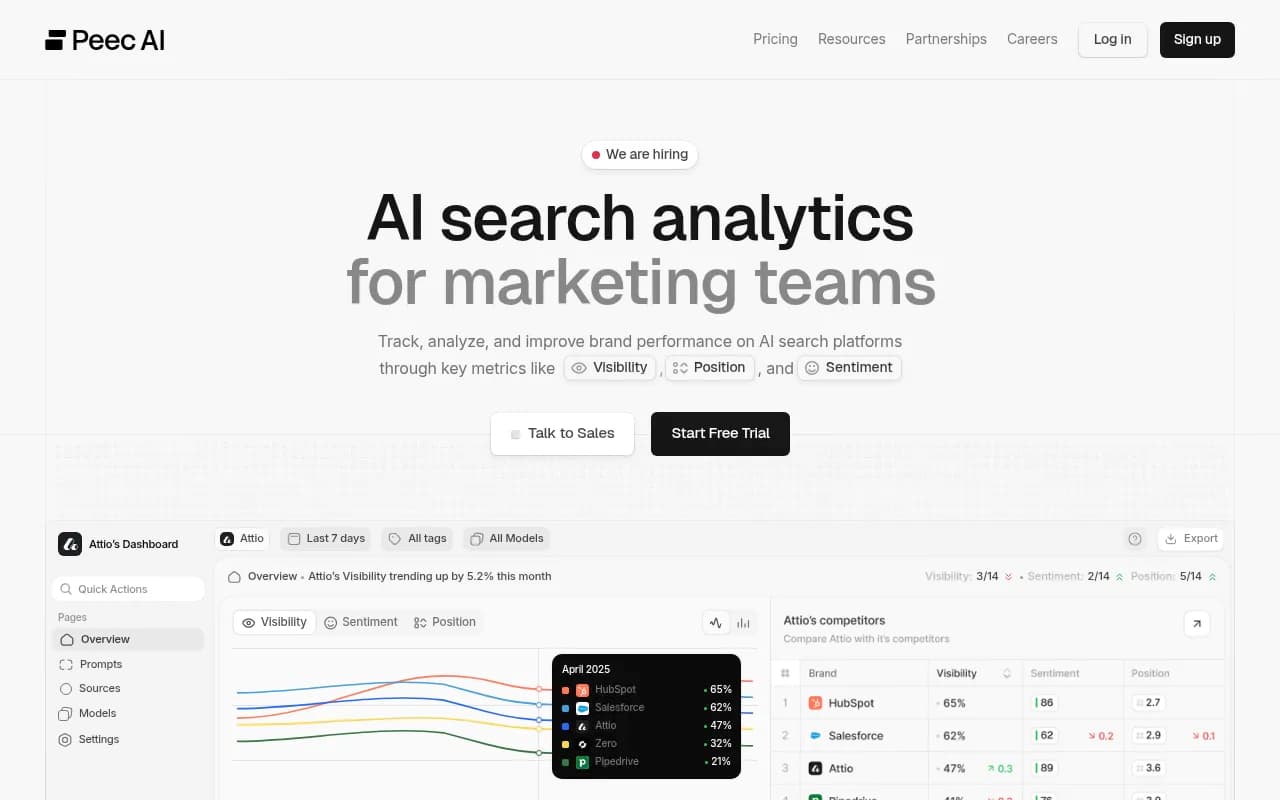
Peec AI sits in the affordable-depth middle of this market. Annual billing puts Starter at roughly €70/mo (50 prompts, 3 of 6 engines), Pro at €180/mo (150 prompts, sentiment included), and Advanced at €360/mo. Monthly billing runs about 15% higher. It's the tool teams most often name when they leave a pricier platform, and it cut Starter pricing about 16% in mid-2026, which tells you something about where this market's pricing pressure is heading.
The dashboards are clean: visibility, position, and sentiment per prompt, competitor benchmarking, and a Query Fanouts page that shows how LLMs expand queries. There's an MCP server that can pull the actual scraped markdown of cited source URLs, which is a genuinely useful differentiator. Engine selection is capped at 3 of 6 on standard plans (ChatGPT, Google AI Overviews, Google AI Mode, Copilot, Perplexity, Gemini), with extra engines costing €25–€115/mo depending on tier.
The limitation is the one Peec can't escape: it's monitoring-only. No content generation, no CMS publishing, no AI traffic attribution. If you want the Siftly-style "agent drafts the fix" workflow, Peec won't give it to you. But if you want the best visibility data per euro and you're happy to do the fixing yourself, it's hard to beat.
Profound
Profound is the enterprise analytics heavyweight of this category, having raised $96M at a billion-dollar valuation. If your buying process involves a security review and a procurement team, Profound is the name that clears those hurdles.
The pricing structure has a well-known catch: Starter is $99/mo billed yearly but tracks ChatGPT only. Growth at $399/mo adds Perplexity and Google AI Overviews. Real multi-engine coverage (up to 9 engines including Gemini, Copilot, Claude, Grok, DeepSeek) is Enterprise-only, and real-world enterprise pricing reportedly runs $2,000–$5,000+/month. Profound doesn't publish that, which tells you the audience.
Recent moves show where the product is heading: FactCheck monitors inaccurate AI-generated brand claims and integrates with Noble and iPullRank for automated remediation, addressing what Profound cites as the 7.9% of AI responses needing brand-led accuracy correction. That's a genuinely differentiated feature for brands with reputation risk.
Compared to Siftly, Profound offers deeper conversation analytics and enterprise credibility, but you pay a lot more for equivalent coverage, and the affordable tier is a single-engine teaser. If you're a B2B SaaS company with an enterprise budget and a compliance requirement, Profound belongs on your shortlist. Otherwise it's probably overkill.
Writesonic
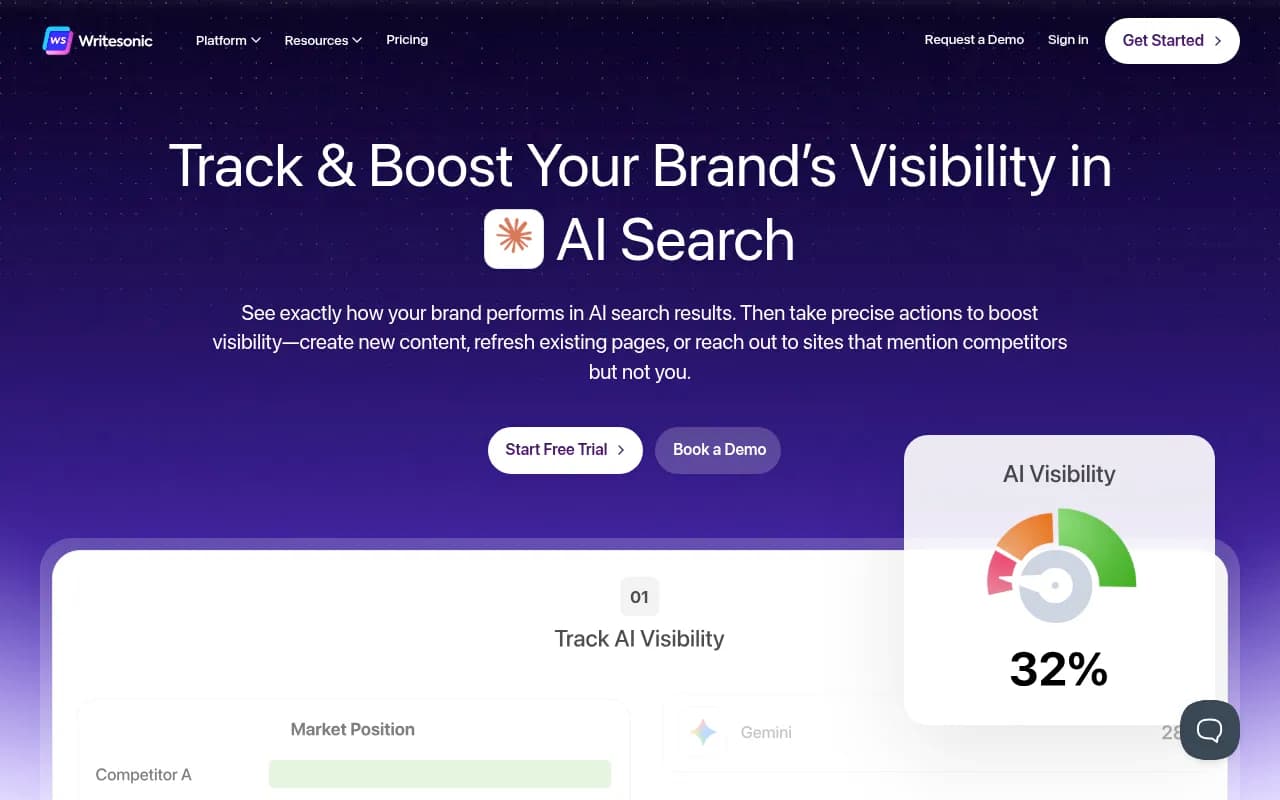
Writesonic has repositioned itself as an "AI Search Growth Engine" and is probably the most aggressive competitor in the execution lane Siftly is playing in. Its pitch mirrors Siftly's almost exactly: track 10+ AI engines, find where AI ignores you, then fix it with content, citations, and technical work, and prove the lift in traffic and pipeline.
The differentiator is agent depth. Writesonic's autonomous agents carry a gap through content drafting, off-page outreach, approved technical changes, and measurement of what moved. It claims customers like Amazon, Unilever, and Acer, and reports a largest customer at $350K+ ACV. Pricing starts around $79/mo billed annually, with a $399/mo tier that "tracks AI visibility and acts on it," and agency plans from $200/mo.
Two things to keep in mind. First, much of the comparison content favoring Writesonic is written by its founder, which is a conflict of interest worth discounting when you read it. Second, Writesonic started as a content-generation tool, so its monitoring layer is newer than its writing layer, the inverse of a tool like Otterly. Whether that matters depends on whether you trust its visibility data as much as its prose.
If Siftly's agent pitch is what attracted you, Writesonic is the alternative to test head-to-head.
LLM Pulse
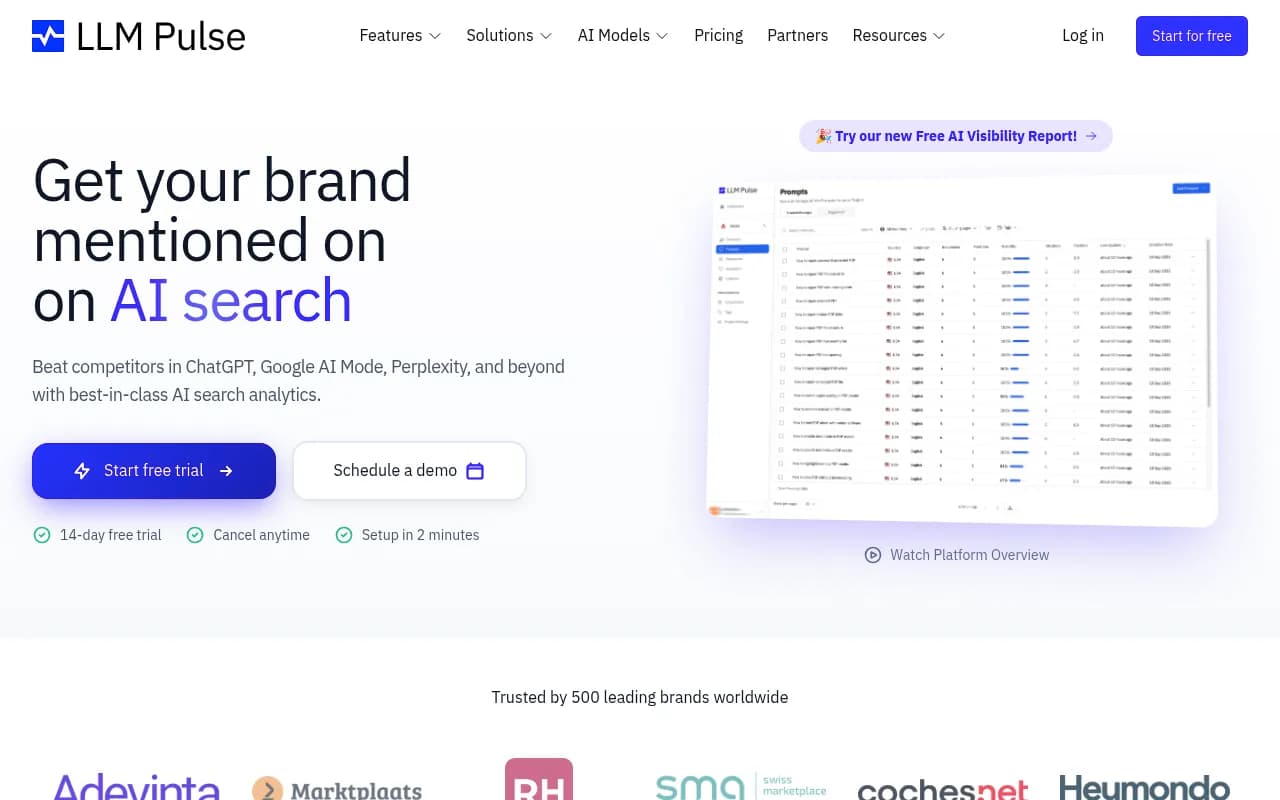
LLM Pulse is the European, bootstrapped option, and its pricing is the most transparent in the category: Starter at €49/mo (50 prompts, 1 project, 5 standard models), Growth at €99/mo, Scale at €299/mo, with unlimited seats on every plan. Claude, Copilot, Grok, DeepSeek, and Alexa for Shopping are paid add-ons at every tier. It claims 5,000+ users including AutoScout24, ImmoScout24, and Softonic.
It covers the track-measure-optimize loop: visibility and share of voice, traffic and conversion measurement, and prioritized recommendations. Sentiment analysis kicks in from the Growth tier. There's white-label agency support and a full API/MCP offering.
The gap versus Siftly is execution: LLM Pulse gives you recommendations, not drafted content or outreach. Its own marketing leans hard on price comparisons (claiming 80% lower cost than Profound for comparable coverage), which is compelling if budget is your constraint and less so if agent-driven fixing is your priority.
Scrunch AI
Scrunch AI is the enterprise brand-and-reputation play, aimed at mid-market and enterprise teams rather than startups. Entry pricing is $250/mo billed annually ($300 month-to-month), with a 7-day free trial, and Enterprise is custom. Core covers four engines (ChatGPT, Perplexity, Google AI Overviews, Copilot), expanding to up to nine on Enterprise along with SSO, API access, and the Agent Experience Platform.
Scrunch's strength is agent-traffic attribution and brand monitoring at scale, with SOC 2 compliance for enterprise security requirements. Its weakness is price: it's been flagged as one of the most expensive entry points in the category, roughly 181% above the category median, and there's no MCP server, just a REST API without an official SDK.
If you're a B2B SaaS company evaluating Siftly, Scrunch is probably a step up in price and a step sideways in focus, toward brand reputation rather than pipeline generation. Worth knowing about, hard to recommend over Siftly for the same budget.
AthenaHQ
AthenaHQ is another YC-backed player (raised $2.2M in seed in mid-2025), which makes it the closest peer to Siftly in origin story. It offers a free Essential tier for sampling multiple engines, then a self-serve Starter at $295/mo on a credit model (1 credit = 1 AI response), with Enterprise above that.
Its recent Athena Citation Engine (ACE) is a predictive ML model estimating brand citation probability, which is an interesting feature, though it's Enterprise-only. Engine coverage on the self-serve tier is wider than Profound's single-engine Starter, tracking up to 8-9 engines.
The criticisms are consistent across reviews: no free trial of the paid product, credit-based pricing that scales unpredictably as your prompt and engine volume grows, single-country coverage on self-serve, and no API on Starter without paying extra. At $295/mo entry versus Siftly's $79/mo, it's a more expensive bet on a similarly young platform, without Siftly's execution layer.
Semrush
Semrush is the "if you already use it" option. Its AI Toolkit runs $99/mo per domain billed annually, including 25 custom prompts, tracking ChatGPT, Google AI, Gemini, and Perplexity. Extra domains cost $99 each and extra prompts $60 per 50. It can be bought standalone, without a full Semrush subscription.
The appeal is obvious: AI visibility data sitting next to your keyword, backlink, and competitive data, with the reporting infrastructure of a $376.8M-revenue public company behind it. Semrush's own research showing 88% uniqueness across AI citations is a useful data point for the whole category, demonstrating that traditional SEO dominance doesn't guarantee LLM visibility.
The limitation is depth. It tracks four or five engines, prompt and domain limits are tight at the base price, and the AI-specific tooling is an add-on to an SEO suite rather than a purpose-built GEO platform. If your team already lives in Semrush, adding the AI Toolkit is a no-brainer. If you're choosing a dedicated AI visibility platform, the specialists are ahead.
How to choose between Siftly and its alternatives
The real question isn't "which tool has the most features," because at this point they all track prompts, citations, and share of voice, and the feature grids blur together. The question is which of these three profiles you fit:
You want monitoring only, and you want it cheap. Otterly.AI at $29/mo or Peec AI at ~€70/mo. You'll do the content work yourself. This is a perfectly reasonable choice if you have a strong content team and a tight budget.
You want monitoring plus execution. This is Siftly's pitch, and it's a good one. Test Siftly against Promptwatch and Writesonic head-to-head with the same prompt set. Promptwatch brings the largest data set and the longest track record; Writesonic brings the most aggressive agent workflow; Siftly brings a focused B2B SaaS lens and a clean product. Run the same five revenue-tied prompts through all three for two weeks and compare what actually gets shipped, not how the dashboards look.
You're an enterprise with procurement and security requirements. Profound or Scrunch AI. You'll pay more, you'll get more enterprise hand-holding, and you'll have a vendor that can survive a security review.
One more thing worth weighing regardless of which you pick: most AI citations come from other people's sites. Muck Rack's May 2026 study of more than 25 million cited links found 84% came from earned media, not owned content. Any tool promising that on-site fixes alone will win you AI visibility is overselling, which is why the tools with outreach and offsite mention tracking (Promptwatch, Siftly, Writesonic) have a structural advantage over the pure trackers.
If you want to browse the full category rather than just these nine, the GEO software directory at bestgeosoftware.com keeps a maintained list, and the AI rank tracking tools directory at ai-rank-tools.com covers the monitoring side specifically.
A final note on who's behind this comparison: this site is published by 1001 SEO Media, an SEO agency specializing in AI search optimization, and we use Promptwatch as our own GEO and AI visibility platform. That's disclosed here because you should know every comparison has a perspective. The perspective of this one is that execution beats monitoring, and you should test the execution tools against each other before you buy anything.