Summary
- Integration gaps are the real bottleneck: Most GEO platforms track AI visibility but leave you stuck exporting CSVs and manually connecting the dots between citations and revenue. The platforms that integrate with GA4, CRMs, and your content stack are the ones that actually drive action.
- Promptwatch leads on integrations: Looker Studio, Google Analytics, API access, and server log analysis make it the only platform where you can close the loop from AI visibility to traffic attribution to revenue impact.
- Enterprise platforms prioritize APIs over plug-and-play: Tools like Profound and Bluefish AI offer secure APIs for custom integrations but require dev resources. Mid-market platforms like Otterly.AI and Peec.ai lack integrations entirely.
- Content stack connections matter most: Platforms that integrate with your CMS (WordPress, Webflow, Contentful) or content ops tools (Jasper, Clearscope, MarketMuse) let you optimize existing pages instead of starting from scratch.
- Attribution is still broken for most tools: Only a handful of platforms (Promptwatch, Profound, Bluefish AI) offer real traffic attribution via code snippets, GSC integration, or server logs. The rest show you citations but can't prove ROI.
Why integrations matter more than features
I've tested 10 GEO platforms over the past three months. The pattern is clear: the tools with the best feature lists are often the ones that leave you stuck.
You get a dashboard full of data -- citation counts, visibility scores, competitor heatmaps -- but then what? You export a CSV, paste it into a deck, and try to convince your team that "AI visibility" matters. Meanwhile, your CRM has no idea which leads came from AI search, your content team is still writing based on gut feel, and your analytics setup treats AI traffic like direct/none.
The platforms that actually work are the ones that connect to the tools you already use. They pull data into your existing workflows instead of creating a new silo. They tie AI visibility to revenue instead of leaving you guessing.
Here's what integrates with what -- and which platforms are worth your time.
The integration landscape: what connects to what
| Platform | GA4 / Analytics | CRM (HubSpot, Salesforce) | CMS (WordPress, Webflow) | API Access | Looker Studio | Content Tools |
|---|---|---|---|---|---|---|
| Promptwatch | ✅ Code snippet + GSC | ✅ Via API | ✅ Via API | ✅ Full API | ✅ Native | ✅ Built-in AI writer |
| Profound | ✅ Code snippet | ✅ HubSpot, Salesforce | ❌ | ✅ Secure API | ❌ | ❌ |
| Bluefish AI | ✅ Server logs | ✅ Via API | ❌ | ✅ Enterprise API | ❌ | ❌ |
| Scrunch | ✅ Code snippet | ❌ | ❌ | ✅ API | ❌ | ❌ |
| Otterly.AI | ❌ | ❌ | ❌ | ❌ | ❌ | ❌ |
| Peec.ai | ❌ | ❌ | ❌ | ❌ | ❌ | ❌ |
| AthenaHQ | ❌ | ❌ | ❌ | ❌ | ❌ | ❌ |
| Search Party | ✅ Custom builds | ✅ Custom builds | ✅ Custom builds | ✅ Custom API | ❌ | ✅ Custom builds |
| Semrush | ✅ GA4 connector | ✅ Limited | ❌ | ✅ API | ❌ | ❌ |
| Ahrefs Brand Radar | ✅ Via API | ❌ | ❌ | ✅ API | ❌ | ❌ |
The table tells the story: most platforms are monitoring-only dashboards. They show you data but don't help you act on it.

Analytics integrations: connecting AI visibility to traffic
The first question every exec asks: "How much traffic are we actually getting from AI search?"
Most GEO platforms can't answer this. They track citations (how often ChatGPT or Perplexity mentions your brand) but have no way to measure clicks or conversions. You're left guessing whether AI visibility actually drives revenue.
Promptwatch: the only platform with full attribution
Promptwatch solves this with three methods:
- Code snippet: Drop a tracking pixel on your site and Promptwatch identifies visitors from AI search engines (ChatGPT, Perplexity, Claude, etc.). You see traffic volume, pages visited, and conversion events.
- Google Search Console integration: Pull GSC data to see which AI-generated queries are driving clicks from Google AI Overviews.
- Server log analysis: Upload server logs and Promptwatch identifies AI crawler activity (GPTBot, ClaudeBot, PerplexityBot) -- which pages they're reading, how often they return, and what errors they encounter.
This is the only platform where you can close the loop: track citations → measure traffic → attribute revenue. The Looker Studio integration lets you build custom dashboards that combine AI visibility scores with GA4 traffic data and CRM conversion metrics.
Profound and Bluefish AI: enterprise-grade but limited
Profound and Bluefish AI both offer code snippet tracking for AI traffic attribution. The difference: they're built for enterprises with dev resources.
Profound integrates with HubSpot and Salesforce via secure APIs. You can push citation data into your CRM and build reports that show which accounts are being influenced by AI search. But there's no plug-and-play connector -- you need a developer to set it up.
Bluefish AI uses server log analysis to track AI crawler activity. This is more accurate than code snippets (no ad blockers, no cookie consent issues) but requires access to your server logs and a technical setup process.
Both platforms are overkill for small teams. If you don't have a data engineer on staff, you're better off with Promptwatch.
Scrunch: basic tracking, no CRM integration
Scrunch offers a code snippet for tracking AI traffic but doesn't integrate with CRMs or analytics platforms. You see traffic volume in the Scrunch dashboard but can't connect it to leads or revenue.
This works if you just want directional data ("Are we getting any traffic from AI search?") but falls apart when you need to prove ROI.
The monitoring-only platforms: Otterly.AI, Peec.ai, AthenaHQ
Otterly.AI, Peec.ai, and AthenaHQ have zero analytics integrations. No code snippet, no GSC connector, no API for pulling data into your own tools.
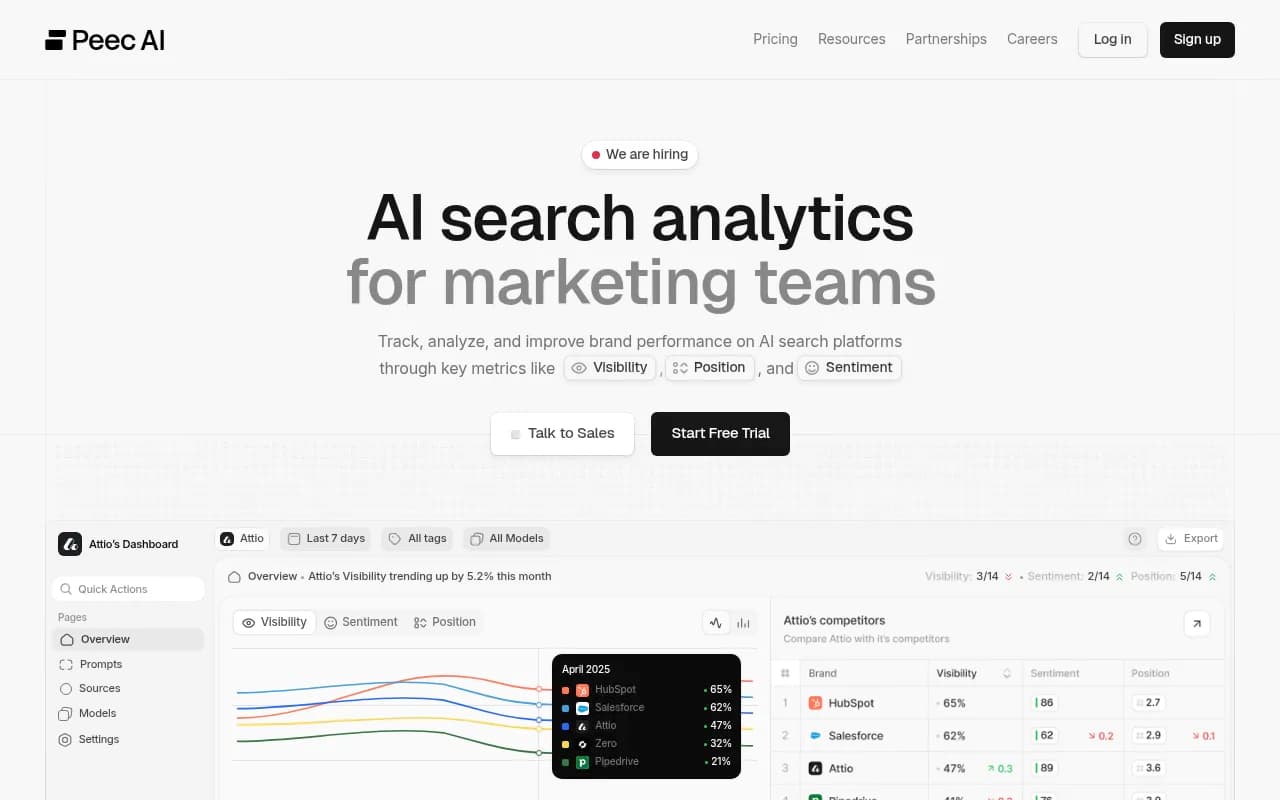

You get a dashboard that shows citation counts and visibility scores. That's it. If you want to measure traffic or attribute revenue, you're on your own.
These platforms are fine for early-stage monitoring ("Is ChatGPT mentioning us at all?") but useless for optimization or proving business impact.
CRM integrations: connecting citations to pipeline
The second question execs ask: "Which deals are influenced by AI search?"
This requires connecting your GEO platform to your CRM. You need to know which accounts are being mentioned in AI responses, which prompts are driving awareness, and whether AI visibility correlates with deal velocity.
Only a few platforms support this.
Promptwatch: API-first approach
Promptwatch doesn't have a native HubSpot or Salesforce connector, but the API makes it easy to build one. You can pull citation data, visibility scores, and prompt volumes into your CRM via Zapier, Make, or a custom script.
Example workflow: When Promptwatch detects a new citation for your brand in a high-value prompt (e.g. "best CRM for SaaS companies"), trigger a Zapier automation that creates a task in HubSpot for your sales team to follow up with accounts searching for that solution.
This requires some setup but gives you full control over how AI visibility data flows into your CRM.
Profound: native HubSpot and Salesforce connectors
Profound is the only platform with native CRM integrations. You can push citation data, sentiment scores, and competitor mentions directly into HubSpot or Salesforce.
The use case: your sales team sees which accounts are being influenced by AI search before they even fill out a form. If ChatGPT is recommending your competitor for a specific use case, your reps know to address that objection early.
The downside: Profound starts at $2,000+/month and requires an enterprise contract. If you're a mid-market team, this is out of reach.
Search Party: custom integrations for agencies
Search Party
Search Party positions itself as an "AI implementation partner" rather than a SaaS platform. They build custom integrations between GEO data and your existing stack -- CRM, analytics, content ops, whatever you need.
This works if you have budget for custom dev work and want a fully integrated solution. But it's overkill for most teams.
CMS and content stack integrations: optimizing existing pages
The third question: "How do we actually improve our AI visibility?"
Most GEO platforms tell you what's wrong ("You're not visible for this prompt") but don't help you fix it. The platforms that integrate with your CMS or content tools let you optimize existing pages instead of starting from scratch.
Promptwatch: built-in AI content generation
Promptwatch has an AI writing agent that generates articles, listicles, and comparisons grounded in real citation data. You see which prompts competitors are visible for but you're not, then generate content that fills those gaps.
The content is optimized for AI search -- it uses the language patterns, structures, and sources that ChatGPT and Perplexity prefer. You're not writing generic SEO filler; you're creating content engineered to get cited.
Once the content is published, Promptwatch tracks whether it improves your visibility scores. You see exactly which pages are being cited, how often, and by which AI models.
This closes the action loop: find gaps → generate content → track results. Most competitors stop at step one.
MarketMuse and Clearscope: SEO tools adding GEO features

MarketMuse and Clearscope are traditional SEO content platforms that are starting to add GEO features. They analyze your existing content and suggest optimizations to improve AI visibility.
The advantage: if you're already using these tools for SEO, you don't need to add another platform to your stack. The disadvantage: their GEO features are still early and lack the depth of dedicated platforms like Promptwatch or Profound.
WordPress and Webflow: no native integrations yet
No GEO platform has a native WordPress or Webflow plugin. You can use the API to pull data into your CMS, but there's no plug-and-play solution.
This is a gap in the market. The first platform to build a WordPress plugin that shows AI visibility scores inside the editor will have a massive advantage.
API access: building custom workflows
If you have dev resources, API access is the most important integration. It lets you pull GEO data into your own tools, build custom dashboards, and automate workflows.
Promptwatch: full API with Looker Studio integration
Promptwatch offers a full API that exposes all platform data: citations, visibility scores, prompt volumes, competitor mentions, crawler logs, and more.
The Looker Studio integration is the standout feature. You can build custom dashboards that combine GEO data with GA4 traffic, CRM pipeline, and content performance metrics. This is the only way to see the full picture: AI visibility → traffic → leads → revenue.
Profound and Bluefish AI: enterprise APIs with security controls
Profound and Bluefish AI offer enterprise-grade APIs with role-based access controls, audit logs, and SLA guarantees. These are built for large teams that need to integrate GEO data into existing data warehouses or BI tools.
The downside: you need a data engineer to set this up. If you're a small team, the overhead isn't worth it.
Semrush and Ahrefs: limited API access
Semrush and Ahrefs both offer APIs, but their GEO features are limited. Semrush uses a fixed set of prompts (you can't customize them), and Ahrefs Brand Radar doesn't support traffic attribution.
You can pull citation data via API, but you're missing the depth and flexibility of dedicated GEO platforms.
The platforms with zero integrations
Otterly.AI, Peec.ai, and AthenaHQ have no integrations at all. No API, no analytics connector, no CRM support, no content tools.
You get a standalone dashboard that shows citation counts and visibility scores. If you want to connect this data to your existing stack, you're exporting CSVs and doing manual work.
These platforms are fine for early-stage monitoring but fall apart when you need to scale or prove ROI.
What to look for when evaluating GEO platforms
Here's what actually matters:
- Traffic attribution: Can you measure how much traffic you're getting from AI search? Code snippet, GSC integration, or server log analysis are the only real options.
- CRM connectivity: Can you connect citations to pipeline? Native integrations (Profound) or API access (Promptwatch) are both fine, but you need one or the other.
- Content optimization: Does the platform help you fix gaps or just show you data? Built-in content generation (Promptwatch) or integrations with content tools (MarketMuse, Clearscope) are key.
- API access: Can you pull data into your own tools? Full API access (Promptwatch, Profound, Bluefish AI) is essential for custom workflows.
- Looker Studio or BI tool support: Can you build custom dashboards? This is the only way to combine GEO data with traffic, pipeline, and revenue metrics.
If a platform doesn't check at least three of these boxes, it's a monitoring-only tool that will leave you stuck.
The integration hierarchy: what to prioritize
Not all integrations are created equal. Here's what to prioritize based on your team size and goals:
Small teams (1-5 people)
- Must-have: Traffic attribution (code snippet or GSC integration)
- Nice-to-have: Built-in content generation, API access for Zapier workflows
- Skip: CRM integrations (you're not managing enough pipeline to justify the overhead), enterprise APIs
Recommendation: Promptwatch. It has traffic attribution, built-in content generation, and a simple API for Zapier workflows. You don't need dev resources to get value.
Mid-market teams (5-20 people)
- Must-have: Traffic attribution, API access, content optimization tools
- Nice-to-have: CRM integrations (via API or Zapier), Looker Studio support
- Skip: Enterprise APIs with security controls (overkill for your team size)
Recommendation: Promptwatch or Scrunch. Both offer traffic attribution and API access. Promptwatch has better content tools; Scrunch is cheaper if you just need monitoring.
Enterprise teams (20+ people)
- Must-have: Native CRM integrations, enterprise API with security controls, Looker Studio or BI tool support
- Nice-to-have: Server log analysis, custom integrations (via Search Party or similar)
- Skip: Monitoring-only platforms (Otterly.AI, Peec.ai) that don't integrate with your stack
Recommendation: Profound or Bluefish AI for native CRM integrations and enterprise APIs. Promptwatch if you want Looker Studio support and don't need CRM connectors.
The reality: most platforms are still monitoring-only
The GEO market is still early. Most platforms are focused on showing you data (citation counts, visibility scores, competitor heatmaps) but don't help you act on it.
The platforms that win will be the ones that integrate with your existing stack. They'll connect AI visibility to traffic, pipeline, and revenue. They'll help you optimize content instead of just pointing out gaps. They'll turn GEO from a reporting exercise into an optimization engine.
Right now, Promptwatch is the only platform that does all of this. It's not perfect -- the UI could be cleaner, the onboarding could be smoother -- but it's the only tool where you can close the loop from AI visibility to revenue impact.
If you're evaluating GEO platforms, start there. If you need enterprise-grade CRM integrations, look at Profound. If you're just dipping your toes in, try Otterly.AI or Peec.ai for basic monitoring.
But don't settle for a platform that leaves you stuck with a dashboard full of data and no way to act on it. The integrations are what matter.