Summary
- Most GEO tools only monitor AI visibility, leaving you stuck with data but no way to fix gaps. The best platforms in 2026 combine tracking with built-in content creation.
- Promptwatch leads with Answer Gap Analysis that shows exactly what content you're missing, then generates articles grounded in 880M+ citations. Track results with page-level citation monitoring and traffic attribution.
- Relixir, Gushwork, and Orchly.ai offer strong content generation features, but differ in approach: Relixir focuses on briefs and optimization, Gushwork builds 100+ pages at scale, Orchly.ai handles end-to-end content ops.
- Traditional SEO tools (Jasper, Surfer, Frase) can generate content but lack AI search visibility tracking. You're writing blind without knowing if AI models will cite you.
- The action loop matters more than features: find gaps, create content, measure citations, iterate. Choose a platform that supports the full cycle, not just one step.
Why content creation matters for GEO
Tracking your AI visibility is table stakes. Every GEO platform shows you citation counts, competitor benchmarks, and visibility scores. The question is: what do you do with that data?
Most teams hit a wall. They see gaps—prompts where competitors get cited but they don't—and then manually brief writers, wait weeks for drafts, publish, and hope AI models notice. By the time the content goes live, the competitive landscape has shifted.
The platforms that matter in 2026 are the ones that close this loop. They don't just tell you what's broken. They help you fix it.
The gap between monitoring and action
I've talked to marketing teams using five different GEO tools. The pattern is consistent: they pay for dashboards that show declining visibility, then scramble to figure out what content to create. The tools show the problem but offer no path to a solution.
This is where built-in content creation changes the game. Instead of exporting a list of missing topics and handing it to a writer, you generate drafts directly inside the platform—drafts informed by citation data, prompt volumes, and what's already working for competitors.
The best platforms don't just generate generic SEO filler. They create content engineered to get cited by ChatGPT, Claude, Perplexity, and Google AI Overviews.
How Promptwatch combines gap analysis with content generation

Promptwatch is the only GEO platform rated as a "Leader" across all categories in a 2026 comparison of 12 competitors. The core difference: it's built around the action loop.
Answer Gap Analysis shows exactly which prompts competitors are visible for but you're not. You see the specific content your website is missing—the topics, angles, and questions AI models want answers to but can't find on your site.
Then the built-in AI writing agent generates articles, listicles, and comparisons grounded in real citation data (880M+ citations analyzed), prompt volumes, persona targeting, and competitor analysis. This isn't generic content. It's engineered to get cited.
Finally, page-level tracking shows which pages AI models are citing, how often, and by which models. Close the loop with traffic attribution (code snippet, GSC integration, or server log analysis) to connect visibility to revenue.
This cycle—find gaps, generate content, track results—is what makes Promptwatch an optimization platform, not just another tracker. Most competitors (Otterly.AI, Peec.ai, AthenaHQ, Search Party) stop at step one.
Additional capabilities that support the action loop:
- AI Crawler Logs: Real-time logs of AI crawlers hitting your website—which pages they read, errors they encounter, how often they return
- Prompt Intelligence: Volume estimates and difficulty scores for each prompt, plus query fan-outs that show how one prompt branches into sub-queries
- Citation & Source Analysis: See exactly which pages, Reddit threads, YouTube videos, and domains AI models cite
- Reddit & YouTube Insights: Surface discussions that directly influence AI recommendations
- ChatGPT Shopping Tracking: Monitor when your brand appears in product recommendations and shopping carousels
- Competitor Heatmaps: Compare your AI visibility vs competitors across LLMs
Pricing starts at $99/mo (Essential: 1 site, 50 prompts, 5 articles), $249/mo (Professional: 2 sites, 150 prompts, 15 articles, crawler logs), $579/mo (Business: 5 sites, 350 prompts, 30 articles). Agency and Enterprise plans available.
Other GEO platforms with content creation features
Relixir: Briefs and optimization
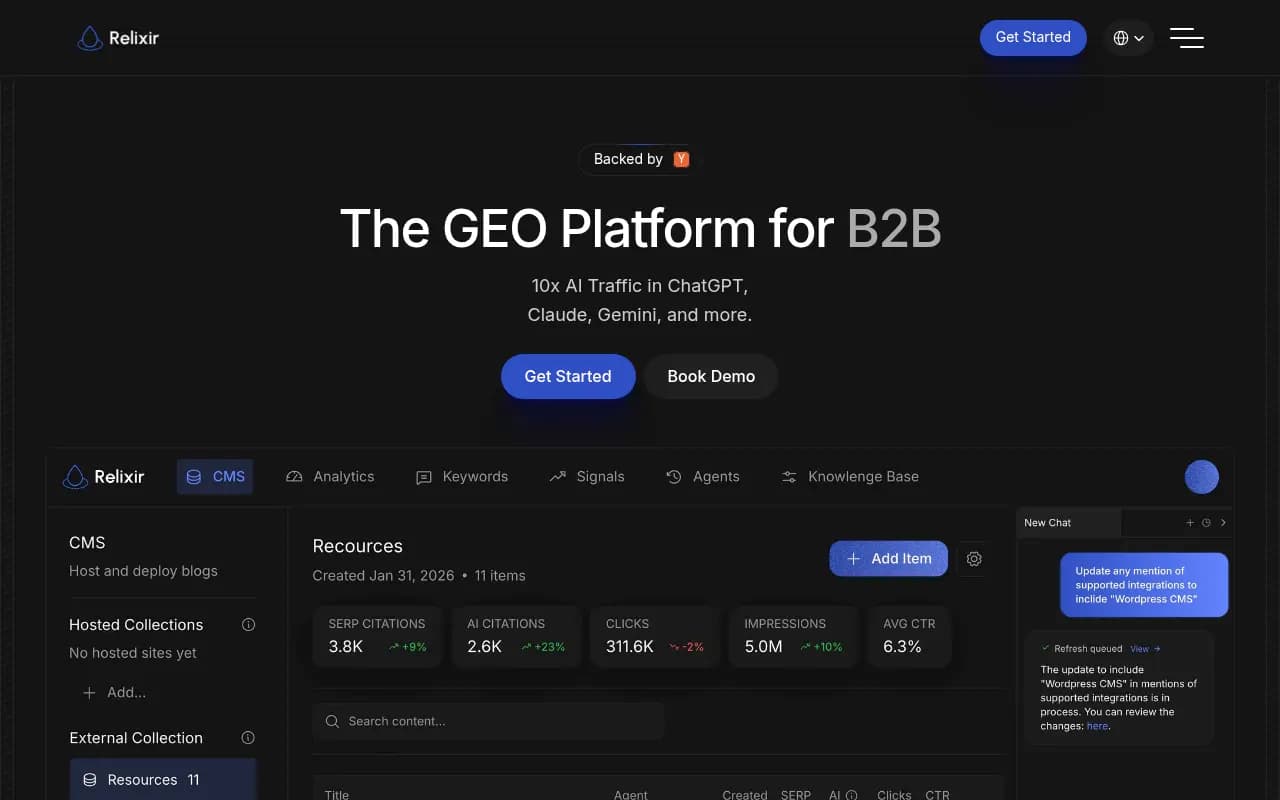
Relixir combines AI visibility tracking with content brief generation and optimization tools. It monitors ChatGPT, Perplexity, Google AI Overviews, and other models, then helps you create content that targets gaps.
The platform generates detailed content briefs based on what's missing from your AI visibility profile. You can also optimize existing content to improve citation rates. It's a solid middle ground if you have writers on staff and just need direction.
What it lacks: the depth of citation data Promptwatch uses (Relixir doesn't publish how many citations it analyzes), and the end-to-end automation of platforms like Gushwork. You still need humans to turn briefs into finished articles.
Gushwork: 100+ pages at scale
Gushwork

Gushwork is an AI-powered content engine that builds 100+ pages to generate qualified B2B leads from Google and AI search. It's designed for companies that need volume—programmatic SEO meets GEO.
The platform identifies content gaps, generates pages at scale, and publishes them directly. It's less about crafting individual hero articles and more about covering the entire search landscape with programmatically generated content.
Best for: B2B SaaS companies that need to dominate long-tail prompts and queries. Not ideal if you're focused on a small set of high-value prompts or need deep customization for each article.
Orchly.ai: End-to-end content ops

Orchly.ai is an AI-powered content ops platform that writes, optimizes, and publishes content. It combines SEO and GEO workflows in one place, handling everything from keyword research to final publication.
The platform uses AI to generate drafts, then runs them through optimization checks (readability, SEO, AI search compatibility) before publishing. It's built for teams that want to consolidate tools and reduce manual handoffs.
What sets it apart: the focus on content operations, not just content creation. Orchly.ai manages the entire workflow, including approvals, revisions, and publishing schedules.
SnowSEO: Auto-generated content for AI visibility

SnowSEO auto-generates content specifically optimized for AI visibility. It's a lightweight tool focused on one thing: creating articles that AI models will cite.
The platform analyzes what's working in AI search, then generates drafts that match those patterns. It's fast and affordable, but lacks the monitoring and tracking features of full-stack GEO platforms.
Best for: small teams or solo marketers who need content generation without the overhead of a full GEO suite. You'll need a separate tool to track whether the content actually works.
Traditional SEO tools with AI writing (but no GEO tracking)
Several established SEO platforms have added AI writing features. They can generate content, but they don't track AI search visibility. You're writing blind.
Jasper AI: Long-form SEO content

Jasper is one of the most popular AI writing assistants for long-form SEO content. It generates articles, blog posts, and product descriptions based on keywords and briefs.
What it doesn't do: tell you if ChatGPT or Perplexity will cite your content. Jasper optimizes for traditional search engines, not AI models. You can write great content with Jasper, but you won't know if it's working for GEO until you check manually or use a separate tracking tool.
Surfer SEO: Content optimization with AI writing
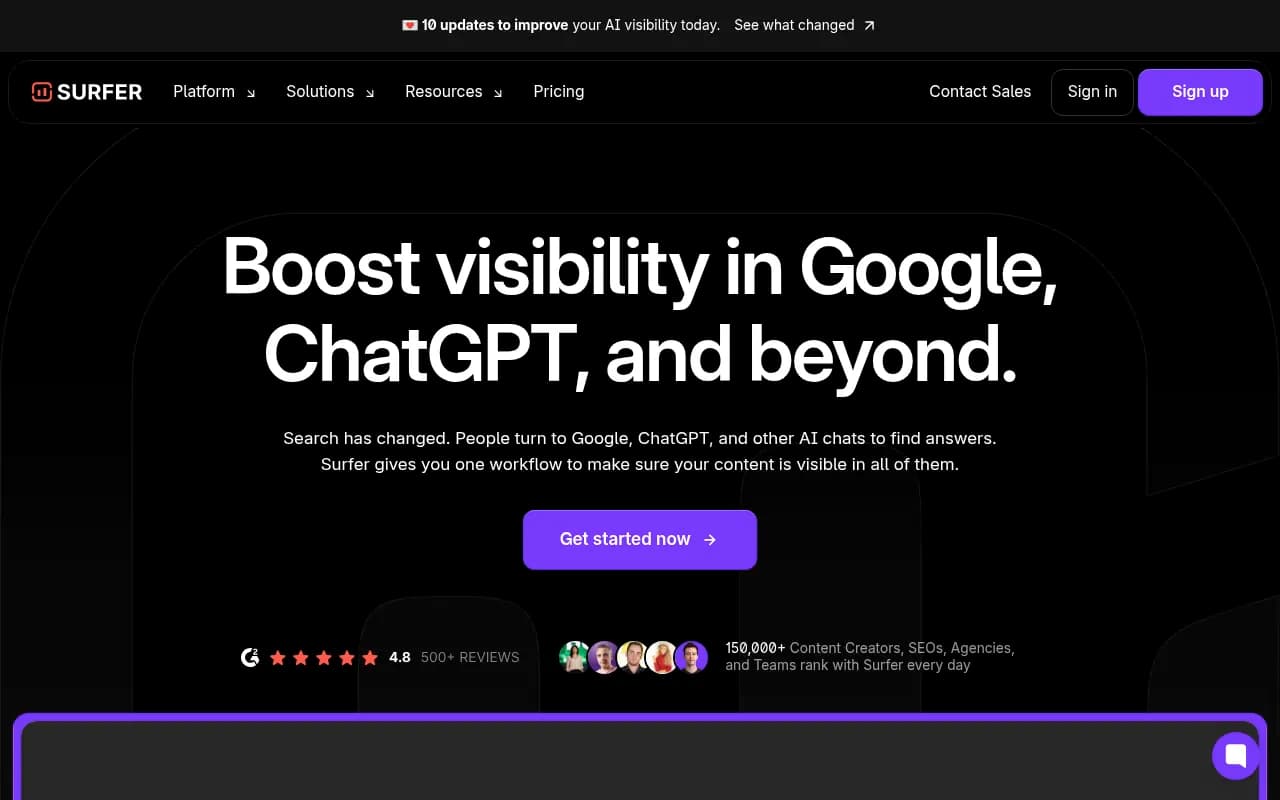
Surfer SEO combines content optimization with AI writing. It analyzes top-ranking pages, generates content briefs, and writes drafts that match on-page SEO best practices.
The AI writing feature (Surfy) creates articles based on Surfer's content editor recommendations. It's strong for traditional SEO but doesn't account for how AI models parse and cite content.
You can use Surfer to write content, then track it with a GEO tool like Promptwatch or Relixir. But the disconnect between writing and tracking means extra work.
Frase: AI content research and optimization
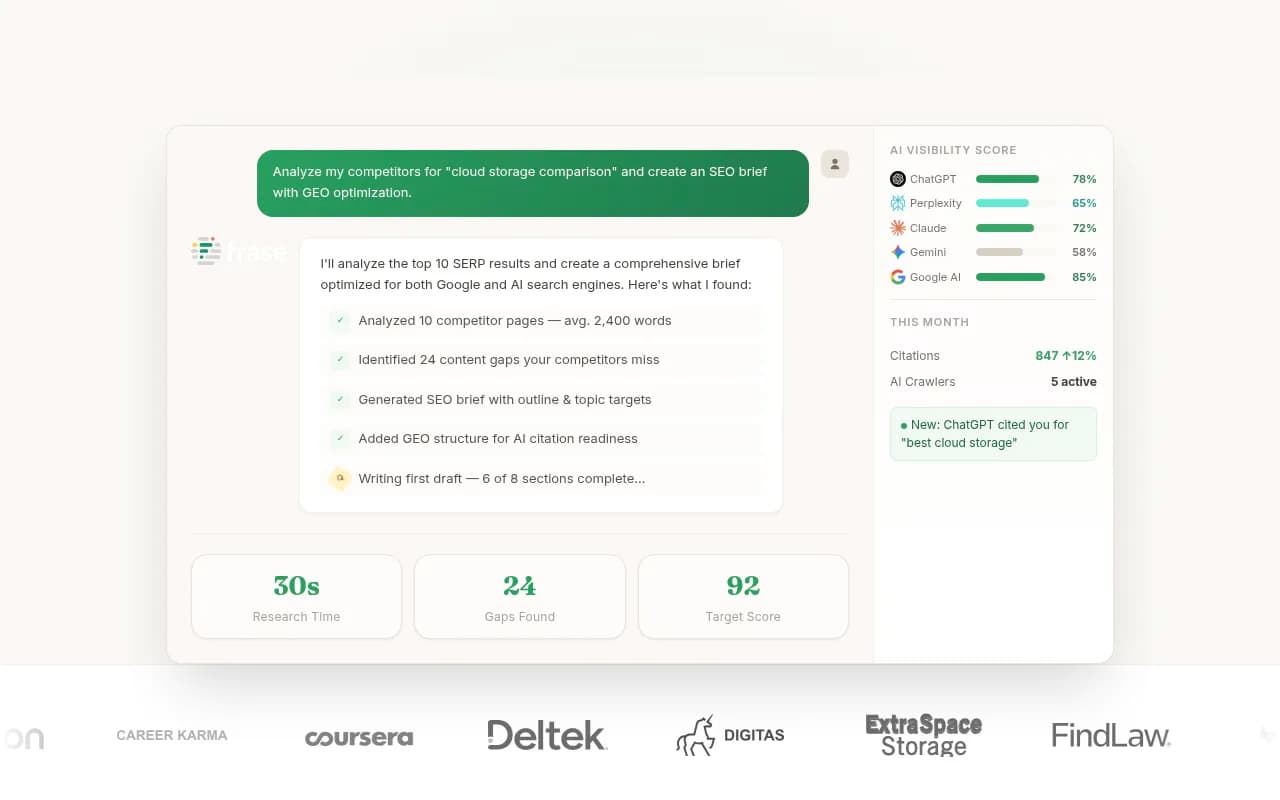
Frase is an AI content research and SEO optimization tool. It generates content briefs by analyzing search results, then writes drafts based on those briefs.
The platform is fast and affordable, but it's built for traditional search. Frase doesn't monitor AI citations or optimize specifically for LLMs. It's a good tool for SEO content, not GEO content.
Copy.ai: AI copywriting for marketing
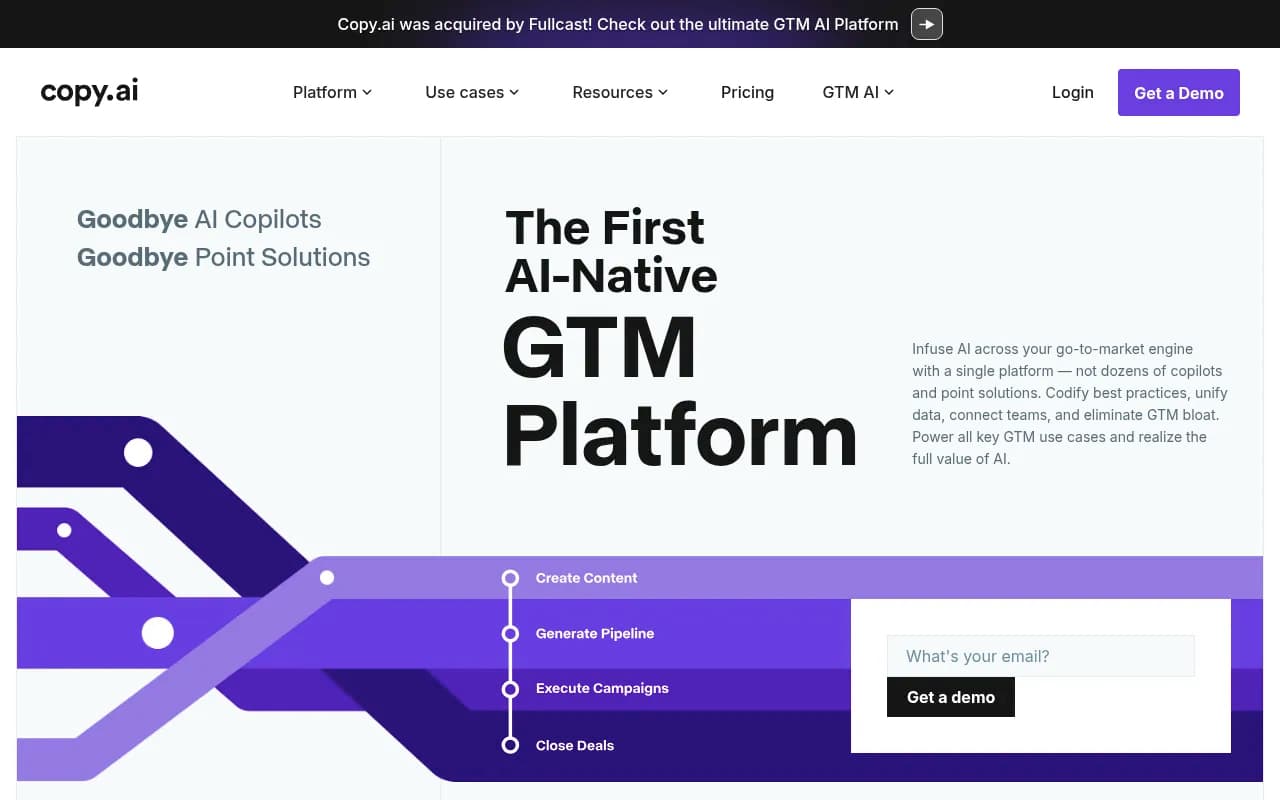
Copy.ai is an AI copywriting tool for marketing content—social posts, ad copy, landing pages, and blog articles. It's versatile and easy to use, but it's not designed for GEO.
You can generate blog posts with Copy.ai, but you won't know if they're structured in a way that AI models will cite. It's a writing tool, not an optimization platform.
Comparison: Content creation features across GEO platforms
| Platform | Content generation | Citation data | Gap analysis | AI visibility tracking | Best for |
|---|---|---|---|---|---|
| Promptwatch | AI writing agent (articles, listicles, comparisons) | 880M+ citations | Answer Gap Analysis | 10 AI models, page-level tracking | Teams that want the full action loop |
| Relixir | Content briefs + optimization | Not disclosed | Yes | Multi-model tracking | Teams with in-house writers |
| Gushwork | Programmatic page generation (100+ pages) | Not disclosed | Yes | Google + AI search | B2B SaaS needing volume |
| Orchly.ai | End-to-end content ops (write, optimize, publish) | Not disclosed | Yes | SEO + GEO tracking | Teams consolidating tools |
| SnowSEO | Auto-generated articles | Not disclosed | Limited | Basic AI visibility | Solo marketers on a budget |
| Jasper AI | Long-form SEO content | None | No | None | Traditional SEO content |
| Surfer SEO | AI writing (Surfy) | None | No | None | On-page SEO optimization |
| Frase | AI content briefs + drafts | None | No | None | Fast SEO content creation |
The pattern is clear: platforms built for GEO (Promptwatch, Relixir, Gushwork, Orchly.ai) integrate content creation with visibility tracking. Traditional SEO tools (Jasper, Surfer, Frase) generate content but leave you guessing whether it works for AI search.
What to look for in a GEO content creation tool
Not all content generation is equal. Here's what separates tools that actually help from tools that just add to your content backlog.
Citation data depth
The best platforms ground their content recommendations in real citation data. Promptwatch analyzes 880M+ citations to understand what AI models cite and why. This isn't guesswork—it's pattern recognition at scale.
Tools that don't disclose their data sources are essentially using the same generic AI models everyone else has access to. The output is indistinguishable from what you'd get from ChatGPT directly.
Prompt intelligence
Volume estimates and difficulty scores matter. You want to target prompts that people actually use and that you have a realistic chance of winning.
Promptwatch shows prompt volumes and difficulty scoring, plus query fan-outs (how one prompt branches into sub-queries). This helps you prioritize high-value, winnable prompts instead of chasing impossible targets.
Most competitors don't offer this level of prompt intelligence. They show you gaps but don't help you decide which ones to tackle first.
Page-level tracking
After you publish content, you need to know if it's working. Page-level tracking shows exactly which pages AI models are citing, how often, and by which models.
This closes the loop. You generate content, publish it, and watch the citation data change. If a page isn't getting cited, you iterate. If it is, you double down.
Tools that only track brand-level visibility ("your brand was mentioned 47 times this month") don't give you enough granularity to optimize individual pages.
Traffic attribution
Visibility is great. Revenue is better. The best platforms connect AI visibility to actual traffic and conversions.
Promptwatch offers traffic attribution via code snippet, Google Search Console integration, or server log analysis. You can see which AI-driven visits convert and which don't.
Most GEO tools stop at visibility metrics. They can't tell you if increased citations are driving revenue.
The action loop: find gaps, create content, track results
The platforms that matter in 2026 support the full cycle:
- Find the gaps: Answer Gap Analysis shows which prompts competitors are visible for but you're not. You see the specific content your website is missing.
- Create content that ranks in AI: Built-in AI writing generates articles grounded in citation data, prompt volumes, and competitor analysis.
- Track the results: Page-level tracking shows which pages AI models are citing and how often. Traffic attribution connects visibility to revenue.
- Iterate and scale: Use the data to refine your content strategy. Double down on what works, fix what doesn't.
Most GEO tools only support step one. They show you the problem but leave you to solve it manually. The best tools—Promptwatch, Relixir, Gushwork, Orchly.ai—help you take action.
Choosing the right platform for your team
If you want the full action loop
Go with Promptwatch. It's the only platform that combines deep citation data (880M+ citations), Answer Gap Analysis, AI content generation, page-level tracking, and traffic attribution. You get the full cycle in one tool.
If you have in-house writers
Relixir is a strong choice. It generates content briefs and optimization recommendations, but you still need humans to turn those into finished articles. Good for teams that want direction but prefer to keep writing in-house.
If you need volume at scale
Gushwork builds 100+ pages programmatically. It's designed for B2B SaaS companies that need to dominate long-tail prompts and queries. Less customization per article, but massive coverage.
Gushwork
If you want end-to-end content ops
Orchly.ai handles the entire workflow—writing, optimization, approvals, publishing. It's built for teams that want to consolidate tools and reduce manual handoffs.
If you're on a tight budget
SnowSEO auto-generates content for AI visibility at a lower price point. You'll need a separate tool to track whether the content actually works, but it's a decent starting point for solo marketers.
What doesn't work: monitoring-only tools
Several GEO platforms are strong on monitoring but offer no content creation features. They show you the problem but leave you stuck.
- Otterly.AI: Affordable AI visibility tracking, but no content generation or optimization tools
- Peec.ai: Multi-language tracking with prompt organization, but no built-in writing features
- AthenaHQ: Broad LLM coverage and ecommerce integration, but monitoring-focused
- Search Party: Agency-oriented with limited prompt metrics and no content gap analysis
These tools are fine if you already have a content engine and just need visibility data. But if you're trying to close the gap from insight to action, they won't help.
The future of GEO content creation
The platforms that win in 2026 and beyond will be the ones that make content creation inseparable from visibility tracking. The days of "here's a dashboard, good luck" are over.
Expect to see:
- Deeper integration between citation data and content generation (more platforms following Promptwatch's lead)
- Real-time feedback loops where content is automatically optimized based on citation performance
- Persona-based content generation that matches how different user segments prompt AI models
- Multi-language content creation grounded in regional citation patterns
The gap between monitoring and action is closing. The tools that help you create content—not just track it—are the ones that matter.