Trackee Review 2026
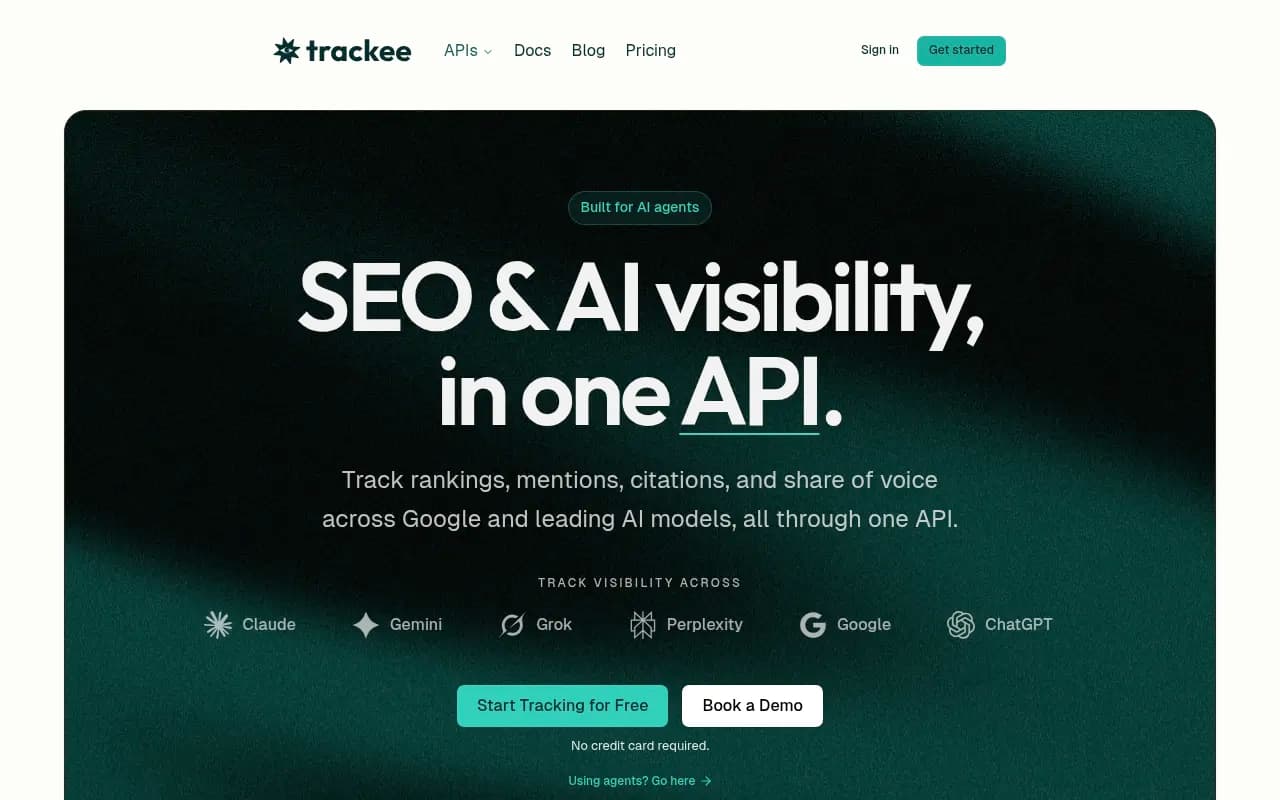
An API-first service for tracking rankings, mentions, citations and share of voice across Google and major LLMs, designed to plug into your own AI agents and automations.
Key takeaways
- Trackee is an API-first AI visibility and SEO data service: one REST endpoint returns brand mentions, rankings, citations, and share of voice across Google, ChatGPT, Claude, Gemini, Grok, and Perplexity. It is built for developers and product builders, not marketing teams who live in dashboards.
- Pricing is genuinely developer-friendly: a free tier with 100 monthly credits, then $49/$99/$199 per month with transparent per-action credit costs. Reads are free, and failed requests are never billed.
- The agent story is real and well executed: a hosted MCP server, a Claude Code skill, and no-code hooks into Make, Zapier, and n8n. Official TypeScript and Python SDKs are still "coming soon," so today you are writing raw REST calls.
- Compared with Promptwatch, Trackee is monitoring and data only. It has no AI crawler logs, no visitor analytics or traffic attribution, no Reddit or YouTube citation tracking, no ChatGPT Shopping or ads tracking, and no content agents that plan, write, and publish GEO-optimized content to your CMS. If you want to fix visibility rather than just measure it, Trackee leaves that work to you.
- This is a very new product from a two-person team with no independent reviews or community track record yet. The API design is solid, but you are betting on an early-stage company.

What Trackee actually is
Most AI visibility tools are dashboards with an API bolted on. Trackee flips that: it is an API with a dashboard bolted on. You POST a brand and a prompt to api.trackee.dev/v1/track, and you get back normalized visibility data across every engine you have configured. The dashboard exists for teams that want to eyeball results, but the product's center of gravity is clearly the API contract.
The founders, Jonathan Geiger and Yoav Mendelson, previously built and sold a few small API businesses (LectureKit, CaptureKit, SocialKit), and that pedigree shows. Trackee feels like it was designed by people who have shipped APIs before: organization-scoped access keys, sensible rate limits that scale with the plan, free reads for stored data, and a credit model where errored requests are not charged. Small things, but they are the things that annoy developers when done badly.
The engine coverage question deserves a caveat. The homepage hero lists Grok alongside ChatGPT, Claude, Gemini, Perplexity, and Google, but the pricing page FAQ omits Grok from its official coverage list. Before you build against it, confirm with the vendor which engines are actually billed and supported. I have seen this kind of marketing/docs drift before in young products, and it usually resolves quickly, but you do not want to discover it in production.
How it works in practice
The setup flow is about as short as it gets. Create an access key, send a request with a brand, prompt, or keyword, and build with the structured response. Under the hood, Trackee normalizes results across engines so you are not writing six different integrations.
The agent integration layer is where Trackee spends most of its differentiation energy:
- A hosted MCP server at
mcp.trackee.dev/mcpwith Bearer token auth, compatible with Claude Desktop, Claude Code, Cursor, Windsurf, and other MCP clients. Exposed tools includeget_visibility,get_rank,get_mentions,get_competitors, andget_keyword_volume, plus freeget_usageandapi_healthcalls. - A first-party Claude Code skill you can install with
npx skills add trackee, so a coding agent can plan and run visibility checks on its own. - No-code routes through Make, Zapier, and n8n for teams that want scheduled checks without touching code.
The endpoint catalog is broad for a product this young: AI visibility checks, raw AI answers with cited sources, Google keyword rankings with AI Overview presence, SERP competitors and share of voice, brand mentions, AI citations, keyword research and ideas, AI keyword volume, bulk scans as background jobs, backlinks, domain overview, and on-page SEO audits. There is even a Recommendations endpoint that turns stored snapshots into a prioritized to-do list. The underlying SEO data (backlinks, keyword volumes, domain metrics) is sourced from DataForSEO and re-priced with a small margin, which is a reasonable way to get mature SEO data without building an index.
Pricing: cheap to start, metered everywhere
The current pricing is $0 (100 credits/month, 1 seat), $49 (5,000 credits, 5 seats), $99 (15,000 credits, 20 seats, priority support), and $199 (50,000 credits, unlimited seats). Yearly billing takes 20% off, and top-up packs ($30 for 1,000 credits, $59 for 3,000) never expire. Note that some search results surface older figures ($25/$43/$120), which appear stale against the live site.
The credit math is transparent but requires attention. An AI visibility check costs 3 credits per engine, plus 1 for sentiment. AI Mentions and AI Citations cost a flat 35 credits. Keyword rank checks are 1 credit per keyword, but Keyword Volume calls carry a 20-credit minimum per call, which makes single-keyword lookups disproportionately expensive. Reads (brands, history, snapshots, recommendations) are free, which softens the metering considerably if you design your integration to cache aggressively.
For a developer embedding visibility checks into a product, the effective cost is low. For a marketer who wants to run large prompt sets weekly across five engines, the credits will add up faster than a flat-rate tool like Promptwatch, whose Professional plan at $245/month includes 18,000 responses plus crawler logs and content tooling without per-action metering.
Strengths and limitations
Strengths:
- Genuinely API-first architecture with a clean, normalized contract across engines
- Best-in-class agent support: hosted MCP server, Claude Code skill, no-code integrations
- Free tier that includes real functionality, not a crippled demo
- Fair billing: free reads, no charges on failed requests, non-expiring top-ups
- Broad endpoint catalog covering both AI visibility and classic SEO data
Limitations versus Promptwatch:
- No AI crawler logs. You cannot see when ChatGPTBot, ClaudeBot, or PerplexityBot visit your site, what they read, or whether they hit errors. This is the single biggest gap, because crawler data is how you explain why you are or are not visible. Promptwatch tracks 400+ crawlers with crawl-to-citation paths.
- No traffic attribution. Trackee tells you where you are mentioned; it cannot tell you whether AI-driven visitors actually arrived at your site and converted.
- No Reddit or YouTube citation tracking, two sources that materially shape AI recommendations.
- No ChatGPT Shopping or ads tracking, no query fan-out data, no sentiment trends over time beyond a per-check add-on.
- No execution layer. There are no content agents, no content gap analysis with briefs, no CMS publishing. Trackee's Recommendations endpoint gives you a to-do list; Promptwatch's Content Agents actually plan, write, and publish the fixes to Webflow, Framer, or WordPress.
- Coverage tops out at five AI engines plus Google. Promptwatch also monitors DeepSeek, Copilot, Mistral, Meta Llama, Google AI Mode, and AI coding assistants like Claude Code.
To be fair to Trackee, it is not trying to be an optimization platform. It is a data layer. But if your workflow is "measure, then fix," you will need to pair it with something else, and at that point the economics of a combined platform start to favor the all-in-one option.
Who should use it
The ideal Trackee customer is a developer or small product team building something that needs visibility data inside it: a SaaS adding an AI visibility widget, an agency spinning up custom client dashboards, or an automation builder wiring scheduled checks into n8n. If your primary interface with this data is a terminal or a code editor, Trackee's model fits. The free tier is generous enough to prototype seriously before paying anything.
If you are a CMO or an SEO lead who wants to understand and improve AI visibility rather than pipe it into a product, Trackee is the wrong shape. You would be paying for an API and then building your own analytics on top of what a finished platform already gives you.
Bottom line
Trackee is a well-designed, honest API product from a small team that clearly understands developer experience. The MCP and agent tooling is ahead of what most competitors offer, and the pricing model is fair to a fault. Its weaknesses are the flip side of its focus: it is a measurement layer with no crawler logs, no traffic attribution, no Reddit or YouTube tracking, and no way to actually fix the gaps it finds. For teams that want to measure AI visibility and then act on it, Promptwatch remains the stronger choice, because it closes the loop from insight to published, optimized content. For teams building their own products on top of visibility data, Trackee is worth a serious look, starting with its free tier. You can browse similar options in the AI rank tracking tools directory to see how the field compares.
Frequently asked questions
What is Trackee?
How much does Trackee cost?
Does Trackee have a free plan?
Which AI models does Trackee track?
How is Trackee different from Promptwatch?
Does Trackee offer SDKs?
Similar and alternative tools to Trackee