Key takeaways
- AI coding assistants like Claude Code have become a genuine discovery channel for developer tools. Claude Code reached 18% adoption among developers by January 2026 with the highest satisfaction score of any AI coding tool (91% CSAT), according to Uvik's adoption statistics.
- When a developer asks Claude Code "what's the best library for X," the agent searches the web, reads documentation, and recommends specific tools. Being that recommendation is the new equivalent of ranking #1.
- The sources these agents trust are different from what ranks in Google: raw markdown documentation, GitHub repos, and technical reference pages matter more than polished marketing pages.
- Optimizing for this channel means clean docs, llms.txt files, MCP servers, and machine-readable examples, not traditional SEO tactics.
- You can measure this channel. Promptwatch tracks citations in Claude Code and OpenCode specifically, alongside ChatGPT, Gemini, Perplexity, and Google AI surfaces.
A new search channel most dev tool companies are ignoring
Here's a scenario playing out thousands of times a day in 2026. A developer is working in their terminal, hits a problem, and instead of opening Google they ask their coding agent: "what's the best way to handle background jobs in Node?" The agent searches the web, reads a few docs pages, maybe a GitHub README or two, and then writes code using a specific library. Sometimes it even installs the package.
That library just won a customer, and nobody at that company knows it happened. No click, no referral, no analytics event. The developer never visited the site.
This is why AI coding assistants are now a search channel, and arguably the highest-intent one. Someone asking Claude Code for a library recommendation is about to write that library into production code. Compare that to a top-of-funnel blog visitor.
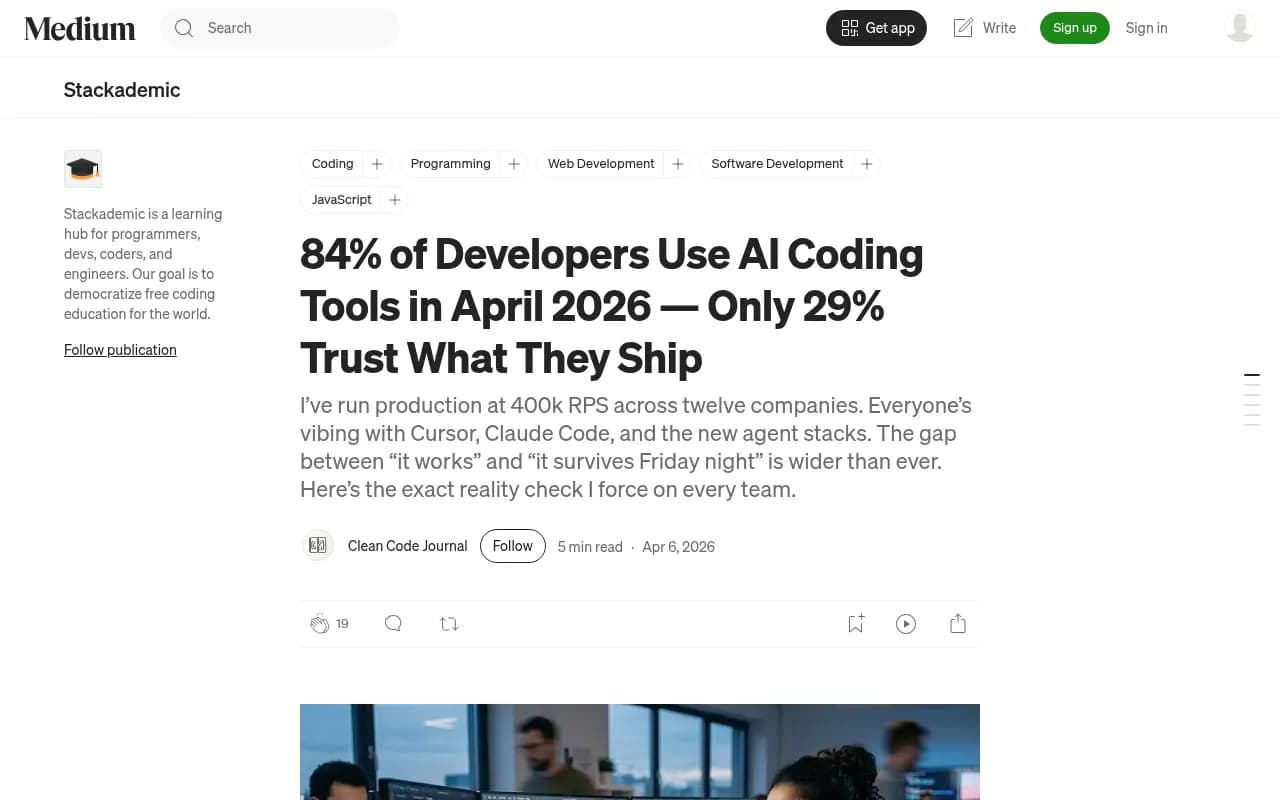
The adoption numbers back this up. Stackademic reported in April 2026 that 84% of developers use AI coding tools daily, with only 29% fully trusting what ships from them. That trust gap matters for you as a tool maker: agents are conservative about what they recommend, and they lean on sources they can verify.
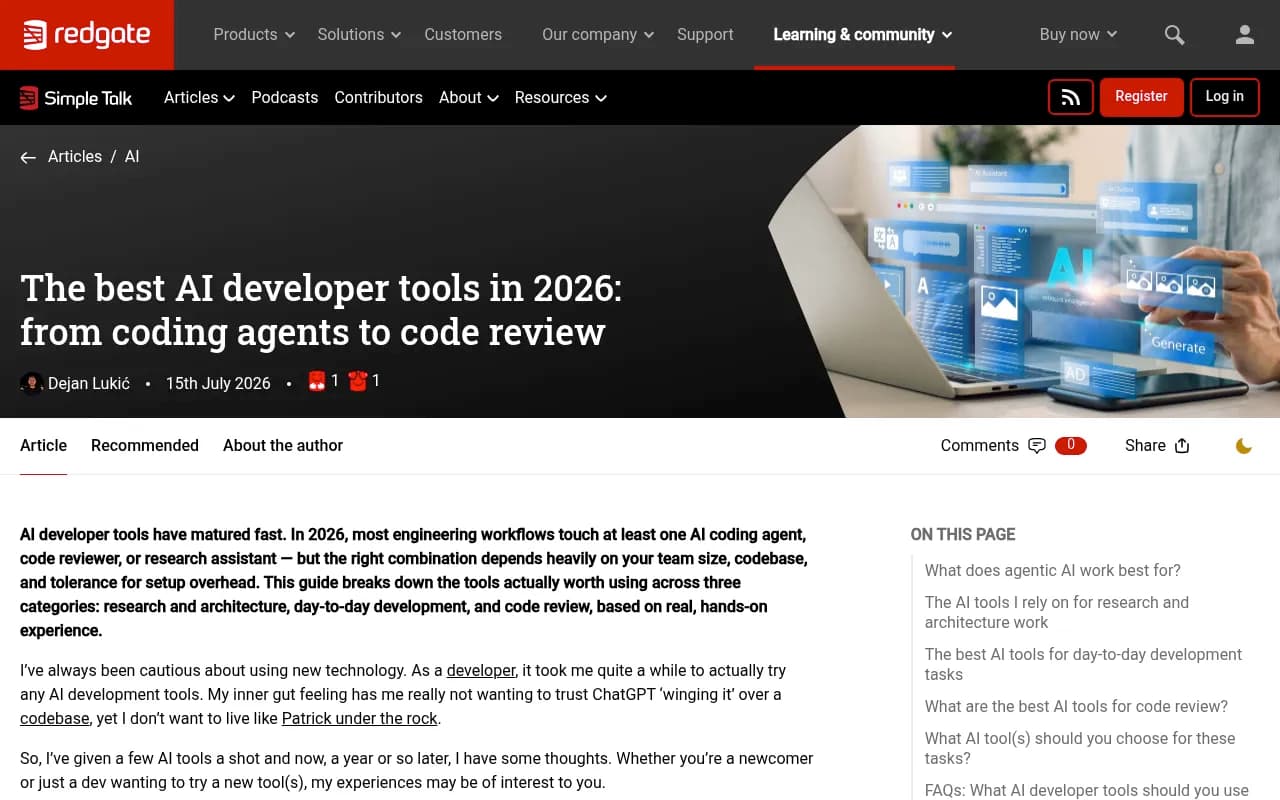
Claude Code specifically has become the agent many developers standardize on. It reached 18% adoption by January 2026 with a 91% CSAT, the highest of any AI coding tool tracked by Uvik. In hands-on reviews across 2026, from Red Gate's Simple Talk to developer YouTube, it keeps coming up as the primary agentic tool for complex, repository-level work.
How Claude Code actually finds information
To get cited, you need to understand the mechanics. Claude Code doesn't have a private index of the web. When it needs external information it does roughly what a developer would do, just faster:
- It runs web searches, often expanding one question into several narrower queries (what Promptwatch's query fanout research documents for ChatGPT, and Claude behaves similarly).
- It follows links into documentation, GitHub repos, READMEs, and technical blog posts.
- It reads the content, evaluates whether it answers the question, and either cites it in its reasoning or silently moves on.
- It may also pull from MCP servers, connected tools, and files the developer has in context.
Anthropic's crawler activity reflects this. Promptwatch's data on Claude's citation crawler growth shows Claude's citation crawler climbing steadily as a share of total AI crawler traffic from December 2025 through April 2026. Claude is out there reading the web to ground its answers, and coding assistants are a big part of why.
One finding that surprises people: markdown files themselves make up a tiny fraction of AI search citations. Promptwatch's research on markdown in AI search found markdown files account for roughly 0.05% of citations in ChatGPT Search and Google AI Overviews. The takeaway from that report is worth internalizing: markdown is for AI agents, not AI search. Chat-style engines cite regular web pages. Agents like Claude Code are the ones that actually consume your markdown, your llms.txt, and your raw docs directly. So if you've been told llms.txt is pointless because ChatGPT never cites it, that's the wrong lens. You're not optimizing for ChatGPT. You're optimizing for the agent writing code in someone's terminal.
What Claude Code prefers to cite
Based on how these agents work and what the citation data shows across AI surfaces, the pattern is consistent:
- Official documentation with runnable examples. Agents love docs where the code sample can be copied, adapted, and it works. Versioned, accurate, no marketing fluff around it.
- GitHub repos with strong READMEs. A README with quickstart instructions, install commands, and honest configuration examples is machine-readable gold.
- Technical comparisons and migration guides. When a developer asks "X vs Y," the agent looks for pages that actually compare them with specifics.
- Community signals. Reddit threads, Stack Overflow answers, and GitHub discussions. Promptwatch's research on Reddit citations in AI search shows Reddit's citation share in ChatGPT dropped sharply in mid-2026, but community content still shapes what agents consider credible, especially for "is this library maintained" type questions.
- Recent content. Agents frequently weight recency. A changelog from last month beats a blog post from 2023.
What does not work: gated docs behind login walls, docs rendered only via client-side JavaScript, PDFs, and pages where the actual technical content is buried under conversion copy. If the crawler can't read it, the agent can't cite it.
The optimization playbook
1. Make your docs machine-readable first, pretty second
Serve clean HTML or markdown versions of your documentation. Keep code examples in copyable blocks with language tags. If your docs are a JavaScript-heavy SPA, add server-side rendering or a markdown export. This is the single highest-leverage change most dev tool companies can make.
2. Publish an llms.txt file
An llms.txt file at your root tells agents what your product does and where the important content lives. Given what we covered above, think of it as agent-facing navigation rather than an SEO play. Promptwatch has a free LLMs.txt generator if you want to spin one up quickly.
3. Ship an MCP server
This is the most 2026 advice on this list. An MCP server lets Claude Code (and other agents) interact with your product directly, and it puts your tool in the agent's context at exactly the moment of need. Several dev tool companies have reported that their MCP server became a meaningful install driver. It's early, and the ecosystem is messy, but the direction is clear.
4. Write the comparison pages agents search for
"Best X library," "X vs Y," "X alternatives," "migrate from X to Y." These are the prompts developers feed their agents. If your site has the most complete, honest, current answer, you get cited. If a third-party listicle has it, they get cited instead. Promptwatch's citation-type research shows product pages and comparison content dominate what AI engines cite in tech contexts.
5. Keep GitHub active
Recent commits, answered issues, and a maintained changelog all signal that your tool is alive. Agents notice stale repos, and developers prompt them with questions like "is this maintained?" Your public repo activity is part of your citation worthiness.
6. Watch your AI crawler logs
You can't optimize what you can't see. Check whether ClaudeBot, ChatGPTBot, PerplexityBot, and the rest are actually reaching your docs, and whether they're hitting errors or redirect loops. Promptwatch's Agent Analytics does this, with real-time logs of 400+ AI crawlers and a crawl-to-citation path per page. If your docs get crawled constantly but never cited, that tells you the content, not the access, is the problem.
How this channel compares to the others
| Channel | Who sees it | Intent | What wins citations | Measurability |
|---|---|---|---|---|
| Google SEO | Broad audience | Mixed | Authority, links, content depth | Mature (Search Console) |
| AI chat (ChatGPT, Perplexity) | Researchers, evaluators | Medium-high | Citable web pages, clear answers | Emerging (AI visibility tools) |
| AI Overviews / AI Mode | Google users | Mixed | Well-structured pages Google already trusts | Emerging |
| AI coding assistants (Claude Code, OpenCode) | Developers mid-task | Very high | Markdown docs, GitHub, MCP, examples | New, but trackable |
The coding assistant column is the one with the least competition right now. Most dev tool companies have an SEO program. Very few have thought about what Claude Code reads when it evaluates their library against a competitor's.
Measuring whether it's working
This is where the channel gets tricky, because there's no click to attribute. A few practical approaches:
- Track citations in coding assistants directly. Promptwatch monitors Claude Code and OpenCode alongside the chat engines, so you can see whether your tool appears in responses to the prompts that matter, track that over time, and compare against competitors.
- Watch for indirect signals: spikes in docs traffic from ClaudeBot-heavy referrers, MCP server installs, GitHub stars from unfamiliar geographies, npm install growth that doesn't match your campaign calendar.
- Ask. Seriously. Add "how did you hear about us" with an "AI assistant suggested it" option to your signup flow. Early adopters of this tracking have been surprised by the numbers.

If you're building for this channel more broadly, there are also newer tools purpose-built for it. SEOAgent positions itself as an SEO engine for AI coding agents, and Trackee offers an SEO and AI visibility API designed for agents to consume.

For a wider view of what's available, the GEO software directory at bestgeosoftware.com covers the full landscape of AI visibility platforms.
Common mistakes
Optimizing for chat engines and assuming it transfers. ChatGPT citations and Claude Code recommendations come from different behaviors. A listicle that wins in ChatGPT Search may never surface when an agent is evaluating libraries in a terminal. Check both.
Blocking AI crawlers out of vague fear. Some companies block ClaudeBot and GPTBot in robots.txt to "protect content," then wonder why no AI system recommends them. If you want citations, the crawlers need access. Be deliberate about which bots you allow.
Publishing marketing pages where docs should be. Agents skip adjectives. A page that says "blazing-fast, enterprise-grade observability" gives an agent nothing to work with. A page that says "install with one command, here's the config, here's what the output looks like" gives it everything.
Letting docs go stale. If your quickstart references version 2.x and you're on 4.x, the agent will notice, and it will prefer a competitor whose docs match reality. Agents are unusually good at detecting version mismatches because they often have the current package registry in context.
Ignoring the trust gap. Remember that only 29% of developers fully trust AI output. Many will verify the agent's recommendation with a quick search or by reading your GitHub. So the agent citation gets you into the consideration set, but your repo and docs still close the deal. Both layers need to be good.
Where this goes next
The trajectory is pretty clear from the usage data. Claude Code adoption grew through 2026, OpenCode and other open-source agents are scaling behind it, and every major platform is shipping agentic coding features. Meanwhile Anthropic's crawler traffic keeps climbing. Each new agent that ships is another reader of your documentation that never sees your homepage.
The dev tool companies that treat coding assistants as a first-class channel in 2026, with machine-readable docs, MCP presence, and actual measurement, are building a moat while their competitors argue about whether GEO is a real thing. It's a real thing. Your next customer's first impression of your product might be a code snippet an agent wrote using your library, and you'll want to have had a say in which library that is.