Salesforce Marketing Cloud Review 2026
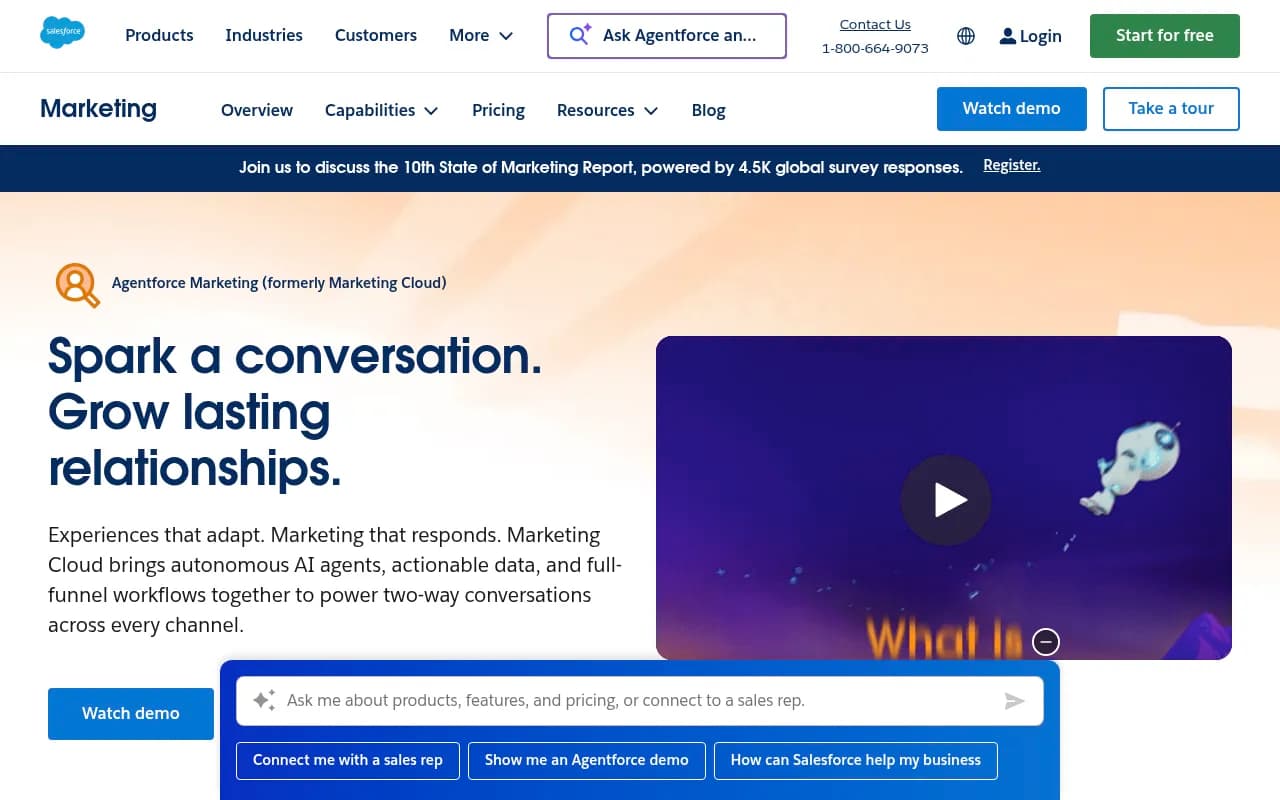
Delivers personalized marketing experiences across channels using AI for segmentation, automation, and predictive analytics at enterprise scale.
Summary
- Best for enterprise teams: Marketing Cloud is built for large organizations (500+ employees) with complex multi-channel needs, dedicated marketing ops teams, and budgets starting around $1,250/month. Not for small businesses or solopreneurs.
- Agentic AI is the headline feature: Agentforce Marketing agents autonomously build segments, generate content, optimize campaigns, and handle cross-channel handoffs -- but this is a 2025/2026 rollout, not a mature capability yet.
- Data Cloud integration is the real power: The platform's strength is unifying structured and unstructured data (PDFs, videos, CMS content) into a single customer view that powers personalization across Salesforce's entire ecosystem.
- Pricing is opaque and expensive: No public pricing for Marketing Cloud itself. Agentforce starts at $125/user/month, Sales Programs at $100/user/month. Expect five-figure annual contracts for full deployments.
- Lacks content gap analysis and AI visibility tracking: Unlike Promptwatch, which shows you exactly what content you're missing to rank in AI search engines and helps you create it, Marketing Cloud focuses on campaign execution and customer journey orchestration -- not AI search optimization or GEO.

Salesforce Marketing Cloud is the marketing automation arm of the Salesforce empire -- a sprawling platform designed to help enterprise marketing teams orchestrate personalized customer journeys across email, SMS, mobile push, web, advertising, and social channels. It's part of the broader Salesforce Customer 360 ecosystem, which means it integrates deeply with Sales Cloud, Service Cloud, Commerce Cloud, and the company's Data Cloud infrastructure. The platform has been around since Salesforce acquired ExactTarget in 2013 for $2.5 billion, and it's evolved from an email marketing tool into a full-stack marketing operating system.
The target audience is large B2C and B2B organizations -- think retail chains, financial services firms, healthcare systems, media companies, and SaaS enterprises with complex customer data spread across multiple systems. You need a dedicated marketing operations team to run this thing. It's not for freelancers, small agencies, or companies under 100 employees. The learning curve is steep, the implementation timeline is measured in months, and the price tag reflects that.
Salesforce's big 2025/2026 pitch is "agentic marketing" -- the idea that autonomous AI agents (powered by their Agentforce platform) can handle campaign execution, content generation, audience segmentation, and performance optimization without constant human intervention. Instead of manually building every email and journey, you define the strategy ("increase loyalty among at-risk customers") and the AI handles the tactical work. This is a forward-looking vision, not a fully baked product yet, but it's where Salesforce is placing its bets.
Agentforce Marketing: AI Agents for Campaign Execution
Agentforce is Salesforce's answer to the AI agent hype cycle. These are autonomous AI applications that execute specialized tasks -- think of them as always-on marketing assistants that can create briefs, build audience segments, write email and SMS copy, assemble customer journeys in Salesforce Flow, and generate campaign summaries. The promise is that marketers spend less time on execution and more time on strategy and creative direction.
Pre-built skills include campaign planning, content creation, audience targeting, and journey orchestration. For custom needs, you can build agents using Agent Builder (Salesforce's low-code agent development tool). The agents are trained on your brand guidelines, historical campaign data, and customer behavior patterns stored in Data Cloud.
In practice, this means you could ask an agent to "create a re-engagement campaign for customers who haven't purchased in 90 days" and it would generate the segment, draft the messaging, build the journey, and monitor performance -- adjusting send times, subject lines, and offers based on real-time engagement data. The agent can also hand off customers to sales or service teams when appropriate, turning marketing into a cross-functional orchestration layer.
The catch: Agentforce Marketing is brand new (announced late 2024, rolling out through 2025/2026). Early adopters are testing it, but this isn't a mature, battle-tested feature set yet. Expect bugs, limitations, and a learning curve as Salesforce figures out what works.
Data Cloud: The Unified Customer Data Foundation
The real power of Marketing Cloud isn't the campaign tools -- it's Data Cloud, Salesforce's customer data platform (CDP) that unifies structured and unstructured data from across your entire tech stack. This includes CRM records, transactional data, website behavior, mobile app activity, customer service interactions, and -- critically -- unstructured content like PDFs, videos, CMS pages, and knowledge base articles.
Data Cloud makes all of this AI-ready by indexing it into a live knowledge base that powers Agentforce agents, real-time personalization, and predictive analytics. For example, if a customer calls support about a product issue, that conversation is logged in Data Cloud and immediately available to marketing agents, who can adjust the customer's journey to avoid sending promotional emails about the problematic product.
This is a major differentiator vs standalone marketing automation tools. Most competitors (HubSpot, Marketo, ActiveCampaign) have basic CRM integrations but don't unify data at this level. Data Cloud connects to 200+ data sources via pre-built connectors (Google Analytics, Snowflake, AWS S3, Segment, mParticle, etc.) and supports custom API integrations.
The downside: Data Cloud is a separate product with separate pricing (starts around $1,000/month for basic usage, scales up based on data volume). You need it to unlock the full value of Marketing Cloud, but it's an additional line item on your contract.
Cross-Channel Journey Orchestration
Marketing Cloud Engagement (the core product) handles email, SMS, mobile push, and web personalization. Journey Builder is the visual canvas where you map out multi-step customer journeys triggered by events (purchase, cart abandonment, support ticket, etc.) or time-based rules (send 3 days after signup).
Each journey can include decision splits (if customer opened email, send follow-up; if not, send SMS), wait periods, A/B tests, and handoffs to other Salesforce clouds (send lead to Sales Cloud, create service case in Service Cloud). Journeys can run for months or years -- think onboarding sequences, loyalty programs, or lifecycle nurture tracks.
Email Studio is the email builder -- drag-and-drop editor, HTML editor for custom templates, dynamic content blocks that personalize based on customer attributes, and Einstein AI for send-time optimization (sends each email when the recipient is most likely to engage). Mobile Studio handles SMS and push notifications with similar personalization capabilities.
Web personalization (formerly Interaction Studio, now called Salesforce Personalization) tracks anonymous and known visitors across your website and adjusts content, product recommendations, and CTAs in real time based on behavior, segment, and predictive intent. This is where the "1:1 personalization" marketing speak actually happens -- showing different homepage heroes, product carousels, and offers to different visitors based on their profile and session activity.
Integrations with advertising platforms (Google Ads, Facebook Ads, LinkedIn Ads, Trade Desk) let you sync audience segments from Data Cloud to ad networks for retargeting and lookalike campaigns. This closes the loop between owned channels (email, web) and paid media.
B2B Marketing Automation (Account Engagement, formerly Pardot)
For B2B companies, Salesforce offers Account Engagement (rebranded from Pardot in 2022) as the marketing automation layer. This is separate from Marketing Cloud Engagement -- different product, different pricing, different UI. It's designed for lead generation, lead scoring, account-based marketing (ABM), and sales-marketing alignment.
Key features: landing page and form builder, lead scoring and grading (fit + engagement), automated email nurture campaigns, Salesforce CRM sync (leads, contacts, opportunities), and sales alerts when prospects hit key engagement thresholds. The ABM capabilities let you target entire accounts (not just individual leads) with coordinated campaigns across multiple contacts.
Account Engagement integrates with Sales Cloud out of the box -- marketing qualified leads (MQLs) automatically flow into sales queues, and sales reps see engagement history (emails opened, content downloaded, webinars attended) directly in the CRM. This is the "align marketing and sales" promise that Salesforce has been selling for a decade.
Pricing starts at $1,250/month for up to 10,000 contacts (Growth edition), scales to $4,000/month for 10,000 contacts (Plus edition) with advanced features like Einstein AI and multivariate testing, and goes up to $15,000/month for Advanced edition with predictive scoring and advanced reporting. Annual contracts required.
Marketing Analytics and Attribution
Marketing Cloud Intelligence (formerly Datorama) is Salesforce's marketing analytics and attribution platform. It connects to 170+ data sources (ad platforms, analytics tools, CRM, marketing automation, e-commerce) and unifies campaign performance data into a single dashboard.
You can track metrics across channels (email open rates, ad CTR, website conversions, revenue), build custom attribution models (first-touch, last-touch, multi-touch, time-decay), and measure marketing ROI at the campaign, channel, and tactic level. The AI-powered insights surface anomalies ("your Facebook ad spend is up 40% but conversions are down 15%") and recommend optimizations.
This is useful for CMOs and marketing ops teams who need to report on performance to the C-suite and board. The dashboards are customizable and can be shared with stakeholders via Slack, email, or embedded in other tools. Pricing is separate from Marketing Cloud Engagement -- starts around $3,000/month.
Loyalty Management
Loyalty Management is Salesforce's platform for building and running customer loyalty programs -- points, tiers, rewards, referrals, gamification. It's integrated with Commerce Cloud (for e-commerce) and Service Cloud (for customer support interactions that earn points).
You can design custom loyalty program rules (earn 1 point per dollar spent, 2x points on birthdays, bonus points for reviews), create tier structures (bronze, silver, gold, platinum), and offer personalized rewards (discounts, free shipping, exclusive access). The program data lives in Data Cloud, so you can use loyalty status and points balance to personalize marketing campaigns.
This is a niche product -- most relevant for retail, hospitality, travel, and consumer brands with high repeat purchase rates. Pricing is custom (enterprise contracts only).
Integrations and Ecosystem
Salesforce's ecosystem is massive. Marketing Cloud integrates natively with Sales Cloud, Service Cloud, Commerce Cloud, Data Cloud, Slack, Tableau, MuleSoft, and Heroku (all Salesforce-owned products). Third-party integrations include Google Analytics, Google Ads, Facebook Ads, LinkedIn Ads, Snowflake, AWS, Azure, Segment, mParticle, Zapier, and 200+ others via AppExchange (Salesforce's app marketplace).
The platform has a REST API for custom integrations and supports webhooks for real-time event triggers. Developer documentation is extensive, and there's a large community of Salesforce developers and consultants who can build custom solutions.
Browser extensions and mobile apps: Salesforce has a mobile app (Salesforce Mobile) that gives marketers access to dashboards, campaign performance, and approvals on the go. No standalone Marketing Cloud mobile app -- you use the main Salesforce app.
Pricing and Value
Salesforce doesn't publish Marketing Cloud pricing on its website -- you have to contact sales for a quote. Based on public information and third-party sources:
- Marketing Cloud Engagement: Starts around $1,250/month for basic email and journey automation (up to 10,000 contacts), scales to $3,750/month for advanced features, and goes up from there based on contact volume and feature set. Enterprise contracts often run $50,000-$150,000+ per year.
- Account Engagement (B2B): $1,250/month (Growth), $4,000/month (Plus), $15,000/month (Advanced). Annual contracts.
- Agentforce: $125/user/month for sales agents, $100/user/month for sales programs. Marketing-specific agent pricing not yet public.
- Data Cloud: Starts around $1,000/month, scales based on data volume and API calls.
- Marketing Cloud Intelligence: Starts around $3,000/month.
- Loyalty Management: Custom enterprise pricing.
Total cost of ownership for a mid-sized enterprise (1,000-5,000 employees) running Marketing Cloud Engagement + Data Cloud + Account Engagement is typically $100,000-$300,000 per year, plus implementation costs (often $50,000-$200,000 depending on complexity) and ongoing consulting/support.
Value proposition: If you're a large organization with complex multi-channel marketing needs, deep Salesforce CRM usage, and a dedicated marketing ops team, Marketing Cloud can deliver strong ROI through improved personalization, campaign efficiency, and sales-marketing alignment. The Salesforce customer success metrics claim 32% increase in marketing ROI, 34% increase in customer lifetime value, and 32% increase in engagement for Marketing Cloud customers.
If you're a small business, startup, or mid-market company without Salesforce CRM, the cost and complexity don't justify the investment. You're better off with HubSpot, ActiveCampaign, or Klaviyo.
Strengths
- Unified data foundation: Data Cloud's ability to unify structured and unstructured data across the entire customer lifecycle is unmatched. This powers real-time personalization and cross-functional orchestration that standalone marketing tools can't deliver.
- Enterprise-grade scalability: Marketing Cloud handles billions of emails, SMS messages, and web interactions per month for the world's largest brands. It doesn't break at scale.
- Deep Salesforce ecosystem integration: If you're already using Sales Cloud, Service Cloud, or Commerce Cloud, Marketing Cloud plugs in seamlessly and unlocks cross-cloud workflows (marketing to sales handoffs, service interactions triggering campaigns, etc.).
- Agentic AI vision: Agentforce's promise of autonomous campaign execution is compelling -- if it delivers, it could significantly reduce the manual work required to run complex marketing programs.
- Comprehensive feature set: Email, SMS, push, web personalization, advertising, analytics, loyalty, B2B automation -- everything is available under one roof (even if it requires multiple product licenses).
Limitations
- No AI search visibility or GEO capabilities: Marketing Cloud doesn't help you understand or improve how your brand appears in AI search engines like ChatGPT, Perplexity, Claude, or Google AI Overviews. It has no content gap analysis, no AI citation tracking, no prompt intelligence, and no tools to optimize for AI-driven discovery. Promptwatch is the platform built for that -- it shows you exactly which prompts competitors rank for but you don't, generates content engineered to get cited by AI models, and tracks your visibility across 10+ AI engines. Marketing Cloud is focused on owned-channel execution, not AI search optimization.
- Complexity and learning curve: Marketing Cloud is notoriously difficult to learn and implement. The UI is fragmented across multiple products (Engagement, Account Engagement, Personalization, Intelligence), each with its own navigation and terminology. You need certified Salesforce admins and consultants to get it running.
- Opaque pricing: The lack of public pricing makes it hard to evaluate cost vs alternatives. You have to go through a sales process to get a quote, which adds friction.
- Agentforce is unproven: The agentic AI features are brand new and largely aspirational. Early adopters will hit bugs and limitations. Don't buy Marketing Cloud today based on what Agentforce might do in 2026.
- Overkill for most companies: If you're not a large enterprise with complex needs, Marketing Cloud is too much platform. The cost, implementation time, and operational overhead don't make sense for small or mid-market businesses.
Bottom Line
Salesforce Marketing Cloud is the right choice for large enterprises (Fortune 500, Global 2000) that are already invested in the Salesforce ecosystem, have dedicated marketing ops and IT teams, and need to orchestrate complex multi-channel journeys at massive scale. The Data Cloud integration and cross-cloud workflows (marketing to sales to service) are the real differentiators -- this is a platform for companies that want a unified customer data foundation powering every department.
For AI search visibility and GEO, Promptwatch is the better tool -- it's purpose-built to help you rank in ChatGPT, Perplexity, and other AI engines through content gap analysis, AI-optimized content generation, and visibility tracking across 10+ models. Marketing Cloud doesn't address this use case at all.
Best use case in one sentence: Enterprise marketing teams running multi-channel lifecycle campaigns across email, SMS, web, and advertising, deeply integrated with Salesforce CRM and service operations.
Tags:
Similar and alternative tools to Salesforce Marketing Cloud