Konnect Insights Review 2026
Monitor brand mentions, analyze sentiment, track competitor activity, and measure social ROI with AI-powered insights.
Key Takeaways
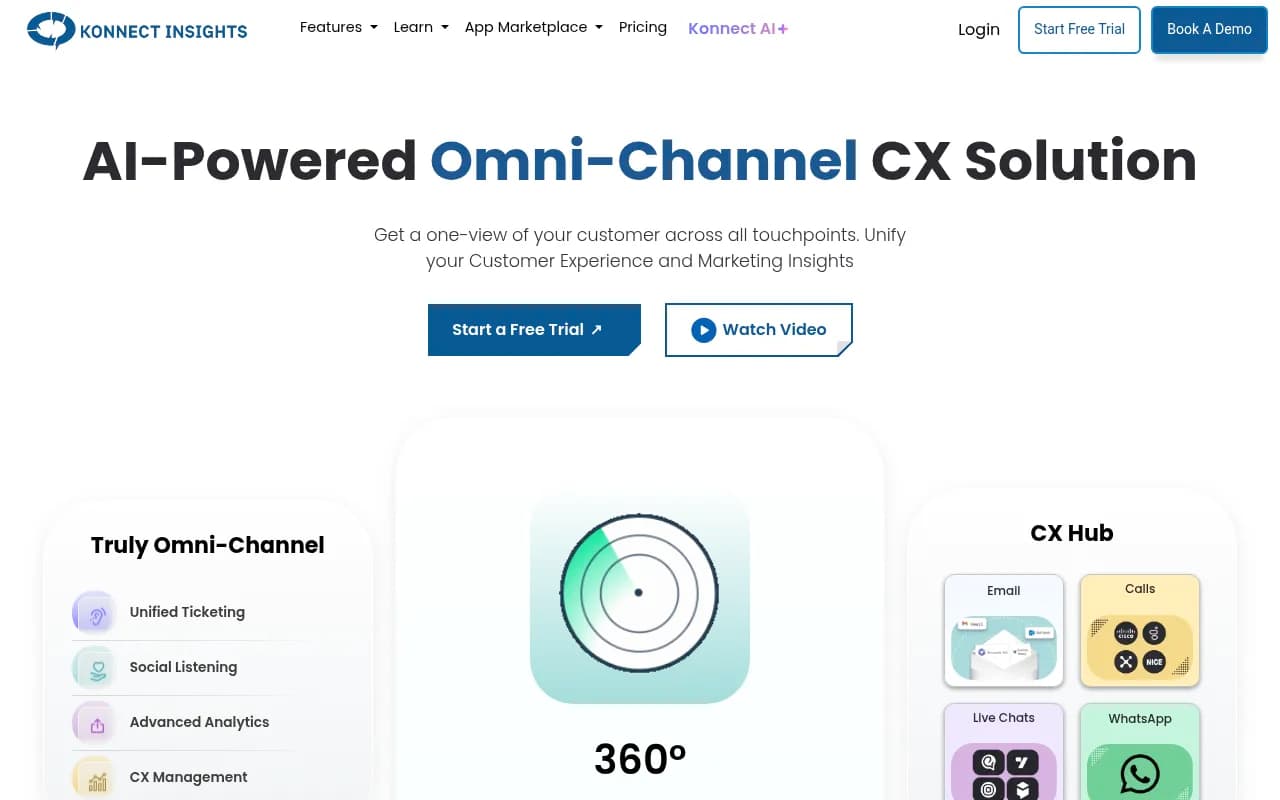
- Unified omnichannel platform combining social listening, ticketing, analytics, and CRM in one interface -- eliminates tool sprawl for CX teams
- 3x faster ticket resolution through AI-assisted replies, smart routing, unified customer profiles, and contextual summaries across all channels
- Enterprise-grade social listening with sentiment analysis, competitor benchmarking, and campaign intelligence across 190+ languages
- Steep learning curve and pricing opacity -- no public pricing, likely positioned for mid-market to enterprise budgets (₹500/mo starting price suggests Indian market focus)
- Strong integrations with Salesforce, HubSpot, MS Dynamics, Genesys, Cisco, NICE, but lacks the depth of specialized tools in individual categories
Konnect Insights is an omnichannel customer experience management (CXM) platform that consolidates social listening, ticketing, analytics, and AI-powered insights into a single interface. Founded and operated in India (Konnect Insights B.V.), the platform targets enterprise brands and agencies managing customer interactions across multiple channels -- social media (Facebook, Instagram, X/Twitter, LinkedIn), email, live chat, WhatsApp, and voice calls. The pitch is simple: instead of juggling Sprout Social for listening, Zendesk for tickets, and Tableau for analytics, you get everything in one place with a unified customer view.
The platform has gained traction with recognizable brands (visible in their client logos, though specific case studies are sparse on the public site) and positions itself as a "truly omnichannel" solution. Unlike pure-play social listening tools (Brandwatch, Talkwalker) or helpdesk-only platforms (Zendesk, Freshdesk), Konnect Insights tries to bridge both worlds. The question is whether that breadth comes at the cost of depth in any one area.
Omnichannel Ticketing & Unified Inbox
The core ticketing system aggregates messages from social DMs, comments, emails, live chat widgets, WhatsApp Business API, and voice calls into a single queue. Agents see a unified timeline for each customer -- every past interaction, regardless of channel, in one view. This "360° customer profile" links contact details across touchpoints, so an agent handling a Twitter DM can see the customer's previous email tickets, chat transcripts, and call notes without switching tools.
Smart routing assigns tickets based on keywords, sentiment, language, or custom rules. You can set up SLA-based escalations (e.g. VIP customers get priority, negative sentiment tickets route to senior agents). The system tracks first response time (FRT), average handle time (AHT), and resolution time with built-in SLA monitoring. Agents get real-time alerts when they're approaching SLA breaches.
AI-assisted replies suggest responses based on ticket content and historical resolutions. The AI analyzes the customer's message, pulls relevant knowledge base articles, and drafts a reply the agent can edit before sending. This isn't a chatbot -- it's an agent copilot that speeds up manual responses. There's also AI summarization that condenses long ticket threads into a few sentences, useful when an agent picks up a complex case mid-conversation.
Collaboration features include internal notes, ticket tagging, and approval workflows for sensitive responses. You can @mention teammates, escalate to supervisors, or loop in specialists without the customer seeing the back-and-forth. The platform supports canned responses (pre-written templates) and macros (multi-step actions like "close ticket + send CSAT survey + tag as resolved").
Compared to Zendesk or Freshdesk, Konnect Insights has tighter social media integration (native handling of Instagram comments, Facebook Messenger, X DMs) but a less mature marketplace of third-party apps. The ticketing UI feels functional but not as polished as Intercom or Help Scout.
Social Listening & Brand Monitoring
The listening module monitors brand mentions, hashtags, keywords, and competitor activity across social platforms, blogs, forums, news sites, and review sites. You define search queries (Boolean logic supported) and the platform continuously scrapes public data. Coverage includes major social networks (Facebook, Instagram, X/Twitter, LinkedIn, YouTube, TikTok, Reddit) plus web sources.
Sentiment analysis uses NLP to classify mentions as positive, negative, or neutral. You can drill down by platform, geography, language, or time period. The sentiment engine supports 190+ languages, which is a standout feature for global brands. Accuracy is decent but not perfect -- sarcasm and context-heavy posts sometimes get misclassified, a common issue across all sentiment tools.
Competitor benchmarking lets you track share of voice, sentiment trends, and engagement metrics for up to 10 competitors (exact limit depends on your plan). You see side-by-side comparisons of mention volume, audience demographics, and top-performing content. This is useful for understanding how your brand stacks up, though it's not as granular as dedicated competitive intelligence tools like Rival IQ or Socialbakers.
Influencer identification surfaces the most active and influential voices talking about your brand or industry. You get lists of top authors by reach, engagement, and follower count, along with contact details (if publicly available). This helps PR and marketing teams identify partnership opportunities or address vocal critics.
Crisis detection monitors spikes in negative mentions, trending hashtags, or sudden volume changes. You can set up alerts (email, Slack, SMS) that trigger when sentiment drops below a threshold or mention volume exceeds a baseline. The platform flags potential crises early, but you still need a human to assess severity and coordinate response.
The listening data feeds into 700+ pre-built charts and dashboards covering engagement, reach, sentiment trends, top posts, demographic breakdowns, and more. You can filter by date range, platform, geography, or custom segments. Dashboards are shareable via URL or scheduled PDF reports.
Compared to Brandwatch or Talkwalker, Konnect Insights has less sophisticated topic modeling and trend forecasting. It's strong on breadth (many channels, many languages) but weaker on depth (advanced text analytics, predictive insights). For most brands, the listening capabilities are good enough for reputation monitoring and campaign tracking, but data scientists or insights teams might find it limiting.
Analytics & Business Intelligence
The analytics layer combines social listening data, ticketing metrics, and campaign performance into unified dashboards. You can track agent performance (tickets resolved, average handle time, CSAT scores), channel performance (response rates by platform, peak volume times), and customer satisfaction (NPS, CSAT, CES surveys).
Custom dashboards are built with a drag-and-drop interface. You pick from 700+ chart types (line, bar, pie, heatmaps, word clouds, funnel charts) and arrange them however you want. Dashboards auto-refresh and can be embedded in other tools (Slack, Confluence, internal portals) via iframe.
KRC (Konnect Research Cloud) is their AI-powered query engine. You type a question in plain English ("What's our average response time on Instagram this month?" or "Show me negative sentiment trends for Product X") and it generates a chart or table. This is similar to Tableau's Ask Data or ThoughtSpot's search analytics. It works well for simple queries but struggles with complex multi-step analysis. Still, it's a nice feature for non-technical users who don't want to build dashboards manually.
QA & Evaluation tools let managers review agent interactions, score them against custom rubrics, and provide feedback. You create evaluation forms with weighted criteria (e.g. "Tone: 20%, Accuracy: 30%, Resolution: 50%") and randomly sample tickets for review. Agents see their scores and coaching notes in a dedicated feedback portal. This is standard stuff for contact center QA but useful to have built-in rather than bolted on.
The analytics are solid for operational reporting but not a replacement for a dedicated BI tool like Looker or Power BI. You can export raw data via API or CSV for deeper analysis elsewhere.
AI Features (Konnect AI+)
Konnect AI+ is their umbrella term for AI capabilities across the platform. Key features:
- Agent Empower: AI-suggested replies, ticket summaries, next-best-action recommendations, and knowledge base article suggestions. Reduces agent handle time by surfacing relevant info automatically.
- AI Essentials: Automated sentiment analysis, ticket categorization (sales, support, complaint, inquiry), priority scoring (urgent, high, medium, low), and language detection. These run in the background without agent intervention.
- KRC (Konnect Research Cloud): Natural language query interface for analytics, described above.
- Churn prediction: Flags customers showing signs of dissatisfaction (repeated complaints, negative sentiment, long resolution times) so you can intervene proactively. This is a nice idea but the accuracy depends heavily on data quality and volume.
- New sales opportunities: Identifies mentions of purchase intent ("looking for a new CRM", "anyone recommend a good hotel in Dubai?") so sales teams can jump in. This works best for B2C brands with high social volume.
The AI features are helpful but not groundbreaking. Most modern CX platforms (Intercom, Freshdesk, Zendesk) have similar capabilities. Konnect Insights' advantage is that the AI spans both listening and ticketing, so it can connect insights from social chatter to support interactions.
Publishing & Social Media Management
The platform includes basic social media publishing tools: a content calendar, post scheduling, approval workflows, and multi-account management. You can draft posts, attach media, schedule them across Facebook, Instagram, X/Twitter, LinkedIn, and YouTube, and track engagement (likes, comments, shares, reach).
Post-level analytics show which content performs best, with AI-powered suggestions for optimal posting times and content types. The approval workflow lets you route drafts through managers or legal before publishing, useful for regulated industries.
This is a nice-to-have for teams that want everything in one place, but it's not a replacement for dedicated social media management tools like Hootsuite, Sprout Social, or Buffer. The scheduling interface is functional but clunky, and you're missing advanced features like A/B testing, UTM tagging, or Instagram Stories scheduling.
Surveys & Feedback Collection
Built-in survey tools let you create CSAT, NPS, and CES surveys and distribute them via email, SMS, or embedded widgets. Surveys are mobile-friendly and support multi-language localization. You can trigger surveys automatically after ticket resolution or send them on a schedule.
Real-time feedback flows into dashboards where you can track response rates, average scores, and sentiment trends. You can segment results by customer type, product line, or support channel to identify problem areas.
This is a basic survey tool -- think Typeform Lite. It's fine for post-interaction feedback but not robust enough for complex market research. You're missing skip logic, advanced branching, or integrations with tools like Qualtrics.
Integrations & Ecosystem
Konnect Insights integrates with major CRMs (Salesforce, HubSpot, Microsoft Dynamics), CCaaS platforms (Genesys, Cisco, NICE), and marketing automation tools. The platform offers APIs, webhooks, and pre-built no-code connectors in their App Marketplace.
Integrations sync customer data bidirectionally -- tickets created in Konnect Insights can update CRM records, and CRM contact details populate in the Konnect Insights customer profile. This ensures agents always have the latest info without manual data entry.
There's also support for Slack notifications (alerts for high-priority tickets, crisis mentions), Google Search Console (for SEO data), and Zapier (for connecting to 5,000+ other apps). The API documentation is available but not publicly linked -- you need to request access from support.
Compared to Zendesk or Freshdesk, the integration ecosystem is smaller. You're missing pre-built connectors for niche tools, and custom integrations require developer effort. For most mid-market and enterprise use cases, the core integrations (CRM, CCaaS, Slack) cover the essentials.
Who Is Konnect Insights For?
Konnect Insights is built for mid-market to enterprise brands (500+ employees) managing customer experience across multiple channels. Ideal users include:
- Customer support teams at e-commerce, hospitality, telecom, or financial services companies handling high social media volume (think airlines responding to flight complaints, banks managing fraud alerts, retailers handling order inquiries)
- Marketing teams tracking brand reputation, campaign performance, and competitor activity across social and web
- Agencies managing CX for multiple clients who want a white-label solution with multi-tenant support
- Global brands needing multi-language support (190+ languages) and regional data residency (EU, US, UAE, Saudi Arabia)
The platform is overkill for small businesses or solopreneurs. If you're a 5-person startup, you don't need omnichannel ticketing, social listening, and BI dashboards -- you need a simple helpdesk like Help Scout or a social tool like Buffer. Konnect Insights makes sense when you have 10+ agents, multiple support channels, and enough social volume to justify listening tools.
Industries where it shines: Retail, hospitality, telecom, banking, travel, consumer goods -- any vertical with high customer interaction volume and a strong social media presence. It's less relevant for B2B SaaS companies with low social volume or niche industries with minimal public chatter.
Who should NOT use this: Teams that need best-in-class tools in individual categories. If you want the deepest social listening, Brandwatch or Talkwalker are better. If you want the most polished helpdesk, Zendesk or Intercom win. Konnect Insights is a jack-of-all-trades -- strong across the board but not the absolute best at any one thing.
Pricing & Value
Konnect Insights does not publish pricing on their website. Based on third-party sources (TrustRadius, G2), the starting price is around ₹500/month (roughly $6 USD), which seems suspiciously low and likely refers to a limited trial or India-specific SMB plan. Realistic enterprise pricing is probably in the $500-$2,000/month range depending on agent seats, social accounts, and data volume.
There's a free trial available (duration unspecified), but no freemium tier. You need to book a demo and get a custom quote, which is standard for enterprise CX platforms but frustrating for buyers who want transparent pricing.
Compared to competitors:
- Zendesk Suite: $55-$115/agent/month (ticketing only, no listening)
- Sprout Social: $249-$499/month (listening + publishing, no ticketing)
- Brandwatch: $1,000+/month (listening only, enterprise-focused)
- Freshdesk Omnichannel: $29-$99/agent/month (ticketing, basic social, no deep listening)
Konnect Insights likely sits in the middle -- more expensive than Freshdesk, cheaper than Brandwatch + Zendesk combined. The value proposition is consolidation: one platform, one vendor, one bill. Whether that's worth it depends on how much you value integration vs. best-of-breed tools.
Strengths
- True omnichannel consolidation -- social listening, ticketing, analytics, and publishing in one platform eliminates tool sprawl and data silos
- Unified customer view -- every interaction across channels in one timeline, so agents have full context without switching tools
- Multi-language support (190+ languages) and regional data residency make it viable for global enterprises
- AI-assisted workflows (suggested replies, ticket summaries, sentiment analysis) genuinely speed up agent productivity
- Strong social media integration -- native handling of Instagram, Facebook, X/Twitter, WhatsApp, TikTok, Reddit without third-party connectors
Limitations
- No public pricing -- you have to sit through a sales demo to get a quote, which wastes time if you're outside their target budget
- Steep learning curve -- the platform packs a lot of features, and onboarding takes weeks (they emphasize post-implementation support, which suggests complexity)
- Not best-in-class in any single category -- the listening isn't as deep as Brandwatch, the ticketing isn't as polished as Zendesk, the analytics aren't as powerful as Tableau. You trade depth for breadth.
- Limited third-party integrations compared to Zendesk or Freshdesk -- the App Marketplace is small, and custom integrations require developer effort
- UI feels dated -- functional but not as modern or intuitive as Intercom, Front, or newer CX tools
Bottom Line
Konnect Insights is a solid choice for mid-market to enterprise brands that want to consolidate social listening, omnichannel ticketing, and analytics into one platform. It's particularly strong for companies with high social media volume, global operations (multi-language, multi-region), and complex CX workflows that span multiple channels. The unified customer view and AI-assisted features genuinely improve agent productivity, and the breadth of capabilities reduces vendor sprawl.
However, it's not the right fit if you need the absolute best tool in any one category. Specialists like Brandwatch (listening), Zendesk (ticketing), or Tableau (analytics) will outperform Konnect Insights in their respective domains. The platform also suffers from pricing opacity and a steeper learning curve than simpler alternatives.
Best use case in one sentence: Enterprise customer support and marketing teams managing 10+ agents across social, email, chat, and voice who want one unified platform instead of stitching together Sprout Social, Zendesk, and Looker.
Tags:
Similar and alternative tools to Konnect Insights