Key takeaways
- Bluefish has no public pricing, and third-party estimates put enterprise contracts anywhere from $100K to $500K+ annually, a friction point when renewal time comes and budget owners want to justify the line item.
- Independent reviewers flag real product gaps: no GA4 or revenue attribution layer, domain-level (not URL-level) citation tracking, and reliance on expert-configured prompt sets rather than real user prompt volume.
- Competitors like Profound now publish self-serve pricing starting around $99/month and track more platforms with URL-level resolution, which makes Bluefish's enterprise-only model look expensive by comparison.
- The category itself is volatile: citation sources change 40-60% month over month according to Profound's own research, which raises a fair question about whether any static annual contract can keep pace.
- If you're mid-renewal, running a parallel trial on a cheaper, published-pricing tool for a full quarter is the cheapest way to find out whether Bluefish's premium modules are actually worth what you're paying.
Bluefish built a real business, but renewal conversations are different from sales conversations
Bluefish earned its reputation fast. Since launching in 2024 it has raised roughly $68 million total, including a $43 million Series B in April 2026 co-led by Threshold Ventures and NEA, with American Express Ventures, Salesforce Ventures, and Bloomberg Beta also writing checks. CB Insights named it a GEO Market Leader in October 2025. The customer list includes Adidas, American Express, LVMH, Ulta Beauty, and Tishman Speyer, and the company claims over 10% of the Fortune 500 as clients.
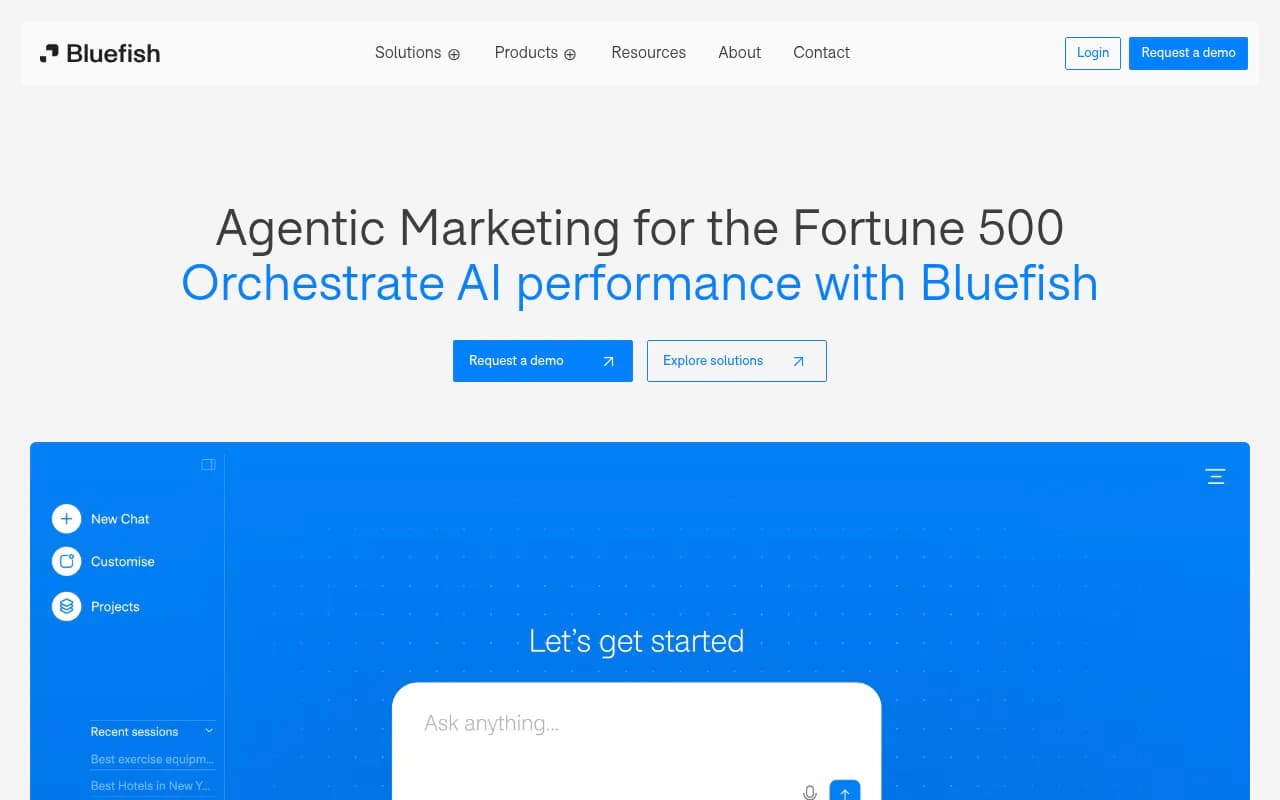
None of that is in dispute. What's changed is the conversation happening inside marketing teams right now, twelve to eighteen months into their first contracts, as renewal invoices land on someone's desk who wasn't in the original buying meeting. I've read through a stack of independent reviews and competitor comparisons published over the past few months, and a pattern shows up again and again: people who bought into Bluefish's Fortune 500 positioning are now asking whether the platform's specific gaps justify its price, especially now that cheaper, more transparent alternatives exist.
The pricing opacity problem hasn't gone away
Here's the thing that keeps coming up. Bluefish's pricing page has never listed a number. Multiple reviewers, including tryanalyze.ai and dageno.ai, confirm the only call to action on the pricing page is "Request a demo." No tiers, no ballpark, nothing.
That's normal for enterprise software at the sales stage. It's less normal, and more annoying, at renewal. By the time you're renewing, you already know what you paid last year. What you don't know is whether that number is competitive, because Bluefish still won't tell you what anyone else pays. Third-party estimates vary wildly: one reviewer cites entry tiers of $99 to $799 a month with enterprise contracts reaching five or six figures annually, while another pegs typical annual contract value at $100,000 to $500,000+ based on comparable platforms. Those numbers aren't confirmed by Bluefish itself, but the spread alone tells you something: nobody outside the sales process actually knows what they're supposed to pay.
Compare that to Profound, which now publishes a Starter tier around $99/month and a Growth tier around $399/month before its enterprise pricing kicks in at $2,000-$5,000+/month. That gives a renewal decision-maker something to benchmark against. Bluefish gives them nothing, which is exactly the kind of thing a CFO notices when they're staring at a six-figure renewal line with no comparable on record.
| Platform | Public pricing | Citation tracking granularity | Real prompt data | Platform coverage breadth |
|---|---|---|---|---|
| Bluefish AI | None (quote-only) | Domain-level | Expert-configured prompt sets | Historically narrower, coverage details unclear |
| Profound | Yes, from ~$99/mo | URL-level | 1.5B+ real prompts, growing ~150M/month | ChatGPT, Perplexity, Gemini, AI Overviews, AI Mode, Copilot, Claude, Grok, Meta AI, DeepSeek |
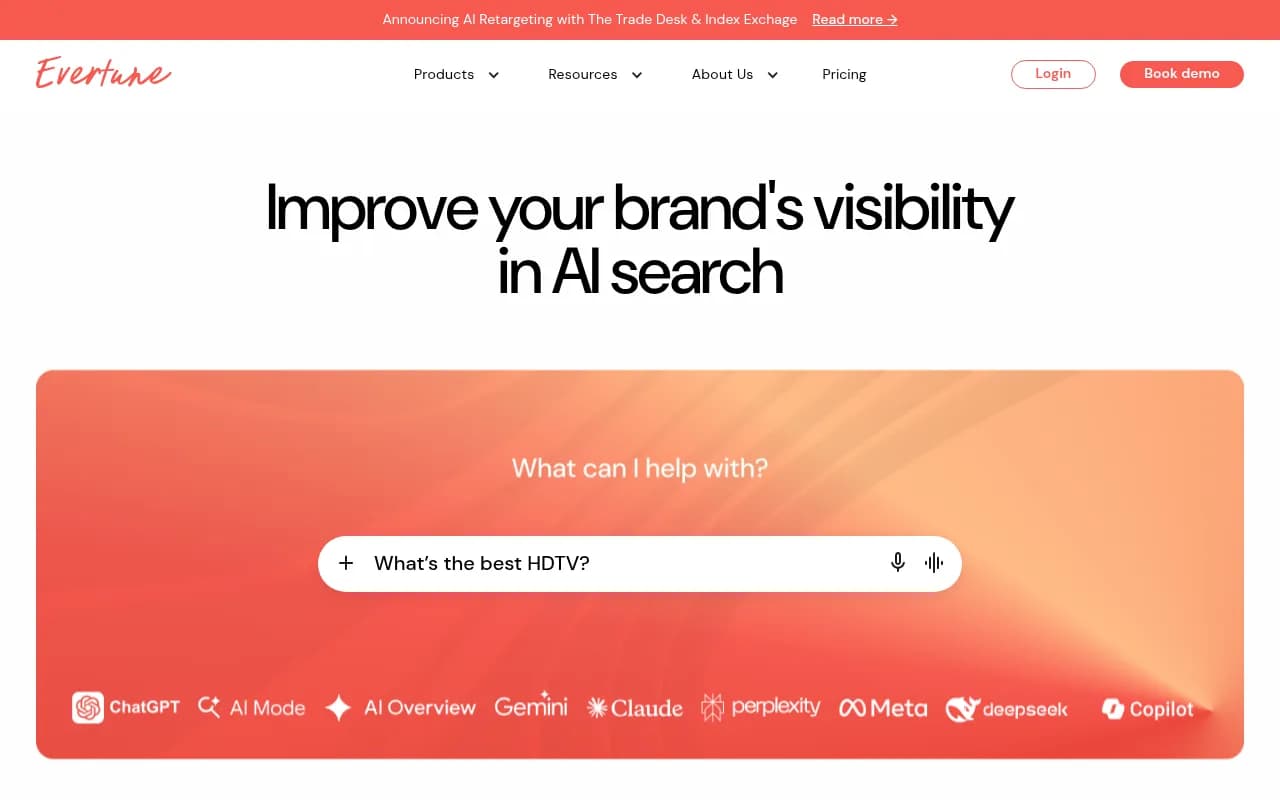
| Evertune | Quote-only | URL-level via EverPanel | Consumer panel, tens of millions of real users | Direct API access to major base models |
| Menra | $69/mo | Monitoring core | Credit-based, self-serve | Limited but transparent |
| Promptwatch | From $95/mo (Essential) | Page-level with crawler-to-citation path | Prompt volumes, difficulty scores, fan-outs | ChatGPT, Gemini, Claude, Perplexity, Grok, Llama, DeepSeek, Mistral, Copilot, AI Overviews, AI Mode |
The product gaps that only show up after you've lived with it for a year
The first few months with any monitoring platform are exciting. You see visibility scores, you see where you show up, you feel like you finally have eyes on the AI search black box. The problems tend to surface later, once a team has actually tried to use the data to make a decision and hit a wall.
Three specific gaps show up repeatedly in independent reviews:
No attribution layer. Bluefish doesn't connect to GA4 or any revenue/conversion pipeline. You can see that your brand showed up favorably in an AI response, but you can't trace that response to a session, a lead, or a sale. For a Fortune 500 brand with a dedicated brand team, that might be tolerable if visibility itself is the KPI. For most marketing teams accountable to a CFO, it's a real problem come budget season.
Domain-level, not URL-level, citation tracking. Bluefish tells you which third-party domains carry influence in your category. It doesn't tell you which specific page on your own site is actually earning citations. That distinction matters enormously if you're trying to decide where to invest content resources. Knowing "Wikipedia matters in your category" is interesting. Knowing "this specific product page on your site gets cited and this one doesn't" is actionable.
Simulated prompt sets instead of real user data. Bluefish's audience analytics run on expert-configured prompt sets mapped to personas, not a live feed of what real people are actually typing into ChatGPT or Gemini. That's a reasonable design choice for structured brand-safety audits, but it limits how confidently you can prioritize content work based on actual demand.
Worth noting too: G2 has no verified review profile for Bluefish AI specifically, the "Bluefish" listing that turns up is an unrelated legacy text editor with 4.1 stars and 51 reviews. If you're trying to sanity-check the product through peer reviews before a renewal decision, that avenue is currently a dead end.
The category itself makes static contracts a hard sell
There's a structural reason renewal conversations are getting harder across the entire GEO category, not just for Bluefish. AI citation behavior moves fast. Profound's own research found that 40-60% of cited domains change month to month across major platforms, Google AI Overviews at 59.3%, ChatGPT at 54.1%, Microsoft Copilot at 53.4%, and that drift can reach 70-90% over six months.
On top of that, the citation slots themselves aren't stable. Promptwatch's data shows average sources cited per ChatGPT response fell from roughly 6.4 to 4.7-4.9 in the weeks after the GPT-5.3 rollout on March 4, 2026, a roughly 27% drop that held for a month with no recovery. That's not something any vendor controls, and it's a reminder that a snapshot from your onboarding demo eighteen months ago tells you almost nothing about today.
If you want to see this volatility yourself, Promptwatch's average sources per response data breaks it down by engine, and it's a useful gut check before you sign anything for another twelve months.

The budget conversation makes this worse. Per a Scribewise survey of 205 marketing executives, 55% now have GEO budget allocated and 70% of those spend 11-20% of total search/marketing budget on it. But experts quoted by Digiday describe GEO ROI as still murky, PMG's Matt Allfrey put it plainly: the category "lacks a clear output or clear ROI." That's the exact environment where a renewal with no public pricing and no revenue attribution becomes very hard to defend in a budget review.
AI Accuracy is a real feature, but it doesn't fix the core complaints
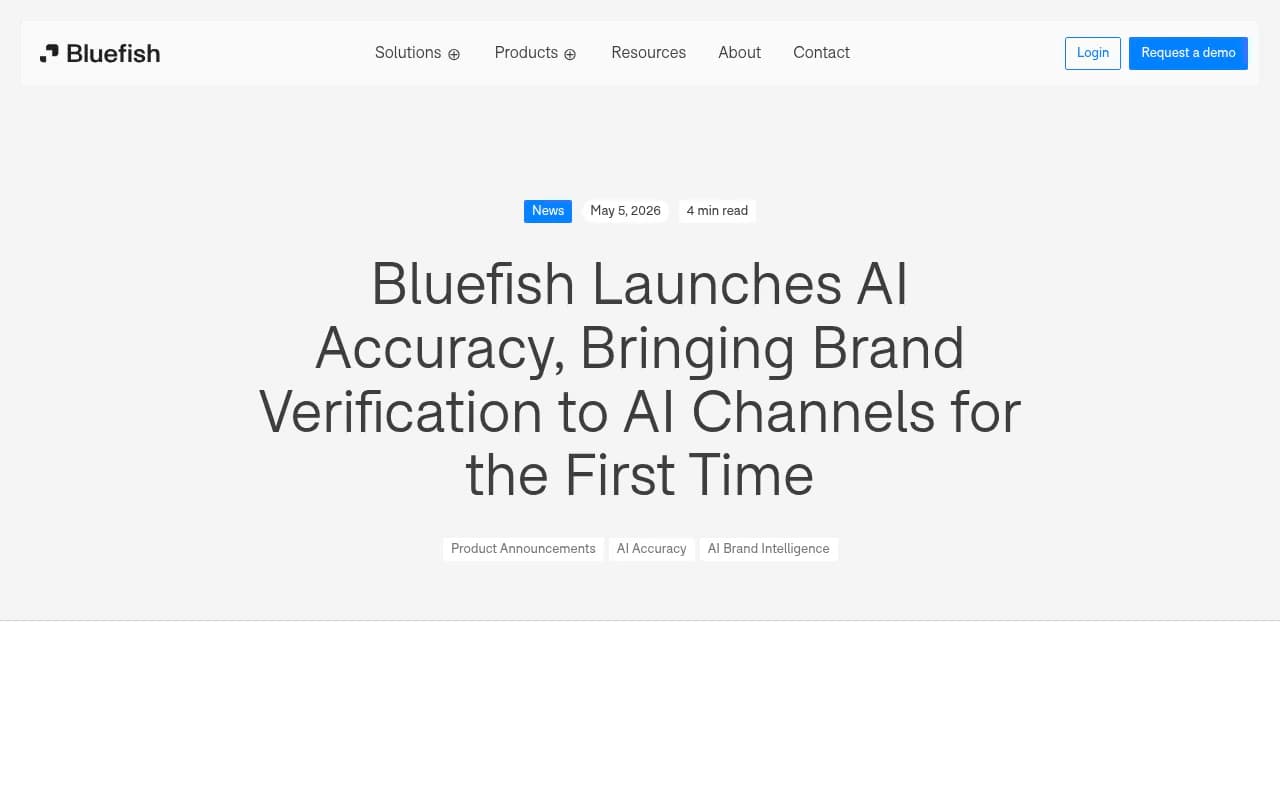
To be fair, Bluefish isn't standing still. In May 2026 it launched AI Accuracy, built around a "Brand Vault" that ingests first-party content to create a verified source of truth for LLMs. The pitch is grounded in a real problem: a March 2026 Rithum survey of over 1,000 US and UK shoppers found 58% say their trust in a brand drops when AI gets product information wrong, and 16% abandon the purchase entirely. Bluefish co-founder Jing Feng made the point directly: "when AI gets facts about a brand wrong, consumers don't blame AI, they blame the brand."
That's a genuinely useful addition to the product, and it addresses a problem that's easy to underweight until it costs you a sale. But it's a fifth module layered onto a platform whose core complaints, pricing opacity, no attribution, domain-level citation tracking, haven't been addressed. Adding a new capability doesn't retroactively fix the reasons a renewal is getting a second look.
What to actually do before you sign again
A few reviewers, Menra among them, make a specific recommendation worth repeating: run a parallel trial on a cheaper, published-pricing tool for a full quarter before committing to another year of an enterprise contract. Menra costs $69/month and covers roughly 1-2% of a typical enterprise contract for the monitoring core alone. Even if you end up staying with Bluefish, that trial gives you a real benchmark instead of a sales deck.
A practical renewal checklist:
- Ask procurement to get last year's actual invoice next to this year's quote, in writing, before the sales call.
- Request URL-level citation data specifically and see whether Bluefish can provide it or whether it's staying domain-level.
- Ask how audience/persona prompt sets are built and how often they're refreshed against real query behavior.
- Pull your own GA4 or analytics data for the same period and see if you can find any correlation with the visibility scores you were shown, since Bluefish won't do that connection for you.
- Price out at least one alternative with public pricing, even if you don't switch, just so the renewal number has a comparison point.
If what you actually need is a platform that closes the loop between monitoring and action, crawler logs showing exactly when AI bots hit your pages, content generation that publishes straight to your CMS, and a prioritized action list instead of a dashboard you have to interpret yourself, that's worth putting on the shortlist next to Bluefish and Profound. It's the kind of stack most monitoring-only tools, Bluefish included, simply don't build.
For teams that want a broader look at what else is out there before the renewal deadline, the GEO software directory at bestgeosoftware.com is a reasonable place to compare options side by side rather than relying on vendor sales decks alone.