Key takeaways
- Finseo has moved to published, self-serve pricing (Starter €84/mo, Business €210/mo, Growth €479/mo), correcting its old demo-only reputation, but Enterprise is still quote-based
- Its competitor benchmarking (share of voice, citation share, top-3 share, mention depth) is one of the more detailed feature sets in the category
- The biggest catch: paid plans below Enterprise only track 3 AI models concurrently, even though the platform supports 11+
- Its 5.0/5 G2 rating rests on just 3 reviews, and one of those flags mobile UI bugs, so treat the score with caution
- Teams that need broader model coverage, deeper crawler analytics, or a stronger content-to-publish loop tend to end up comparing Finseo against platforms like Profound, LLM Pulse, or Promptwatch
Where Finseo actually delivers
Finseo GmbH is a bootstrapped, profitable German company founded in 2025 by David Mühlenweg and Maurice Marinelli, and it has built something more substantial than a me-too prompt tracker. Before writing this off as just another AI visibility tool riding the GEO wave, it's worth being specific about what it does well, because the strengths are real.
Competitor benchmarking is genuinely detailed
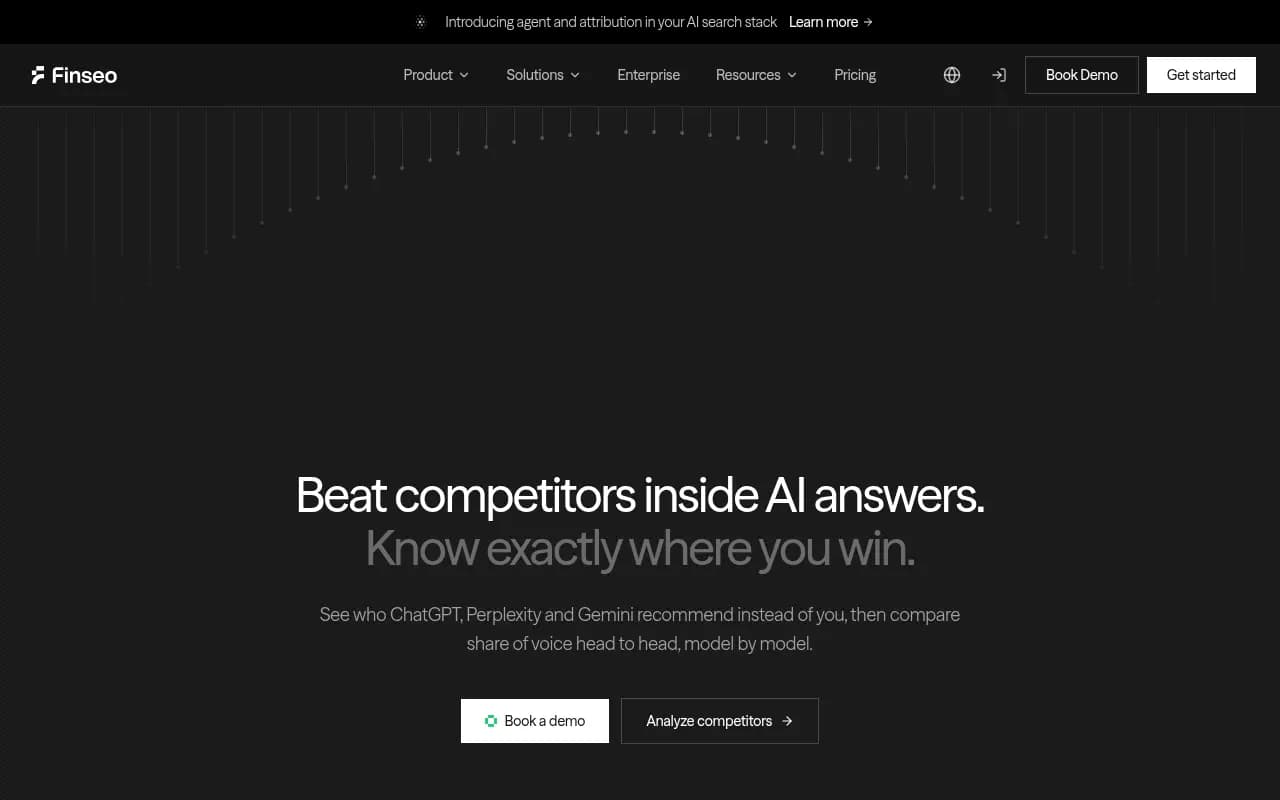
Finseo's AI Competitor Analysis module tracks share of voice, citation share, top-3 share, mention depth, and average position, broken down per prompt, per model. It shows head-to-head results against named competitors model by model (you might be winning on Perplexity and Claude while losing on ChatGPT and Gemini to the same rival), and it maps which prompt clusters a competitor is winning and which source is driving that win. That last part, connecting a competitor's win on "best-of" prompts to the fact that Wikipedia is their top-cited source, is the kind of diagnostic detail a lot of trackers skip.
Model breadth on paper is unmatched
Finseo's tracker list runs to 20+ surfaces: ChatGPT, Gemini, Google AI Overviews, Google AI Mode, Claude, Perplexity, Microsoft Copilot, Grok, DeepSeek, Mistral, Meta AI, and a genuinely unusual set of regional engines like Qwen, Kimi, Yuanbao, Naver AI Briefing, Solar, and Sabiá. If your brand sells into China, Korea, or Brazil, that regional coverage is not something most Western AI visibility platforms bother building.
Real customers, real case studies
Kellogg's, Lidl, Würth, Panasonic, Raiffeisen, Jägermeister, and Trustpilot are named customers, not just logos on a slide. Finseo also publishes specific outcome numbers: HolzLand gained 53.4 percentage points of AI visibility, Laserhub gained 26.7, and Plantura gained 11.1. Published, attributable numbers like that are worth more than a generic "trusted by hundreds of brands" claim.
The pricing story has genuinely improved
An older, widely repeated criticism of Finseo was that every plan required booking a demo, with zero public pricing. That's no longer accurate. Finseo now lists four self-serve brand plans (Starter, Business, Growth, and Enterprise) plus published agency tiers (Solo, Studio, Custom), with only Enterprise and the managed-service option still gated behind a sales conversation. Agencies get volume discounts on additional client projects and a 14-day free pitch-project allowance. If you were avoiding Finseo purely because of opaque pricing, that objection is mostly out of date.
EU data residency and enterprise-grade contracting
Data is hosted in Frankfurt with GDPR-native handling, and Finseo offers invoice billing, a German AVV (data processing agreement), and SLAs even outside the Enterprise tier. For regulated European buyers, that's not a small thing, and it's a detail a lot of US-based competitors can't match as easily.
The 5 gaps that send teams looking elsewhere
None of the above means Finseo is the obvious pick for every team. Here are the five specific reasons buyers keep comparing it against alternatives.
1. The model coverage is narrower than the marketing page suggests
This is the big one. Finseo's Starter, Business, and Growth plans, the three tiers most teams will actually buy, only let you track 3 models concurrently. You pick any 3 from the full list (ChatGPT, Gemini, Google AI Overviews, Google AI Mode, Claude, Perplexity, Copilot, Grok, DeepSeek, Mistral), and the rest go untracked unless you upgrade to the custom-quoted Enterprise tier, which unlocks up to 11 models at once. Regional engines like Naver, Qwen, and Kimi are separate add-ons on top of that.
This matters more than it sounds like on the surface, because AI engines don't behave the same way. Promptwatch's own citation research shows ChatGPT typically cites around 5 sources per web-search response, Google AI Overviews cites close to double that at around 10, and Perplexity sits consistently near 10 as well, per Promptwatch's average sources per response data. If you're only watching 3 of those surfaces, you're blind to citation dynamics on the other 6 to 8 Finseo claims to support. A brand that's losing ground in Google AI Overviews while a team is watching ChatGPT, Claude, and Perplexity would never know.
2. The 5.0/5 G2 rating is built on 3 reviews
Finseo advertises a 4.9/5 on OMR and a 5.0/5 on G2. Those numbers are real, but G2 itself displays a caveat: "There are not enough reviews of Finseo.ai for G2 to provide buying insight." The actual review count is three. One of those three flags a specific problem: "There are bugs and the interface isn't working well on my phone because it's far to the right." A perfect score built on three data points, one of which complains about bugs, isn't the kind of social proof that should carry much weight in a buying decision. A third-party summary from CheckThat.ai echoes this, noting "stability issues and technical problems typical of early-stage SaaS products."
3. Pricing complexity creeps in fast, especially for agencies
The headline plans look reasonable, but the details stack up. Agency plans carry a six-month minimum term. Overage on AI answers runs at €0.015 per answer past the included allowance. The "Agent" feature (Finseo's AI content and audit assistant) is credit-based, so heavier usage of the automation features costs more on top of the subscription. None of this is unusual for the category, but it's a step away from the simple, flat self-serve pricing some competitors offer, and it means the number on the pricing page isn't always the number on the invoice.
4. Known, self-disclosed data limitations
Finseo's own documentation is refreshingly honest about two limitations: its models read HTML only, meaning JavaScript-rendered or paywalled content is invisible to the crawl, and AI answers are probabilistic, so the same prompt can surface different brands run to run. Finseo compensates by tracking trends over time rather than single snapshots, which is the right approach, but it's worth knowing this isn't unique to Finseo and isn't fully solved by any platform in the category yet.
5. The action loop stops short of full content publishing
Finseo's Agent feature can generate content and run audits, and Business-tier customers get access to "Tasks" and bot traffic analytics. But compared to platforms built around a full agentic loop, tracking, diagnosing why you're not cited, generating a fix, and publishing it directly to your CMS on a schedule, Finseo's content tooling is closer to an assistant than an automated pipeline. If your team wants a platform that plans, writes, and pushes GEO-optimized articles straight into Webflow, Framer, or WordPress without a human copying and pasting, you'll likely need to pair Finseo with something else, or look at a platform built around that workflow from the start.
How Finseo compares to the alternatives
| Platform | Entry pricing | Models tracked concurrently | Content automation | Notable strength |
|---|---|---|---|---|
| Finseo | €84/mo (Starter) | 3 (paid tiers below Enterprise) | Credit-based AI Agent | Competitor benchmarking, regional model coverage |
| Profound | Custom quote (no self-serve mid-tier) | Up to 9 on Enterprise | Limited | Agent Analytics, ChatGPT Shopping tracking |
| LLM Pulse | €49/mo | 5 default models included | GEO Writer, query fan-out | Transparent pricing, Looker Studio template |
| Promptwatch | $95/mo (Essential) | All major models on every paid plan | Content Agents with CMS publishing | Full crawler logs, Reddit/YouTube citation tracking, Unified Actions |

For teams whose real problem is "we need to see why we're invisible and then actually fix it," the gap between monitoring and action is the thing worth paying attention to. Promptwatch leans hardest into that gap: its Content Agents plan, write, and publish GEO-optimized articles directly to Webflow, Framer, or WordPress on a schedule, its Agent Analytics shows exactly which AI crawlers hit your pages and what they read (something Finseo's bot traffic analytics touches on but doesn't match in depth), and it tracks Reddit and YouTube citations specifically, two channels Promptwatch's own research shows are shifting fast (reddit.com's share of ChatGPT Search citations dropped from roughly 4% to 0.5% in mid-August 2026). Promptwatch also runs against real UI data across ChatGPT, Gemini, Claude, Perplexity, Grok, and Google's AI surfaces rather than API-only sampling, and its Unified Actions feature turns all of that into a prioritized to-do list rather than just a dashboard to stare at.
If you're leaning toward LLM Pulse
LLM Pulse is the more direct like-for-like alternative if price transparency and self-serve signup are your main frustration with Finseo. It starts at €49/month for 50 prompts across five default AI surfaces (ChatGPT, Perplexity, Gemini, Google AI Mode, and Google AI Overviews), with citations, share of voice, exports, MCP, and unlimited team seats included from the first tier. It doesn't try to match Finseo's regional model coverage (no Qwen, Kimi, or Naver tracking), but if your footprint is mostly Western markets, that tradeoff may not matter.
If you're leaning toward Profound
Profound is the enterprise-grade option, with Agent Analytics for crawler behavior and ChatGPT Shopping tracking, but it currently has no published mid-tier plan. You go from a 7-day free trial straight to a custom Enterprise quote, which recreates the exact pricing-opacity problem teams were trying to escape from Finseo in the first place.
Who should actually stick with Finseo
Finseo makes the most sense for European brands and agencies that value GDPR-native data residency and invoice billing, teams that specifically need competitor share-of-voice depth with per-prompt source attribution, and brands with real exposure to Chinese, Korean, or Brazilian AI engines where Finseo's regional coverage has no real equivalent among Western competitors. If none of those apply, and your priority is either full model breadth on every paid tier or a tighter loop from citation gap to published fix, it's worth running a side-by-side trial before committing to a contract.
For a broader look at where the category is heading, the GEO software directory at bestgeosoftware.com tracks a wider set of platforms worth comparing against your specific requirements.