Key takeaways
- In 9,434 ChatGPT answers to home-services questions (Aug 31 to Sep 20, 2026), Expertise.com was cited in 32.1% and Angi or HomeAdvisor in 29.4%. Yelp was cited in 0.6%.
- 84% of ChatGPT answers that cited anything cited at least one directory, review platform or "best of" list. Google AI Mode behaves very differently: it cites Google's own pages in 95.5% of answers.
- Review sites are a small slice of ChatGPT citations overall, but they matter more when someone is asking for a recommendation or naming a company.
- Where reviews are written (Facebook and Yelp lead on Bing Places) is not the same as what ChatGPT cites. Do not treat them as one thing.
- The practical plan: get listed on the directories ChatGPT actually cites in your category and country, keep your own site crawlable, and measure the result.
Why this question is harder than it looks
Most advice about ChatGPT and local businesses boils down to "get more Yelp reviews." The data says that is, at best, incomplete. Yelp barely shows up as a cited source in ChatGPT's answers, while sites most owners have never heard of show up constantly.
A quick caveat before the numbers. Almost all of the local-specific figures below come from third-party research, mainly the Cheers Market Baseline and a study by Insites. They cover home services in the US and Canada, so a restaurant, dentist or hotel may look different. Treat the numbers as a strong signal for service businesses and a rougher guide elsewhere.
The core finding: ChatGPT is a directory engine
Cheers asked 32 home-services questions weekly across 100 US and Canadian metros. Between August 31 and September 20, 2026, that produced 9,434 usable ChatGPT answers. Here is how often each source was cited.
| Source | Share of ChatGPT answers citing it |
|---|---|
| Business websites (any) | 44.2% |
| Expertise.com | 32.1% |
| Angi or HomeAdvisor | 29.4% |
| HomeStars (Canada only) | 16% |
| BBB | 14.5% |
| 4.9% | |
| Yelp | 0.6% (52 of 9,434) |
| Google's own pages | 0.1% |
| Online booking pages | 0.0% |
Two more numbers frame the picture. A long tail of other directories and list sites (Three Best Rated, Best Pick Reports, HomeGuide, Yellow Pages and dozens of smaller ones) appeared in 59.9% of answers. And "best of" list pages, the format that ranks local companies, showed up in 64.2% of answers that cited anything.
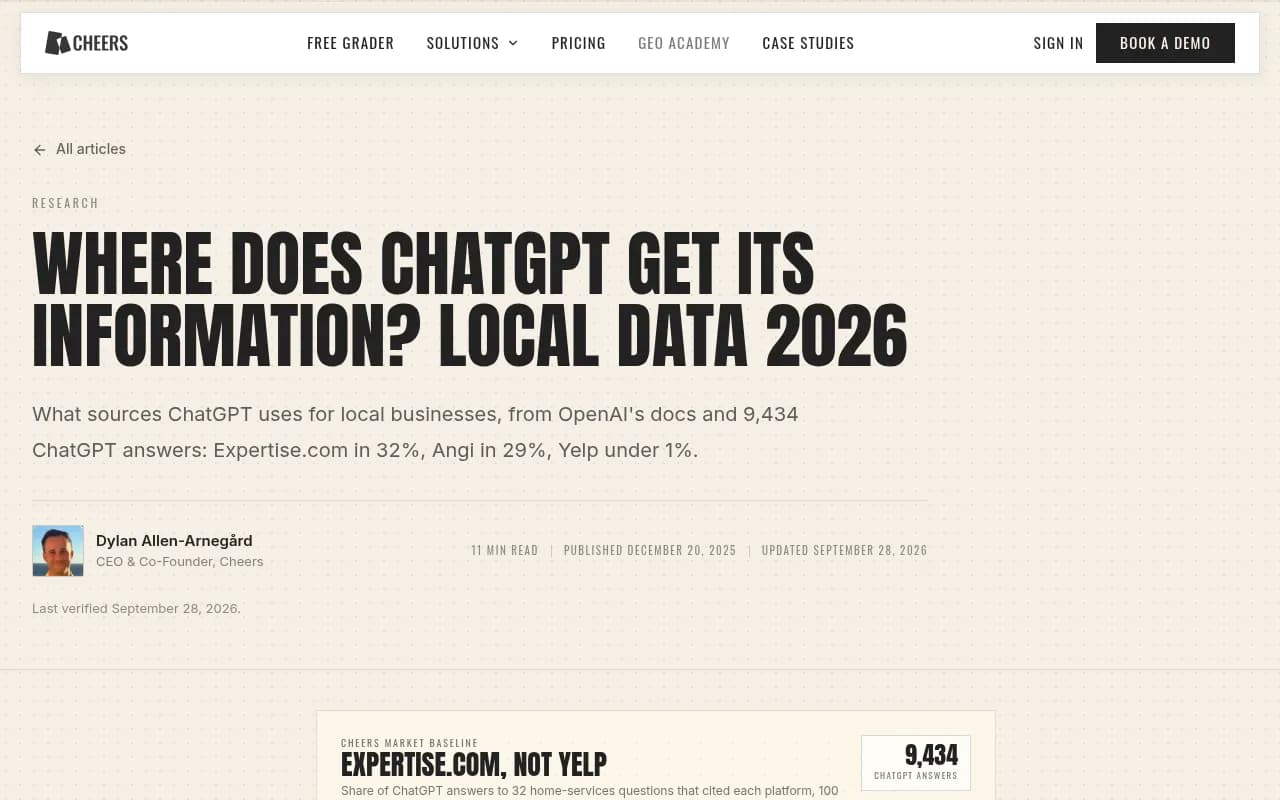
That is the headline: for home services, ChatGPT leans on third-party ranking and directory sites far more than on the review giants. If you run a roofing company, your own site was cited in only 17.8% of 600 roofing answers, while Expertise.com was cited in 40.0%. Plumbing was friendlier to owners: 53.7% of plumbing answers cited a plumber's own site.
What about the Yelp paradox?
There is a wrinkle worth knowing. Yelp is almost never cited as a source link, yet in a separate five-day capture (September 18 to 22, 2026), 34% of the rated business cards on ChatGPT's map linked to a Yelp business page. Cheers also found that those Yelp-linked cards averaged 4.3 stars against 4.9 on Google AI Mode for the same businesses in the same city.
So Yelp may feed the map-style cards even when it is missing from the citation list. I would not write Yelp off. I would just stop assuming it is the main thing driving what ChatGPT writes in its answer text.
Country matters
The mix shifts by market. HomeStars appears only in Canadian answers, where it hit 16%. BBB was cited in 21.5% of Canadian answers against 9.8% of US ones, more than twice as often. If you operate in Canada, the BBB and HomeStars deserve real attention. In the US, Expertise.com and Angi or HomeAdvisor are the bigger levers.
What your own website contributes
Own sites still matter. Insites logged sources across thousands of AI responses for local businesses and found the business's own website was the single most-cited source: 72.3% of awareness and reputation queries and 50.7% of recommendation queries.
In the Cheers data, when ChatGPT cited a contractor's site, the page types looked like this:
| Page type cited | Share |
|---|---|
| Homepage | 37.4% |
| Service page | 24.1% |
| Service plus city page | 17.4% |
| Location page | 10.7% |
| Blog post | 1.2% |
Blog posts barely register for local questions. If your content plan is mostly blog articles, that is worth rethinking. Homepages and service pages do the work.
Recommendation queries shift the mix
The Insites breakdown is useful because it separates "tell me about this business" from "who should I hire."
| Citation type | Awareness / reputation queries | Recommendation queries |
|---|---|---|
| Own website | 72.3% | 50.7% |
| Directory / listings | 38.85% | 35.25% |
| Trades sites | 10.07% | 23.02% |
| Review sites | 1.8% | 11.51% |
| Government portals | 0% | 2.88% |
| News sites | 0.72% | 3.6% |
| Social media | 0.72% | 2.16% |
When someone asks for a recommendation, reliance on your own site drops, while review sites jump from 1.8% to 11.51% and trade-specific sites from 10.07% to 23.02%. Reviews are not irrelevant. They matter at the moment of choice.
Promptwatch's all-industry data tells a similar story. In Promptwatch Data's content-type report (Sep 28 to Oct 4, 2026), reviews were only 1.7% of ChatGPT citations across all prompts, but 5.6% for branded prompts, more than three times higher. That report is not local-specific, so read it as direction rather than a local benchmark.
Four engines, four source lists
The single most useful table in the Cheers data compares engines. Optimizing for "AI search" as one thing will mislead you.
| Source | ChatGPT | Google AI Mode | Perplexity | Gemini* |
|---|---|---|---|---|
| Business websites | 44.2% | 92.5% | 89.0% | 88.3% |
| Google's own pages | 0.1% | 95.5% | 1.1% | 0.2% |
| Expertise.com | 32.1% | 0.2% | 30.9% | 6.0% |
| BBB | 14.5% | 1.7% | 31.0% | 8.4% |
| Yelp | 0.6% | 19.7% | 13.9% | 0.0% |
| 4.9% | 9.1% | 10.8% | 1.2% | |
| Online booking pages | 0.0% | 31.2% | 0.2% | 0.0% |
*Gemini figures cover only the 4,141 answers where citations were captured, so read them cautiously.
Sample sizes were 9,434 answers for ChatGPT, 9,435 for AI Mode and 6,509 for Perplexity.
A few takeaways:
- ChatGPT is the directory engine. It almost never cites Google, Yelp or booking pages.
- Google AI Mode is the opposite. It cites Google's own pages almost every time, links booking pages in 31.2% of answers and Yelp in 19.7%. Only 38.3% of its cited answers included any directory, review platform or list, against 84.2% for ChatGPT.
- Perplexity cites everything at once: business websites, long-tail directories (81.7%), BBB, Expertise.com and Angi or HomeAdvisor each around 30%.
- Gemini leans on business websites and a long tail of directories.
If you want to test the Perplexity side yourself, Perplexity is free to try with local queries.
Perplexity
For AI Mode, your Google Business Profile and booking links are the obvious levers. For ChatGPT, they are not.
What about Reddit and social?
In the Cheers data, Reddit appeared in 4.9% of ChatGPT's local home-services answers. But that was measured as a share of answers, and the picture has moved. According to Promptwatch's data on Reddit citations in ChatGPT, reddit.com's share of ChatGPT citations fell from about 4% to 0.5% on August 14, 2026.
The follow-up social media citations report (Sep 28 to Oct 4, 2026) found all seven tracked social platforms together made up 0.46% of ChatGPT citations, versus 12.2% for Google AI Overviews. For ChatGPT, LinkedIn was the top social platform at 0.3%. For AI Overviews, YouTube (4.28%) and Facebook (2.38%) mattered more.
Practical read: a Reddit campaign is a weak bet for ChatGPT visibility right now. Facebook and Instagram presence helps more for Google's AI surfaces.
Where reviews are written is not what gets cited
Whitespark studied 17 local categories across 9 US cities (153 queries) and looked at which review platforms appeared on the first page of Bing Places results. Facebook beat Yelp as the dominant review source in every city except Los Angeles. For plumbers, Facebook (37) edged Yelp (36), with Porch third (13). For yoga studios, Yelp (63) led Facebook (41).
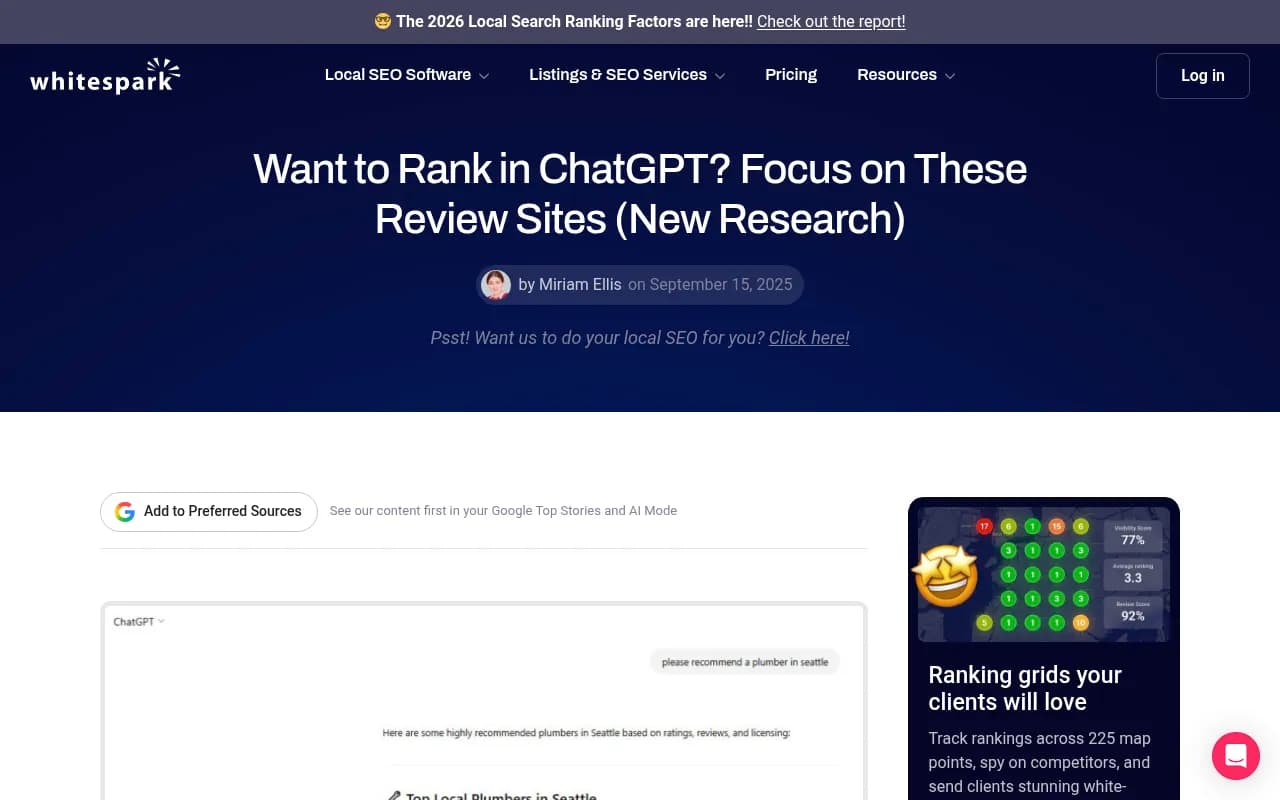
This is a different measurement. Whitespark shows where reviews live on Bing Places listings. Cheers shows what ChatGPT cites in its answers. Together they suggest two layers: Bing-fed listing data on one side, and directory or list pages cited in the answer text on the other. Visible Owl notes that OpenAI does not publish where ChatGPT gets its listings and that outside research points to Bing Places, Yelp and the BBB, which it frames as an educated guess.
Diversifying reviews across Google, Facebook, Yelp and a category-specific site covers both layers without much extra cost.
A practical plan for local businesses
1. Find out which directories ChatGPT cites in your category
Do not copy the home-services list blindly. Run 20 to 30 real customer questions in ChatGPT for your service and city and note every cited domain. For roofing it was Expertise.com. For a dental practice or a boutique hotel, the list will differ. Promptwatch's travel data (Sep 28 to Oct 4, 2026) shows how category-specific this gets: Skyscanner, Going and Tripadvisor lead ChatGPT travel citations, and booking and search sites outearn review sites.
2. Claim and complete the directory profiles that show up
In the US home-services case that means Expertise.com, Angi or HomeAdvisor and the BBB. In Canada add HomeStars. Make sure name, address, phone, services and service area match your website exactly. Also check the "best of" list sites in your metro. Being on those lists is how many businesses get named at all, since 64.2% of citing answers included one.
3. Make your homepage and service pages do the heavy lifting
With homepages and service pages making up most cited contractor pages, give each core service its own page and add city-specific pages where you genuinely serve that area. Cheers has a separate analysis of 74,969 AI citations to contractor sites, finding 43% went to homepages and 48% to service and location pages, but only 1.5% to blogs.
4. Spread reviews across platforms
Keep Google as your main source, but collect reviews on one or two other platforms your category uses, and reply to every one. Visible Owl's guidance points to a steady flow of new reviews that name the job and the town.
5. Check crawl access
If AI crawlers are blocked or your pages throw errors, none of this matters. A crawler or log inspector can confirm that bots reach your key pages.
6. Track it over time
Citation patterns shift. Reddit's collapse in ChatGPT happened in a single day. A one-time audit goes stale quickly, so re-run your question set monthly.
Tools that help
For review and listing management at scale, the usual names are BrightLocal, Birdeye, Yext and Synup.
These manage listings and reviews but do not tell you what ChatGPT cites. For that you need AI visibility tracking. Tools like Promptwatch can show which pages and third-party sources AI engines cite for your prompts, and whether your pages get crawled by AI bots.

Smaller options built with local businesses in mind include Tibly, and general trackers like Otterly.AI exist if you only want basic monitoring.


For a wider list of options, the GEO software directory at bestgeosoftware.com is a decent starting point.
| Need | Type of tool | Examples |
|---|---|---|
| Keep listings consistent | Listings management | Yext, Synup, Moz Local |
| Collect and answer reviews | Reputation management | Birdeye, NiceJob, Reputation.com |
| Track local rankings and citations | Local SEO | BrightLocal |
| See what AI engines cite | AI visibility | Promptwatch, Otterly.AI |
What this data cannot tell you
Three honest limits. First, the main dataset is home services in the US and Canada, so it is not a universal answer for every local niche. Second, the figures change month to month; Cheers last verified its numbers on September 28, 2026, and ChatGPT's search behavior has shifted before. Third, Promptwatch has no local-specific report on Yelp, Angi or BBB, so the local numbers here are third-party and should be labeled that way when you share them.
The short version
For local service businesses in the US and Canada, ChatGPT mostly cites directories and "best of" lists, with Expertise.com and Angi or HomeAdvisor far ahead of Yelp. Google's AI Mode cites Google. Perplexity cites nearly everything. So start by checking what each engine actually cites for your service and city, then fix those specific profiles and pages first.
If you want outside help with the broader strategy, agencies such as 1001 SEO Media work on exactly this blend of local SEO and AI search visibility.