Summary
- AI visibility tracking measures how often your brand appears in AI-generated answers across ChatGPT, Perplexity, Google AI Overviews, Claude, and other answer engines -- a critical metric as more searches happen without clicks
- Traffic attribution connects AI visibility to real business outcomes by tracking which AI citations drive website visits, conversions, and revenue, closing the loop between monitoring and ROI
- Promptwatch leads the category with end-to-end optimization: Answer Gap Analysis shows missing content, AI writing agents generate citation-worthy articles, and traffic attribution proves which pages convert AI visitors into customers
- Most competitors are monitoring-only dashboards that show you data but leave you stuck -- Profound, Scrunch, and Semrush track visibility well but lack content generation and deep attribution
- The best platforms combine three capabilities: comprehensive AI engine coverage (10+ models), actionable content recommendations (not just scores), and attribution that connects citations to revenue
What is AI visibility and why does traffic attribution matter?
AI visibility measures how often your brand, products, or content appear in responses from AI search engines like ChatGPT, Perplexity, Google AI Overviews, Claude, Gemini, and others. Unlike traditional SEO where you track rankings on a search results page, AI visibility is about being cited, recommended, or mentioned inside the answer itself.
The shift matters because user behavior is changing. When someone asks ChatGPT "best project management tools for remote teams," they get a curated list with explanations -- not 10 blue links. If your brand isn't in that answer, you're invisible. Even if you rank #1 on Google for the same query.
But visibility alone doesn't pay the bills. You need to know: are these AI citations driving traffic? Are visitors from AI search converting? What's the ROI of optimizing for answer engines?
That's where traffic attribution comes in. The best AI visibility platforms don't just show you a score or a citation count -- they track which AI-generated answers led to website visits, which pages those visitors landed on, and whether they converted into leads or customers. Without attribution, you're optimizing blind.
The action loop: find gaps, create content, track results
Most AI visibility tools stop at monitoring. They show you a dashboard with scores, citations, and competitor comparisons. Then they leave you to figure out what to do next.
The best platforms -- led by Promptwatch -- close the loop with an action-oriented workflow:

- Find the gaps: Answer Gap Analysis shows exactly which prompts competitors are visible for but you're not. You see the specific content your website is missing -- the topics, angles, and questions AI models want answers to but can't find on your site.
- Create content that ranks in AI: Built-in AI writing agents generate articles, listicles, and comparisons grounded in real citation data (880M+ citations analyzed), prompt volumes, persona targeting, and competitor analysis. This isn't generic SEO filler -- it's content engineered to get cited by ChatGPT, Claude, Perplexity, and other AI models.
- Track the results: See your visibility scores improve as AI models start citing your new content. Page-level tracking shows exactly which pages are being cited, how often, and by which models. Close the loop with traffic attribution (code snippet, GSC integration, or server log analysis) to connect visibility to actual revenue.
This cycle -- find gaps, generate content, track results -- is what separates optimization platforms from monitoring dashboards. Most competitors (Otterly.AI, Peec.ai, AthenaHQ, Search Party) stop at step one.
Top AI visibility tools with traffic attribution in 2026
Promptwatch: end-to-end AI search optimization platform
Promptwatch is the only platform rated as a "Leader" across all categories in a 2026 comparison of 12 GEO platforms. It monitors 10 AI models (ChatGPT, Perplexity, Google AI Overviews, Google AI Mode, Claude, Gemini, Meta/Llama, DeepSeek, Grok, Mistral, Copilot) and processes over 1.1 billion citations, clicks, and prompts.
What sets it apart: Promptwatch doesn't just show you where you're invisible -- it helps you fix it. Answer Gap Analysis reveals the exact content your competitors have that you don't. The AI writing agent then generates articles optimized for AI citation, grounded in 880M+ citations analyzed. Traffic attribution (via code snippet, Google Search Console integration, or server logs) connects visibility to conversions.
Additional capabilities that support the action loop:
- AI Crawler Logs: Real-time logs of AI crawlers (ChatGPT, Claude, Perplexity) hitting your website -- which pages they read, errors they encounter, how often they return
- Prompt Intelligence: Volume estimates and difficulty scores for each prompt, plus query fan-outs that show how one prompt branches into sub-queries
- Citation & Source Analysis: See exactly which pages, Reddit threads, YouTube videos, and domains AI models cite in their responses
- Reddit & YouTube Insights: Surface discussions that directly influence AI recommendations
- ChatGPT Shopping Tracking: Monitor when your brand appears in ChatGPT's product recommendations and shopping carousels
- Competitor Heatmaps: Compare your AI visibility vs competitors across LLMs
Pricing: Essential $99/mo (1 site, 50 prompts, 5 articles), Professional $249/mo (2 sites, 150 prompts, 15 articles, crawler logs, state/city tracking), Business $579/mo (5 sites, 350 prompts, 30 articles). Agency/Enterprise custom pricing available.
Best for: Marketing teams, SEO teams, digital agencies, and any brand that wants to be visible and rank in AI search results.
Profound: enterprise AI visibility with governance and depth
Profound positions itself as an enterprise-grade platform for teams that need governance, advanced attribution, and deep "why did we appear?" analysis. It tracks 10+ AI engines with 400M+ prompt insights and holds SOC 2 Type II certification.
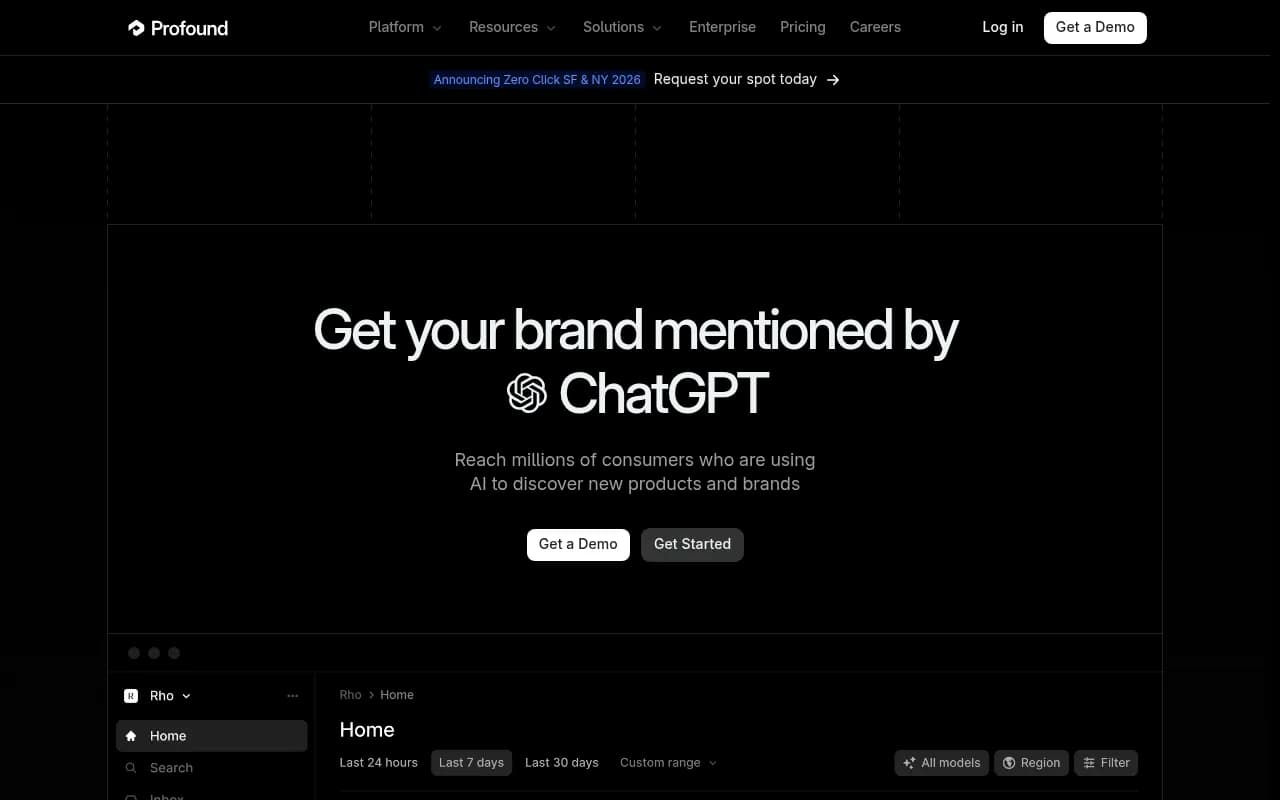
Profound's Agency mode includes brand configurations, pitch environments, and client management tools. The platform excels at monitoring and competitor analysis but lacks the content generation capabilities that Promptwatch offers. You'll see what's happening and why, but you're on your own to create the content that fixes it.
Pricing: Not publicly listed; enterprise-focused with custom contracts.
Best for: Large enterprises and agencies that need compliance, governance, and detailed reporting but have separate content production workflows.
Scrunch: broad AI engine coverage with clean monitoring
Scrunch is a solid "AI visibility command center" for teams that want broad coverage and stakeholder-friendly reporting. It monitors multiple major answer engines in one dashboard with prompt and competitor tracking.
Where Scrunch falls short: several reviews note it's stronger at monitoring than prescriptive optimization. It shows you what's happening more than exactly what to do next. No content generation, no traffic attribution beyond basic referral tracking.
Pricing: Starts around $300/mo for entry, $500/mo for team plans.
Best for: Marketing teams and agencies that want reliable visibility tracking with fast onboarding and clean reporting.
Semrush: traditional SEO platform adding AI visibility
Semrush is a well-established SEO platform that added AI visibility tracking as part of its broader suite. It monitors ChatGPT, Perplexity, and Google AI Overviews with fixed prompts.
The limitation: Semrush uses a fixed prompt set, so you can't track custom queries or competitor-specific angles. No AI traffic attribution beyond standard referral tracking. No content generation. It's a monitoring add-on to a traditional SEO platform, not a purpose-built AI optimization tool.
Pricing: Part of broader Semrush subscriptions starting at $139.95/mo.
Best for: Existing Semrush users who want basic AI visibility tracking alongside traditional SEO metrics.
Otterly.AI: affordable monitoring for small teams
Otterly.AI is a budget-friendly monitoring tool that tracks brand mentions across AI search engines. It's simple, affordable, and good for basic visibility tracking.
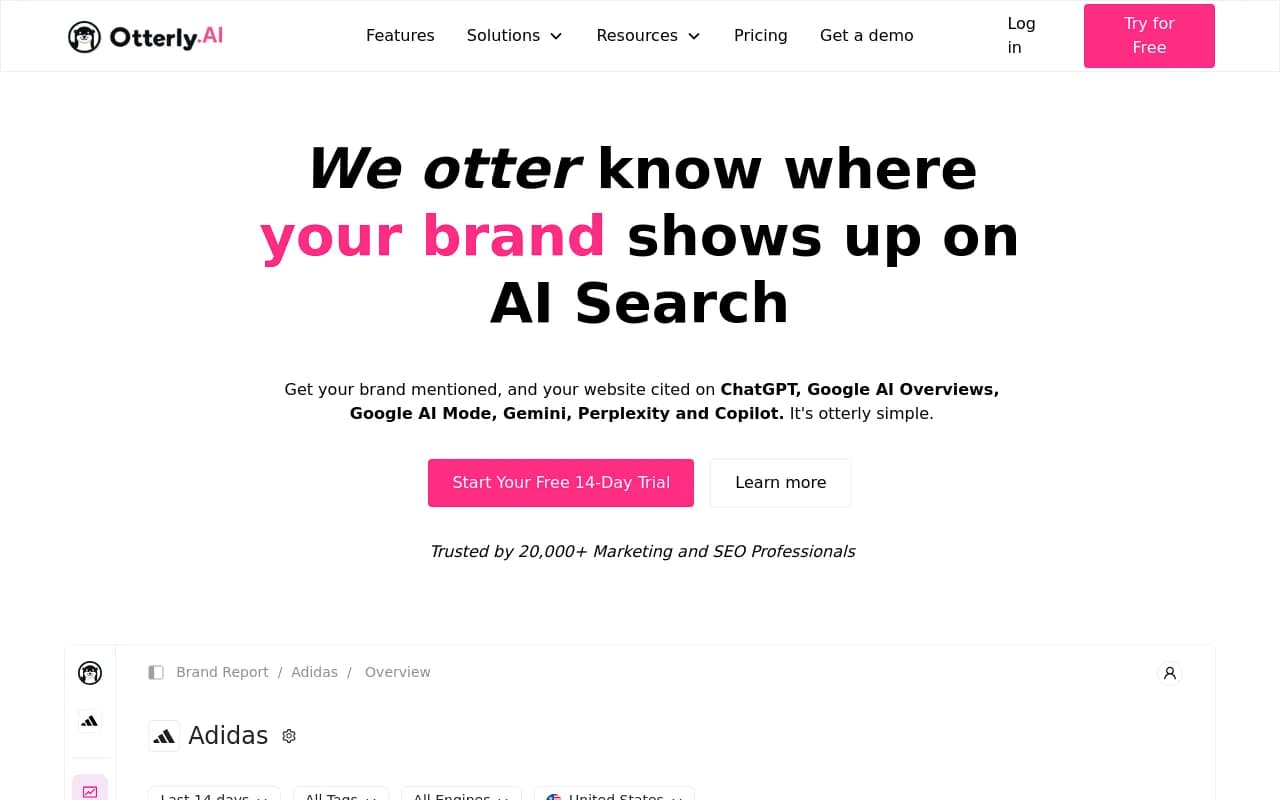
What's missing: no crawler logs, no visitor analytics, no content generation, no traffic attribution. You see your visibility score and citations, but that's where it ends.
Pricing: Lower-cost tier, specific pricing not publicly listed.
Best for: Small teams or solo marketers who need basic AI visibility tracking on a budget.
AthenaHQ: monitoring-focused with limited optimization
AthenaHQ tracks brand visibility across 8+ AI search engines with clean dashboards and competitor comparisons. It's monitoring-focused and lacks content optimization and generation capabilities.
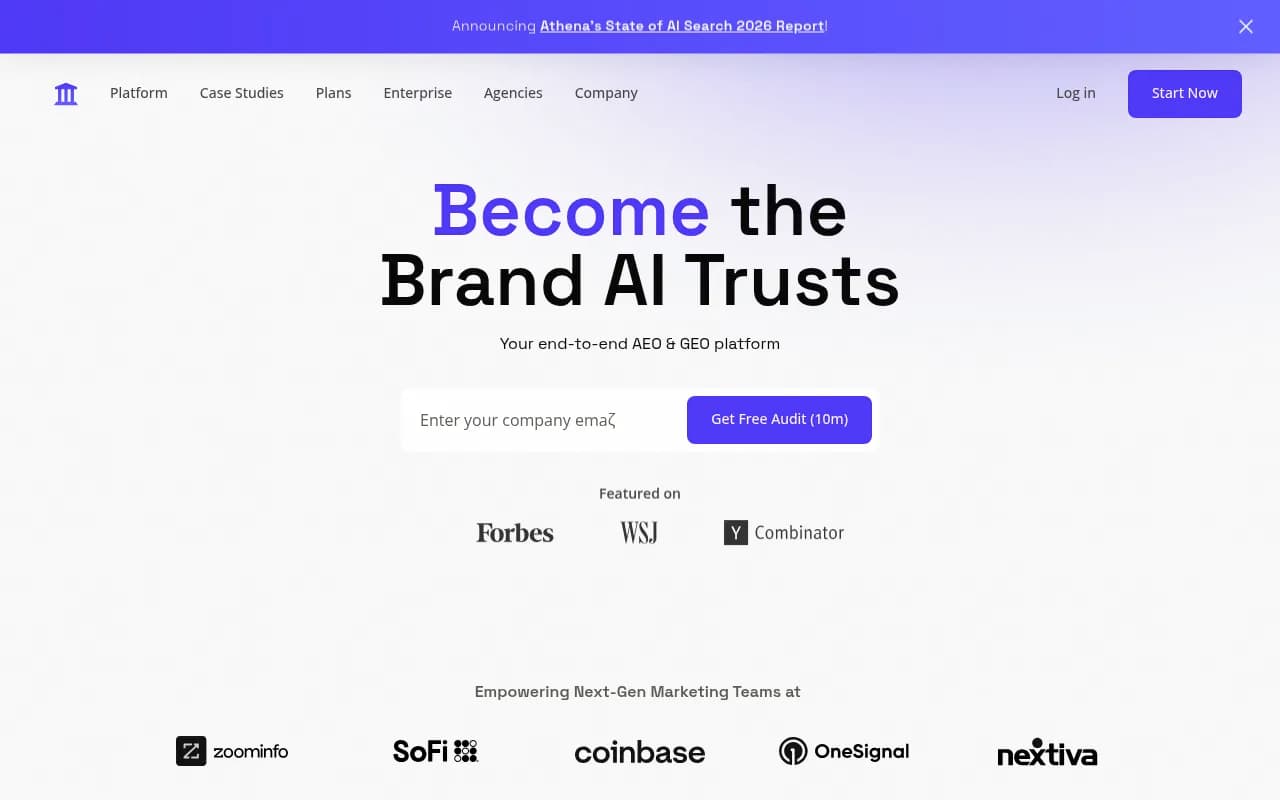
No traffic attribution beyond referral tracking. No content gap analysis. No AI writing tools. You're on your own to figure out what to do with the data.
Pricing: Not publicly listed.
Best for: Teams that only need monitoring and have separate workflows for content creation and optimization.
Comparison table: key features across platforms
| Platform | AI engines tracked | Traffic attribution | Content generation | Answer gap analysis | AI crawler logs | Pricing (starting) |
|---|---|---|---|---|---|---|
| Promptwatch | 10 (ChatGPT, Perplexity, Claude, Gemini, etc.) | Yes (code snippet, GSC, server logs) | Yes (AI writing agent) | Yes | Yes | $99/mo |
| Profound | 10+ | Basic | No | Limited | No | Enterprise (custom) |
| Scrunch | Multiple major engines | Basic referral tracking | No | Limited | No | $300/mo |
| Semrush | 3 (ChatGPT, Perplexity, Google AI) | Basic referral tracking | No | No | No | $139.95/mo |
| Otterly.AI | Multiple | No | No | No | No | Budget tier |
| AthenaHQ | 8+ | Basic referral tracking | No | No | No | Not listed |
What to look for in an AI visibility platform
When evaluating AI visibility tools, prioritize platforms that support the full optimization loop -- not just monitoring. Here's what matters:
Comprehensive AI engine coverage
Your customers are using multiple AI search engines. A good platform tracks at least:
- ChatGPT (OpenAI)
- Perplexity
- Google AI Overviews and AI Mode
- Claude (Anthropic)
- Gemini (Google)
- Copilot (Microsoft)
Bonus points for coverage of Meta AI, Grok, DeepSeek, and Mistral. The more engines you monitor, the more complete your visibility picture.
Traffic attribution that connects citations to revenue
Visibility scores are interesting. Revenue is what matters. Look for platforms that offer:
- Code snippet or tag-based tracking to identify AI referral traffic
- Google Search Console integration to pull AI search data
- Server log analysis to see AI crawler activity
- Page-level attribution showing which cited pages convert visitors
Without attribution, you're optimizing for a vanity metric.
Content gap analysis and recommendations
Monitoring tells you where you stand. Gap analysis tells you what to do next. The best platforms show:
- Which prompts competitors rank for but you don't
- What content your site is missing
- Which topics and angles AI models want but can't find on your site
- Prompt volumes and difficulty scores to prioritize high-value opportunities
This turns a dashboard into a roadmap.
AI content generation (or at least optimization guidance)
Once you know what content is missing, you need to create it. Platforms that include AI writing agents (like Promptwatch) generate articles grounded in citation data, prompt volumes, and competitor analysis. If the platform doesn't generate content, it should at least provide detailed optimization guidance -- not just a score.
AI crawler logs and indexing insights
AI models crawl your website to gather information for their responses. If they can't access your pages, encounter errors, or rarely return, your visibility suffers. Platforms with crawler logs show:
- Which pages AI crawlers are reading
- How often they return
- Errors they encounter (404s, timeouts, blocked resources)
- Indexing status across different AI engines
This is a critical diagnostic tool that most competitors lack entirely.
Competitor analysis and benchmarking
You're not optimizing in a vacuum. You need to see:
- How your visibility compares to competitors across AI engines
- Which competitors are winning for specific prompts
- What content they have that you don't
- Citation sources they're leveraging (Reddit, YouTube, specific domains)
Heatmaps and side-by-side comparisons make this actionable.
How to measure ROI from AI visibility optimization
Tracking visibility is step one. Proving ROI is what gets budget approved. Here's how to connect AI visibility to business outcomes:
Set up traffic attribution
Install a tracking code snippet (if your platform provides one) or integrate Google Search Console to identify visitors coming from AI search engines. Tag these visits with a source parameter so you can track them through your analytics.
If you have access to server logs, analyze them to see which AI crawlers are hitting your site and correlate that with traffic spikes.
Track page-level performance
Not all citations are equal. A citation that drives 100 visitors to a high-converting landing page is worth more than a citation that drives 10 visitors to a blog post. Use your attribution setup to see:
- Which cited pages get the most traffic from AI search
- Conversion rates for AI-referred visitors vs other sources
- Revenue or lead value from AI traffic
This tells you which content to prioritize and which prompts to optimize for.
Monitor visibility trends over time
Track your visibility score, citation count, and share of voice across AI engines month over month. Correlate changes with:
- New content published
- Optimization efforts (updating existing pages, fixing crawler errors)
- Competitor activity
Look for inflection points where visibility jumps -- those indicate what's working.
Calculate cost per acquisition from AI traffic
If you're paying for an AI visibility platform, divide the monthly cost by the number of leads or customers acquired from AI search traffic. Compare this to your CPA from paid search, SEO, or other channels.
In most cases, AI search traffic converts at higher rates than cold traffic because the AI model has already pre-qualified the visitor by recommending your brand.
Report on prompt coverage and content gaps closed
Show stakeholders how many high-value prompts you're now visible for that you weren't before. Highlight content gaps you've closed and the visibility gains that resulted. This demonstrates proactive optimization, not just passive monitoring.
Common mistakes when tracking AI visibility
Teams new to AI visibility optimization often make these mistakes:
Treating visibility scores as the end goal
A high visibility score is meaningless if it doesn't drive traffic or conversions. Always connect visibility to business outcomes.
Ignoring AI crawler logs
If AI models can't crawl your site effectively, your visibility will suffer no matter how good your content is. Check crawler logs regularly and fix errors.
Optimizing for the wrong prompts
Not all prompts have equal value. A prompt with high volume but low commercial intent won't drive revenue. Use prompt intelligence (volume estimates, difficulty scores, query fan-outs) to prioritize.
Focusing only on branded prompts
It's easy to rank for prompts that include your brand name. The real opportunity is non-branded prompts where potential customers are discovering solutions. Track both, but prioritize non-branded.
Using monitoring-only tools and expecting optimization results
If your platform only shows you data without helping you create or optimize content, you're stuck. Choose a platform that supports the full action loop.
Neglecting Reddit and YouTube
AI models cite Reddit threads and YouTube videos heavily. If your platform doesn't track these sources, you're missing a major piece of the puzzle.
The future of AI visibility and attribution
AI search is still early. The tools, tactics, and measurement standards are evolving fast. Here's what's coming:
More AI engines, more fragmentation
Every major tech company is launching an AI search product. Monitoring 10 engines in 2026 will become monitoring 20+ by 2027. The platforms that scale coverage quickly will win.
Deeper attribution and conversion tracking
Current attribution mostly tracks referral traffic. Future platforms will integrate with CRMs, marketing automation, and e-commerce systems to show full customer journeys from AI citation to closed deal.
AI-generated content becoming table stakes
Manually writing content for hundreds of prompts doesn't scale. Platforms with built-in AI writing agents (grounded in citation data and prompt intelligence) will become standard. Those without will fall behind.
Real-time optimization and A/B testing
Today, you publish content and wait to see if AI models cite it. Tomorrow, platforms will test multiple content variations in real-time and optimize for maximum citation rates.
Integration with traditional SEO and paid search
AI visibility won't replace SEO or paid search -- it's another channel. The best platforms will integrate all three, showing how they work together to drive traffic and revenue.
Final thoughts
AI search is changing how customers discover brands. Visibility in ChatGPT, Perplexity, Claude, and other answer engines is no longer optional -- it's a competitive requirement.
But visibility without attribution is just a vanity metric. The platforms that win are the ones that close the loop: find content gaps, help you create citation-worthy content, then prove which citations drive traffic and revenue.
Promptwatch leads this category because it's the only platform built around the full action loop. Most competitors stop at monitoring. Promptwatch shows you what's missing, helps you fix it, then tracks the results.
If you're serious about AI search optimization, start with a platform that supports the full cycle. Monitoring alone won't get you there.