Key takeaways
- Fact-checking AI means checking each claim ChatGPT, Gemini or Perplexity makes about you against your own site and the sources the model cites. Checking the answer in isolation tells you little.
- Wrong claims often trace back to a page you control: one that is outdated, silent on the topic, or contradicted by another page.
- Brand prompts draw on a short list of sources, so one bad review page or comparison article carries real weight.
- Answers drift as models re-crawl and pages age. Treat this as a recurring job, not a one-time audit.
- Triage by deal impact. A wrong price or a missing integration matters. A wrong founding year barely does.
Why PR teams now own this problem
A buyer asks ChatGPT which AI meeting assistants connect to Claude. The answer lists a few tools and says one of them has no MCP connector. That is false, because the connector has been live for a year. The buyer moves on to a competitor and nobody at the company ever finds out.
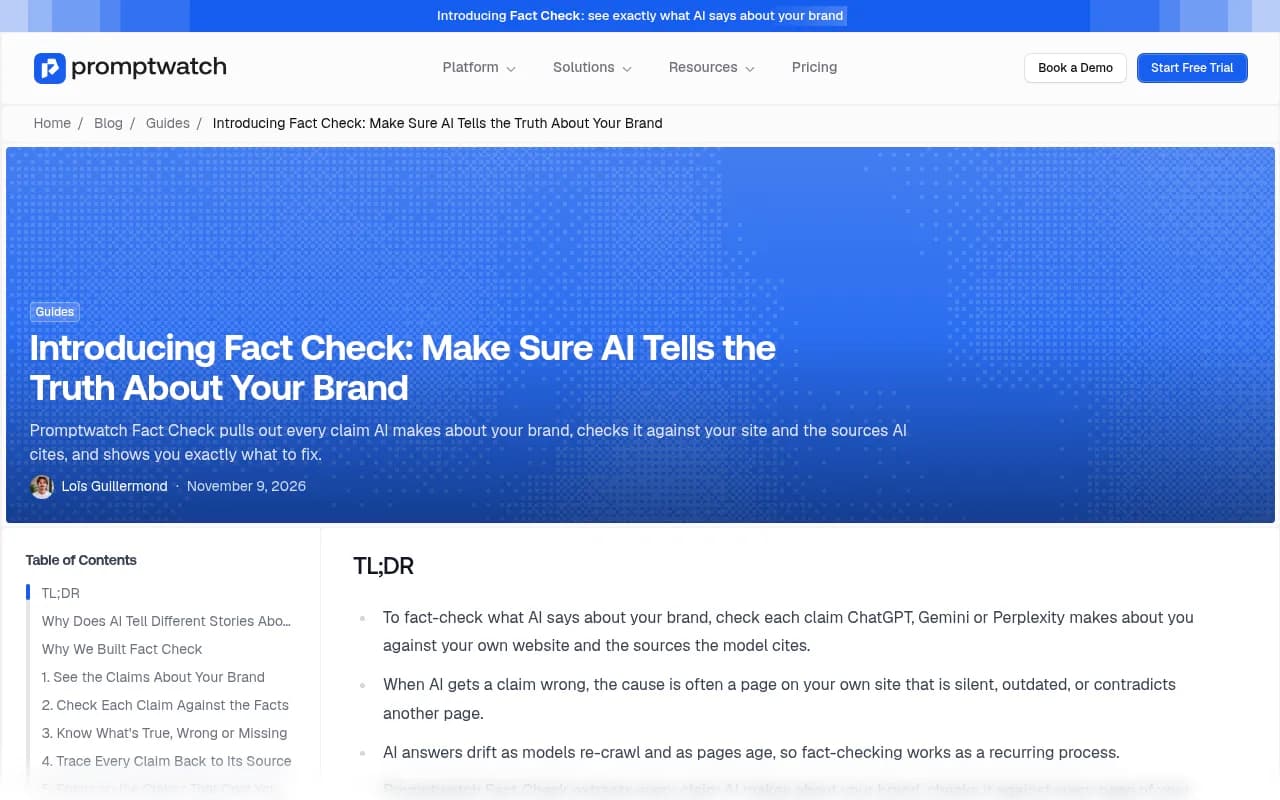
That scenario comes from Promptwatch's Fact Check launch post, which uses it as an illustration of how a wrong claim spreads. The mechanism is the useful part. A comparison page written before the launch is still live, and AI reads it alongside the current product pages.
Traditional PR monitoring was built for articles, broadcasts and social posts, where you can see a mistake and request a correction. AI answers are different. The model assembles one response from many sources and restates it in its own words. You cannot read every answer, and the same question can produce different claims on different days.
Profound's research across 50,000 LLM responses found that 47% of response content is unsolicited, meaning the model adds commentary about the brand beyond what the user asked. That is a lot of surface area for errors, and it is why the job needs a process.
Why AI gets brands wrong
Before you fix anything, it helps to know where errors come from. Semrush's guide to AI misinformation describes two inputs: training data with a cutoff date, and live web retrieval at the time of the query. Both can introduce errors. If your brand was misdescribed in enough articles, forums or reviews before the cutoff, the model absorbed it. If retrieval pulls a stale page today, you get the same result.
There is also a confidence problem. A model's fluent tone reflects how probable the sentence is, not whether it is true. Nothing in the phrasing tells you which claims are shaky.
In practice, errors tend to fall into five buckets:
- Outdated facts: old pricing, a former CEO, closed offices, discontinued products
- Inaccurate facts: wrong years, wrong metrics, distorted events
- Negative framing: phrases like "little-known" or "lags behind competitors"
- Missing context: a true statement that leaves out the part that matters
- Silence: your site never addresses the question, so AI fills the gap from elsewhere
The fifth one gets overlooked. If nothing on your site confirms or contradicts a claim, the model has no authoritative source to prefer.
Which sources actually shape the answer
The number of sources behind an answer matters for triage. In Promptwatch Data's report on unique domains per ChatGPT response (Sep 28 to Oct 4, 2026), 47.6% of cited responses cited 10 or more unique domains. Brand-specific prompts, such as "is Asana good for small teams," draw on far fewer. Five domains was the most common count at 14.9%, and 40.7% of those responses cited five or fewer.
For a PR team, that is the useful finding. A brand question is answered from a short list of pages, so an error on one of them carries more weight than it would in a broad category query. Find that short list first.
Social sources matter less than many teams assume, at least outside Google. Promptwatch Data's November 2026 social citations report (Oct 11 to Nov 9) shows social platforms made up 13.16% of AI Overviews citations, with YouTube at 6.71%, Facebook at 2.34% and Reddit at 2.10%. In ChatGPT they made up just 0.64%. So a Reddit rumor is a bigger worry in AI Overviews than in ChatGPT, where your own site, listicles and comparison pages dominate.
Stale pages stay cited for months
Corrections are slow to land. Promptwatch Data's content half-life report tracked pages ChatGPT cited on July 6, 2026 through October 4. After 60 days, ChatGPT still cited 69% of landing pages and 67% of docs. Comparison pages held at 63%. Product pages, reviews and how-tos sat around 55% with a half-life of 74 to 77 days.
News is the exception. Half of cited news pages were gone after 36 days. That means a stale pricing or docs page can feed a wrong claim for months, while a corrected news story fades quickly and does less long-term work.
A five-step fact-checking process
The steps below borrow from editorial fact-checking practice, such as the claim inventory and disposition approach in BrandWell's guide to checking AI content, and adapt it to claims AI makes about a brand.
Step 1: build a claim inventory from real answers
Start with the prompts your buyers actually use: category queries ("best X for Y"), brand queries ("is [brand] good for..."), and comparison queries ("[brand] vs [competitor]"). Run them across ChatGPT, Gemini, Perplexity, Claude and Google's AI surfaces.
Then pull out every verifiable statement. BrandWell's list of claim types transfers well:
- Prices, plans, limits and eligibility
- Product capabilities and integrations
- Dates, history and leadership
- Comparisons to competitors
- Reputation statements and customer quotes
Keep the exact quote, the model, the prompt and the date. Without those, you cannot reproduce the claim or show a stakeholder where it came from.
Group claims that mean the same thing. "Fireflies can't connect to Claude" and "Fireflies has no MCP support" are one claim. If you count them separately, your problem looks bigger or smaller than it is.
A one-off search is a weak starting point. Semrush makes the same point: a single search tells you what one platform said once, and it won't reveal patterns or changes over time.
Step 2: check each claim against your own site first
Before blaming a third party, search your own pages. Three outcomes are common:
- Your site states the claim. If it is wrong, you found the source.
- Your site states the opposite. A retired page or old blog post is probably competing with the current one.
- Your site is silent. AI is guessing.
Mark each claim with a status and a reason. A simple scale works: confirmed, leans confirmed, conflicting, leans conflicting, inconclusive. Promptwatch uses that same five-level scale in its Fact Check feature, and it is a good model even if you do the work by hand.
Pay attention to inconclusive claims. They are an opportunity, because AI keeps saying something your site never addresses.
Step 3: check the sources AI cites
Now open the citations. For each wrong claim, list the pages the model cited and read them. You are looking for:
- Third-party pages that state the wrong version
- Competitor comparison pages that spread it
- Review sites with outdated plan or pricing details
- Forum threads or videos that repeat old information
Promptwatch Data's advice on brand prompts applies here: make sure your own site answers pricing, features, reviews and alternatives, then check which other domains ChatGPT cites for those prompts. The review sites and forums on that short list shape how it describes you.
For comparison prompts, publish your own comparison pages and find the third-party ones ChatGPT cites, then make sure they describe you accurately.
Step 4: triage by business impact
Most claims do not need action. A trivia claim about a founding year can be dismissed. A claim that tells buyers your product cannot plug into their workflow costs deals.
A practical triage order:
- Claims about pricing and plans
- Claims about features and integrations, especially those that decide a purchase
- Claims that show up in category and comparison prompts, where buyers are shortlisting
- Low-sentiment claims about reputation or support
- Everything else, which you can dismiss or revisit quarterly
Grouping claims by theme (pricing, features, support, reputation) helps here. If one theme is wrong across every model, start there.
Step 5: fix at the source, then verify
What you do depends on who owns the source.
| Source type | Typical fix | Who does it |
|---|---|---|
| Your own outdated page | Rewrite or retire it, add dates, make the current fact explicit | Content or web team |
| Your own silent pages | Publish a clear page that states the fact | Content team |
| Competitor comparison page | Publish your own accurate comparison, use clear factual language | Content and PR |
| Third-party review or listicle | Contact the author or site owner with the correct information and evidence | PR |
| Forum, video or social post | Respond with a correction where appropriate, publish an authoritative source | PR and community |
Write for extraction. Semrush's advice is to publish clear, factual, jargon-free descriptions and keep content updated with explicit dates so AI systems can judge recency. Put the answer in a sentence that can stand alone, because the model may quote it without the surrounding page.
Then close the loop. Re-run the same prompts after the page is re-crawled and compare. BrandWell's guidance on recording the reviewer, the changes and the next maintenance date is worth copying: keep a log of what you changed and when, so you can tell whether a fix worked.
When a fact changes, update every place that repeats it. That includes the pricing page, the FAQ, old blog posts, press kits and partner pages.
Tools that can do the heavy lifting
Doing this by hand works for a few dozen claims. Beyond that, you need software that extracts claims at scale. Two products are built specifically for it.
Promptwatch Fact Check
Promptwatch is an AI visibility and GEO platform, and Fact Check is part of it. It extracts every claim AI makes about your brand and competitors from your tracked answers, keeps the exact quote, and groups claims that mean the same thing. It then checks each claim against every page of your site and the top 50 sources AI cites, assigns one of the five statuses described above, and sends pages that need fixing to the Content Agent for a refresh.

A few details matter for PR teams. Claims come only from real AI answers to prompts you track, so you see what AI actually says rather than a list you supplied. An Overview tab rolls everything into an Accuracy Score and a heatmap by model and theme. Because it uses AI to read your pages, it can sometimes surface a page only loosely related to a claim, so you confirm or dismiss each one. Fact Check is available on Business, Agency Scale and Enterprise plans and uses Agent Credits. Confirm current pricing at promptwatch.com/pricing.
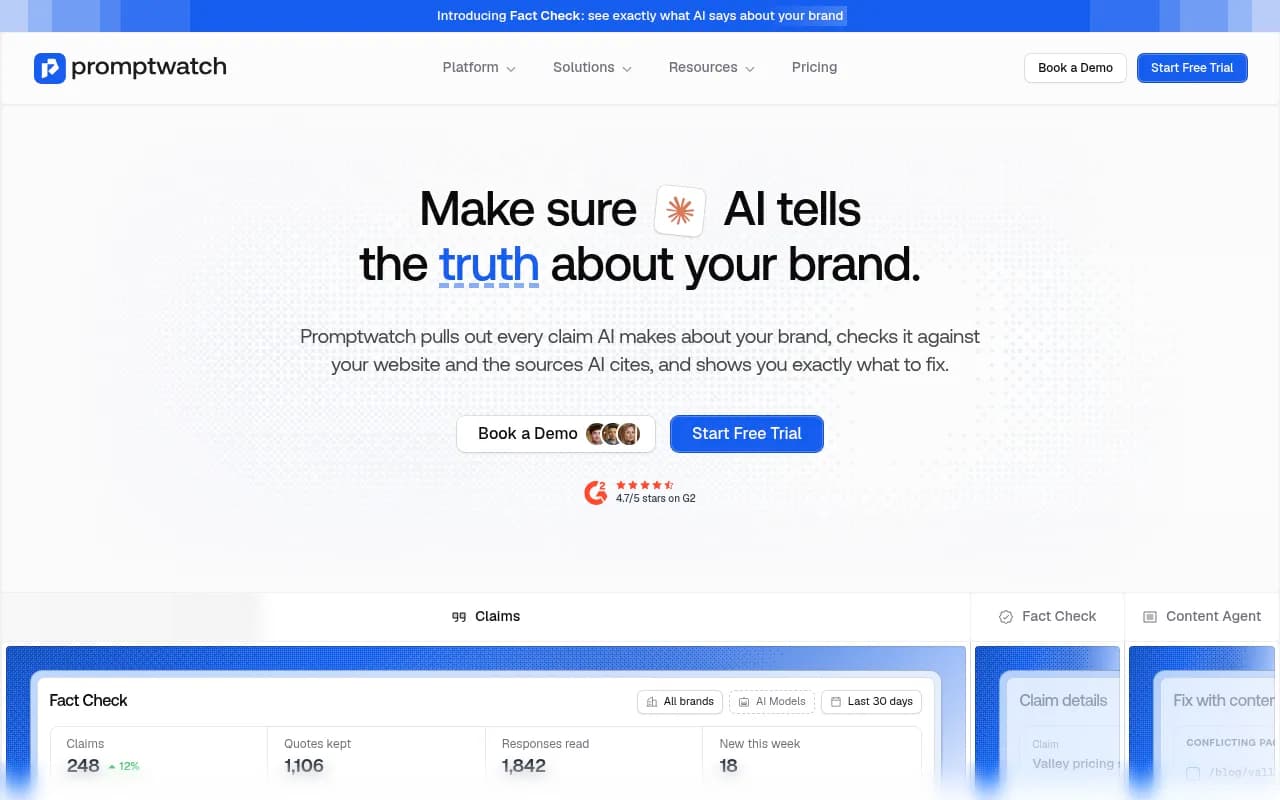
If you want to see where you stand first, the free AI visibility report shows how ChatGPT, Gemini and Perplexity describe your brand, and Promptwatch also offers a 7-day free trial on monthly billing.
Profound FactCheck
Profound launched FactCheck in July 2026. It takes a different approach to ground truth: you maintain a Knowledge Base (website content, product pages, docs, FAQs, PDFs, Google Drive, Notion) and its claim-detection model compares sentence-level claims in AI answers against it. It reports an overall accuracy measure, shows which sources contribute to inaccurate answers, and connects owned, competitive and third-party sources to different agents: a refresh agent, a content creation agent and an outreach agent respectively.
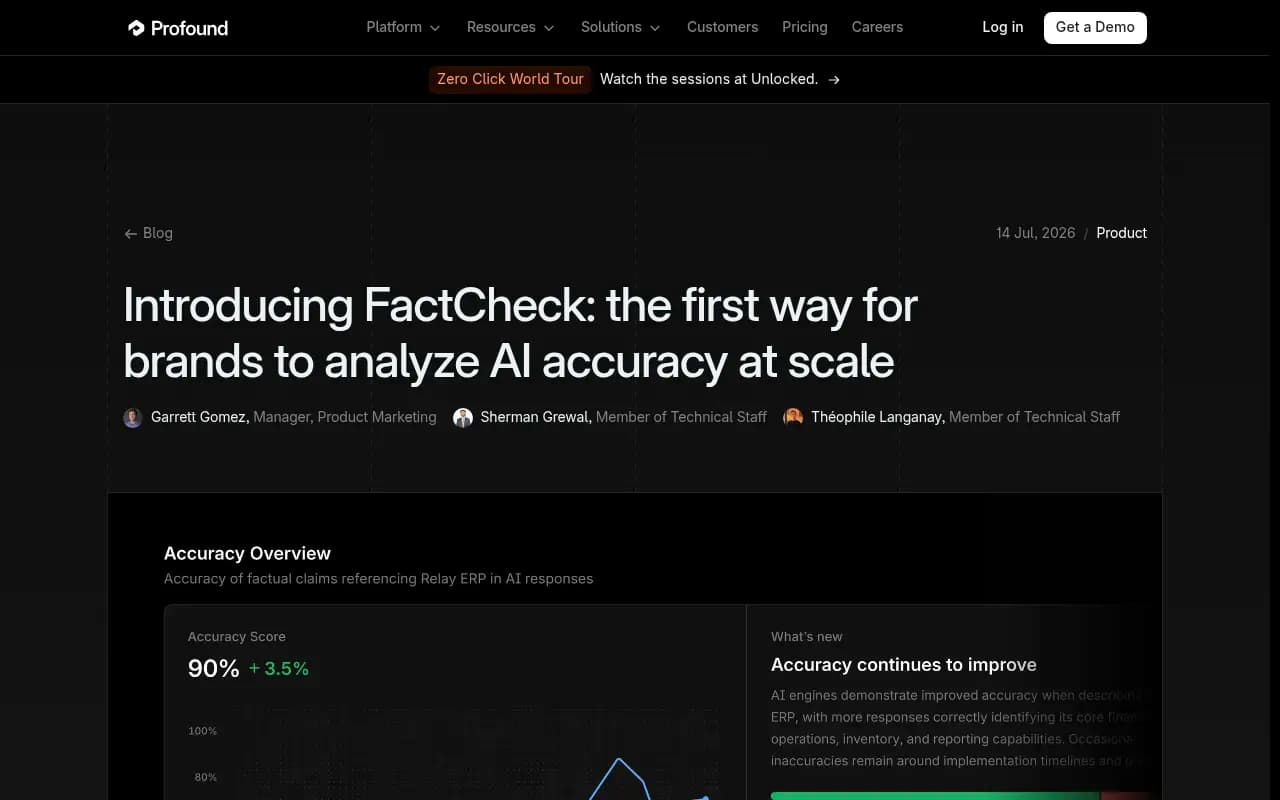
The design difference is worth understanding. Checking against a curated Knowledge Base gives you control over what counts as true. Checking against your live site and cited sources tells you which of your own pages is feeding the error. Both are valid, and which fits depends on how well your canonical facts are documented.
Other options
Semantica AI includes a fact-checking section aimed at PR specialists. It extracts facts from AI responses, runs a plausibility check, lets you mark incorrect ones, classifies risks (factual error, outdated info, negative framing, harmful association, missing context) with severity levels, and tracks source-correction requests in an appeals tab. It is closer to a PR case-management workflow than a content fixer.
[tool:llmclicks] markets AI visibility tracking with hallucination detection, which is worth a look if hallucinated claims are your main concern. Semrush's AI visibility reporting lets you click through answers to see sources.
| Tool | Ground truth | Fix workflow | Best for |
|---|---|---|---|
| Promptwatch Fact Check | Your site plus the top 50 cited sources | Content Agent refresh, CMS publishing | Teams that want detection and fixes in one place |
| Profound FactCheck | Customer-maintained Knowledge Base | Refresh, creation and outreach agents | Enterprises with documented brand facts |
| Semantica AI | Company context profile | Marking, risk register, source appeals | PR teams running correction cases |
| Manual process | Spreadsheet and judgment | Whatever your team does | Small claim volumes, early pilots |
For more options, browse the GEO software directory.
Setting up a recurring cadence
Answers drift. Models re-crawl, pages age, and new third-party content appears. A quarterly audit will miss problems that cost you deals for weeks.
A workable rhythm:
- Weekly: review new claims flagged since the last check, focusing on pricing and features themes
- Monthly: re-run your core prompts, compare accuracy by model and theme, and review which sources conflict most
- After any launch, rebrand, price change or leadership change: run a targeted check within days, and update or retire old pages
- Quarterly: audit old comparison pages, blog posts and press kits that still say something outdated
Assign owners. PR owns outreach to third parties. Content owns your pages. Product marketing owns the canonical facts. Without that split, claims sit in a spreadsheet and nobody acts.
Common mistakes
- Arguing with a single AI answer. One response is a sample, not a trend.
- Fixing the symptom. Asking a model to "remember" a correction does not change what the next user sees. Fix the sources.
- Ignoring your own archive. Old blog posts and retired product pages are the most common culprits.
- Treating all claims equally. You will burn time on trivia while a pricing error runs for months.
- Skipping the re-check. Without a second run, you do not know if the fix worked.
- Trusting an automated verdict blindly. Tools that use AI to read pages can surface loosely related matches, so a human should make the final call.
What to do this week
Pick ten prompts a buyer would actually ask about your brand and run them across at least three AI platforms. List every claim about pricing and features. Check each against your site, then open the cited sources for the wrong ones. Fix the pages you own first, because those are the fastest wins, and send correction requests to the third-party owners for the rest. Re-run the prompts in two to three weeks and record what changed.
If the list is longer than you can manage by hand, that is when a tool earns its cost.