Key takeaways
- City-level tracking is the right default for most local and multi-location businesses. State-level data hides the differences that actually drive customer decisions.
- Neighborhood or grid-level tracking only pays off if you run a physical location with a tight service radius, or you serve clients who do.
- State-level tracking is fine for broad-coverage brands, e-commerce with regional shipping, and as a cheap first pass before you spend prompts on cities.
- Nobody has published a clean number for how much AI answers vary by city versus state. Treat any tool vendor's claim on that as a hypothesis and test it on your own prompts.
- Granularity multiplies cost. Every extra location multiplies your prompt count and response volume, so pick the minimum level that changes a decision.
Why this question exists at all
Traditional local SEO had a settled answer. You tracked rankings on a grid, you looked at the map pack, and you argued about radius. AI search broke that habit. When someone asks ChatGPT for "a reliable family lawyer in Austin", there is no fixed results page with a position #3. There is a generated answer that mentions some brands, cites some sources, and ignores everyone else.
So the old question "what's my rank in Dallas?" turns into "am I mentioned at all when someone in Dallas asks?" And then the follow-up that this guide is about: do you need that answer for Texas, for Dallas, or for the neighborhood around your front door?
I'll be upfront about one thing. The public evidence on how much AI answers shift between a state and a city is thin. Promptwatch Data has no report on location-level variance, and the vendor material I reviewed (mostly from rank-tracker companies) doesn't quantify it either. What follows is a framework built on how the systems retrieve information, plus honest trade-offs, not a claim that city data is always X% different.
How AI platforms actually use location
Three things can bring geography into an AI answer.
- The prompt itself. "Best dentist in Chicago" or "plumber near me" contains a place name or a locality cue. This is the strongest and most reliable signal.
- The platform's context about the user, such as an approximate location from the device or the search layer. This is more likely in Google's AI surfaces, which sit on top of web search and local knowledge data, than in a standalone chatbot.
- The retrieval step. When a model searches the web to build an answer, it runs queries. Those queries inherit the place name from the prompt, and the results depend on which pages exist for that place.
That third point matters more than it first appears. Promptwatch's ChatGPT query fanout data shows average fanout queries per response sitting around 2.15 in December 2025, 1.84 by early March 2026, and at 1.0 per response when data resumed in April, with average query length falling from roughly 117 characters to about 53. That report doesn't discuss geography. My inference, and it is only an inference, is that when ChatGPT fires fewer, shorter searches, a city modifier carries more weight in each one. A page that clearly says "Austin" has a better shot than one that implies it.
There is a second hint. On August 8, 2026, ChatGPT began using the site: operator at scale, with site:-scoped queries jumping from 0.37% to 16.8% of fanouts, per Promptwatch's site: operator report. For local businesses, that suggests your own location pages are a direct retrieval target. If you have no page for a city, you have nothing for that query to land on.
The three levels, compared
| Level | What you track | Typical use | Main risk |
|---|---|---|---|
| State or region | Prompts like "best accountant in Ohio" | Regional brands, e-commerce, early scoping | Averages hide the cities where you are weak |
| City or metro | Prompts like "best accountant in Columbus" | Most local, service-area, and multi-location brands | Prompt count grows fast across many cities |
| Neighborhood or grid point | Simulated searches from specific coordinates | Single-location retail, restaurants, clinics, local SEO agencies | Cost, noise, and over-reading small differences |
State-level tracking
State-level is the cheapest way to start. You write a prompt set once, run it with a state modifier, and see whether you appear. It works when your business sells across a whole region and customers don't care much where you physically sit: an online retailer with state-specific shipping, a regulated service (insurance, legal, licensing) where state law is the whole point, or a utility-style brand.
The weakness is averaging. If you show up in 8 of 10 Texas prompts, the number looks healthy. But if the 2 misses are Houston and San Antonio, which hold most of your customers, the average is lying to you. State-level data is a scoping tool. It rarely tells you what to do on Monday.
City-level tracking
This is where I'd start for almost any business with a physical footprint or a defined service area. City names are exactly how people phrase local prompts. "Top dentist in Chicago" is a city prompt, not a state prompt. It also maps to something you can act on: a location page, a set of local citations, local reviews, and local press.
City-level also matches how you already organize the business. Sales territories, ad budgets, and Google Business Profiles are city-shaped. When the data lines up with the way you make decisions, people actually use it.
One practical guideline from the research: build a prompt set of roughly 10 to 20 realistic questions per city or region, then log how often your brand is mentioned, cited, or recommended. Track inclusion and prominence, not a fake "rank by city".
Neighborhood and grid-level tracking
Grid tools simulate a search from many points across a map. Local Falcon, for example, launched local AI visibility grids in October 2026. Per its own announcement, each grid point reflects a simulated search from that location with the AI response, ranked brand mentions, and cited sources, and the results roll up into metrics such as Share of AI Voice and Average Rank Position. It covers Google AI Overviews, AI Mode, Gemini, and ChatGPT.
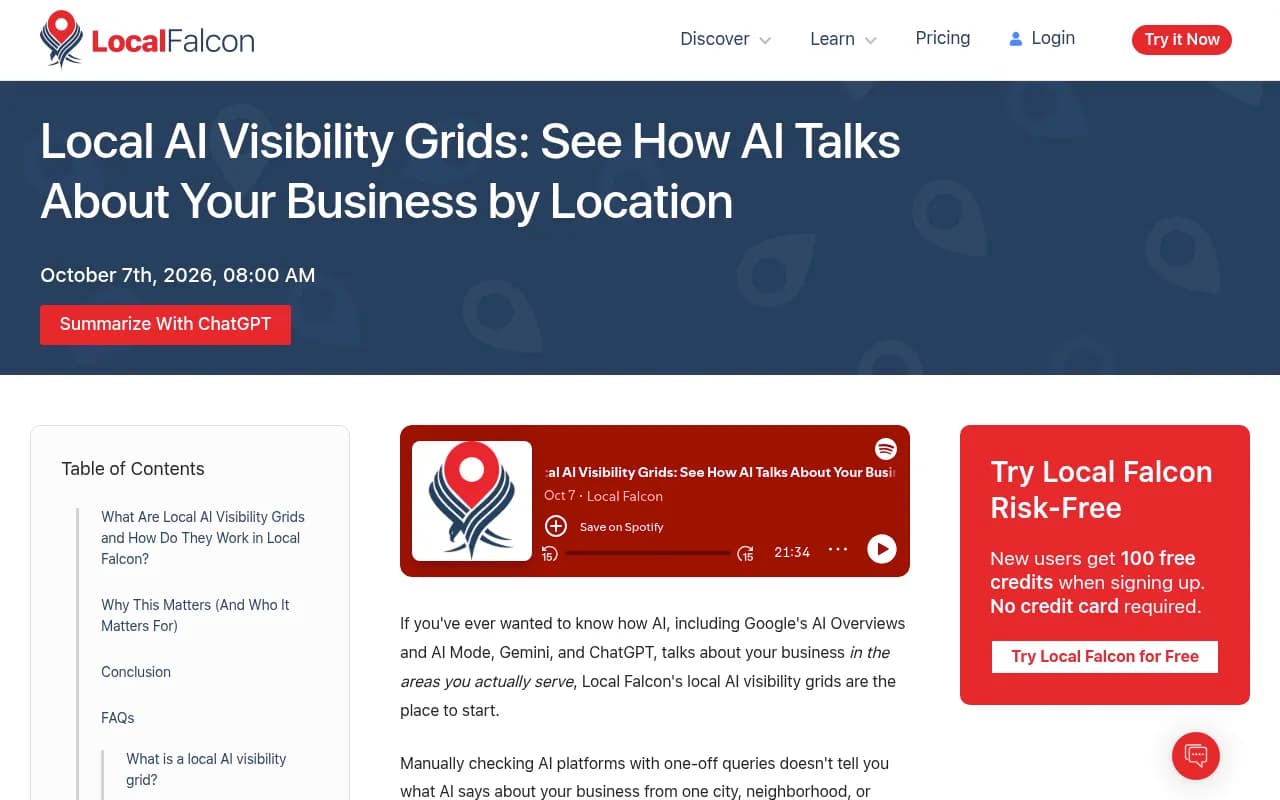
That is valuable if you are a restaurant, a clinic, or a retailer where the next block over is a different competitive set. It is much less valuable if you serve a whole metro by van. Keep in mind that this is vendor-authored material. The claim that grid-level data reveals meaningful block-to-block differences in AI answers is plausible, since Google's local layers are location-sensitive, but the announcement does not publish figures to prove it. Run a small pilot before buying into it.
There is also a counterweight. One vendor-neutral-ish guide on this topic argues that treating AI visibility by city as a "rank by location" problem is the wrong frame, because generated answers vary by prompt, intent, and retrieval sources rather than sitting on a static results page. I agree with the spirit. A pretty map is not the same as a GEO workflow.
A decision framework
Ask these questions in order and stop at the first level that changes what you'd do.
- Does your customer choose you based on where you are? If no (national SaaS, e-commerce), state or region is enough, and you may only need country tracking.
- Do you have separate locations, offices, or service areas per city? If yes, track at city level, one prompt set per city.
- Does your performance swing inside a city, for example by neighborhood foot traffic or distance? If yes, add grid-level tracking for those specific locations only.
- Are you an agency pitching a client? A grid report is a strong visual for a sales conversation, even if the client ends up on city-level tracking.
Rules of thumb for different business types
| Business | Start at | Add later |
|---|---|---|
| Single-location restaurant or clinic | Neighborhood grid plus city prompts | Competitor comparison per radius |
| Home services with a metro service area | City | Suburbs with the highest revenue |
| Multi-location franchise | City, per location | Grids for the weakest 10% of locations |
| Regional e-commerce | State or region | Top 5 cities by order volume |
| Regulated services (legal, insurance) | State | City for the biggest offices |
| National SaaS with local case studies | Country | City-level only for named market launches |
What it costs you to go finer
Granularity is not free, and this is the part most guides skip. Tracking 20 prompts in 1 state is 20 prompt checks. Tracking those same 20 in 15 cities is 300. Add a persona or two and a few AI platforms, and your response volume balloons.
So the plan should be a funnel:
- Stage one: state-level on a core prompt set to find where you're absent.
- Stage two: city-level on the weakest and the most valuable markets.
- Stage three: grids or neighborhood checks on the handful of locations where it changes a decision.
This keeps spend proportional to revenue at stake.
Metrics that make local data usable
Whatever level you pick, track the same few numbers per location so they are comparable:
- Mention rate: the share of prompts where your brand appears.
- Position in the answer: first-named or buried at the end.
- Citation of your own pages: are the cited sources your location pages, or third-party directories and review sites?
- Competitors named alongside you.
- Sentiment: how the answer describes you.
If you appear but never get cited, the problem is usually the content or crawlability of your location pages. If you don't appear at all in one city but do in another, look at that city's local mentions and reviews. The geography tells you where to look, and the metrics tell you what's broken.
Tool options
The market splits into two groups: general AI visibility platforms that support country or location settings, and local-specific tools built around map-style grids.
Promptwatch tracks the real UIs of ChatGPT, Google AI Overviews, AI Mode, Gemini, Perplexity and others, with country tracking on every paid plan and state and city tracking from the Business plan. It also adds crawler logs, AI traffic analytics, and a content workflow, which matters because location data is only useful if you can act on it. Confirm current limits at promptwatch.com/pricing.

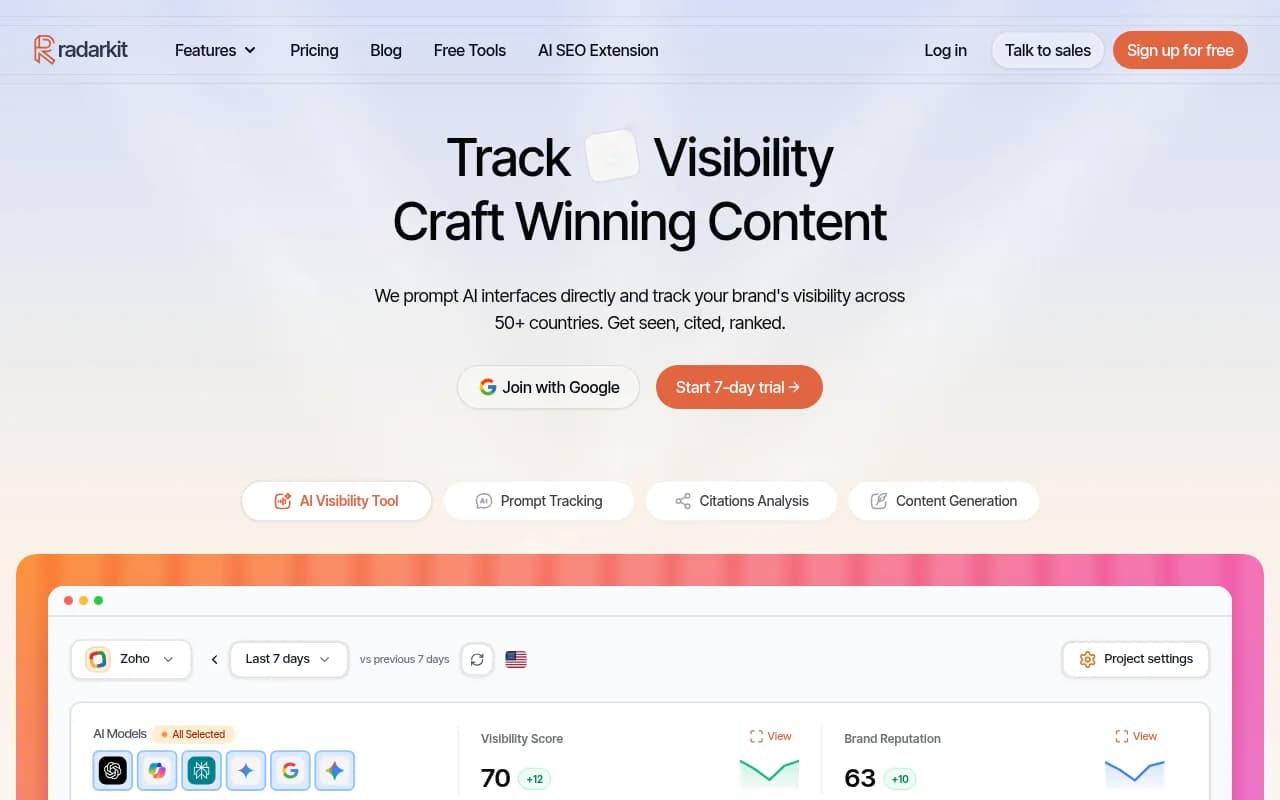
Radarkit positions itself around location-based AI tracking for local businesses and agencies, and its own roundup of local AI rank trackers lists it first.
Tibly is aimed squarely at local business AI visibility.

For listings and reputation signals that feed local AI answers, BrightLocal and Yext are established options.
General monitors with simpler setups include Otterly.AI and Peec AI, though you should check whether they support the location depth you need before committing.


| Tool | Geographic angle | Best for |
|---|---|---|
| Promptwatch | Country on all paid plans, state and city from Business | Teams that want tracking plus content and crawler data |
| Local Falcon | Grid-based local AI visibility | Local SEO agencies, single-location businesses |
| Radarkit | Location-based AI tracking | Local businesses and agencies |
| Tibly | Local business focus | Small local operators |
| BrightLocal | Local SEO and listings | Citation and review groundwork |
If you want to compare more options, the GEO software directory and the AI rank tracking tools directory list many more.
Making the data worth the money
Granular tracking does nothing if the pages AI retrieves don't exist. Some practical steps:
- Build a real page per city or location that states who you serve, where, and why. Thin, templated pages with a swapped city name are weak.
- Keep Google Business Profile data, listings, and reviews consistent. Google's AI surfaces sit on top of that data.
- Check that AI crawlers can reach your location pages. Crawler logs make this visible.
- Test manually first. Write five location-aware prompts a customer would really ask and see how you appear. It takes 30 minutes and tells you whether you need a tool yet.
- Re-check regularly. Platform behavior moves, as the August 2026 site: operator change showed, so a one-off audit goes stale.
Common mistakes
- Treating a grid color map as the goal. The goal is being recommended, not turning dots green.
- Using state-level averages to judge a city-driven business.
- Tracking every suburb because you can. If a location doesn't change a budget or a page, drop it.
- Assuming traditional local rank equals AI visibility. Ranking well in local search does not guarantee you appear in AI answers.
- Believing precise variance claims. Until someone publishes city-versus-state variance data you can verify, run your own pilot.
Bottom line
Start at city level. Use state level as a cheap scouting pass, and add neighborhood grids only where distance and foot traffic really change who gets recommended. Pick the coarsest level that still changes a decision, then spend the rest of your budget on the content and local signals that move the numbers.