Key takeaways
- Searchable, Otterly.AI, and Peec AI are all solid monitoring tools -- they track brand mentions, sentiment, and visibility scores across major AI models.
- None of the three tell you why you're invisible for certain prompts, which content to create, or how to close the gap.
- Peec AI has the strongest multi-language and multi-region support; Otterly.AI wins on simplicity and ease of setup; Searchable sits somewhere in between.
- The shared blind spot: all three are dashboards that show you the problem but hand you nothing to fix it with.
- If you need to actually improve your AI visibility -- not just measure it -- you'll need a platform that goes beyond monitoring.
There's a pattern that shows up constantly in AI visibility tool reviews: someone signs up, watches their mention count tick up or down, and then asks "okay, now what?" The tool has no answer. That's not a bug in Searchable, Otterly.AI, or Peec AI specifically -- it's a design philosophy shared by all three. They were built to monitor, not optimize.
That distinction matters a lot more now than it did two years ago. AI search has gone from a curiosity to a meaningful traffic channel. ChatGPT, Perplexity, Claude, Gemini, and Google AI Overviews collectively handle a huge and growing share of informational queries. If your brand isn't showing up in those responses, you're losing consideration at the exact moment someone is deciding what to buy or who to hire.
Knowing you're invisible is step one. Knowing what to do about it is step two. This guide covers all three tools honestly -- what they're good at, where they fall short, and what the monitoring-only approach leaves on the table.
What these tools actually do
Before getting into the differences, it's worth being clear about what all three tools share. Each one works roughly the same way: you define a set of prompts (questions your potential customers might ask an AI), the platform runs those prompts across one or more AI models on a schedule, and it reports back on whether your brand appeared, how prominently, and with what sentiment.
That's genuinely useful. Before these tools existed, the only way to know if ChatGPT was recommending you was to ask it yourself, manually, and hope you remembered to check. Automated monitoring at scale is a real improvement.
The question is whether monitoring alone is enough.
Otterly.AI
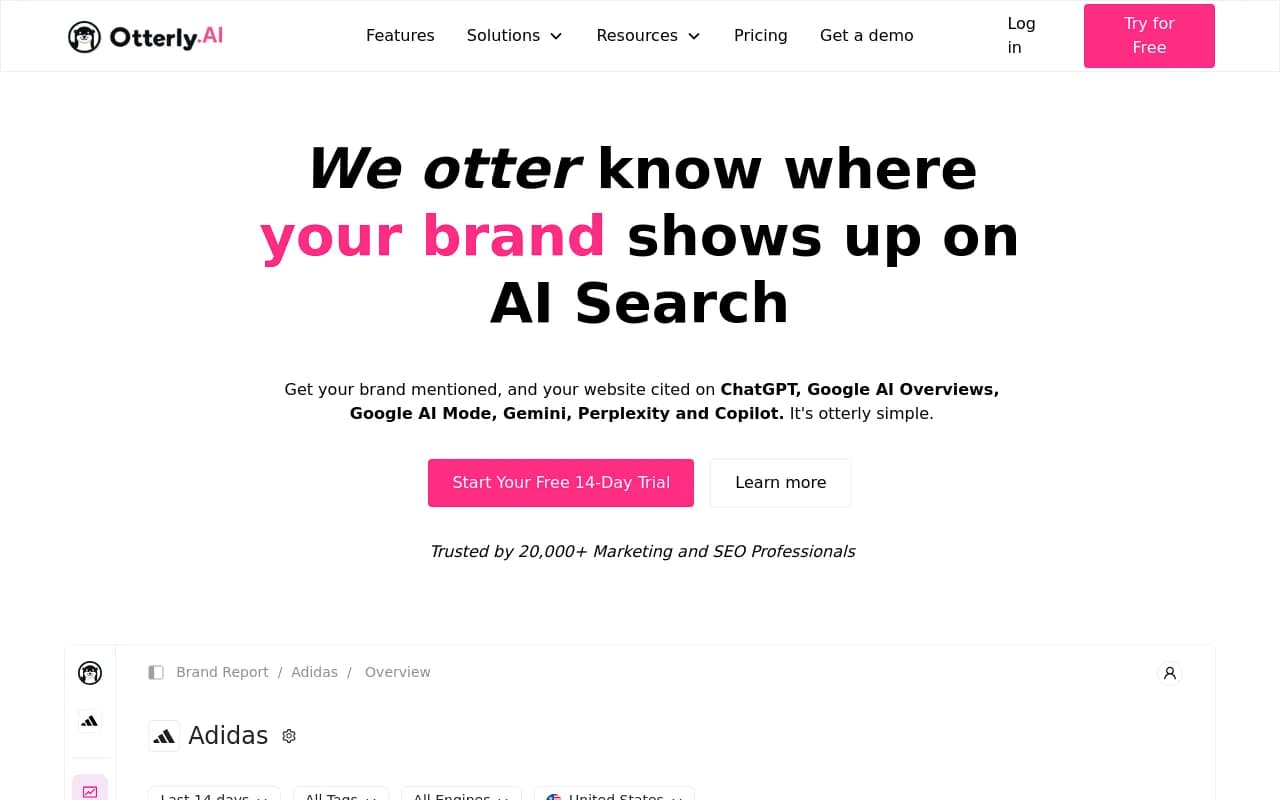
Otterly.AI is probably the most approachable entry point in this category. Setup is fast -- you can go from signup to your first visibility report in under 30 minutes. The interface is clean, the prompt library covers common use cases, and the pricing is accessible enough that solo marketers and small teams can justify it without a procurement conversation.
Where Otterly wins is simplicity. You get a clear visibility score, a breakdown of which AI models mention you, and sentiment tagging. For someone who just wants to know "is my brand showing up in AI search?" it answers that question without overwhelming you with configuration options.
The limitations are real, though. Otterly's prompt coverage is relatively shallow -- you're working with a fixed set of prompts unless you manually add your own, and there's no prompt volume data to help you prioritize which queries actually matter. You also won't find crawler logs, content gap analysis, or any mechanism for understanding why a competitor is outranking you for a given prompt.
One thing worth noting: Otterly has been flagged in several comparisons for not detecting accuracy issues. If ChatGPT is citing your brand but getting your pricing wrong, or attributing a competitor's feature to you, Otterly's sentiment scoring won't catch that. It sees a mention and calls it positive. The LLMClicks research cited above documented exactly this failure mode -- 18 brand mentions logged, zero alerts, while wrong pricing was actively costing demos.
Best for: Small teams or individuals who want a quick, low-friction way to track brand mentions across AI models without a steep learning curve.
Peec AI
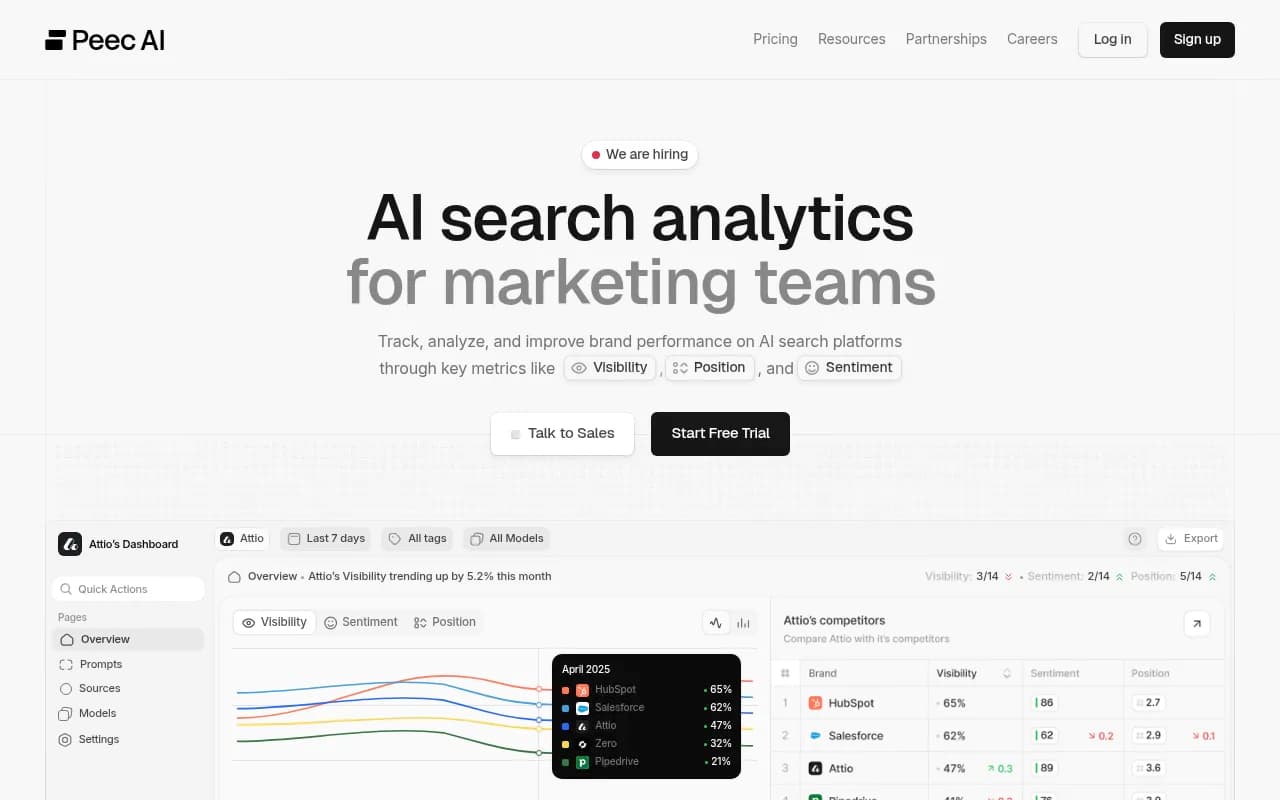
Peec AI takes a more structured approach. The platform is built around multi-language and multi-region monitoring, which is genuinely best-in-class. If you're a brand operating across multiple markets -- say, English, French, German, and Spanish -- Peec handles that in a way that most competitors don't. The reporting is polished, and the competitive comparison features give you a reasonable sense of how you stack up against named rivals.
The seat model is also worth mentioning. Peec AI's pricing structure tends to be more agency-friendly than Otterly's, with unlimited seats available at certain tiers. If you're managing multiple client accounts, that matters.
Where Peec AI falls short is the same place Otterly does: it stops at measurement. You get visibility scores, share-of-voice comparisons, and sentiment breakdowns. You don't get prompt difficulty scores, content recommendations, or any way to act on what you're seeing. The data is well-organized, but it points at the problem without helping you solve it.
Best for: Multi-market brands and agencies that need reliable cross-language monitoring and clean client-facing reports.
Searchable
Searchable sits in a similar tier to the other two -- a monitoring-focused platform with a reasonable feature set for tracking brand visibility across AI models. It covers the core use cases: brand mention tracking, competitive comparisons, and sentiment analysis.
Compared to Otterly and Peec, Searchable is less differentiated. It doesn't have Otterly's simplicity advantage or Peec's multi-language depth. It's a capable tool, but it's harder to identify a specific scenario where it's clearly the best choice over the other two.
Best for: Teams that have already evaluated Otterly and Peec and are looking for a third option, or those who find Searchable's specific interface or integrations a better fit for their workflow.
Side-by-side comparison
| Feature | Otterly.AI | Peec AI | Searchable |
|---|---|---|---|
| AI models covered | ChatGPT, Perplexity, Gemini, Claude | ChatGPT, Perplexity, Gemini, Claude | ChatGPT, Perplexity, Gemini |
| Multi-language support | Limited | Best-in-class | Basic |
| Custom prompts | Yes (manual) | Yes | Yes |
| Prompt volume/difficulty data | No | No | No |
| Competitor visibility comparison | Basic | Yes | Basic |
| Content gap analysis | No | No | No |
| AI content generation | No | No | No |
| Crawler logs | No | No | No |
| Hallucination/accuracy detection | No | No | No |
| Traffic attribution | No | No | No |
| Agency seat model | Limited | Yes (unlimited seats) | Limited |
| Pricing entry point | ~$49/mo | ~$79/mo | ~$49/mo |
| Ease of setup | Very easy | Moderate | Moderate |
The shared gap: monitoring without optimization
Here's the honest problem with all three tools. They answer "are we visible?" They don't answer "why aren't we visible for this prompt?" or "what should we publish to change that?"
That gap has real consequences. Knowing your visibility score is 23% while a competitor sits at 61% is frustrating information if you have no path to close it. You can see the delta. You can't act on it.
The missing piece is what's sometimes called the action loop: find the specific prompts where competitors are visible and you're not, understand what content AI models are citing for those prompts, create content that fills the gap, and track whether your visibility improves as a result. None of the three tools in this comparison support that loop.
There's also the accuracy problem. AI models don't just mention or not mention your brand -- they sometimes mention your brand and get things wrong. Wrong pricing, wrong features, outdated integrations, misattributed quotes. A monitoring tool that counts mentions without checking accuracy is giving you an incomplete picture. If ChatGPT is actively telling prospects incorrect things about your product, a positive sentiment score is worse than useless -- it's actively misleading.
What to look for if monitoring isn't enough
If you've outgrown the monitoring-only approach -- or if you're starting fresh and want a platform that can actually move the needle -- there are a few capabilities worth prioritizing:
Answer gap analysis. This shows you the specific prompts where competitors are being cited and you're not. Not just "you're less visible than Competitor X" but "here are the 14 prompts where they appear and you don't, and here's what content AI models are pulling from when they answer those queries."
Content generation grounded in citation data. Generic AI writing tools won't help here. What you need is content built around the actual sources AI models cite -- the specific angles, formats, and topics that get pulled into responses. That requires real citation data at scale, not guesswork.
Crawler logs. Knowing which pages AI crawlers are actually visiting (and which ones they're ignoring or hitting errors on) is a different kind of insight than visibility scores. It tells you about the technical layer of AI discoverability.
Traffic attribution. Visibility scores are a proxy metric. What you actually care about is whether AI search is driving real traffic and revenue. That requires connecting your visibility data to actual site visits and conversions.
Promptwatch is built around exactly this loop -- it covers monitoring across 10 AI models but adds answer gap analysis, an AI writing agent that generates content grounded in 880M+ citations analyzed, crawler logs, and traffic attribution. It's the difference between a dashboard and an optimization platform.

Choosing between the three
If you've decided that monitoring-only is sufficient for your current needs -- maybe you're just getting started with AI visibility tracking, or you need a simple report to show stakeholders -- here's how to choose between the three:
Pick Otterly.AI if you want the fastest setup and the lowest friction. It's the right tool for someone who needs to answer "are we showing up in AI search?" without spending a week configuring the platform.
Pick Peec AI if you're operating across multiple languages or markets, or if you're an agency that needs unlimited seats and clean client-facing reports. The multi-language support is a genuine differentiator.
Pick Searchable if you've evaluated the other two and neither fits your workflow, or if a specific integration or interface detail makes it the better fit for your team.
All three will give you a reasonable baseline picture of your AI visibility. None of them will tell you what to do about it.
The monitoring trap
There's a version of this that plays out a lot: a team signs up for one of these tools, watches their visibility score for a few months, notices it's not improving, and concludes that AI visibility is hard to influence. That conclusion is wrong, but it's an understandable one when your only tool is a measurement instrument.
AI visibility is influenceable. The brands winning in AI search are winning because they've published content that AI models want to cite -- specific, authoritative, well-structured content that answers the questions people are actually asking. That's a content strategy problem, not a monitoring problem. And it requires tools that can tell you what to write, not just whether you're being mentioned.
The monitoring tools in this comparison are useful. They're just not sufficient on their own. If your goal is to actually improve your AI search presence -- not just track it -- you'll need to pair them with something that closes the loop from insight to action.
Further reading
If you're evaluating the broader AI visibility tool landscape, a few resources worth checking:
- The Frase.io breakdown of 10 AI visibility platforms covers pricing and use cases across enterprise, mid-market, and emerging tiers
- SE Ranking's guide to AI Mode tracking tools includes a useful breakdown of which platforms cover which AI models
- The Loamly comparison of AI search visibility tools categorizes platforms by use case (GEO audits, persona-based tracking, agency seats, SEO integration) which is a helpful frame for narrowing down options
The market is moving fast. Tools that were monitoring-only a year ago are adding optimization features, and new platforms are launching with the full action loop built in from day one. Worth revisiting your stack every six months or so to see what's changed.