Key takeaways
- Ranketta is an AI visibility and merchandising platform for e-commerce and D2C brands. It measures visibility per SKU, not per brand, and rewrites product data to fix gaps.
- Pricing starts at €29/mo for Tracker (2 AI models, 30 prompts per model) and €79/mo for Starter, which is where merchandising begins. Growth is €199 and Scale is €449.
- Model limits are the catch. Each plan caps how many engines you can track, and premium engines (Claude, Copilot, Alexa, Grok) count against a smaller sub-limit.
- Its own G2 profile shows 21 reviews at 4.9, which is a small sample. I could not verify independent user reviews beyond that.
- Stores without a catalog (B2B, SaaS, publishers), teams that need classic search reporting, or teams that need crawler logs should look elsewhere.
What Ranketta actually is
Ranketta is built for one kind of buyer: a team that owns a product catalog and wants AI assistants to recommend the individual products in it. Most AI visibility tools count how often your brand name appears in an answer. Ranketta counts how often a specific SKU appears, where it ranks, and what competing products show up instead.
That distinction matters more than it sounds. A brand tracker can tell you that you appear in 40% of answers while your actual products never make the shortlist. For a store, that gap is the whole problem.
The company says it serves 1,200+ e-commerce and D2C brands, and lists logos such as T-Mobile, Rossmann, O2, GymBeam and Vilgain on its homepage. Logos on a homepage are marketing, not proof of depth of use, so I treat them as a signal of audience (a lot of Central European retail) rather than a quality guarantee.
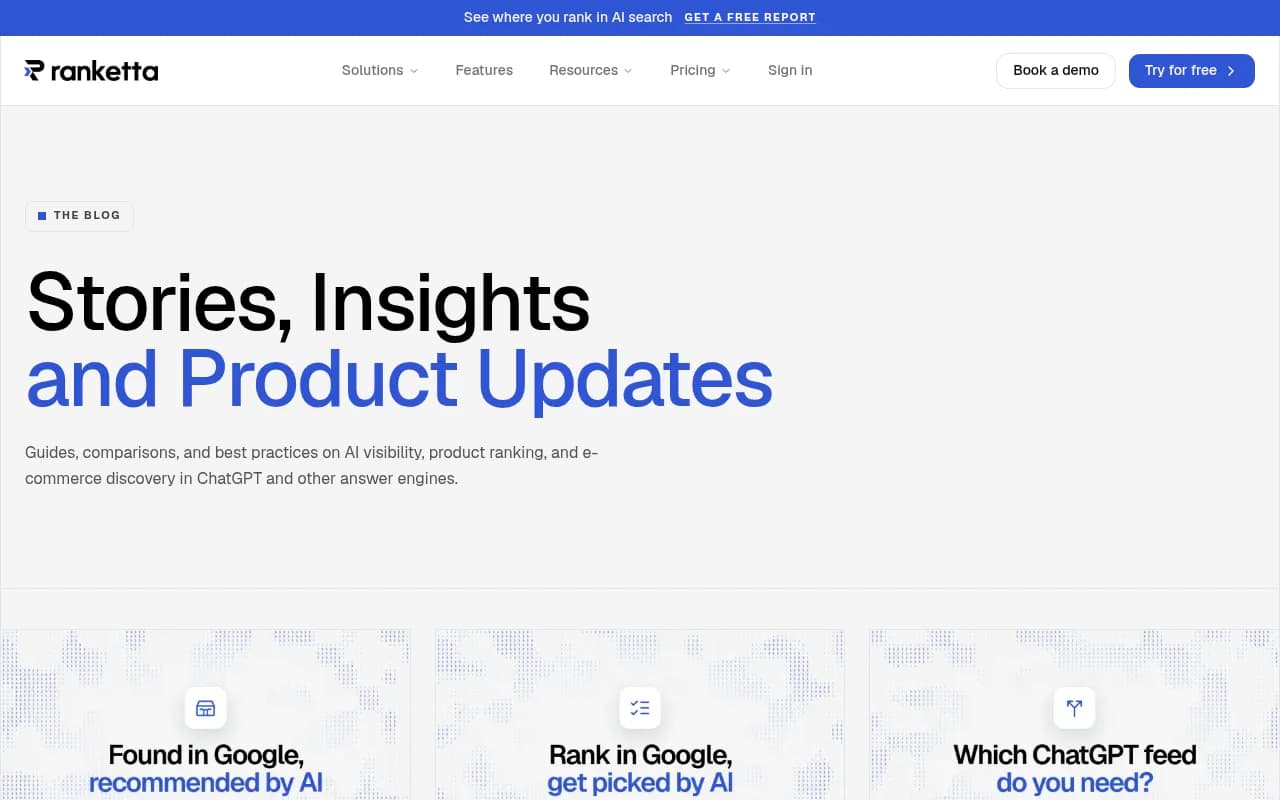
The blog is worth a glance before you buy. Recent posts cover the ChatGPT product feed (including the difference between the Ads Manager feed and the organic commerce feed) and Shopify SEO. It tells you where the team's head is: product data first, content second.
Features, in plain terms
Product-level visibility tracking
Per-product mention frequency, ranking position and sentiment across the engines you pick. There is a Best Sellers style view that ranks the products AI recommends most often by share of voice, and a competitor landscape showing which rival products win the same prompts.
Ranketta says it collects data from real browser sessions rather than vendor APIs, running each prompt repeatedly and cross-validating. That is the right approach in principle, since shopping surfaces often have no public API. I could not independently verify the claim, so ask for the methodology doc and sample exports during the trial.
Product data enrichment (merchandising)
This is the feature that separates Ranketta from most trackers. An AI agent rewrites titles, descriptions, GTINs and attributes at catalog scale, attaching a confidence score to each proposed fix. You can approve manually or auto-approve. Feeds then export to Amazon, Google Merchant Center, Heureka and Zboží.cz, with native Shopify and Shoptet integrations.
If your listings are thin, this is a real reason to buy. Even AmICited, a competitor that wrote a comparison of these tools, concedes Ranketta is ahead on feed merchandising.
Content studio
It drafts comparisons, listicles and guides based on your tracked prompts. Nothing publishes without your approval, per Ranketta's FAQ. This is a fairly standard add-on in 2026, so I would not pay a premium for it alone.
Integrations and reporting
- Platforms: Shopify, Shoptet, Adobe Commerce, Wix, BigCommerce, Amazon, Walmart
- Data sources: Google Merchant Center, Google Analytics, Cloudflare for AI traffic attribution
- MCP server for Claude, Cursor and other clients
- Looker Studio connector and multi-client tracking for agencies
Pricing and where the limits bite
Prices below come from Ranketta's pricing page, in EUR. The Shopify App Store lists the same tiers in USD ($29, $79, $199, $449), so check which currency applies to you at checkout. All plans start with a 7-day free trial.
| Plan | Price | AI models | Prompts per model | Credits | Sites / countries |
|---|---|---|---|---|---|
| Tracker | €29/mo | 2 | 30 | n/a | 1 / 1 |
| Starter | €79/mo | 3 | 50 | 5k | 1 / 1 |
| Growth | €199/mo | 4 | 100 | 15k | 2 / 3 |
| Scale | €449/mo | 5 | 300 | 45k | 5 / 10 |
| Enterprise | Custom | 1000+ prompts per model | 45k+ | 5+ / 10+ | SLA, SSO, AEO specialist |
A few things to notice before you commit.
Tracker is tracking only. It is the cheapest way in, but you pick just 2 models. G2 lists 25 prompts per month for it while the homepage and Shopify say 30 per model, so the G2 listing is probably stale. Confirm in the app.
Premium engines are rationed. Standard models are Google AI Overviews, AI Mode, ChatGPT, Gemini and Perplexity. Premium ones are Amazon Alexa, Claude, Copilot, Grok, Meta Muse, Walmart Sparky and Instacart Clementine. Per the Shopify listing, Starter allows one premium model, Growth two, Scale three. If you care about Alexa and Copilot plus ChatGPT, you are on Growth or higher.
Credits are shared. Merchandising, Agent Mode and article generation all draw from one monthly pool. Extra credits cost $1 per 1,000 on Shopify, with packs from €10 per month. A large catalog being rewritten will burn through 5k credits quickly, so ask how many credits a typical SKU fix costs before sizing a plan.
Scale is per-site. Starter covers one website and one country. Multi-market stores climb the ladder fast.
Annual billing saves €180, €420 and €900 a year on Starter, Growth and Scale respectively.
What users and third parties say
On G2, Ranketta shows 21 reviews, all five stars, averaging 4.9. That is encouraging and also not very informative. Twenty-one reviews with zero spread usually means a vendor-driven review push. The Shopify App Store listing showed no ratings when I checked. I did not find independent Reddit or forum threads of substance, so treat the praise as unverified until you test it yourself.
The most useful outside source is the AmICited comparison. It is a competitor's view, and the author says Ranketta declined them a trial, so read it with that in mind. Their verdict: Ranketta is the pick when your problem is thin listings that AI never picks, but it has no Search Console layer (no striking-distance or CTR-gap reporting) and no order data for margin or retention views.
Who should pick Ranketta
- Online stores with their own catalog and GTINs that already feed Google Merchant Center or a marketplace
- D2C brands where the brand and the product are the same thing
- Agencies running several small store clients who want share of voice and Looker Studio reporting
- Teams that would rather fix product data than write more blog posts
Who should pick something else
You do not sell a catalog
Ranketta lists B2B and SaaS use cases, but the whole product is shaped around SKUs and feeds. A SaaS company is paying for merchandising it cannot use. A general AI visibility platform is a better fit.
You need to know whether AI bots can read your site
Ranketta offers Cloudflare-based AI traffic attribution, but it is not a crawler observability product. If engineering suspects bots are blocked or rate-limited, Promptwatch offers IP-verified AI crawler logs that show which pages each bot reads and where it fails, then connect that to citations and AI-referred visits. It also writes and publishes content to WordPress, Webflow or Framer through its Content Agent, so the loop continues past the dashboard.

Promptwatch also has ChatGPT Shopping tracking for product recommendations, and you can start with the free AI visibility report or the 7-day trial. It does not rewrite your product feed the way Ranketta does, so for a store with thin listings the two address different problems.
You want a cheap brand-level tracker
If you only need to know whether your brand shows up, Otterly.AI is a common low-cost starting point.

Peec AI is another monitoring-focused option.

Neither fixes anything, but neither charges you for merchandising you will not use.
You need the whole search surface
Ranketta says content it helps create improves Google visibility too, but it has no Search Console reporting. If you work Google and Bing as hard as AI, you will want that data next to your AI numbers. Promptwatch pulls Search Console and Bing data alongside AI citations, and classic suites like Semrush cover the traditional side.
More options are collected in the GEO software directory at bestgeosoftware.com.
Comparison at a glance
| Need | Ranketta | Promptwatch | Otterly.AI |
|---|---|---|---|
| SKU-level tracking | Yes, core feature | Shopping tracking in ChatGPT and Alexa | No SKU-level tracking on base plan |
| Product feed rewriting | Yes, with confidence scores | No | No |
| AI crawler logs | No | Yes, IP-verified | No |
| Search Console and Bing data | No | Yes | No |
| Content generation and CMS publishing | Content studio, approval-based | Content Agent with WordPress, Webflow, Framer | No |
| Entry price | €29/mo | $95/mo | $29/mo |
Promptwatch pricing is Essential $95, Professional $245 and Business $579 per month. Confirm current numbers at promptwatch.com/pricing, since the Content Agent and faster tracking only start on Business.
One thing to remember about AI prompts
Whatever tool you pick, remember that AI search queries are getting shorter. Promptwatch Data's ChatGPT query fanouts report shows average fanout query length falling from about 117 characters in December 2025 to roughly 53 characters once fanouts returned in April 2026. Prompts you track should look like short, keyword-like searches too, not only long conversational questions. Ask any vendor, Ranketta included, how it builds its prompt set.
How I would evaluate it
- Start the 7-day trial on Starter, not Tracker, so you can test merchandising.
- Pick 20 to 30 SKUs you care about and check whether the tracked prompts reflect how shoppers ask.
- Run a small batch of enrichment fixes and check the confidence scores against your own judgment before auto-approving anything.
- Count credit usage after that batch and project it across your catalog.
- Compare the visible model list with the engines your customers use. If Alexa or Copilot matters, price Growth, not Starter.
Verdict
Ranketta is a focused product, and focus is its strength. For a store with a messy catalog and a Shopify or Merchant Center setup, SKU-level tracking plus feed enrichment is something most competitors do not offer at all. The trade-offs are real: tight model caps, a shared credit pool, no classic search reporting, no crawler logs, and a review profile that is too small to lean on. If your problem is product data, try it. If your problem is anything broader, shortlist an end-to-end AI visibility platform first and use Ranketta's trial as a comparison.