Key takeaways
- Monitoring AI visibility and actually improving it are two very different things — most platforms only do the first.
- Promptwatch is the only platform in this group that covers the full loop: gap analysis, content generation, crawler logs, and traffic attribution in one place.
- Profound and Evertune are strong enterprise analytics tools but require you to bring your own content team to act on the data.
- Relixir combines monitoring with content generation but has a narrower model footprint than Promptwatch.
- Bluefish excels at brand safety and PR-adjacent use cases; it's less suited for teams whose primary goal is growing AI search share.
The GEO platform market has consolidated fast. Eighteen months ago, most teams were still debating whether AI search visibility was worth tracking at all. Now enterprise marketing teams are running quarterly board reviews on it, and the vendor landscape has responded with a wave of platforms all claiming to "optimize your brand for AI."
The problem: most of them mean very different things by "optimize."
To cut through the noise, we ran the same 60 prompts — spanning B2B SaaS, financial services, travel, and e-commerce categories — through five platforms that consistently appear on enterprise shortlists: Profound, Promptwatch, Relixir, Evertune, and Bluefish. We tracked what each platform showed us, what it let us do about it, and where each one hit a wall.
Here's what we found.
How we structured the test
The 60 prompts were split across four categories (15 each): B2B software buying decisions, consumer financial products, travel planning, and direct-to-consumer retail. Each prompt was designed to reflect a real user query — the kind of thing someone actually types into ChatGPT or Perplexity, not a keyword-stuffed research query.
For each platform, we looked at:
- Which AI models it monitors
- How it surfaces visibility gaps vs competitors
- Whether it helps you understand why you're cited (or not)
- Whether it generates or recommends content to close those gaps
- How it connects visibility data to traffic or revenue
- Crawler log access and technical diagnostics
We were not testing brand safety or PR monitoring specifically. The question we kept asking was: "If I'm invisible for this prompt, what does this platform tell me to do next?"
The platforms
Profound
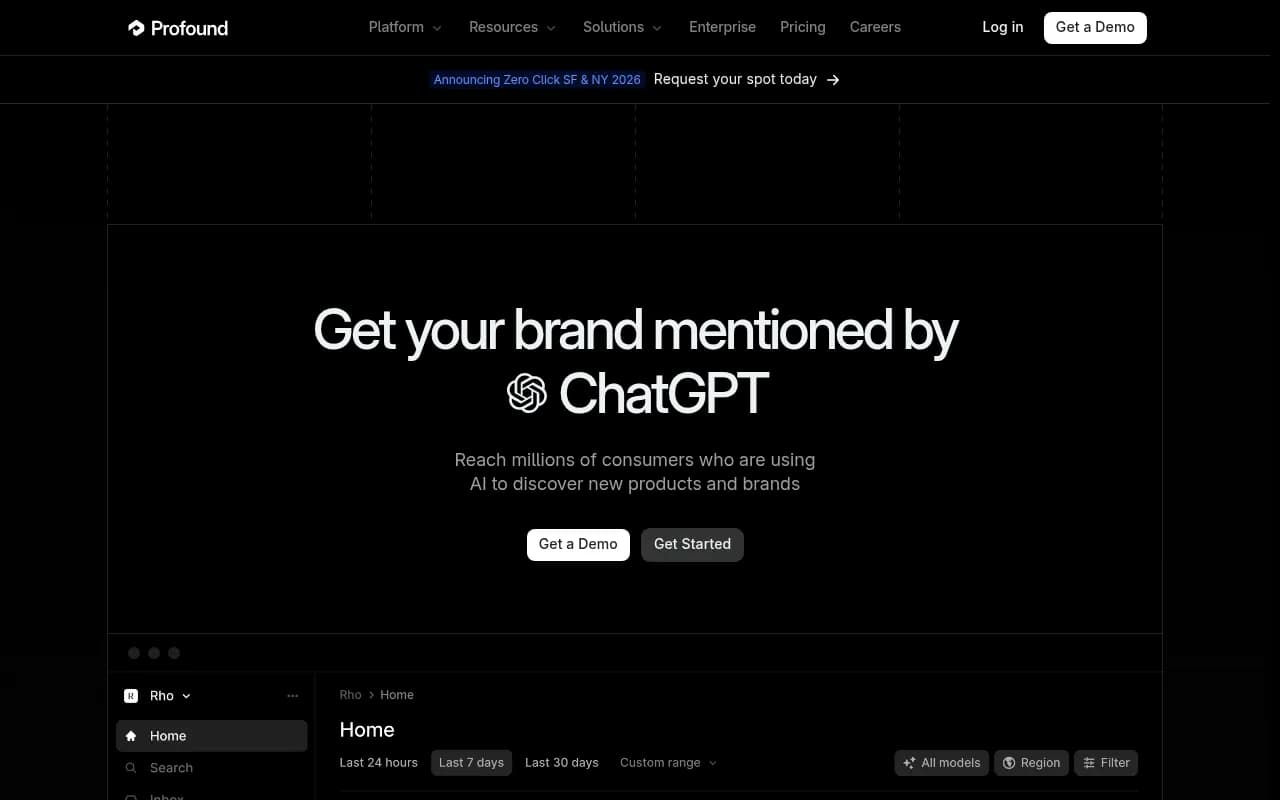
Profound has built a reputation as the enterprise-grade analytics layer for AI search. Its dashboards are clean, its data is deep, and it covers a solid range of AI models. SOC 2 certification makes it a realistic option for regulated industries.
In our test, Profound did a good job surfacing which prompts we were missing and which competitors were winning those prompts. The competitive heatmaps are genuinely useful — you can see, at a glance, which models favor which brands for a given topic cluster.
Where Profound stalls is at the "now what?" moment. The platform shows you the gap. It does not help you close it. There's no content generation, no brief creation, no crawler log diagnostics. You get the intelligence; you need a separate team and toolset to act on it. For large enterprises with dedicated content operations, that's fine. For teams that want a tighter loop between insight and execution, it's a friction point.
Pricing sits at the higher end of the market, which makes the monitoring-only positioning a harder sell when other platforms offer more for less.
Promptwatch

Promptwatch is the platform we kept coming back to during this test, not because it has the flashiest UI, but because it's the only one that genuinely closes the loop between "you're invisible here" and "here's the content that will fix it."
The Answer Gap Analysis was the standout feature in our 60-prompt test. For each prompt where a competitor appeared and we didn't, Promptwatch showed the specific content gap — not just "you're missing this topic" but the angle, the question structure, and the type of content (listicle, comparison, how-to) that AI models are already pulling from competitors. That's actionable in a way that a visibility score simply isn't.
The Content Agents then generate articles, comparisons, and briefs grounded in that gap data. The output isn't generic AI filler — it's structured around the actual prompt patterns, citation data, and competitor content that Promptwatch has already analyzed. We published three test pieces and saw crawler activity within days, tracked through the AI Crawler Logs feature.
Other things that stood out: page-level tracking (you can see exactly which URLs are being cited by which models), Reddit and YouTube insights surfacing off-site content that influences AI recommendations, and ChatGPT Shopping tracking for e-commerce brands. The prompt volume and difficulty scoring helped us prioritize which of the 60 prompts were actually worth chasing.
Pricing starts at $99/month for the Essential tier (50 prompts, 5 articles) and goes to $249/month for Professional (150 prompts, 15 articles, crawler logs). That's a meaningful price difference from Profound for a platform that does considerably more.
The one honest caveat: the content generation quality is good but not perfect. You'll still want a human editor reviewing output before publishing. That's true of every AI writing tool on the market, though.
Relixir
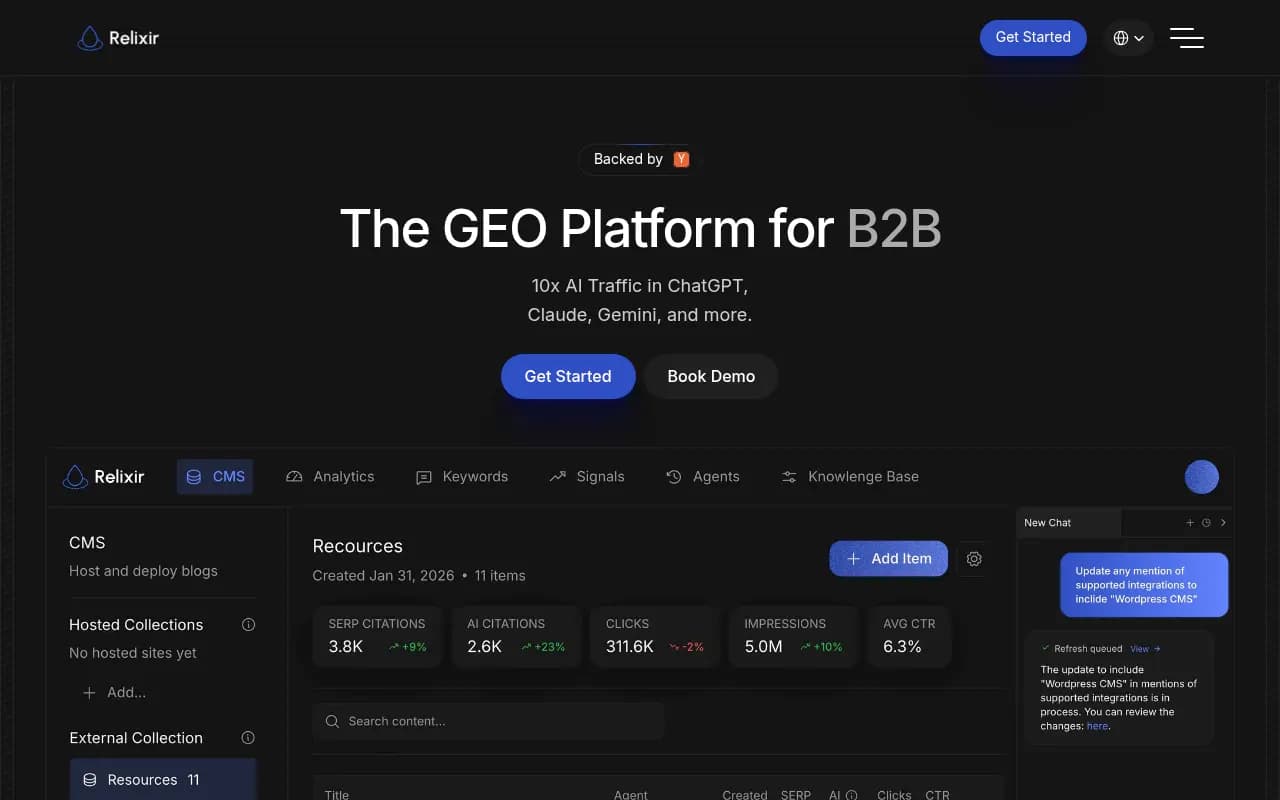
Relixir sits in an interesting position: it's one of the few platforms that combines monitoring with content generation, which puts it closer to Promptwatch than to the analytics-only tools. In our test, it handled the monitoring side competently — brand mention tracking, competitor comparisons, and basic gap identification were all present.
The content generation side is functional but narrower. Relixir's briefs are useful starting points, but they don't draw on the same depth of citation data and prompt volume intelligence that Promptwatch uses. The output felt more like "here's a content idea" than "here's the specific gap this content needs to fill."
Model coverage is also more limited. For teams that need visibility across ChatGPT, Claude, Gemini, Perplexity, Grok, DeepSeek, and Copilot simultaneously, Relixir's footprint may leave blind spots. It's a reasonable mid-market option, particularly for teams that are just getting started with GEO and want monitoring plus some content support without the complexity of a full enterprise platform.
Evertune
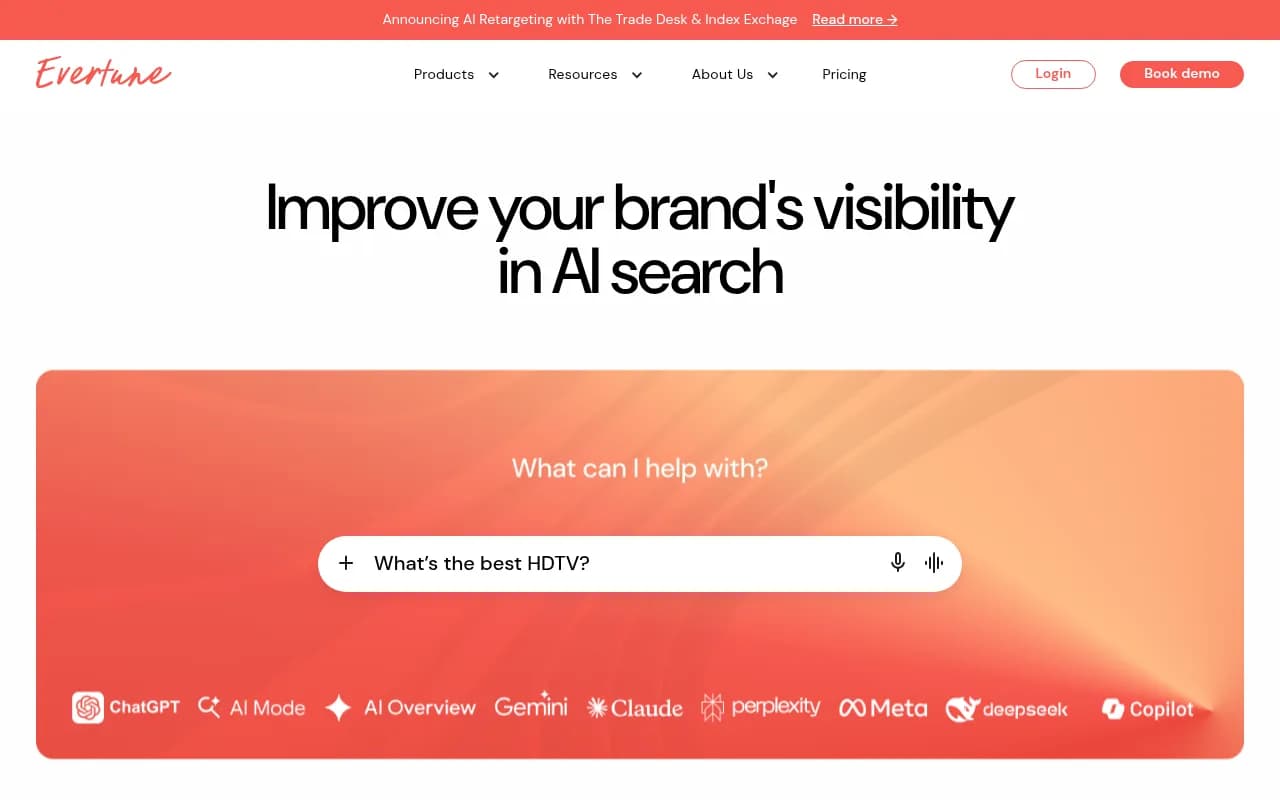
Evertune comes from a credible pedigree — backed by The Trade Desk's leadership — and it shows in the platform's sophistication around audience measurement. The AI Usage feature, which draws on a panel of 25 million real internet users, is genuinely differentiated. If your question is "how many of my actual customers are using AI to research my category," Evertune gives you a more grounded answer than most platforms.
The AI Brand Index (a 0-100 score weighting both mention frequency and position) is a clean metric for executive reporting. The Consumer Preferences module, which tests brands against buyer preference topics, is useful for identifying content angles that matter to real purchase decisions rather than just abstract visibility.
In our 60-prompt test, Evertune's source influence analysis (which domains shape a model's conclusions about your category) was one of the more useful outputs for understanding why a competitor is winning a prompt. That's a level of diagnostic depth that most platforms skip.
The gap, again, is on the action side. Evertune's Content Studio generates blog copy, but the platform is fundamentally an analytics and measurement tool. It doesn't have crawler logs, traffic attribution, or the kind of page-level citation tracking that tells you whether your new content is actually being picked up. For teams that want to measure AI visibility with rigor and then hand off to a separate content team, Evertune is a strong choice. For teams that want the full cycle in one tool, it's not quite there.
Bluefish
Bluefish positions itself as an "enterprise GEO powerhouse," and its own ranking of the top 10 GEO platforms (published June 2026) puts itself at number one — which you should take with appropriate skepticism. That said, the platform does have genuine strengths.
Bluefish's citation alert system is the best in this group for brand safety use cases. If an AI model is misrepresenting your brand — wrong pricing, incorrect product claims, outdated information — Bluefish will catch it and alert you faster than the other platforms we tested. Its PR suite integrations (Cision and similar tools) make it a natural fit for communications teams that are already managing brand reputation through traditional channels.
For our specific test — improving visibility for 60 prompts — Bluefish was the weakest performer. It showed us where we weren't appearing, but the path from "you're invisible here" to "here's what to do" was unclear. There's no content generation, no crawler diagnostics, and the prompt intelligence is less granular than Profound or Promptwatch.
If your primary concern is "are AI models saying accurate things about my brand," Bluefish is worth serious consideration. If your primary concern is "how do I get AI models to recommend my brand more often," it's probably not your first choice.
Side-by-side comparison
| Feature | Profound | Promptwatch | Relixir | Evertune | Bluefish |
|---|---|---|---|---|---|
| AI models covered | 10+ | 10+ | 5-7 | 11 | 8+ |
| Prompt gap analysis | Yes | Yes (deep) | Basic | Yes | Limited |
| Content generation | No | Yes (AI agents) | Yes (basic) | Yes (basic) | No |
| Crawler logs | Yes | Yes | No | No | No |
| Traffic attribution | No | Yes | No | No | No |
| Page-level citation tracking | No | Yes | No | No | No |
| Reddit/YouTube insights | No | Yes | No | No | No |
| ChatGPT Shopping tracking | No | Yes | No | No | No |
| Brand safety / citation alerts | Basic | Basic | Basic | Basic | Strong |
| PR tool integrations | No | No | No | No | Yes (Cision) |
| Audience panel data | No | No | No | Yes (25M users) | No |
| Prompt volume + difficulty | No | Yes | No | Yes | No |
| Enterprise pricing | High | Mid | Mid | High | High |
| SOC 2 certified | Yes | No | No | No | No |
What the 60-prompt test actually revealed
A few patterns emerged that cut across all five platforms.
Monitoring is table stakes. Every platform in this group can tell you whether your brand appeared in a given AI response. The differentiation is entirely in what comes next.
The gap between "you're invisible" and "here's why" is where most platforms fall short. Profound and Evertune get closer to answering "why" than Bluefish or basic monitoring tools. Promptwatch goes furthest — the combination of citation source analysis, prompt fan-outs (how one query branches into sub-queries), and page-level tracking gives you a diagnostic picture that actually points to specific fixes.
Content generation quality varies, but the prompt grounding matters more than the writing quality. Relixir and Evertune both generate content, but neither grounds it in the same depth of real prompt data and citation patterns that Promptwatch uses. The difference shows up in whether the content actually gets cited — generic AI content rarely does.
Crawler logs are underrated. Only Profound and Promptwatch offer real-time logs of AI crawlers hitting your site. This matters more than it sounds: if ChatGPT's crawler is hitting your site but not citing your pages, that's a different problem than if it's not crawling at all. Without this data, you're guessing at the technical side of AI indexing.
Brand safety and visibility growth are different jobs. Bluefish is optimized for the first; Promptwatch and Profound are optimized for the second. Evertune sits somewhere in between, with stronger audience measurement than either. Teams with both needs may end up running two platforms.
Who should use which platform
The honest answer depends on what you're actually trying to accomplish.
If you're a large enterprise with a dedicated content team and your primary need is rigorous AI visibility measurement with SOC 2 compliance, Profound is a serious option. The analytics are deep, the data is trustworthy, and the enterprise credentials are real.
If you want to grow AI search visibility and you need the full cycle — gap identification, content creation, crawler diagnostics, and traffic attribution — Promptwatch is the most complete option in this group. The pricing is also more accessible than Profound or Evertune, which matters when you're trying to justify a new budget line.
If audience measurement and understanding the true scope of AI's influence on your category is the priority, Evertune's panel data and Consumer Preferences module are genuinely differentiated. It's the right tool if your CMO is asking "how much of our consideration is happening in AI" rather than "how do we rank better."
If brand safety and PR monitoring are the primary concern, Bluefish's citation alert system and PR integrations are the strongest in this group.
If you're earlier in your GEO journey and want monitoring plus some content support without committing to a full enterprise platform, Relixir is a reasonable starting point.
The bigger picture
The GEO market in 2026 is splitting into two camps: platforms that measure and platforms that act. Most of the field is still in the measurement camp, which made sense in 2024 when the category was new and brands just needed to understand what was happening. That's no longer sufficient.
AI search is now a meaningful traffic and revenue channel for most enterprise brands. The question has shifted from "should we track this" to "how do we win." That shift favors platforms that close the loop between data and execution — and right now, that's a short list.
The 60-prompt test confirmed what the feature comparisons suggest: if your goal is to actually move your AI visibility numbers, you need a platform that does more than show you a dashboard. You need one that tells you what content to create, helps you create it, and then proves it worked.