Key takeaways
- Syndicated wire copy is a tiny slice of AI citations. In BuzzStream and Xofu's 4-million-citation study, direct newswire citations were 0.21% of the dataset, and Meltwater put press releases at 0.2% of citations in May 2026.
- Owned pages carry far more weight. Promptwatch Data shows product pages (22.4%) and landing pages (16.8%) make up about 39% of ChatGPT citations (Sep 28 to Oct 4, 2026).
- Press releases are not worthless. Their value comes mostly from the earned coverage they trigger and from the newsroom copy on your own domain, not from the wire copy itself.
- News-type pages decay fast in ChatGPT: half lose their citation within 36 days. Landing pages and docs last for months.
- The practical answer is to publish on your own domain first, treat the wire as a delivery channel, and measure which URL AI actually cites.
The short answer
If your goal is to get cited in ChatGPT, Perplexity, Gemini or Google AI Overviews, owned content beats press release distribution by a wide margin. That is not a close call in any of the datasets I could find. But "owned content wins" hides a more useful story, because a press release can still do real work. It just rarely does that work as the cited page.
This guide separates three things people lump together: the wire copy that lands on Yahoo Finance or a pickup site, the announcement on your own newsroom, and the editorial article a journalist writes because of the release. They behave very differently in AI answers.
What the numbers say about press releases
A caution first. These studies use different datasets, engines, prompts and time windows, so treat the figures as directional rather than as one clean benchmark.
| Source | What it measured | Finding |
|---|---|---|
| BuzzStream and Xofu | 4 million AI citations | Syndicated releases (Yahoo, MSN and similar) were 0.32% of news citations and 0.04% of the full dataset. Direct newswire citations such as PR Newswire were 0.21% of the dataset |
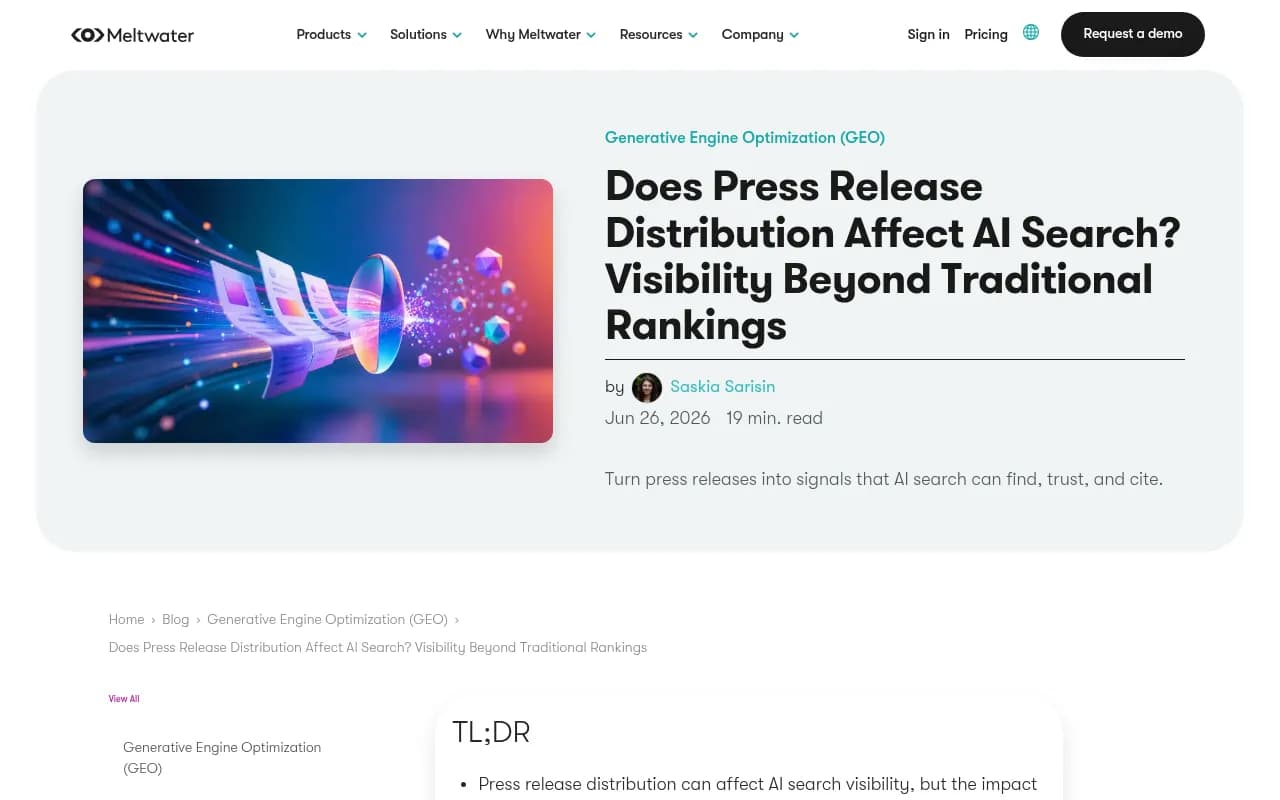
| Meltwater GenAI Lens | 8 million+ citations across eight LLMs | Earned and news media were 37.6% of citations in May 2026. Press releases were 0.2%, down from 0.4% in April |
| Presenc AI | About 5,200 announcement queries | Syndicated releases on newswire pickup sites were cited directly in AI answers less than 8% of the time |
| Muck Rack | Generative Pulse, July 2025 edition | About 95% of cited links came from non-paid sources and about 89% from earned media |
| Promptwatch Data | ChatGPT content types, Sep 28 to Oct 4, 2026 | Press releases were 2.1% of citations on branded prompts. Promptwatch has no all-prompts press release figure, so I won't invent one |
The pattern is consistent even though the exact numbers are not. Wire-distributed text is a rounding error in most citation samples. The one place it shows up with any weight is branded prompts, where someone is already asking about your company by name. Even there, Promptwatch Data puts it at about 2%.
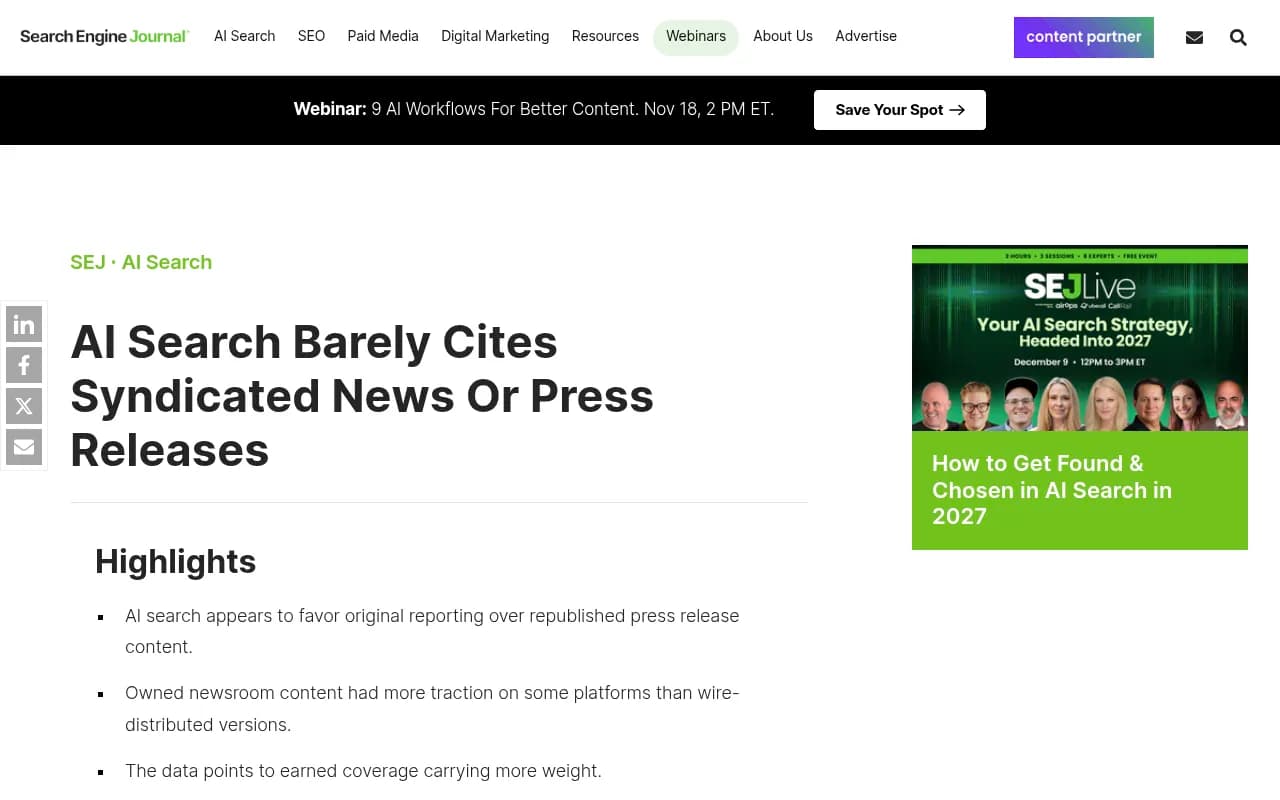
There is a wrinkle worth noting. The SEJ summary of the BuzzStream report says internal press releases and newsroom content on company-owned domains accounted for 18% of ChatGPT's citations in that dataset. So the same announcement can be nearly invisible when it sits on a syndication site and noticeably visible when it sits on your own domain. Where the text lives matters more than the text.
What owned content looks like in the data
Promptwatch Data on which content types ChatGPT cites most (Sep 28 to Oct 4, 2026) gives the clearest picture of what AI actually pulls from.
| Content type | Share of ChatGPT citations |
|---|---|
| Product pages | 22.4% |
| Landing pages | 16.8% |
| Listicles | 13.6% |
| How-tos | 8.7% |
| Documentation | 7.5% |
| General articles | 6.1% |
| Comparisons | 5.9% |
| News | 5.7% |
| FAQ pages | 3.3% |
| Reviews | 1.7% |
Pages that describe what a company sells (product and landing pages) add up to about 39%. On commercial prompts the split leans even harder to owned pages: product pages at 26.0% and landing pages at 20.6%. On branded prompts, landing pages reach 22.8%.
Editorial formats add up to roughly 43%, which is where earned coverage lives. So the real contest is not "press release vs blog post." It is owned commercial pages plus earned editorial on one side, and syndicated wire copy on the other.
AirOps' 2026 analysis of 21,000+ brands, as summarized in a LinkedIn write-up, found brands are roughly 6.5x more likely to be cited through a third-party source than through their own domain. I haven't verified that figure independently, but it fits the Muck Rack and Meltwater numbers. Earned media is the largest pool. Owned pages are the second pool. Wire copy is a distant third.
Why wire copy gets ignored
I can see a few reasons, and only some of them are proven.
It is a duplicate. The same release shows up on dozens of pickup sites. AI engines pulling sources tend to prefer one page that is clearly the original, and often prefer a reported article over a brand talking about itself.
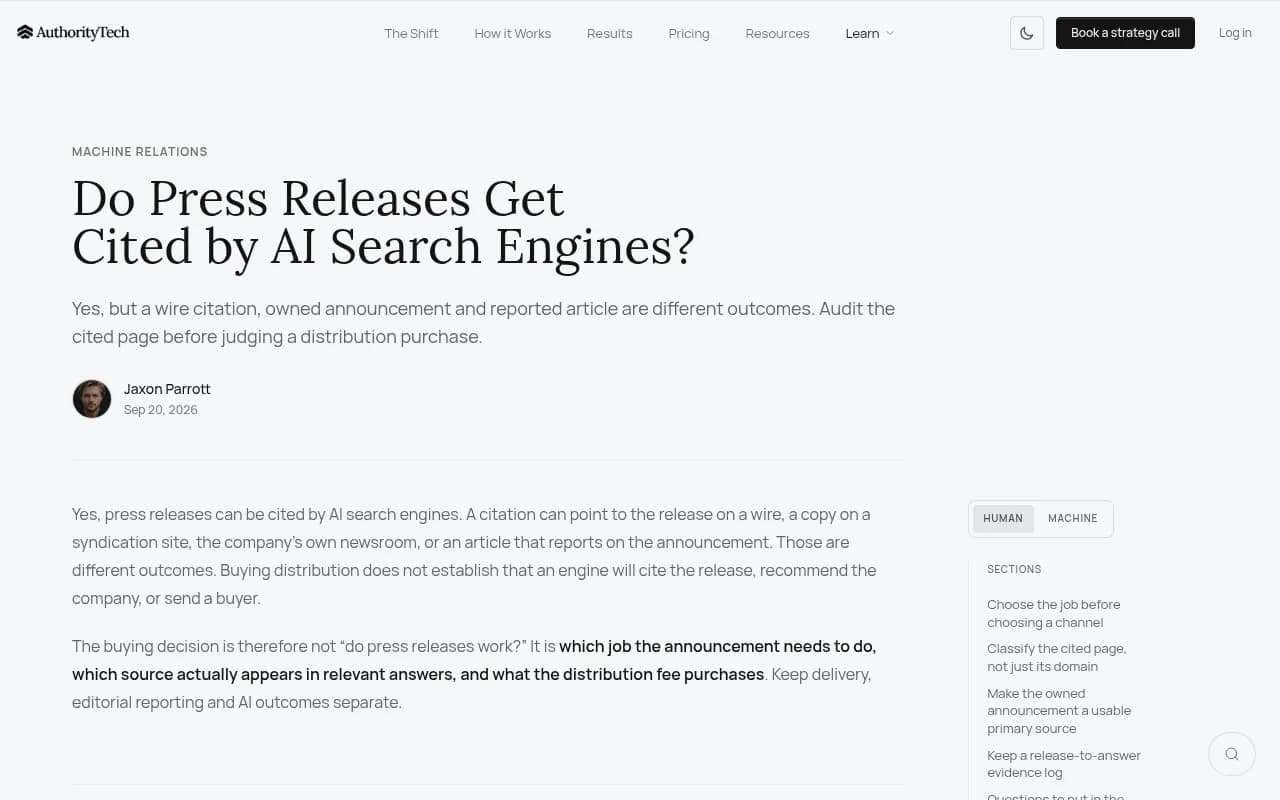
It is thin on evidence. Authoritytech.io cites analysis finding that cited releases contain roughly twice as many statistics and 2.5 times as many bullet points as non-cited ones. A release that says a company is "thrilled to announce" gives a model very little to quote. (That comparison comes from a newswire vendor's blog, so weigh it accordingly.)
It decays quickly. Promptwatch's content half-life report tracked every page ChatGPT cited on July 6, 2026 for 90 days. News pages decayed fastest: almost a quarter were never cited again after day 0, half were gone after 36 days, and 41% were still cited at day 60. Wire copy is closest to news in format, so expect similar behavior. That last step is my inference, since the report does not break out press releases.
Owned pages last longer
The same half-life report shows what persists:
| Page type | Still cited after 30 days | Still cited after 60 days |
|---|---|---|
| Landing pages | 78% | 69% |
| Docs | 76% | 67% |
| Comparisons | 72% | 63% |
| Listicles | n/a | 60% |
| Product pages, reviews, how-tos | n/a | about 55% (half-life 74 to 77 days) |
| News | about half gone by day 36 | 41% |
The landing page, docs and comparison lines drop in the final week only because the study window ends. Their real half-life is likely near or beyond 90 days. Promptwatch's own advice from the report is to use news and press coverage for short bursts of visibility and to treat landing pages, docs and pricing pages as long-term assets.
That gives a workable mental model. A press release is a flare. A landing page is a lamp.
Where press releases do pay off
It would be wrong to read all this as "stop issuing releases." The research points to three ways a release earns its keep.
Triggering earned coverage
Presenc AI estimates each independent editorial article generated from a release adds 0.6 to 1.1 extra AI citation sources per platform, and that trade publication coverage drives 2.8x to 4.2x more AI citations than the same information on a newswire pickup page. Treat these as vendor-research estimates, not settled facts. Still, the direction matches Meltwater's finding that earned and news media are 37.6% of citations.
Data-led announcements
Presenc also reports that releases with original statistics get picked up editorially at 2.7x the rate of standard announcements like funding rounds or new hires. The reasoning is simple. A journalist can use a number. They cannot use an adjective. And a statistic can get cited on its own even when the article around it is ignored.
Feeding a canonical page on your domain
The 18% figure for company-owned newsroom content in ChatGPT's citations suggests an announcement on your own site can be cited directly. Authoritytech.io makes a similar point: a wire citation, an owned announcement and a reported article are different outcomes, and you should audit the cited page before judging a distribution purchase.
A decision framework
Pick the job first, then the channel.
| Goal | Best vehicle | Why |
|---|---|---|
| Get cited for commercial and branded prompts | Owned product and landing pages | They are the largest and longest-lived citation surface |
| Get cited on technical or how-to questions | Docs, how-tos, FAQs kept public and crawlable | Docs persist and 93% were cited again after day 0 |
| Be named in third-party "best of" answers | Earned coverage, listicles, reviews on trusted sites | Editorial formats are about 43% of ChatGPT citations |
| Short burst of visibility around news | Wire plus owned newsroom plus outreach | News decays in weeks, so plan for a spike |
| Prove a claim to journalists | Data-led release with original statistics | Higher editorial pickup rate |
| Meet a contractual or regulatory disclosure need | Wire distribution | That is what the wire is built for, regardless of AI |
A practical workflow
- Publish the canonical version on your own domain first. Put the facts, dates, named sources and supporting data on a crawlable newsroom page. Include the numbers in plain text rather than in an image.
- Lead with original data where you can. Survey results, benchmarks and internal stats give journalists and AI something to quote.
- Pitch the story, not the release. A source brief aimed at a specific reporter's beat is what produces the earned articles that AI actually cites.
- Use the wire for reach, not citations. Buy it if you need delivery to a defined audience. Don't buy it expecting AI visibility.
- Update the evergreen page. If the announcement changes what you sell, change the product or landing page too. That page lasts longer than the news item.
- Check what got cited. Look at the exact URL in AI answers for the relevant questions, and note whether it is the wire, your site or an article.
Measuring which version gets cited
The hard part is attribution. You need to know which URL an engine cited, which prompts it appeared for, and whether AI crawlers even reached your newsroom page. Tools in this space include Promptwatch, which tracks citations by page and shows IP-verified AI crawler logs so you can tell an access problem from a content problem.

It also has a free AI visibility report if you want a starting snapshot before committing to anything. Other options for tracking AI citations and mentions include Profound, Otterly.AI and Peec AI, which focus mostly on monitoring.


If you want to see how coverage and press pickups flow through traditional media monitoring, Meltwater publishes a GEO blog and sells media intelligence. It is where the 37.6% earned media figure came from.
For browsing more options, the GEO software directory at bestgeosoftware.com lists tools by category.
To check whether your own pages are crawlable by AI bots before blaming your content, Promptwatch's agentic readiness check is free.
Common mistakes
- Judging a wire purchase by pickup count. Dozens of pickup sites do not translate into dozens of citations. Meltwater and BuzzStream both show the opposite.
- Writing the release like an ad. Superlatives give a model nothing to extract. Specific numbers, named people and dates do.
- Leaving the newsroom thin. If your own announcement page is a short paragraph with no data, the engine will cite someone else's summary of it.
- Ignoring decay. News-type pages lose half their citations in about 36 days. Plan a follow-up, not a one-off.
- Treating one study as law. BuzzStream, Meltwater, Presenc and Promptwatch measured different things. The direction agrees. The decimals don't.
What the evidence does not tell us
Some gaps are worth being upfront about. None of these studies prove that distribution causes lower citation rates, only that wire copy is rarely the cited page. Promptwatch has no dedicated press release vs owned content report, so the only press release figure from its data is the 2.1% share on branded prompts. I also did not verify the BuzzStream, Meltwater, Presenc or AirOps findings against their original reports beyond what the cited summaries state, and I did not research wire pricing. If you are weighing a specific purchase, ask the vendor for a list of live destinations and run your own before-and-after test.
The bottom line
Owned content gets cited more, and it keeps getting cited longer. Product pages, landing pages and docs are the core surface. Earned editorial coverage is the second big pool, and a good release is one of the better ways to trigger it. The syndicated wire copy itself is the weakest link. Put your effort into the page on your own domain, use the release to earn reporting, and check the cited URL before you decide the wire was worth it.