Key takeaways
- Peec AI and Otterly.AI are both AI visibility monitoring tools -- they track brand mentions across LLMs but stop there
- Peec AI suits enterprise and agency teams that need real-time alerts and API access; Otterly.AI is better for smaller teams on tighter budgets who want GEO audit depth
- Neither platform helps you create content, close visibility gaps, or connect AI mentions to actual traffic or revenue
- Both tools miss accuracy problems -- they can show healthy mention counts while ChatGPT is quoting your wrong pricing or attributing a competitor's feature to you
- If you need to go beyond monitoring and actually improve your AI search visibility, you'll need a platform with content generation and optimization built in
The AI visibility tracking space filled up fast. Seemingly overnight, a dozen tools appeared promising to tell you how often ChatGPT, Perplexity, and Claude mention your brand. Peec AI and Otterly.AI were among the earliest and most talked-about.
Both are legitimate products. Both do what they say. The problem is what they say is a fairly narrow thing: "we'll show you the data." What happens after you see the data is your problem.
This guide breaks down how the two platforms compare, where each one genuinely shines, and why the monitoring-only model has a ceiling that matters more and more as AI search becomes a real revenue channel.
What Peec AI actually does
Peec AI is built around speed and breadth. It monitors your brand across 7+ AI platforms in near real-time, fires alerts when something changes, and gives enterprise teams the API access they need to pipe data into their own BI tools.
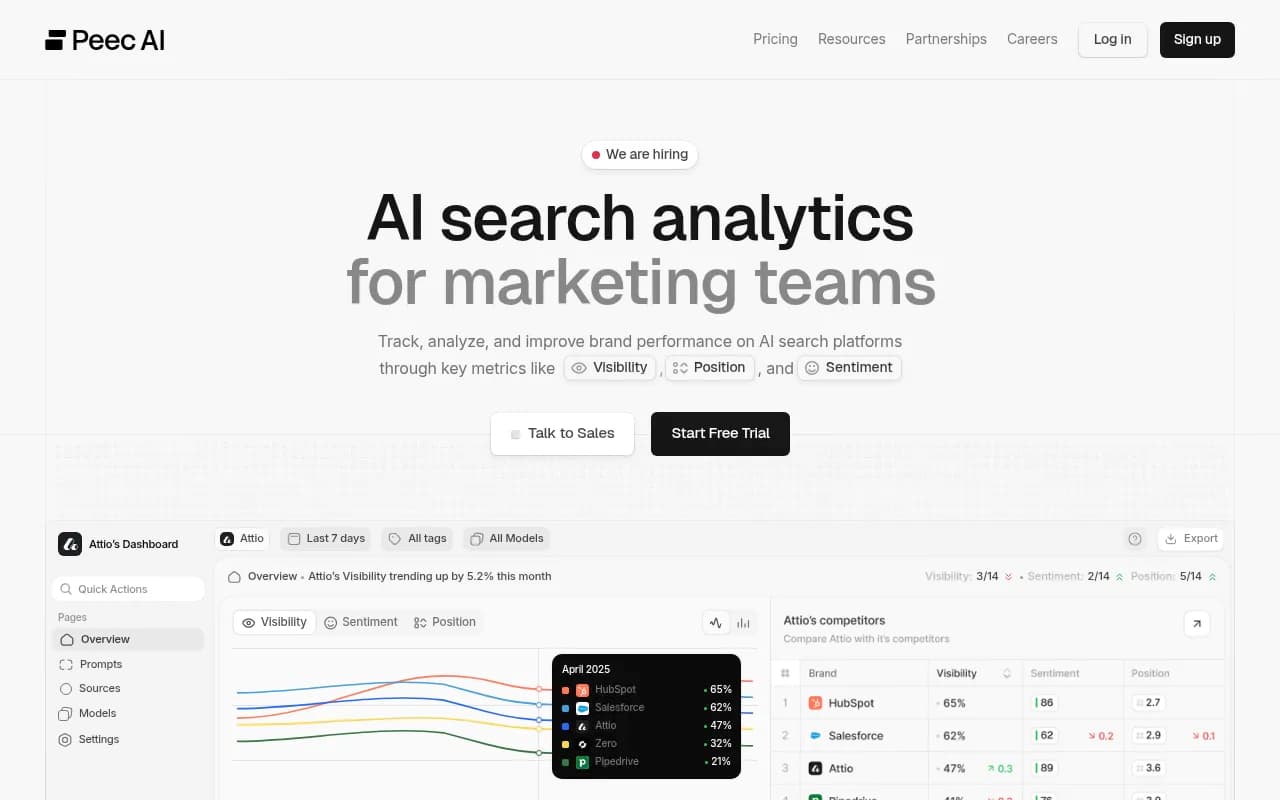
The platform is strongest for teams that need to know immediately when something shifts -- a competitor suddenly appearing in responses where you used to dominate, or your brand dropping out of a category you've owned. The competitive intelligence layer is solid: you can track share-of-voice trends and see how your visibility stacks up against named competitors over time.
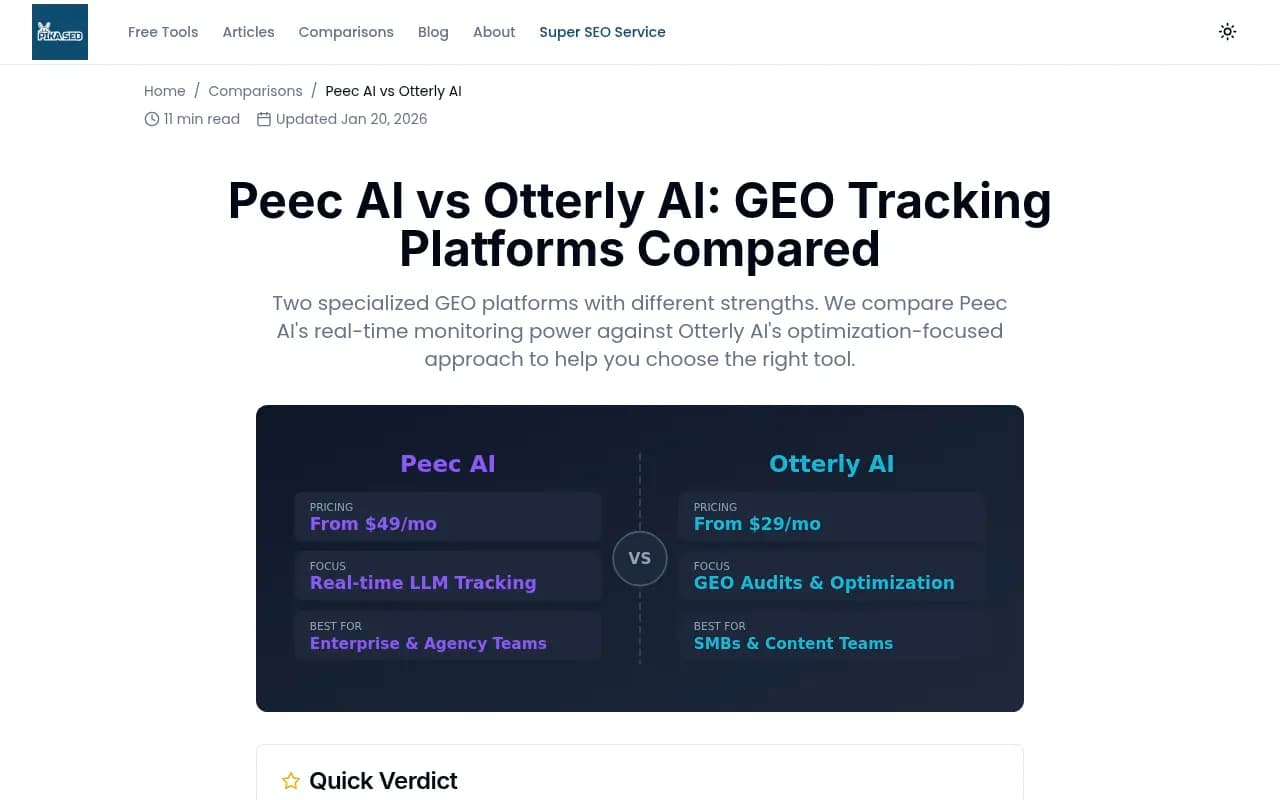
Peec AI starts at around €89/month, with enterprise tiers for larger teams. There's a 14-day free trial.
Where it works well:
- Real-time alerting across multiple AI models
- API access for custom reporting pipelines
- Multi-language monitoring (particularly strong for European brands)
- Enterprise security and compliance features (relevant for EU-based companies)
Where it falls short:
- No content creation or optimization tools
- No traffic attribution -- you can't connect AI mentions to actual site visits
- No crawler log analysis to see how AI bots interact with your site
- Monitoring-only: it shows you the gap, then leaves you to figure out how to close it
What Otterly.AI actually does
Otterly.AI takes a slightly different angle. Where Peec AI emphasizes monitoring speed, Otterly leans into audit depth. Its GEO audit analyzes 25+ factors that affect how AI models perceive and cite your content, and it gives content teams specific recommendations rather than just raw visibility scores.
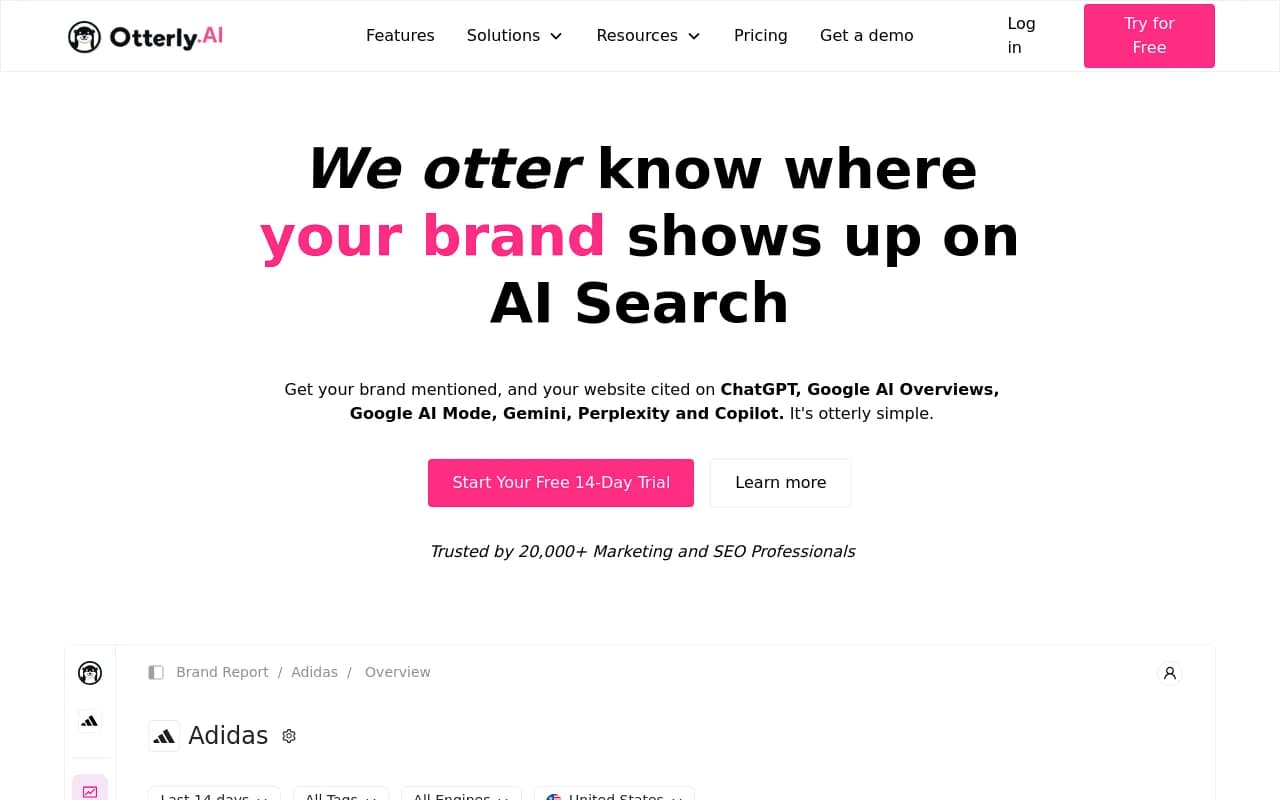
It's cheaper -- starting at $29/month -- and that price point makes it accessible to smaller teams and solo SEOs who are just starting to think about AI search visibility. The 7-day free trial is shorter than Peec AI's, but the onboarding is simpler.
Where it works well:
- Detailed GEO audits with specific content recommendations
- Lower price point for smaller teams
- Cleaner interface that's easier to navigate without training
- Good for content teams who want to understand why they're not being cited
Where it falls short:
- Fewer AI platforms covered (6+ vs Peec AI's 7+)
- No enterprise API access
- No real-time alerting
- Same fundamental limitation: it diagnoses but doesn't treat
Head-to-head comparison
| Feature | Peec AI | Otterly.AI |
|---|---|---|
| Starting price | ~€89/month | $29/month |
| AI platforms covered | 7+ | 6+ |
| Free trial | 14 days | 7 days |
| Real-time alerts | Yes | No |
| GEO audit depth | Basic | Strong (25+ factors) |
| API access | Yes | No |
| Content recommendations | Limited | Yes |
| Content generation | No | No |
| Traffic attribution | No | No |
| Crawler log analysis | No | No |
| Multi-language | Strong | Basic |
| Best for | Enterprise/agency teams | SMBs and content teams |
The table tells the story pretty clearly. These two tools are optimized for different buyers, but they share the same ceiling: both stop at "here's what's happening." Neither one helps you change it.
The accuracy problem neither platform solves
Here's something that doesn't get talked about enough in these comparisons.
Both Peec AI and Otterly.AI measure whether your brand appears in AI responses. They count mentions, score sentiment, and track visibility over time. What they don't do is check whether what the AI is saying about you is actually true.
One account documented by LLMClicks.ai illustrates this well: ChatGPT was telling prospects their Pro plan cost $79/month. The actual price was $49. Prospects arrived at sales calls skeptical, or didn't show up at all. The Otterly dashboard showed 18 brand mentions and positive sentiment. Zero alerts.
The tool was working exactly as designed. The design just didn't include accuracy checking.
This is a real gap. AI models hallucinate. They mix up pricing, attribute features to the wrong company, invent integrations that don't exist. A monitoring tool that only counts mentions will show you a healthy score while ChatGPT is actively misleading your prospects.
Neither Peec AI nor Otterly.AI addresses this. It's worth knowing before you buy.
Who should use Peec AI
Peec AI makes the most sense if:
- You're an enterprise marketing or PR team that needs real-time alerts -- you want to know within hours, not days, if something changes
- You have a data team that can actually use API access to build custom dashboards or integrate AI visibility data into existing reporting
- You're a European brand that needs strong multi-language coverage and EU compliance features
- You're an agency managing AI visibility for multiple clients and need robust competitive intelligence across accounts
If you're a solo marketer or a small team without the bandwidth to act on real-time alerts, the enterprise features are overhead you won't use.
Who should use Otterly.AI
Otterly.AI makes more sense if:
- You're a content team or SEO professional who wants to understand the specific factors affecting your AI visibility
- Budget is a real constraint and you need something functional under $50/month
- You want actionable audit recommendations, not just raw data
- You're early in your AI search journey and need a tool that helps you understand the problem before you invest in solving it at scale
The GEO audit depth is genuinely useful for content teams. The recommendations aren't always specific enough to act on directly, but they point you in the right direction.
The bigger problem: monitoring without optimization
Both platforms were built when "AI visibility" was still a new concept and the main question was "are we even showing up?" That question mattered in 2024. By 2026, it's table stakes.
The question now is: how do you actually improve your visibility? How do you find the specific prompts where competitors are being cited and you're not? How do you create content that AI models will actually want to cite? And how do you know if the content you created is working?
Neither Peec AI nor Otterly.AI answers those questions. They show you the scoreboard. They don't help you win the game.
This is the gap that separates monitoring tools from optimization platforms. A few things that monitoring-only tools can't do:
- Show you which specific prompts your competitors are winning that you're not
- Generate content designed to get cited by ChatGPT, Claude, or Perplexity
- Track which of your pages AI crawlers are actually reading and which ones they're ignoring
- Connect AI visibility to traffic and revenue so you know if any of this is actually working
- Surface Reddit threads and YouTube discussions that are influencing AI recommendations
If you're at the point where you know you have an AI visibility problem and you want to fix it, you need something that goes further.
What to use when monitoring isn't enough
For teams that have outgrown the monitoring-only model, Promptwatch is worth looking at seriously. It covers the full loop: find the gaps, create content to fill them, track whether it worked.

The Answer Gap Analysis shows exactly which prompts competitors are visible for that you're not -- not just "you're losing share" but the specific questions and topics where you're absent. The built-in AI writing agent generates content grounded in actual citation data (880M+ citations analyzed), so you're not writing generic SEO filler but content that AI models have demonstrated they want to cite. And the page-level tracking closes the loop by showing which of your pages are being cited, how often, and by which models.
It also has crawler logs -- real-time records of AI bots hitting your site, which pages they read, which ones they skip, and any errors they encounter. Most monitoring-only tools don't have this at all, which means you can have a healthy visibility score while AI crawlers are quietly failing to index your most important pages.
Pricing starts at $99/month for the Essential plan (1 site, 50 prompts, 5 articles), which is more than Otterly.AI but covers considerably more ground. There's a free trial if you want to see the gap analysis before committing.
A few other tools worth knowing about depending on your specific situation:
Profound is the enterprise-grade option in this space -- deep analytical capability at $499/month. It's genuinely powerful but, like Peec AI and Otterly.AI, it's primarily a measurement tool. The insights are excellent; the execution is still on you.

AthenaHQ monitors across 8+ AI search engines and has a clean interface, but it's similarly monitoring-focused without content generation or optimization capabilities.
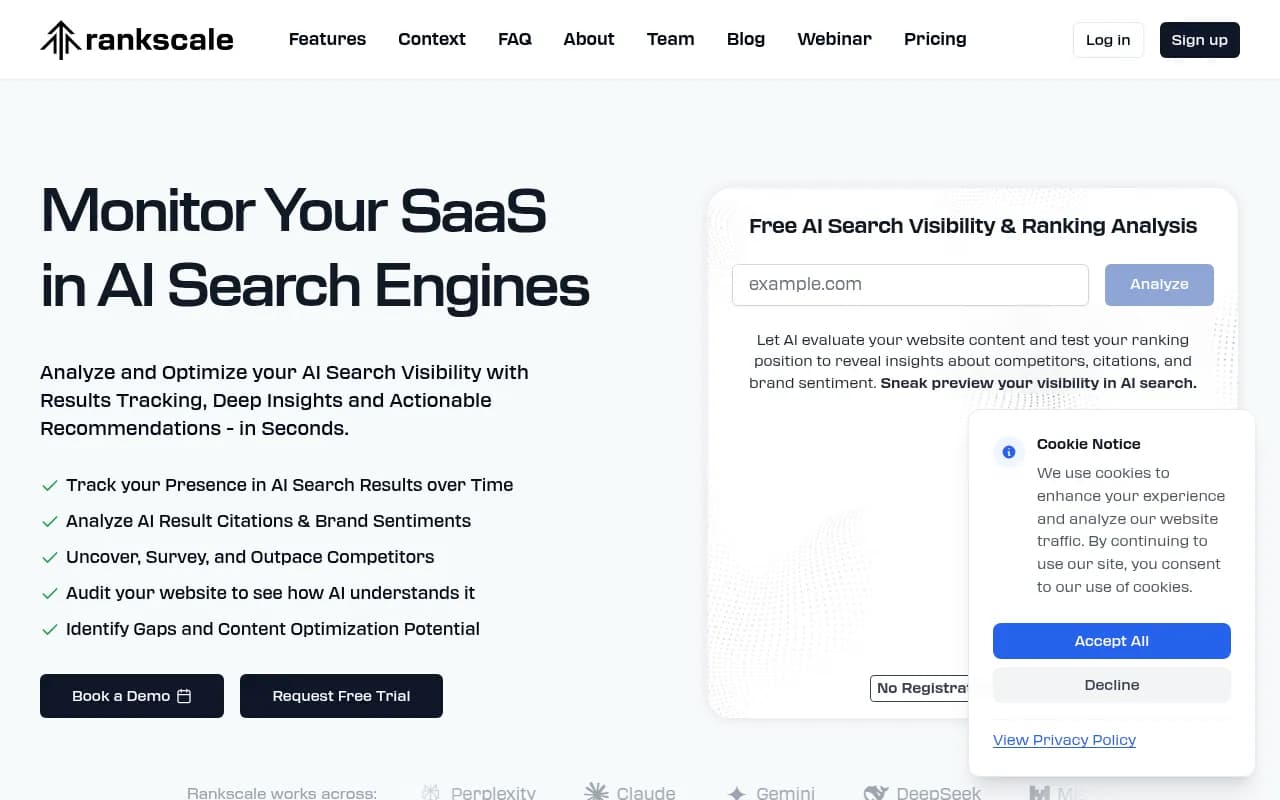
Rankscale takes an interesting angle on AI visibility scaling, though it's a newer entrant and still building out its feature set.
Making the call
If you're choosing between Peec AI and Otterly.AI specifically:
Choose Peec AI if you're an enterprise or agency team that needs real-time alerting, API access, and strong multi-language coverage. The higher price is justified if you'll actually use the enterprise features.
Choose Otterly.AI if you're a smaller team or solo practitioner who wants GEO audit depth at a budget-friendly price. The content recommendations are useful even if they're not always specific enough to act on directly.
But go in with clear eyes about what you're buying. Both tools will tell you where you stand. Neither will help you move.
If your goal is to actually improve your AI search visibility -- not just measure it -- you're going to need a platform that closes the loop between data and action. The monitoring-only category had its moment. The teams pulling ahead now are the ones who've moved past it.