Key takeaways
- No independent head-to-head accuracy benchmark of Otterly.AI, Peec AI and ZipTie exists. Anyone telling you one is "most accurate" is guessing or selling.
- Accuracy depends on method: real-interface collection versus APIs, how many samples per prompt, and whether the raw answer is stored so you can check it.
- Peec collects from consumer web interfaces with logged-out browser automation. ZipTie records the public answer and citations. Otterly documents its approach on its help site.
- Surfer reports that about 75% of brands named via APIs did not match what the real AI interfaces showed. Prefer tools that track the real interface.
- Pick by fit: Otterly for a low entry price, Peec for share-of-voice reporting, ZipTie for configurable engines and checkable numbers.
The accuracy question nobody can answer cleanly
I went looking for a neutral test of these three tools. There isn't one. What exists is vendor content, and a lot of it is biased. Several of the comparison pages in circulation are published by ZipTie itself, which ranks itself first, and Otterly's blog does the same for Otterly. Treat those claims about competitors as marketing.
So this guide does something more useful. It explains what actually makes an AI visibility number accurate or not, then shows where each tool stands on those points. You can then run your own test in a week.
What makes an AI visibility number accurate
Real interfaces versus APIs
The answer a model gives through an API is often not the answer a person sees in the product. Surfer's 2026 roundup says about 75% of brands named via APIs didn't match what the real AI interfaces showed. Citations and shopping results differ too. A tracker that scrapes the real UI will usually be closer to what your buyers see.
Sample size per prompt
AI answers vary run to run. Peec's docs describe one response per prompt, model, country and day. That is a single sample, which is noisy by nature. Promptwatch's data shows why: for Sep 28 to Oct 4, 2026, 47.6% of cited ChatGPT responses cited 10 or more domains. With that much spread, one answer tells you little. Judge any tool on trends across many prompts, not on a single check.
The platform itself keeps moving
Retrieval behind answers changes. In Promptwatch's ChatGPT query fanout data, ChatGPT averaged about 2.15 web searches per answer in early December 2025, eased to about 1.84 by early March 2026, and was at 1.0 per response when fanouts returned in April. So a swing in your visibility can come from ChatGPT changing, not from your brand changing. No tracker can fully hide that.
Can you see the raw answer?
A number you can't trace is a number you have to trust. The better question to ask each vendor: can I open the stored answer and citations behind this score?
Otterly.AI
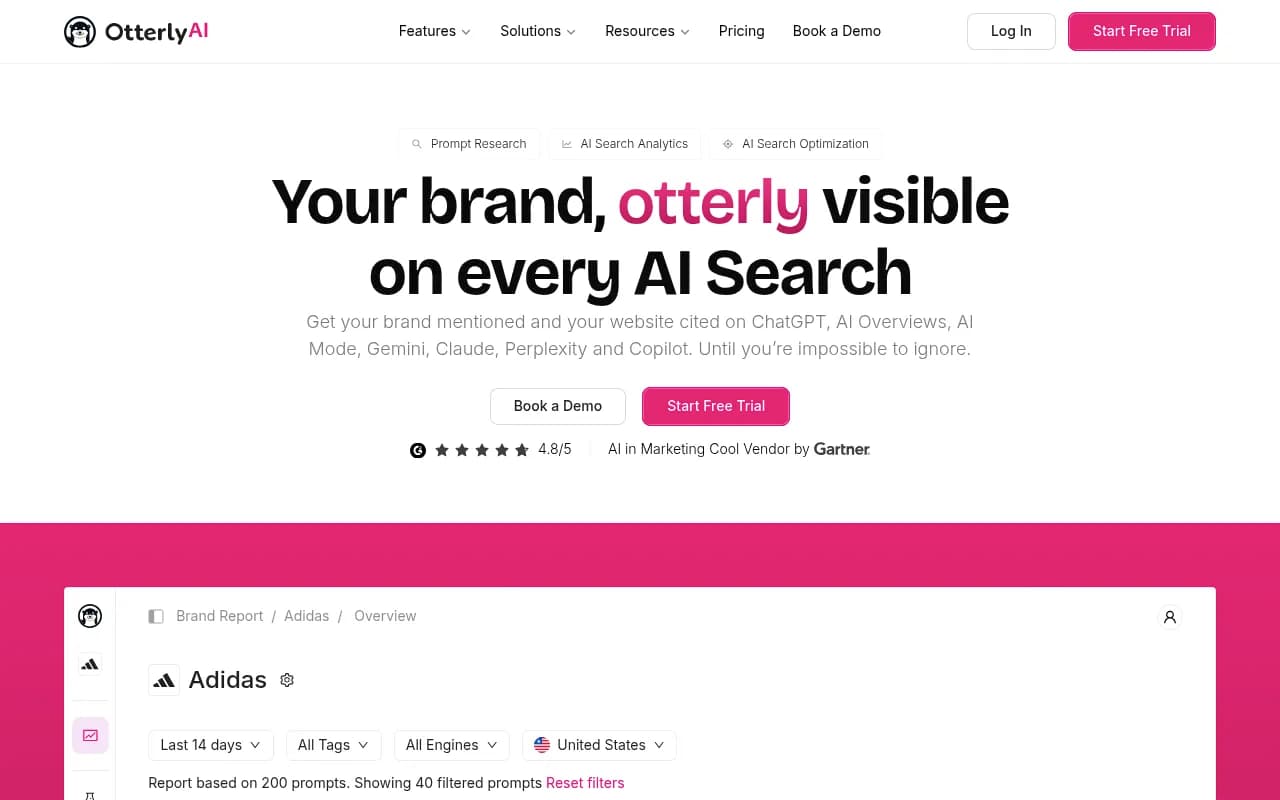

Otterly is the cheap way in. Its official pricing page lists these plans:
- Lite: $29/month, 20 prompts, 3 of 7 engines, daily tracking
- Standard: $189/month, 160 prompts, 3 of 7 engines, with API and MCP access plus agent analytics
- Premium: $489/month, 535 prompts, daily or weekly tracking
- Enterprise: custom, from 1,000 prompts
Some third-party roundups list 15, 100 and 400 prompts and four engines on every plan. The vendor's own page contradicts that, so check the pricing page before buying. The seven engines listed are ChatGPT, Google AI Overviews, Perplexity, Microsoft Copilot, Google AI Mode, Gemini and Claude, and each plan covers only three of them.
On accuracy, Otterly documents how it collects data at help.otterly.ai/how-otterlyai-collects-data. I didn't verify that page's details, so read it yourself and ask support whether answers come from real interfaces and how many samples run per prompt. Its credit-based model also means more prompts or engines eat credits faster.
Peec AI

Peec is the most transparent of the three about method. Its docs say it uses browser automation against consumer web interfaces as a logged-out user, one response per prompt, model, country and day. ChatGPT is tracked natively via UI simulation, and a separate OpenAI Search API model is a paid add-on. That split is useful: you can compare UI results to API results yourself.
Engines included in every plan per Peec's own page: ChatGPT, Google AI Overviews, Google AI Mode, Perplexity, Gemini and Microsoft Copilot. Add-ons include Claude, DeepSeek, Grok, Mistral and others. Some roundups claim three engines per plan chosen from six, which conflicts with Peec's page. Verify at signup.
Metrics are clearly defined: visibility is the percentage of responses where you appear, share of voice is your mentions over all tracked brands' mentions, sentiment is 0 to 100, and position is the average rank when you appear. Third-party lists put pricing at $95, $245 and $495 for 50, 150 and 350 prompts, which I couldn't confirm against the live page.
Peec is also upfront that it is an analytics layer. It doesn't write or publish content. It reports SOC 2 Type II and GDPR compliance.
ZipTie
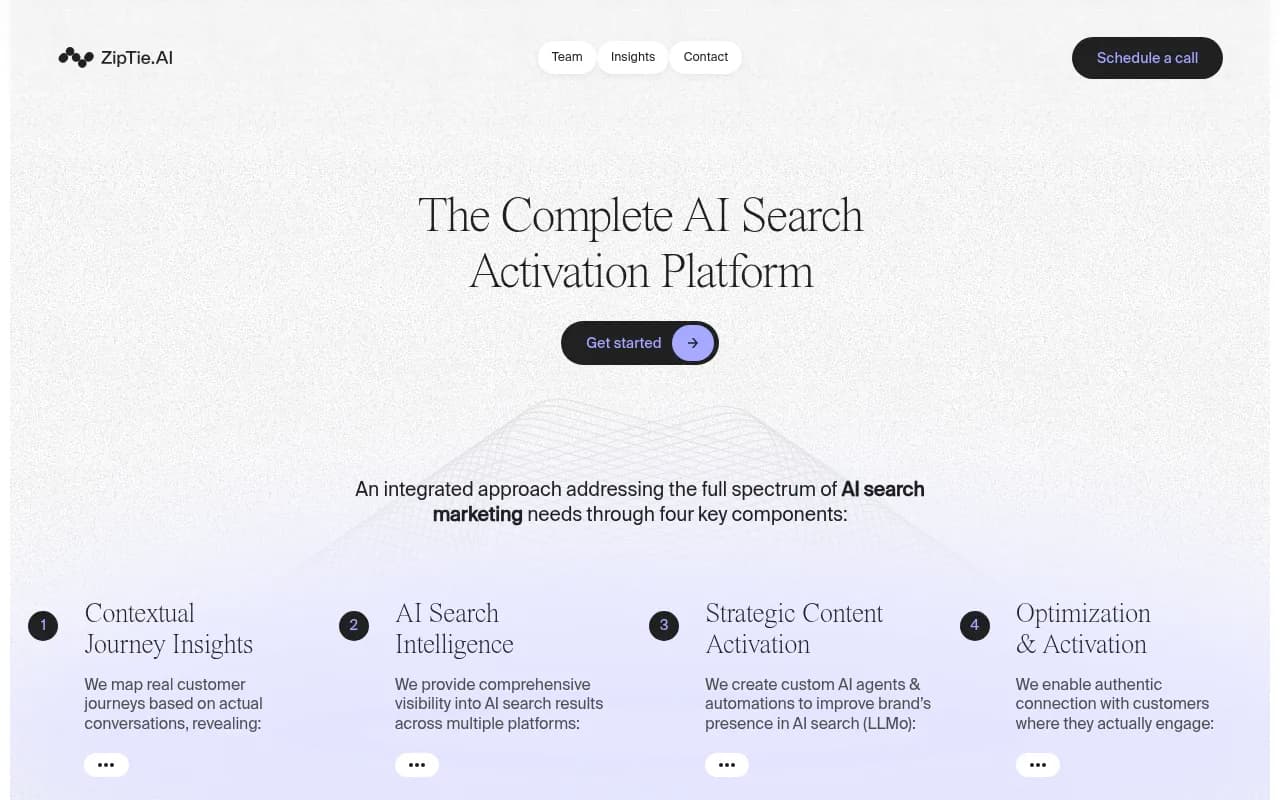
ZipTie treats tracking as configurable infrastructure. You choose engines, how many prompts run, and how often (daily, weekly or monthly). Seats and projects are unlimited. Roundups put entry pricing at $42.75 a month with a 7-day trial, while Surfer's list shows $25.65 on its cheapest setup, so the figure depends on configuration. Confirm in ZipTie's configurator.
Engines reported: ChatGPT, Google AI Overviews, Perplexity, Google AI Mode, Microsoft Copilot, Bing AI Overview and Gemini, depending on country. A feature that matters for accuracy: its Google and Bing AI Overview checks capture the top 10 organic results beside the AI answer, so you can compare AI and organic for the same query. It also classifies cited sources by type, scores brands with an AI Success Score, and offers optional UGC impact analysis.
The downsides: no AI crawler or referral tracking, and no Claude, Grok, Meta AI or DeepSeek according to ZipTie's own comparison. I did not scrape ZipTie's site directly, so details here come from secondary sources. ZipTie's own guides say it stores full answer text and cited sources with each check and that its detection is model-based with no measured accuracy figure. That candor is worth noting, but it is vendor-written.
Side-by-side
| Otterly.AI | Peec AI | ZipTie | |
|---|---|---|---|
| Entry price | $29/mo (20 prompts) | $95/mo (50 prompts, unverified) | From about $25 to $43/mo, configurable |
| Engines | 3 of 7 per plan | 6 included, more as add-ons | Up to 7, you choose |
| Collection method | Documented on help site, verify | Logged-out UI automation | Public answer plus citations |
| Samples per prompt | Check with vendor | One per prompt/model/country/day | One per cycle, per ZipTie |
| Raw answer visible | Citations and sources | Yes, responses and sources | Yes, full text stored |
| Crawler/referral data | Agent analytics on Standard+ | GA4 referrals, crawler analytics (per third parties) | None |
| Content creation | Recommendations, GEO audit | No | No |
So which is most accurate?
Honest answer: they are close enough that setup quality matters more than the brand. A few judgments from the evidence:
- Peec has the clearest documentation of what a number means and where it comes from. That counts for a lot.
- ZipTie is the better pick if you want to inspect the answers and compare them against organic results.
- Otterly is the cheapest way to start, but its three-engine cap and credit model mean you should test before committing.
How to test accuracy yourself
Run a one-week bake-off with trial accounts.
- Pick 20 prompts your buyers actually use, mixed across branded, comparison and category queries.
- Run the same set in each tool, same country, same engines.
- Manually ask the same prompts in ChatGPT and Google AI Overviews in a logged-out browser.
- Compare mentions, citations and brand order. Note where a tool's stored answer differs from what you saw.
- Repeat on day three and day seven. A tool whose numbers swing wildly on identical prompts is showing you noise.
Aggregate across prompts before drawing conclusions. A single mismatch means little given how variable answers are.
When none of the three is enough
All three are largely monitoring tools. If you also need to find out why you are invisible and fix it, you need more. Promptwatch tracks the real interfaces of ChatGPT, Google AI Overviews, Gemini, Perplexity and others, adds IP-verified AI crawler logs and visitor analytics, and includes a Content Agent and Action Board that act on the gaps. Its Visibility Score docs explain how each response is scored. You can start with the free AI visibility report or the 7-day trial, and confirm plans on the pricing page.

For a wider shortlist, the GEO software directory at bestgeosoftware.com lists more trackers.
Bottom line
Choose Peec if you want documented methodology and share-of-voice reporting, ZipTie if you want to configure engines and inspect answers next to organic results, and Otterly if budget is the constraint. Whichever you pick, verify engines and prompt limits on the vendor's live pricing page, and judge accuracy on a week of your own prompts, not on anyone's blog ranking.