Key takeaways
- Unlinked mentions are worth earning, but they are coverage, not proof of AI visibility. Test whether your brand shows up in relevant answers before you claim a win.
- Keep four records separate: the published mention, the AI answer appearance, the citation (and its destination), and the qualified visit.
- Ahrefs' 75,000-brand study found branded web mentions correlate with AI visibility far more strongly than backlinks or site size. It is correlation, and Ahrefs says so itself.
- Press coverage gets cited but decays fast. Promptwatch Data shows news pages losing half their ChatGPT citations in about five weeks, so PR needs refreshing.
- Pick placements by where AI actually looks: listicles, comparisons, reviews, and trusted category sources, not mention volume alone.
The problem with how PR gets measured
A trade publication writes two paragraphs about your company. No link. Your PR lead celebrates, your SEO lead shrugs, and somebody in the meeting says "well, it doesn't count, there's no backlink."
For classic link-based SEO that argument had some logic. For AI search it is only half right, and the half that is wrong costs brands real coverage opportunities.
Language models and AI search engines read text. A sentence that says your company is a good fit for a specific job is useful to them whether or not a hyperlink wraps your name. At the same time, I would not go the other way and declare every unlinked mention a visibility win. Most of the confident claims floating around about this are correlations dressed up as mechanisms. This guide tries to hold both truths: mentions matter, and you still have to verify it.
What counts as a mention, a citation, and an appearance
The fuzziest part of this topic is vocabulary. Reports use "mentions" to mean three different things, and the trend line means nothing until you know which.
- An earned, unlinked mention: a published page names your brand without linking to your site.
- An answer appearance: an AI response names your brand.
- A citation: an AI response points the reader to a source page.
The citation is where people trip. If ChatGPT cites a trade article that names you, that is a citation to the trade publication, not to your domain. It can still be good for you, because the answer may carry your name. But log the destination.
A practical example. A industry comparison names your company, describes the service accurately, and has no link. Log it as an earned unlinked mention. A week later an AI answer to a buyer question names you. Log that as a separate appearance. If the answer cites the comparison, log the cited page as a third record. Do not merge them into one "visibility win," because you cannot yet say the first caused the second.
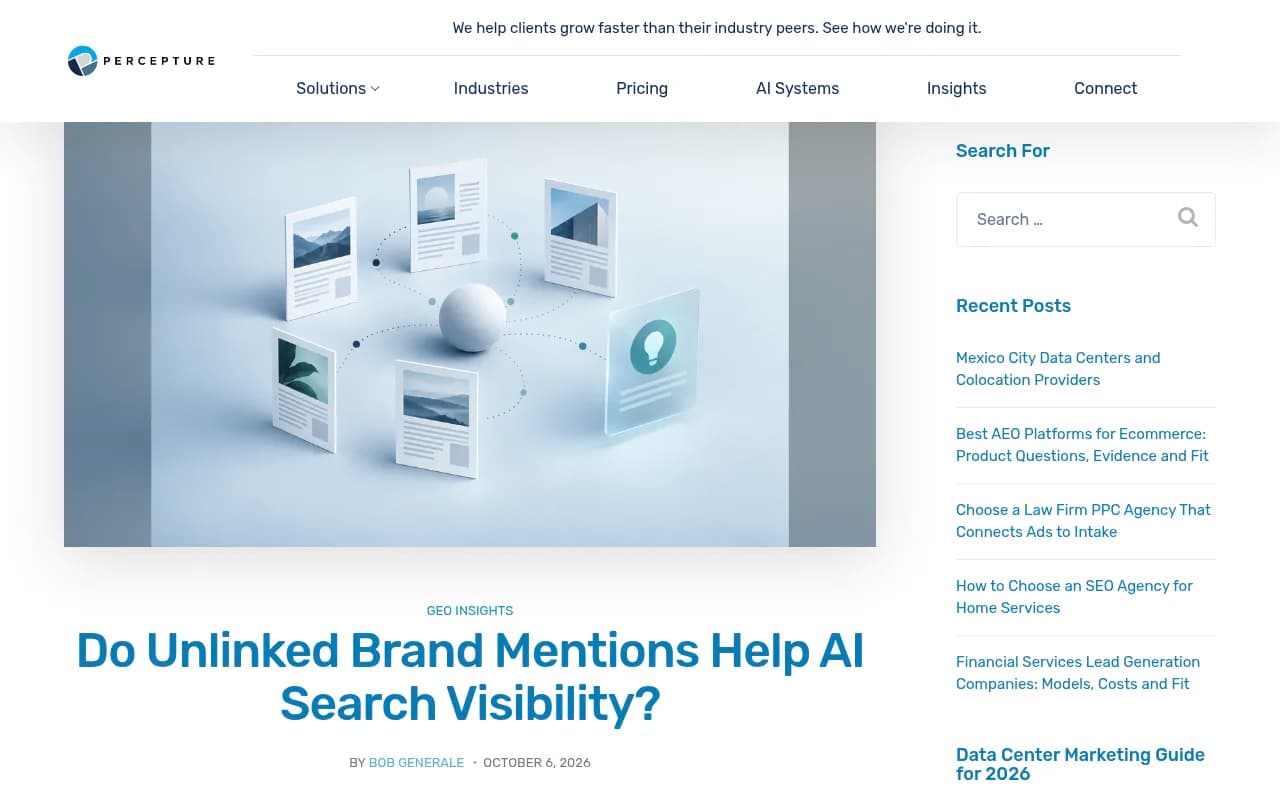
The Percepture piece above makes this separation well. Its core advice: count the coverage, then test whether the brand appears in relevant answers and whether the source gets cited. Spend more only when the evidence supports it.
What the evidence says about mentions versus backlinks
The strongest public data point is Ahrefs' study of 75,000 brands, published December 2025. Brands were domains with DR above 40, each paired with a high-volume keyword, and Ahrefs ran Spearman correlations across millions of AI responses.
The headline numbers:
- YouTube mentions correlated most strongly with AI visibility, around 0.737.
- Branded web mentions came in at roughly 0.66 to 0.71.
- Branded search volume (0.352) and domain rating (0.266) were weaker in ChatGPT.
- The number of pages on a site correlated only about 0.194.
- ChatGPT, AI Mode, and AI Overviews largely name the same brands (output overlap of 0.779).
Ahrefs states plainly that this is correlation, not causation. An earlier Ahrefs AI Overviews study is where the "mentions correlate about three times stronger than backlinks" line comes from, though I have not independently checked that multiple, so treat it as directional.
Two honest readings of all this. The bullish reading: brands that get discussed widely get named by AI. The cautious reading: brands that are already big get discussed widely and get named by AI, and PR did not necessarily create the effect. Probably both are partly true. Nobody outside the AI companies has a published formula for how a model weighs a mention.
Backlinks have not stopped mattering. They carry referral traffic, they help traditional rankings, and they make a source connection explicit. The more defensible position is that links are one part of an authority system that is now wider than your own backlink profile.
Where AI actually pulls from
If unlinked mentions help, they help most when they sit on pages AI actually retrieves. Promptwatch Data gives a useful picture of that for ChatGPT.
In Promptwatch's ChatGPT content type report (Sep 28 to Oct 4, 2026), product pages made up 22.4% of classified citations and landing pages 16.8%. Editorial formats together added up to about 43%: listicles 13.6%, how-tos 8.7%, general articles 6.1%, comparisons 5.9%, and news 5.7%.
For PR, the commercial prompt breakdown is the interesting part. On prompts like "best CRM for small businesses," listicles were 15.0% of citations and comparisons 7.9%, up from 5.9% across all prompts. On branded prompts like "is HubSpot good for startups," reviews were 5.6% of citations, more than three times their overall share, and social posts were 3.0%.
Read that as a placement brief:
- Getting named in the "best of" roundups that AI cites for your category matters more than a generic feature story.
- Reviews on sites people trust in your category carry weight on branded questions.
- Your own product and landing pages still dominate, so mentions elsewhere supplement your site rather than replace it.
Another data point worth knowing: almost half of ChatGPT responses cite 10 or more unique domains. Answers are assembled from many sources, so being present across several credible pages beats being the star of one.
And domain rank matters less than people assume. In August 2026, sites with domain rank 46 to 75 earned almost half of ChatGPT citations, while DR 91 to 100 sites fell to about 3%. A placement on a respected mid-sized niche publication can be worth more than one on a giant general outlet, at least for ChatGPT citations.
The shelf life problem with press coverage
Here is the part PR teams tend not to like. News is 5.7% of ChatGPT citations, but Promptwatch's content half-life data shows that news pages cited on July 6, 2026 lost half of their citations within about 36 days. Landing pages and docs held on for months.
So a launch announcement can get cited this month and vanish the next. That does not make PR pointless. It means a one-off hit has a short tail in AI answers, and the durable value comes from steady coverage plus evergreen pages (comparisons, guides, reviews) that keep naming you.
Social and community mentions depend on the engine
Unlinked mentions are not only articles. They are also Reddit threads, YouTube videos, and LinkedIn posts, and AI engines treat those very differently.
In Promptwatch's November 2026 social citation report (Oct 11 to Nov 9, 2026), social platforms were 13.16% of Google AI Overviews citations, 1.94% of Perplexity's, and 0.64% of ChatGPT's. AI Overviews cited YouTube at 6.71%. ChatGPT cited Reddit at just 0.40%. One caveat: the earlier October comparison covered 7 days and this one covers 30, so the change is not like for like.
This fits the earlier finding that Reddit's share of ChatGPT citations fell from roughly 4% to 0.5% on August 14, 2026. If you are chasing AI Overviews, community and video mentions deserve real attention. For ChatGPT, editorial roundups, comparisons, and your own pages matter more.
How to run a mention test that holds up
Here is a workable process. It is boring, which is the point.
1. Inventory the coverage
For every placement, record the URL, publication, date, whether it links, and what it says about you. Note whether the surrounding text names your service, market, or use case. A bare name gives a model little to work with. A sentence explaining why you belong in the discussion gives it a lot.
2. Check accuracy and identity
Does the page describe you correctly? Is it clearly your company and not another one with a similar name? If an AI answer describes a different company with your name, exclude it from correct-brand presence and flag the identity error. Wrong claims repeated in coverage tend to get repeated in answers.
3. Build a prompt set that matches buyer questions
Pick the questions a real buyer asks: category searches, comparisons, and branded checks. Run them on a schedule across the engines you care about, in the countries you sell in.
4. Log answers and sources separately
For each response, record whether your brand appears, where in the answer, and which sources are cited. If the answer names you without citing the placement, record the appearance and do not assign it to that article. An appearance is not a training-data receipt.
5. Compare before and after, honestly
Measure a baseline before a campaign. After it, look at whether appearances moved on the prompts the placements were relevant to. Multiple things change at once (product launches, seasonality, model updates), so treat any lift as supportive evidence rather than attribution.
6. Keep traffic claims modest
Do not automatically assign unattributed traffic to AI search. Tag what you can and report the rest as unattributed.
Should you ask for the link?
Yes, usually, politely. A link adds referral traffic and a clean source connection. But do not turn down or devalue coverage because the editor declined. Judge each placement against a brief: right audience, right context, accurate description, a source AI is likely to retrieve. A pile of low-quality mentions is worse than three strong ones.
Also avoid the reflex to buy links to compensate. Bulk backlink services solve the wrong problem if the goal is being named in answers.
Tools for tracking mentions and AI outcomes
You need two kinds of tooling: something that finds mentions on the web, and something that shows whether AI answers reflect them.
For finding coverage, classic media and social monitoring tools work.

Meltwater covers news and broadcast at scale, Brand24 handles social listening, and Alertmouse is a lighter, cheaper way to catch new brand mentions in alerts.
For connecting mentions to AI answers, Promptwatch is the one I would point to first. Its Offsite Mentions feature finds third-party pages that name your brand or competitors, even without a link, and ranks them as opportunities. It sits next to citation tracking across ChatGPT, Gemini, Perplexity, Google AI Overviews, and others, so you can check whether the pages naming you are also pages AI cites. Brand Narrative then pulls out the individual claims AI makes about you, which is how you catch an inaccurate description spreading from a mention.

There are other options, with different strengths.


| Tool | Finds unlinked web mentions | Tracks AI answers and citations | Helps act on gaps | Best for |
|---|---|---|---|---|
| Promptwatch | Yes (Offsite Mentions) | Yes, across major AI engines | Yes (Action Board, Content Agent) | Teams that want mentions, citations, and fixes in one place |
| Ahrefs Brand Radar | Yes | Yes | Limited | SEO teams already in Ahrefs |
| Profound | Partly | Yes | Limited | Enterprise monitoring |
| Otterly.AI | No | Yes (prompt tracking) | No | Budget prompt monitoring |
| Meltwater | Yes (news and social) | No | No | PR teams tracking press coverage |
| Brand24 | Yes (social and web) | No | No | Social listening |
If you want to compare more options, the GEO software directory at bestgeosoftware.com lists dozens of them.
A simple scorecard
Avoid a single vanity number. Track these separately:
- Qualified mentions: coverage from sources that meet a relevance threshold, with accuracy noted.
- Answer appearances: share of tracked prompts where your brand is named correctly.
- Source citations: how often the pages naming you get cited, and which ones.
- Sentiment and claims: what the coverage and answers say about you.
- Qualified visits: traffic you can actually attribute, kept apart from guesses.
If mentions go up and appearances stay flat, you have a context or authority problem, or the placements are on pages AI does not retrieve. That is a useful finding, and it is cheaper than finding out a year later.
What to do on Monday
- Audit your last 12 months of PR and list every unlinked mention with its context.
- Pick 20 to 30 buyer prompts and record your current answer presence and cited sources.
- Identify which roundups, comparisons, and review pages AI cites in your category, and aim your outreach there.
- Plan refreshes for news-style coverage, since it fades in weeks.
- Fix inaccurate descriptions at the source page where you can.
PR wins do count in AI search without backlinks. They count as evidence you have to verify, not as a number you get to claim.