Key takeaways
- In Promptwatch's data on pages ChatGPT cited on July 6, 2026, half of news pages were gone after 36 days. Landing pages and docs held up best, with 78% and 76% still cited after 30 days.
- Product pages, reviews and how-to guides sit in the middle. Their half-life lands between day 74 and day 77.
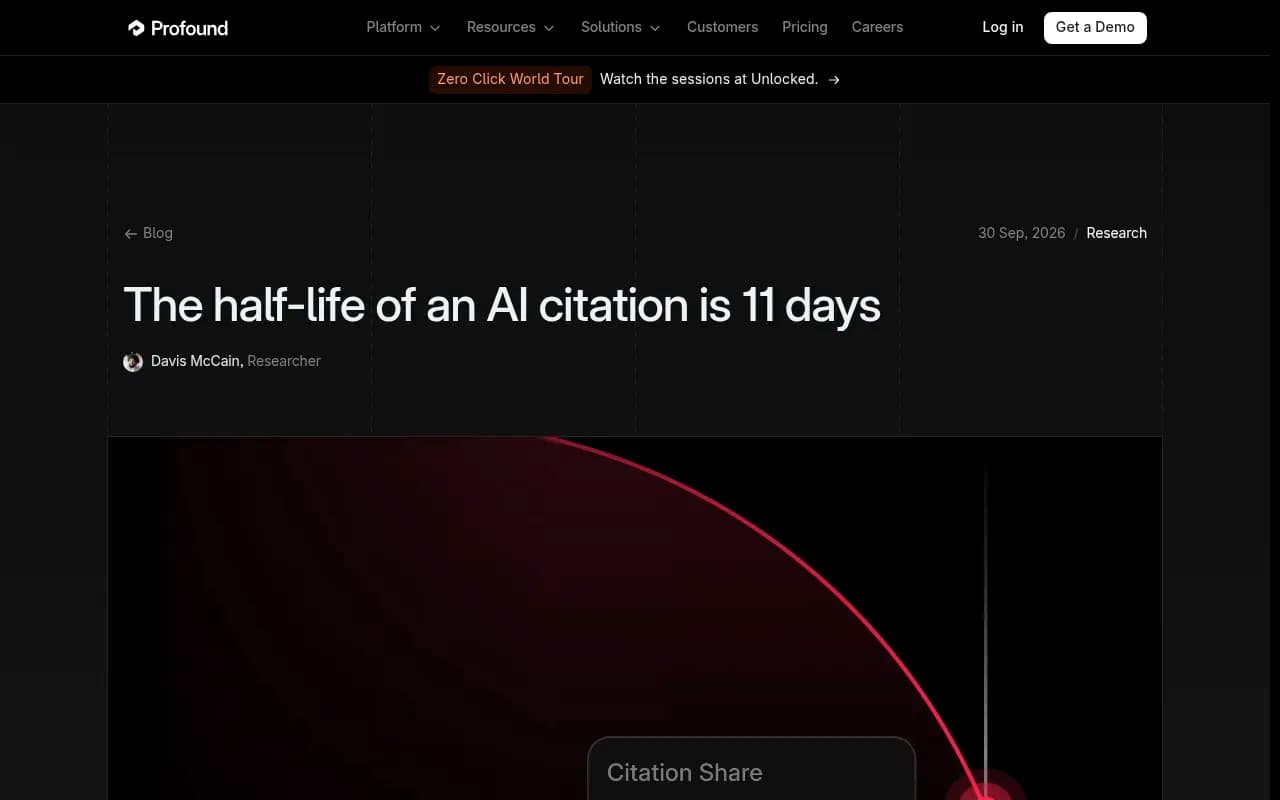
- Profound's separate study of 883K pages found the median page loses half its citation share 11 days after peaking. That is a different metric from Promptwatch's, so do not blend the numbers.
- Refresh on tiers, not on gut feel: news gets treated as a short burst, comparisons and listicles get steady upkeep, and landing, docs and pricing pages get accuracy checks.
- Measure weekly. Citation share moves in days, and a quarterly report catches the drop far too late.
The problem: authority in AI search expires
Traditional SEO taught most of us that a page compounds. You earn links, rankings settle, and the asset keeps paying. AI answers do not behave that way, and the evidence is getting hard to ignore.
Promptwatch published a report called What is the half-life of content in ChatGPT? that takes every classified page ChatGPT cited on July 6, 2026 and follows it for 90 days, through October 4. The question is simple: on each later day, is that page still being cited?
The headline is news. Almost a quarter of news pages were never cited again after day zero. Half were gone after 36 days. By day 60, 41% were still hanging on.
I find that number more useful than it first looks. It does not say news is worthless. It says news is a burst, and if your content plan treats a news post like a library book, you are budgeting for the wrong thing.
What the data says about each content type
Here is the Promptwatch Data breakdown (pages cited on July 6, 2026, tracked to October 4, 2026), laid out so you can plan against it.
| Content type | Still cited at 30 days | Still cited at 60 days | Half-life |
|---|---|---|---|
| News | Not reported | 41% | About 36 days |
| Landing pages | 78% | 69% | Likely near or beyond 90 days |
| Docs | 76% | 67% | Likely near or beyond 90 days |
| Comparisons | 72% | 63% | Likely near or beyond 90 days |
| Listicles | Not reported | 60% | Likely near or beyond 90 days |
| Product pages, reviews, how-tos | Not reported | 55% | Day 74 to day 77 |
Two caveats from the report itself. First, landing pages, docs, comparisons and listicles only cross 50% in the final week, when the window ends, so their real half-life is probably longer than 90 days. Second, the lines drop faster at the end because fewer days remain for a page to be cited again. Read the tail with that in mind.
Also worth noting: 93% of docs were cited again after day zero, against 77% of news pages. Docs are the stickiest thing in the dataset.
A second study, a different number
Profound published a study on the half-life of an AI citation on September 30, 2026, covering 883,000 pages and 1.19 million page-and-engine lifecycles over twelve months. Its headline is shorter: the median page loses half its citation share 11 days after peaking, and 78% of pages halve within 14 days.
Those figures look like they contradict Promptwatch's 36 days for news, but they do not. Profound measures decay in citation share from a peak, across seven engines. Promptwatch measures whether a page is cited again at all, in ChatGPT only. A page can lose most of its share and still show up occasionally. Do not put the two sets of numbers on the same chart.
What they agree on is the direction. Profound found that pages tied to a date or event fade first, and that pages cited by five or more engines are 5.5 times as likely to still be above half their peak after eight weeks. It also found cross-engine correlations of only 0.03 to 0.09, so a citation in one engine tells you almost nothing about the next.
Turning decay rates into content tiers
A refresh calendar is just decay data converted into a schedule. I would use four tiers.
Tier 1: Burst content (news and press)
Promptwatch's own recommendation is to use news and press coverage for short bursts of visibility. Fine. Publish it, promote it, and do not schedule refreshes unless the story keeps developing. If a news post has long-term value, extract the durable part into a guide or comparison and link to it.
Tier 2: Mid-life content (product pages, reviews, how-tos)
These hold roughly 55% of citations at day 60 and cross half somewhere around day 74 to 77. Schedule a refresh at about day 45 to 60, before the cliff. For product pages that means specs, availability and prices. For how-tos, it means screenshots, steps and version numbers.
Tier 3: Compounding content (comparisons and listicles)
These keep over 60% of their citations after two months. They are your best return on effort, so refresh them every 30 to 45 days with new entrants, changed pricing and updated verdicts. A stale comparison is worse than none, because it gets cited and then contradicts reality.
Tier 4: Anchor pages (landing, docs, pricing)
Landing pages and docs last longest, so the job here is not rescue but accuracy. Pricing pages are classified as landing or product pages in the report, which means a wrong price can sit in AI answers for months. Run a monthly fact check and a full review each quarter.
The refresh calendar
Here is a template you can paste into a spreadsheet. It assumes a 90-day cycle, which matches the window in the Promptwatch study.
| Week | Task | Tiers touched |
|---|---|---|
| 1 | Pull citation data per page; flag pages that lost citations in the last 14 days | All |
| 2 | Fact-check pricing, specs and feature claims on anchor pages | Tier 4 |
| 3 to 4 | Refresh top 10 comparisons and listicles | Tier 3 |
| 5 | Review news pages; pull durable content into evergreen guides | Tier 1 |
| 6 to 7 | Refresh product pages, reviews and how-tos older than 45 days | Tier 2 |
| 8 | Check internal links, schema and visible modified dates | All |
| 9 | Publish two or three new comparisons or how-tos to replace decay | Tier 2 and 3 |
| 10 to 12 | Re-measure, compare against week 1, rewrite the next quarter's list | All |
The MarTech piece on why evergreen content expires faster makes a practical point about capacity: a team publishing 10 new articles a month needs bandwidth to refresh 10 to 15 existing pieces. If that is unrealistic, publish less and keep your best assets current. I agree. Most teams I see are over-publishing and under-maintaining.
What counts as a real refresh
Changing the date does nothing. A refresh should do at least some of this:
- Replace outdated facts, numbers and screenshots
- Add recent developments a competitor's newer page would cover
- Update the visible, crawlable modified date only after the content changes
- Re-check schema and internal links
- Re-promote through newsletters, social and links from related pages
The ZipTie content refresh guide suggests every six months for evergreen content as a baseline. Given the decay numbers above, I would treat that as a ceiling for anchor pages and far too slow for comparisons.
Measuring whether it worked
A calendar without measurement is a chore list. You need three signals per page: is it being crawled, is it being cited, and does it send traffic.
Promptwatch's tooling covers all three in one place. Page Tracker and AI crawler logs show whether bots read a page and whether it gets cited, and visitor analytics show whether it drives visits. Its Content Refresh gives git-diff-style update suggestions for existing pages, and underperforming pages come back as actions on the Action Board.

If you want alternatives or a wider look, the GEO software directory at bestgeosoftware.com lists other platforms. For tracking only, a few options in the catalog:

| Need | Option | Note |
|---|---|---|
| Tracking plus content refresh and publishing | Promptwatch | Content Refresh, Content Agent, crawler logs, visitor analytics |
| Enterprise citation-decay research | Profound | Source of the 11-day half-life study |
| Citation analysis | ZipTie | Source of a tiered refresh cadence guide |
| Basic prompt tracking | Otterly.AI | Monitoring focus |
Pair that with Google Search Console data to find pages with lots of impressions and few clicks. Those are the best refresh candidates because the demand already exists.
Do not forget the engines disagree
Profound's data says Claude citations are 2.8 times as likely as ChatGPT citations to last eight weeks among pages that survive two weeks. Cross-engine correlations are near zero. So a refresh that lifts you in ChatGPT may do nothing in Perplexity or Gemini.
Track each engine separately. Aim to be cited by several, because Profound found pages cited by five or more engines are far more durable. It is also a sensible hedge against sudden shifts: Promptwatch Data recorded Reddit's share of ChatGPT citations falling from about 4% to 0.5% on August 14, 2026, overnight and with no warning. If one source type can vanish that fast, one engine's favor can too.
On the content-mix side, Promptwatch's citation share by content type report shows product pages as the most cited type in ChatGPT at 22.4% (Sep 28 to Oct 4, 2026), followed by landing pages and listicles. That fits the tiering above: put your upkeep budget where citations actually land.
Common mistakes
- Refreshing everything on the same cycle. News and a pricing page do not decay alike.
- Editing the date without editing the content.
- Mixing metrics from different studies and drawing a false 11-versus-36 conclusion.
- Waiting for traffic to drop. By then you are weeks late.
- Treating a news spike as a durable asset.
A simple starting plan
If you have one afternoon, do this. List your pages by type. Tag each with its tier. Pick the ten comparisons, listicles and anchor pages most likely to get cited, and fact-check them this week. Put the rest on the 90-day calendar above, and set a weekly reminder to look at citation data. Then repeat next quarter with real numbers from your own site instead of mine.
For agencies running this across client sites, the Promptwatch agency plans start at $199/mo; confirm current pricing at promptwatch.com/pricing, or start with the free AI visibility report to see where your pages stand today.