Key takeaways
- In Promptwatch Data's study of pages ChatGPT cited on July 6, 2026, half of the news pages were no longer cited after 36 days. Landing pages and docs held on much longer.
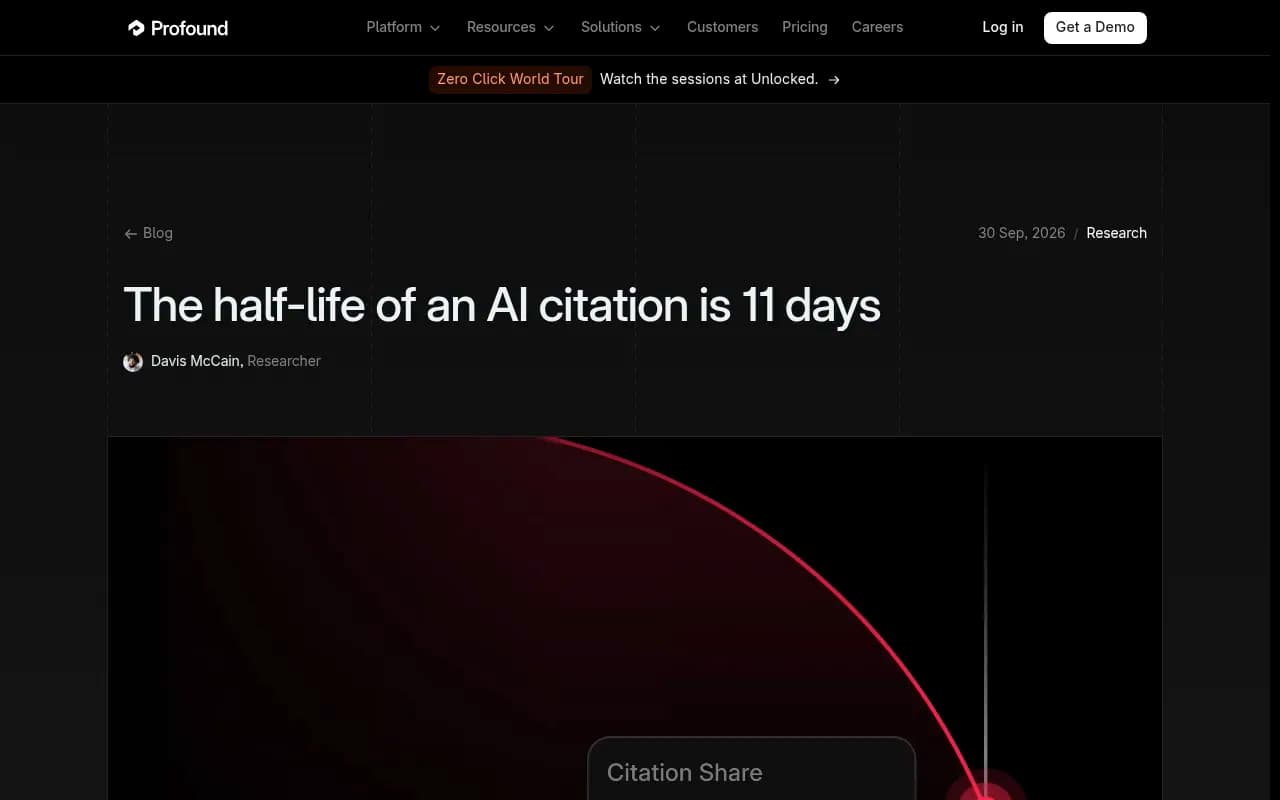
- Profound measured a cross-engine median half-life of 11 days for any AI citation across 883,000 pages, so decay is the norm and not a news-only quirk.
- Press coverage gives you a burst of AI visibility. It does not give you a durable asset, so plan PR as a cadence, not a one-off launch.
- Pair every news push with owned pages (landing pages, docs, comparisons) that keep getting cited after the coverage fades.
- Measure citations weekly, not quarterly. The window to react is days.
The number that changes PR planning
PR used to have a comfortable shelf life. A placement in a top-tier outlet got linked, quoted, and rediscovered for months. You could run a launch in March and still point to the coverage in June.
AI search does not work that way. Promptwatch published a study on October 5, 2026 that took every classified page ChatGPT cited on July 6, 2026 and followed those pages for 90 days. News decayed fastest of all content types. Half of the news pages were gone after 36 days, and almost a quarter were never cited again after day zero. You can read the full numbers in Promptwatch Data's report on the half-life of content in ChatGPT.

That is a hard number for anyone who sells coverage as the outcome. But it is also useful, because it tells you where news fits in a larger plan. Fits, not dominates.
What the data actually says
Here is how the content types compared in the same cohort (ChatGPT only, one-day cohort, tracked through October 4, 2026):
| Content type | Still cited at 30 days | Still cited at 60 days | Notes |
|---|---|---|---|
| News | not reported in the notes | 41% | Half gone after 36 days; only 77% were ever cited again |
| Landing pages | 78% | 69% | Real half-life likely near or beyond 90 days |
| Docs | 76% | 67% | 93% were cited again after day 0 |
| Comparisons | 72% | 63% | Hold up well |
| Listicles | not reported in the notes | 60% | Hold up well |
| Product pages, reviews, how-tos | not reported in the notes | about 55% | Half-life of 74 to 77 days |
The pattern is simple. Pages that answer a standing question (what does this product do, how does this API work, how do these two options compare) keep getting pulled in. Pages tied to a moment fade.
A caveat I want to be upfront about: this is a single-day cohort on one engine. It tells you when a page stops being cited, not how citations are spread across its life. And all the lines drop faster in the last week because the window ends, which is an artifact and not a real cliff. Treat the 36 days as a strong directional signal, not a law.
Is it 36 days or 11 days?
You will see both numbers floating around and they are not in conflict.
Profound's research, published September 30, 2026, measured 883,000 pages across ChatGPT, Perplexity, Claude, Google AI Overviews, Google AI Mode, Gemini, and Copilot over twelve months. Its headline: the median page loses half its citation share within 11 days of peaking. Profound also reports that 78% of cited pages fall to half their peak share within two weeks, and the median interval from first citation to that halfway point is 42 days.
The two studies measure different things. Profound looks at citation share relative to other pages, across all page types and seven engines, starting at each page's peak. Promptwatch asks what fraction of a day-zero cohort of ChatGPT-cited pages is still cited at all, and splits by content type. They are not directly comparable, and I would not try to average them. What they share is the direction: AI authority expires. It does not stack up like backlinks.
Two more findings from Profound matter for PR people:
- Pages cited by five or more engines are 5.5 times as likely as pages cited by one to still be above half their peak share after eight weeks. Breadth of citation predicts lasting power.
- Pages tied to a date or event fade first. That describes most press coverage.
A counterpoint worth reading
Not everyone agrees the picture is grim. Sarah Evans, a partner at Zen Media, argued in a September 21, 2026 newsletter that 3 out of 4 of her team's citations were still alive after 90 days, and that the scary 30-day stats often reflect badly built content. She cites a Semrush test of 81 new pages where Google AI Mode cited 56% at day seven and 26% at day 30.
I think both views can be true. Decay is real for event-driven coverage. Durable, well-structured, regularly updated content can sit outside that curve. The practical lesson is the same: your content type decides your shelf life.
Why news in particular decays
A few reasons, partly inferred and partly from the sources:
- AI engines lean on recent coverage for current, opinion-based, or event-driven questions. Muck Rack's "What is AI Reading?" study, covered by PRsay in July 2025, found that more than 27% of non-paid citations come from news and journalistic coverage. Encyclopedic queries cite older, static sources.
- When the event passes, the questions that triggered the citation stop being asked. The page does not get worse. Its demand disappears.
- Newer stories on the same topic displace it. The source pool is wide, so any given page has a low chance of being cited a second time.
That same Muck Rack study says high-authority outlets such as Reuters, Axios, Financial Times, AP, TIME, Forbes, NPR, and CNN show up often. So news still matters a lot. It just matters in bursts.
What this means for PR timing
Treat coverage as a burst, and schedule the next one
If half your news citations vanish in about five weeks, one big launch announcement gives you a month of lift at best. A steadier drumbeat of newsworthy items (data releases, expert commentary, product milestones, customer stories) keeps the brand eligible. Profound puts it plainly: the marketer's job is to publish with enough specificity to be chosen and enough consistency to be chosen again.
Watch the first 24 hours and the first week
Notified's analysis of 8,000 press releases found that early momentum predicts long-term visibility, and recommends monitoring AI citations in the first 24 hours and adding supporting data within the first week. The same analysis found AI models favor fresher sources. If a release is not getting picked up quickly, you have time to add a data point, a quote, or a clearer summary before it goes stale.
Pair every placement with an owned asset
This is the biggest practical change. When you land coverage, make sure there is a landing page, doc, or comparison page on your own site that says the same thing in plain terms. Promptwatch's data shows those page types keep a majority of their citations through 60 days and likely beyond. Coverage creates the spike. The owned page catches the long tail.
Time launches against the decay curve
A rough sequencing that fits the data:
- Week 0: launch, with the owned landing page live before the press release goes out.
- Days 1 to 7: check citations daily, add supporting data or quotes where AI is not picking you up.
- Weeks 2 to 5: publish a second wave (expert commentary, a data cut, a customer story) before the first wave is halved.
- Week 6 onward: refresh the owned pages with updated facts and dates, and plan the next news moment.
This is my read of the numbers, not a tested playbook, so adjust it to what you see in your own tracking.
Keep content current and show it
PRNEWS highlights an SE Ranking finding that URLs cited by AI assistants were on average 25.7% fresher than URLs in traditional organic results. Put a visible date on every piece and revisit the ones that perform on a schedule.
How to write news that survives longer
You cannot make a news story evergreen, but you can make it more citable while it lasts. PRNEWS's rules are a decent checklist:
- Write in subject-action-result. Cited passages are nearly twice as likely to use direct claims.
- Source what you claim. AI systems are more likely to cite material they can verify.
- Put a summary block right after the introduction.
- Keep it current and show the date.
Also, do not assume a licensing deal or a famous outlet guarantees correct credit. The Tow Center at Columbia Journalism Review compared eight AI search engines and found they often failed to link back to original sources, and that licensing deals did not guarantee accurate citation. That means you should check how your coverage is actually being attributed.
Do not rebuild last year's playbook either
Formats shift too. Reporting from The State of Brand, citing Lily Ray, noted that listicles fell from 15.77% of ChatGPT citations to 7.80%, and comparison pages from 9.08% to 6.17%, after a ChatGPT change. Promptwatch Data also tracks how citation types move over time, for example in its ChatGPT citation share by content type report, where product pages led with 22.4% of citations from Sep 28 to Oct 4, 2026. The mix moves month to month, so treat any single snapshot as a snapshot. Another data point worth knowing: almost half of ChatGPT responses cite 10 or more unique domains, per Promptwatch's unique domains report, which is why one page rarely holds a slot for long.
Tracking decay in practice
You cannot manage a half-life you do not measure. At minimum you want to know which of your pages are cited, on which engines, and when those citations stop.
Platforms built for this include Promptwatch, which tracks citations across ChatGPT, Gemini, Perplexity, Google AI Overviews, and others, shows where each cited page lands in the source list, and follows pages through crawls and AI traffic. Its Page Tracker and citation reporting let you watch a specific URL and see which prompts cite it, and the Action Board turns gaps into a to-do list. Profound is another enterprise option, and the GEO software directory lists many more.

| What to check | Why it matters for timing | How often |
|---|---|---|
| Citations to a new press page | Early momentum predicts long-term visibility | Daily for week 1 |
| Which engines cite you | Citations do not move together across engines | Weekly |
| Owned landing page citations | Your durable layer, should outlast coverage | Weekly |
| Citation drop-off date per page | Tells you when to ship the next wave | Weekly |
| Page freshness and dates | Fresh sources are favored | Monthly refresh |
For a no-cost starting point, Promptwatch offers a free AI visibility report that scans how ChatGPT, Gemini, and Perplexity talk about your brand. For a general news and mention feed to feed the PR side, tools like [tool:meltwater] and [tool:brand24] cover traditional monitoring, though they do not show AI citations.
A simple planning model
Think in layers:
- Burst layer: news, press releases, expert quotes. Expect roughly 36 days to half in ChatGPT for news pages, faster on some engines. Refill every few weeks.
- Durable layer: landing pages, docs, pricing, comparisons. These hold above 60% of citations at 60 days in the Promptwatch cohort. Keep facts accurate.
- Maintenance layer: product specs, availability, prices, how-tos. They lose citations at a pace closer to how-to guides (half-life of 74 to 77 days), so refresh them.
If you run PR for clients, this also changes reporting. A placement report that stops at publication date misses the entire second act. Add a citation-survival line to the monthly report.
If you would rather have a team run this, an agency that blends PR and GEO can handle the cadence. 1001 SEO Media offers digital PR and AI search work, and it uses Promptwatch for tracking.
What I would do this week
- Pick your last three press placements and check whether they are still cited anywhere in AI answers.
- For each, confirm there is an owned page covering the same claim, with a visible date.
- Put the next news moment on the calendar before the current one is five weeks old.
- Set a weekly citation check, with a daily one during launch week.
- Add citation survival to your PR reporting.
The 36-day figure is one engine and one cohort, so do not build a strategy on a single digit. But every study here points the same way: AI visibility is rented by the week, and the brands that keep showing up are the ones that keep publishing.