Key takeaways
- All three platforms track AI visibility across major LLMs, but they differ significantly in how much they help you act on what they find.
- Meteoria.ai is newer and has a limited feature set -- useful for basic monitoring but not built for teams that need to optimize.
- Goodie AI has strong enterprise positioning but comes with a price tag and complexity that doesn't suit most mid-market teams.
- Promptwatch is the most complete platform of the three, with content generation, crawler logs, and traffic attribution built in -- though no tool is perfect.
- If you're choosing between these three in 2026, the right pick depends heavily on whether you need monitoring only or a full optimization workflow.
The GEO software market has gotten crowded fast. Eighteen months ago, most marketing teams had never heard of "AI search visibility." Now there are dozens of platforms claiming to help you rank in ChatGPT, Perplexity, and Google AI Overviews -- and the quality varies wildly.
This comparison focuses on three platforms that come up repeatedly in practitioner discussions: Meteoria.ai, Goodie AI, and Promptwatch. Each has a different origin story, a different target customer, and a different philosophy about what GEO software should actually do.
Let's get into it.
What we're actually comparing
Before diving into features, it's worth being clear about what matters in a GEO platform. There are really two types of tools in this space:
- Monitoring tools: They show you where your brand appears (or doesn't) in AI responses. Useful for awareness, not much else.
- Optimization platforms: They show you the gaps, help you create content to fill them, and track whether that content is working.
The distinction matters because most teams don't just want a dashboard. They want to improve their AI visibility -- which requires knowing what to fix and having some way to fix it. Keep that in mind as we go through each platform.
Meteoria.ai
Meteoria is a relatively new entrant in the GEO space. It tracks brand mentions and citations across a handful of AI models and presents the data in a clean interface. For teams just getting started with AI visibility monitoring, it's approachable.
The problems show up when you push past basic monitoring. Meteoria doesn't have content generation capabilities, so if you discover you're invisible for a set of prompts, you're on your own figuring out what to do about it. There's no crawler log visibility, no prompt volume data, and no traffic attribution -- meaning you can see that you're not being cited, but you can't easily diagnose why or measure the business impact of fixing it.
The platform also has limited AI model coverage compared to more established tools. If your audience uses a mix of ChatGPT, Perplexity, Claude, and Google AI Overviews (which most do), gaps in model coverage mean gaps in your data.
Meteoria is probably fine if you need a lightweight, low-cost way to keep an eye on brand mentions in AI responses. It's not the right tool if you're trying to build a systematic GEO program.
Goodie AI
Goodie AI takes a different approach. It's positioned squarely at enterprise buyers and comes with the feature depth (and pricing) that implies. The platform covers AI visibility monitoring with solid analytics, and it has some optimization capabilities that go beyond pure tracking.
Where Goodie AI runs into trouble is the complexity-to-value ratio for most teams. The onboarding is heavy, the setup takes time, and the reporting can feel over-engineered for teams that just want to understand whether their content is getting cited. Enterprise-grade doesn't always mean better -- sometimes it means slower.
There are also gaps in specific areas that matter for modern GEO work. Reddit and YouTube tracking, for instance, are largely absent from Goodie AI's feature set. That's a real limitation, because a significant portion of what AI models cite comes from those platforms. If you're not monitoring what's being discussed there, you're missing part of the picture.
Goodie AI is a reasonable choice for large organizations with dedicated teams and the patience to implement a complex tool properly. For most mid-market brands and agencies, it's probably more than you need -- and the price reflects that.

Promptwatch
Promptwatch is the most complete of the three platforms, and it's the one I'd recommend for most teams. That said, "most complete" doesn't mean "perfect," so let's be honest about both sides.
The core difference between Promptwatch and the other two is the action loop. Most GEO tools stop at showing you data. Promptwatch is built around a three-step cycle: find the gaps, create content to fill them, and track whether it worked.
The Answer Gap Analysis feature is genuinely useful -- it shows you which prompts your competitors appear for that you don't, and it surfaces the specific content your site is missing. That's not just monitoring; it's a prioritized to-do list. The built-in AI writing agent then generates articles and comparisons grounded in real citation data (Promptwatch has processed over 880 million citations), so the content it produces is calibrated to what AI models actually want to cite, not just generic SEO filler.
On the tracking side, Promptwatch covers 10 AI models including ChatGPT, Claude, Perplexity, Gemini, Grok, DeepSeek, and Google AI Overviews. The AI Crawler Logs feature -- which shows you in real time which pages AI crawlers are reading, how often they return, and what errors they encounter -- is something most competitors don't have at all. It's the kind of technical visibility that helps you understand why you're being cited (or ignored), not just whether you are.
Reddit and YouTube tracking is included, which matters more than it sounds. A lot of what AI models cite comes from community discussions and video content, and most platforms completely ignore that channel.
Where does Promptwatch fall short? A few honest observations:
- The lower pricing tiers have prompt limits that can feel restrictive for teams with large prompt sets. You'll hit the ceiling on the Essential plan ($99/mo, 50 prompts) faster than you might expect.
- The content generation features are powerful but require some investment to use well. You need to set up your personas, define your competitors, and give the system enough context to generate content that's actually on-brand.
- Like any platform in a fast-moving space, there are occasional data lags when AI models update their behavior significantly.
None of these are dealbreakers, but they're worth knowing going in.

Side-by-side comparison
| Feature | Meteoria.ai | Goodie AI | Promptwatch |
|---|---|---|---|
| AI model coverage | Limited (3-4 models) | Good (6+ models) | 10 models (ChatGPT, Claude, Perplexity, Gemini, Grok, DeepSeek, Copilot, Meta AI, Mistral, Google AI Overviews) |
| Prompt tracking | Basic | Yes | Yes, with volume estimates and difficulty scores |
| Answer gap analysis | No | Partial | Yes -- shows exact prompts competitors win that you don't |
| Content generation | No | Limited | Yes -- AI writing agent grounded in citation data |
| AI crawler logs | No | No | Yes -- real-time logs of AI crawlers hitting your site |
| Reddit/YouTube tracking | No | No | Yes |
| Traffic attribution | No | Partial | Yes -- code snippet, GSC integration, or server logs |
| ChatGPT Shopping tracking | No | No | Yes |
| Multi-language/region | Limited | Yes | Yes |
| Pricing (entry) | Low | High (enterprise) | $99/mo (Essential) |
| Best for | Basic monitoring | Large enterprises | Mid-market brands and agencies |
The reliability question
The guide title mentions reliability problems, and that's worth addressing directly. In 2026, every GEO platform has some reliability issues -- not because the teams building them are careless, but because the underlying AI models change constantly. When OpenAI updates ChatGPT's behavior or Google tweaks AI Overviews, visibility scores can shift overnight in ways that have nothing to do with what you've published.
The question isn't really "which platform has zero reliability problems" -- none of them do. The better question is: which platform gives you enough context to distinguish between a real visibility drop and a model behavior change?
Meteoria doesn't give you much to work with here. If your scores drop, you know they dropped. Goodie AI provides more context but can be slow to surface explanations. Promptwatch's crawler logs and page-level tracking give you the most diagnostic information -- you can see whether AI crawlers stopped visiting a specific page, whether there are crawl errors, and how your visibility compares across different models. That doesn't make the reliability problem disappear, but it makes it much easier to investigate.
Which platform should you actually use?
Here's a straightforward breakdown:
-
Choose Meteoria.ai if you're just starting out with AI visibility monitoring, have a tight budget, and don't need optimization capabilities yet. It's a low-commitment way to get a basic read on where you stand.
-
Choose Goodie AI if you're at a large enterprise with a dedicated team, need deep analytics, and have the time and resources to implement a complex tool properly.
-
Choose Promptwatch if you want to actually improve your AI visibility, not just measure it. The combination of gap analysis, content generation, crawler logs, and traffic attribution makes it the only platform of the three that closes the full loop from "we're invisible" to "we fixed it and here's the traffic to prove it."
For most marketing teams and agencies reading this in 2026, Promptwatch is the right call. The pricing is reasonable relative to what you get, the feature set covers the full optimization workflow, and the data depth (880M+ citations, 10 AI models, Reddit and YouTube tracking) is hard to match.
A note on the broader GEO tool landscape
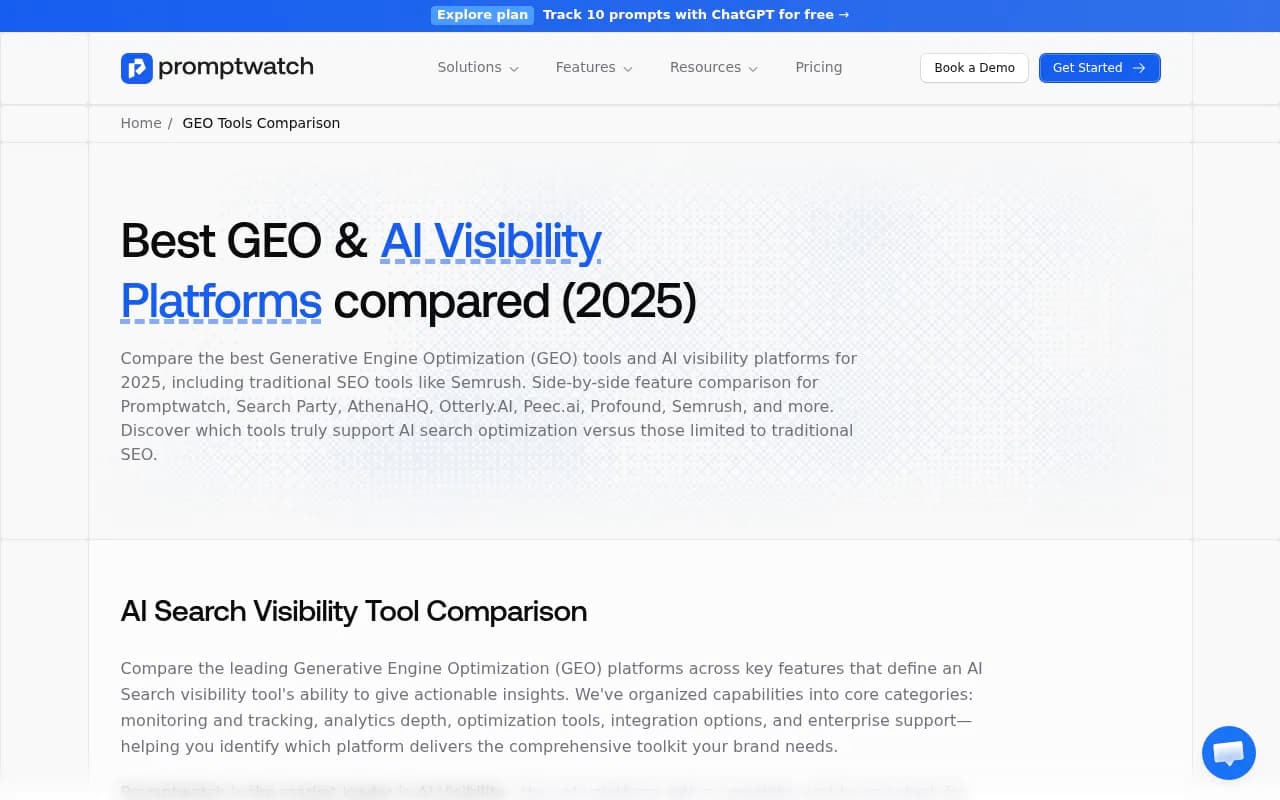
If none of these three platforms feel right, there are other options worth exploring. The GEO tool market now includes everything from lightweight trackers to full-stack optimization platforms.


Each of these has a different set of trade-offs. Otterly.AI is affordable and good for basic monitoring. Profound has strong enterprise analytics. AthenaHQ covers a solid range of AI models. Scrunch AI is worth a look for teams focused on brand sentiment in AI responses.
What most of them share with Meteoria and Goodie AI is the monitoring-only limitation. They show you data. They don't help you act on it. If that distinction matters to your team -- and it should -- Promptwatch remains the clearest choice.
The GEO space will keep evolving. AI models will keep changing. The platforms that survive will be the ones that help teams adapt quickly, not just observe what's happening. By that measure, the gap between monitoring tools and optimization platforms is only going to get wider.