Key takeaways
- ChatGPT's fan-out behavior isn't stable. On August 8, 2026, its use of the
site:operator in sub-queries jumped roughly 46x in a single day, and fanouts per response nearly doubled at the same time, according to Promptwatch data. - The GPT-5.3 rollout on March 4, 2026 hid fan-out query data from the ChatGPT web interface entirely, breaking every DevTools-based tracking method overnight, and cut average citations per response by about 27% platform-wide.
- There's no single reliable window into ChatGPT's real sub-queries anymore. You need a combination of API workarounds, browser extensions, server logs, and manual reverse-engineering, because each method breaks differently.
- Before blaming your own content for a visibility drop, check the date against a known ChatGPT update. Continuous monitoring beats one-off audits because the ground can shift under you without notice.
- Treat your own domain as a retrieval target: ChatGPT now runs
site:yourdomain.com [topic]queries directly against your pages, so unindexed or poorly structured content costs you answers, not just rankings.
Why this is harder than it sounds
I'll say the annoying thing first: there is no stable API where you can just ask ChatGPT "what sub-queries did you run" and get a clean answer back. OpenAI doesn't publish this. It changes the underlying mechanics on its own schedule, without a changelog, and the tools built to reverse-engineer it break constantly. If you've been tracking fan-outs with the same method for more than a few months, there's a decent chance it silently stopped working weeks ago and you just haven't noticed.
Query fan-out itself is simple enough to explain. A user asks one question, and instead of running a single search, the model expands it into several narrower sub-queries, retrieves pages for each, and stitches the results into one answer. SEOcrawl AI's breakdown of the mechanic frames it well: it's not query expansion with synonyms tacked on, it's outright replacement of one query with many independent ones running in parallel. Similarweb's explainer makes the SEO implication explicit too: you're no longer competing for one query, you're competing across every sub-query the model decides to generate.
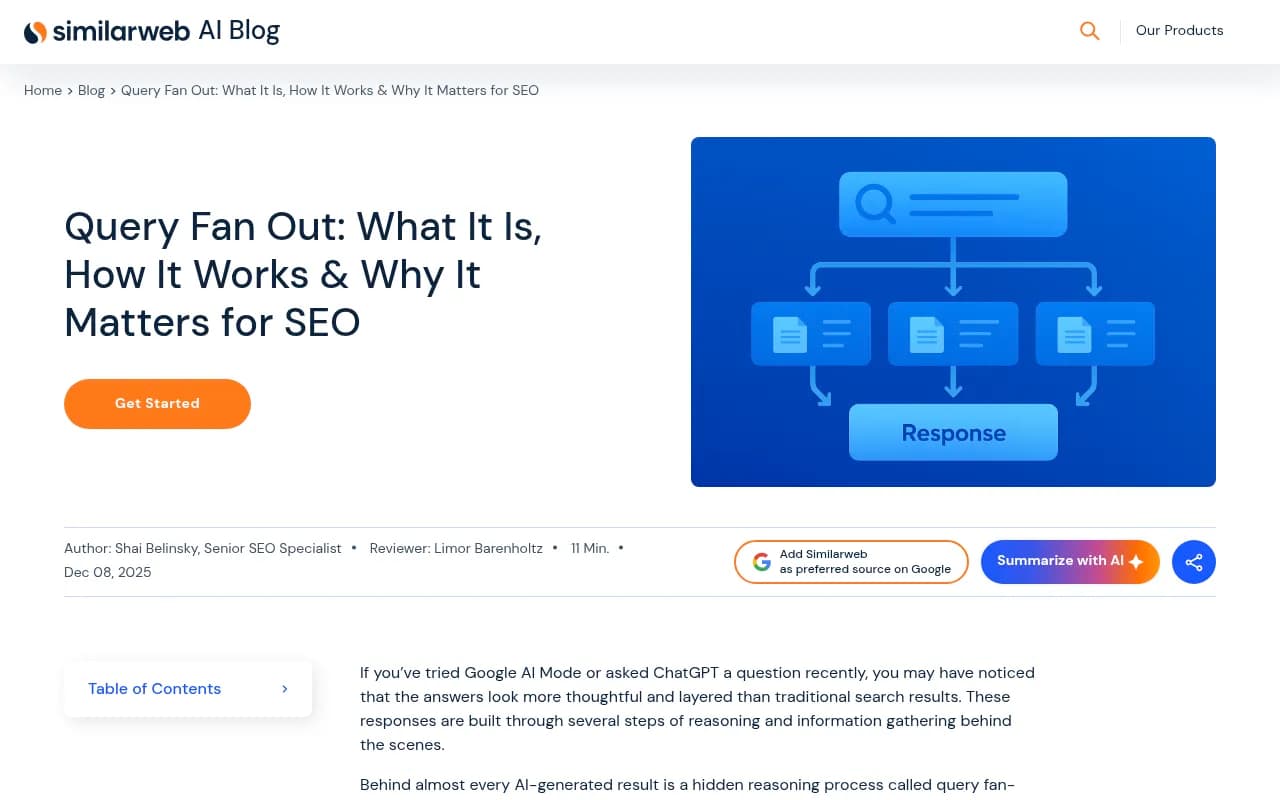
The part that makes this genuinely hard is that the logic governing which sub-queries get generated is not fixed. It moves, sometimes overnight, and the shifts aren't cosmetic.
Two overnight changes that broke everyone's tracking in 2026
March 4, 2026: GPT-5.3 hid the data entirely
Until early March, you could open Chrome DevTools, filter the Network tab for the conversation endpoint, and find a search_query or search_model_queries field showing exactly what ChatGPT searched for. Browser extensions and research tools built entire features on this field.
Then GPT-5.3 rolled out and the field vanished from the web interface, confirmed independently by multiple SEOs including a writeup on NO-BS Marketplace. Sessions on the older GPT-5.2 still showed the data. Sessions on GPT-5.3 came back empty. Anyone relying on that scraping method had their tooling quietly stop working, with no error message, just blank columns.
The same rollout had a second, less visible effect. Promptwatch's citation data shows average citations per ChatGPT response dropping from about 6.4 sources per search-enabled response the week before the rollout to roughly 4.7-4.9 by late March, a drop of around 27% across every model variant simultaneously, with no recovery a month later (see Promptwatch's citation drop analysis). If your traffic from ChatGPT dipped that month, it probably wasn't your content. It was the platform.
August 8, 2026: the site: operator surge
This one is, frankly, the clearest documented example of overnight fan-out logic changing that I've seen. According to Promptwatch's data on the site: operator shift, ChatGPT Search's use of the site: operator inside fan-out queries had been sitting at 0.3-0.5% of all fanout queries for weeks, even dipping to 0.15% between August 3 and 5 (which looks, in retrospect, like a staged pre-launch experiment). Then on August 8, it spiked to 16-17%. That's roughly a 46x jump in a single day.
At the same time, average fanout queries per response nearly doubled, from about 1.08 to 1.83, and stayed there. Because both numbers moved together, the new domain-scoped searches appear to be additive rather than a replacement for generic web search. Your existing visibility chances didn't disappear; a new retrieval path just opened up alongside them.
Think about what that means practically. ChatGPT is now literally running site:yourdomain.com [topic] against your own site as part of building an answer. If your internal search is broken, if key category pages aren't indexed, if your site architecture buries the page that actually answers the sub-query, you don't just rank lower somewhere, you get skipped entirely on that path. Lily Ray's analysis of the change (published August 17, 2026) argues OpenAI is using this to lean on trusted domains the way Google leans on E-E-A-T signals, scoping fan-out queries toward .gov sites, established review platforms, and recognizable brands as a cheap proxy for quality, without building anything as elaborate as Google's ranking stack.
The retrieved vs. cited distinction that trips people up
Before going further, one clarification that will save you from misreading every study you find on this topic: "retrieved" and "cited" are not the same thing. Retrieved means a page ChatGPT fetched during fan-out. Cited means it actually showed up as a link in the visible answer. Lily Ray's research points out these two numbers are moving in opposite directions right now: retrieved URL count is growing while cited domains per response is falling. If two sources tell you contradictory things about ChatGPT's citation behavior, check which metric each one is actually measuring before assuming one of them is wrong.
How to actually track this, ranked by how much access you have
There's no single tool that gives you ChatGPT's real internal sub-queries on a plate. Every method below has a specific failure mode, and the practical answer is to combine two or three of them rather than trust any single one blindly.
1. API workaround (current, but imperfect)
You can hit OpenAI's Responses API directly with model="gpt-5.4", tools=[{"type": "web_search"}], and tool_choice="auto". The response includes output items with url_citation annotations, each carrying title, URL, and the text span it supports. This still works even though the web UI hides the same data. The catch: the API uses a different system prompt than the consumer web interface, so the sub-queries it generates for an identical input can differ from what a real ChatGPT user's browser session triggers. Useful for spotting patterns, not a precise mirror of what your customers see.
2. Browser extensions that read your own sessions
A few free extensions capture fan-out data locally from your own ChatGPT sessions rather than the API. One maintainer put it bluntly in their own documentation: ChatGPT changes its internal response format so often that trying to support three engines properly is worse than supporting one engine well, which is why the tool dropped Perplexity support and never added Gemini. Another extension's changelog shows a field it depended on disappearing from the response stream over a two-day window in July 2026, forcing the developer to infer the data pipeline rather than read it directly. That's the pattern across this entire category: format changes, sometimes twice in a week, and Chrome Web Store review queues mean bug fixes lag by a day to three.
3. Paid GEO platforms with native fan-out views
Several AI visibility platforms build dedicated fan-out tracking into their dashboards rather than asking you to scrape anything yourself. This is where the category has actually matured over the past year, and it's worth understanding the differences before picking one.
| Approach | What it shows you | What breaks it |
|---|---|---|
| DevTools scraping | Raw search_query field from conversation JSON | Broke entirely at GPT-5.3, no warning |
| OpenAI API workaround | Citations + annotations via Responses endpoint | Different system prompt than web UI |
| Browser extensions | Your own session's fanouts, sources vs. cited | Format changes weekly, extension updates lag |
| GEO platforms with fanout views | Aggregated fanout patterns across tracked prompts, over time, with alerting | Vary widely in depth and price |
| Server/CDN logs | Confirms what got cited and crawled, not the query text | No visibility into the actual sub-query itself |
Among platforms that go beyond just showing a fanout count, Promptwatch tracks prompt-level search volume and difficulty, query fan-outs, and citation trends across ChatGPT, Gemini, Perplexity, Claude, Google AI Overviews, and AI Mode, with daily monitoring built to catch exactly this kind of overnight shift rather than relying on a monthly snapshot. It also runs crawler log analysis (Agent Analytics) showing when GPTBot and other AI crawlers actually hit your pages, which lets you cross-check the site:-scoped retrieval behavior against your own server data instead of guessing.

Other tools in this space focus more narrowly on the monitoring side. Peec AI has a dedicated "Query Fanouts" view for ChatGPT, Perplexity, and Copilot, classifying results as Search, Shopping, or Synthetic. Their own research analyzing 5 million fanouts in April 2026 found ChatGPT averages about 2.1 fanouts per prompt, versus Grok's 6.8, and that the top word ChatGPT injects into fanout queries that wasn't in the original prompt is "best," followed closely by "reviews," which explains a lot about why listicle-style content keeps getting cited.
Profound offers multi-engine tracking across ChatGPT, Gemini, and Google AI Overviews with tiered plans, though pricing climbs quickly for enterprise usage and multi-country tracking.
| Tool | Fanout tracking depth | Crawler log data | Content action | Starting price |
|---|---|---|---|---|
| Promptwatch | Prompt-level, with difficulty and citation trends | Yes, real crawler logs | Content Agents + CMS publishing | $95/mo |
| Peec AI | Dedicated fanout classification view | No | No | ~$85-103/mo |
| Profound | Fanout data across 3 engines on paid tiers | No | No | $99/mo (ChatGPT only on entry tier) |
| Otterly.AI | Basic prompt tracking | No | No | $29/mo |
4. Server logs, the ground truth
CDN or server-level logging of GPTBot and citation-referral traffic (via the utm_source=chatgpt.com parameter in GA4) doesn't reveal the actual sub-query text, but it tells you, unambiguously, which pages got fetched and when. If GPTBot pulled a page in the minutes after a prompt class spiked in popularity, that page matched a real sub-query for a real answer. No estimation involved. This is the one method immune to OpenAI changing its web UI or API behavior, because it's watching your own infrastructure, not theirs.
5. Manual reverse-engineering, still legitimate
When all else fails: ask the engine your tracked prompt directly, then look at the sources it cites and work backward to the sub-questions those pages answer. Perplexity actually shows its search steps in the UI as it works, which makes this easier there. ChatGPT hides the steps, so you're inferring. It's slow, maybe ten minutes per prompt, but it costs nothing and it never breaks, because there's no dependency on a field OpenAI controls.
What to actually do when the logic shifts overnight
A few habits make this manageable instead of maddening:
Check the calendar before you check your content. If citations or fanout counts move sharply on a specific date, search for a model rollout on that date before assuming it's something you did. Both the March 4 and August 8 shifts were platform-wide and had nothing to do with any individual site's optimization.
Run the same tracked prompt set daily, not monthly. A one-off audit gives you a false sense of stability. Fan-out behavior documented two distinct overnight changes in 2026 alone; a quarterly check would have missed the August spike for weeks.
Treat your own site as a retrieval surface, not just a ranking target. Since ChatGPT now runs domain-scoped site: queries against sites directly, indexing hygiene and internal search quality matter in a way they didn't a year ago.
Don't trust a single tracking method. Combine at least one aggregated platform view with raw server logs, so you have a check against tool-specific blind spots.
If you want to browse more options for this kind of monitoring, the GEO software directory at bestgeosoftware.com covers a wider set of platforms than fit here, and ai-rank-tools.com is worth a look if you're more focused on the rank-tracking side of AI search than the content-action side.
The honest takeaway is that ChatGPT's fan-out logic will keep changing without notice, probably more than twice a year going forward given how much OpenAI is iterating on the web.run search tool underneath it. Betting your entire tracking setup on one method that happens to work today is how you end up explaining a mystery traffic drop three weeks after everyone else already knew what caused it.