Key takeaways
- Sixty days is long enough to see whether a platform changes your work, not just whether its dashboard looks good. Thirty days is enough for a quick technical check, but too short to see a published change get crawled and cited.
- Lock your prompt set, engines and markets in writing before day one, and run the same set on every vendor you test.
- AI engines shift under you. Log model and retrieval changes during the pilot so you do not credit (or blame) a vendor for engine noise.
- Make the vendor ship one real change, from finding to published page. Monitoring-only tools will struggle with this test, and that is the point.
- Judge success on AI-referred visits and qualified inquiries in your own analytics, not on the vendor's visibility score.
Why pilot at all
Annual contracts for AI visibility tools are easy to sign and annoying to unwind. Demos run on the vendor's prompts, with the vendor's brands, on a good day. Your situation will differ: your prompts, your CMS, your approval chain, your competitors.
A pilot answers one question: can this product do the job in your environment? The LightSite enterprise pilot guide frames it the same way and runs a 30-day version. I prefer 60 days for a reason that is mostly practical. A page you publish in week 3 needs time to get crawled, picked up, and (maybe) cited. Thirty days barely covers that. Another source on measurement recommends collecting 60 to 90 days of data to spot seasonality, content decay and competitor campaigns, which points the same direction.
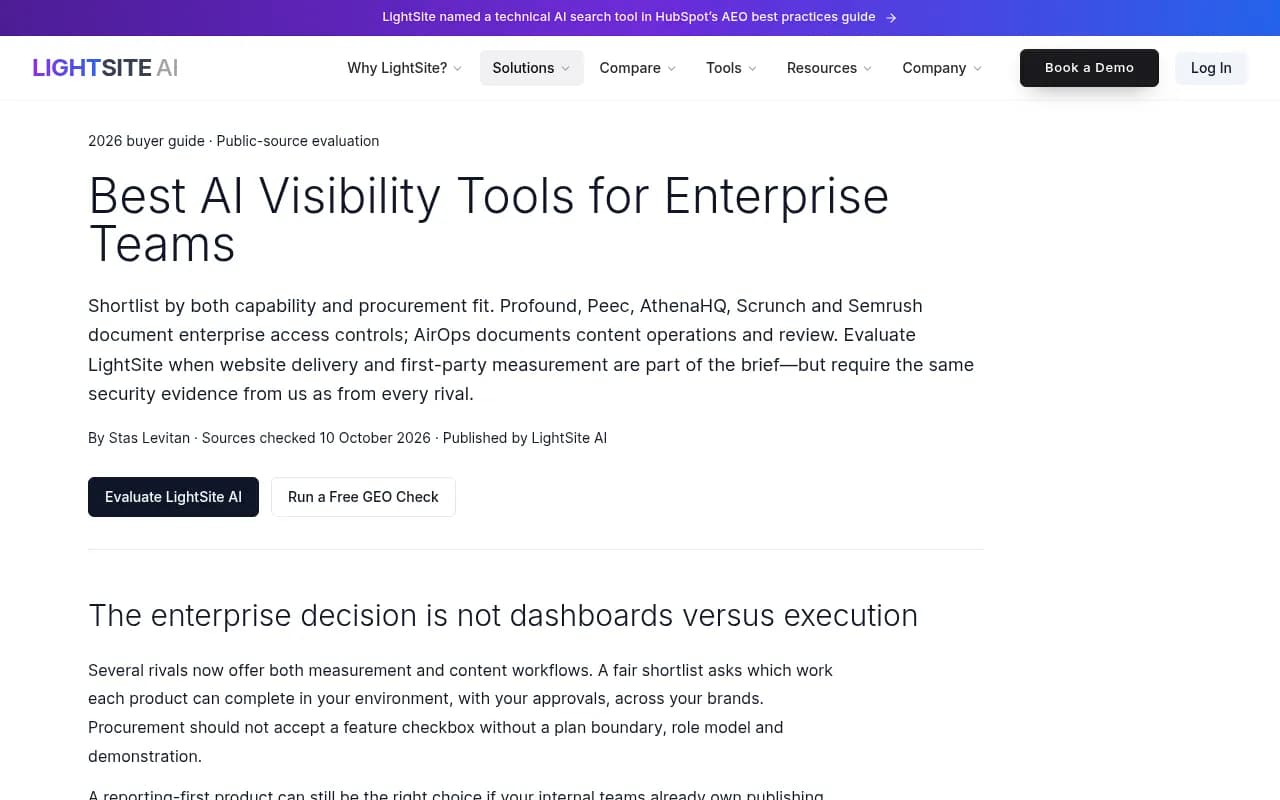
To be fair, LightSite is a vendor writing about vendors, so read its comparisons with that in mind. The pilot structure itself is sound and borrowable.
Before day one: set the rules
Most failed pilots fail here, not during the test. Write down the following and get sign-off from whoever will own the buying decision.
Success criteria
Pick three to five measurable outcomes before you see any data. For example:
- The platform surfaces at least 10 actionable content or technical gaps you did not already know about.
- Spot-checked answers match the live assistants in at least 8 of 10 cases.
- One page goes from finding to published change inside the pilot window.
- AI-referred visits are attributable in your own analytics.
- Your team uses it weekly without being nagged.
The prompt set
Agree on 50 to 100 prompts, the countries and languages, and the engines. Include a mix: category queries ("best X for Y"), comparison queries against named competitors, and branded queries. Freeze the list. If you edit it mid-pilot, you cannot compare week 2 to week 8.
If you run more than one vendor, use the identical set for each. This is the only way the comparison means anything.
Baseline outside the tool
Before starting, record your current AI-referred sessions from analytics, branded search volume from Google Search Console, and a manual sample. A simple manual method: take eight prompts, use a signed-out assistant, start a fresh chat for each, and log the answer, the brands named, the cited URLs and the date. That log becomes your ground truth for the spot-checks later.
Understand the noise before you read results
This is the part people skip, and it matters more than any feature comparison. AI engines change behavior without telling you, and your numbers will move whether or not you did anything.
Promptwatch's own data illustrates the problem. According to Promptwatch's average sources per response data, ChatGPT cites about 5 sources per web-search answer and that average drifts with model and retrieval updates. Google AI Overviews sits around 10 and is steady. Perplexity cites almost exactly 10 sources every day, which the report treats as a stable test bench. Copilot swung from under 2 to nearly 17 sources per response within a few weeks before settling low, and the report advises judging it on monthly trends, not weekly snapshots.
ChatGPT's search behavior also moves. Promptwatch's ChatGPT query fanout data shows fanouts per response averaging 2.15 in early December and about 1.84 by early March, then returning in April at 1.0 per response, with average query length dropping from about 117 characters to about 53. Later, ChatGPT started using the site: operator at scale on August 8, 2026, jumping from roughly 0.4% to 17% of fanout queries overnight. And reddit.com's share of ChatGPT citations fell from about 4% to 0.5% on August 14, 2026.
What this means for your pilot:
- Keep a change log. Note any visible model release, retrieval change or citation shift during the 60 days.
- Use a stable engine as a rough control. If your Perplexity pickup moves and the engine itself is steady, that is more likely your content than noise.
- Read Copilot and ChatGPT on monthly trends, not weekly ones.
- Ask each vendor whether it captures real user-interface responses or simulates the engine through an API. They can differ, and the difference affects whether you can trust the data.
The 60-day plan
| Phase | Days | Focus | Output |
|---|---|---|---|
| Setup | 1-7 | Freeze prompts, connect data, test access | Signed test plan, baseline |
| Evidence audit | 8-21 | Verify data quality against live assistants | Accuracy score per vendor |
| Controlled change | 22-40 | Ship one page end to end | Published change, owner log |
| Measurement | 41-55 | Track crawl, citation, visits | Impact vs baseline |
| Decision | 56-60 | Score, exit test, negotiate | Go / no-go memo |
Days 1-7: fix the test and check access
Load the frozen prompt set. Add your competitors and brand aliases so mentions are counted properly. If your team has more than one brand or region, set up the roles you will actually use: one admin, one editor, one viewer, and one restricted brand. Confirm a restricted user cannot see data outside their brand. Enterprises should also test SSO if it is part of the plan tier.
This is also when you ask the boring questions. Where is data stored? What is the retention period? Who are the subprocessors? Does the vendor hold a security certification such as ISO/IEC 27001 or SOC 2, and will they hand over the report? Some vendors publish this and some make you ask. Ask.
Days 8-21: audit the evidence
Export the raw answer text, cited URLs and dates for a sample. Then take ten answers and check them by hand against the live assistants. You are looking for three things: does the answer match, are the cited URLs real and the ones the engine showed, and is the date right.
A vendor that will not let you export the underlying answers is asking you to trust a score. Treat that as a finding.
Also check what is being measured. Visibility score, share of voice, average position and sentiment are different things. A useful platform lets you read them together to locate the problem: low share of voice points to a coverage gap, late position to a prominence problem, and mentions without citations of your own pages to a content or crawlability problem.
Days 22-40: ship one controlled change
This is the most revealing test. Pick one page, ideally one tied to a prompt cluster where you are weak. Ask the vendor to take it from finding to approved, published change, and record who did what: the tool, the vendor's team, or your own staff.
Some platforms stop at the finding. Others draft content, route it through approvals and publish to your CMS. Neither is wrong, but you need to know which you are buying, because the cost of the missing half lands on your team. If your bottleneck is that nobody has time to act on reports, a monitoring-only tool will give you a nicer to-do list and nothing else.
If technical readiness is in doubt, check crawler access at the same time. Server-log or CDN-based AI crawler data shows whether bots actually reach the page you changed. Promptwatch's AI crawler traffic data is useful context for what normal crawler volumes look like by provider.
Days 41-55: measure the right thing
Now watch what happened to the page. Was it crawled? Did it get cited, on which engines, and for which prompts? Did AI-referred sessions rise in your own analytics?
Keep two reporting lines separate. The first is the vendor's visibility metrics. The second is verified traffic and qualified inquiries from your own analytics. LightSite's guide makes the same point: keep a sampled visibility baseline distinct from verified traffic and sales. One page rarely moves revenue in a few weeks, so do not expect a verdict on ROI. You are testing whether the loop from insight to action to measurement works at all.
Also expect content to age differently depending on type. Promptwatch's content half-life data found that landing pages and docs stayed cited longest among pages ChatGPT cited on July 6, 2026, while news lost half its pages within 36 days. If your test page is news-style, a quick decay is not necessarily the vendor's fault.
Days 56-60: exit test and decision
Disable the integration and confirm your site and data return to their normal state. Export your data. If the vendor makes either hard, you have learned what offboarding looks like, and that is the cheapest time to learn it.
Then score and decide.
What to put in the scorecard
| Criterion | Weight | What a strong result looks like | What to question |
|---|---|---|---|
| Data accuracy | High | 8 of 10 spot-checks match live assistants | Cannot export raw answers |
| Engine coverage | High | Real UI capture for engines you care about | API-only data presented as user-facing |
| Action loop | High | Finding to published change, tracked afterward | Reports only, no workflow |
| Attribution | High | AI-referred visits visible in your analytics | Visibility score only |
| Access and security | Medium | Roles, SSO if needed, security pack provided | Vague answers on residency or retention |
| Contract | Medium | Clear exit, monthly option, data export | Guaranteed citations or rankings |
| Cost per response | Medium | Transparent response and credit limits | Prompt caps that cut your frozen set |
One red flag deserves emphasis. If a vendor or agency guarantees citations or placements, walk. No one controls what an engine cites, and 5WPR's checklist for evaluating AI visibility agencies lists guaranteed placements or rankings as something to question in a contract.
Which platforms to shortlist
You do not need to pilot ten tools. Two or three is plenty. The categories below are a starting point; always confirm current pricing and trial terms on the vendor site, since I have not verified them for every product here.
| Type | Examples | Good fit when |
|---|---|---|
| Monitoring plus action (content, crawler logs, publishing) | Promptwatch, Profound | You need to close the loop from gap to published page |
| Monitoring-focused | Otterly.AI, Peec AI, Athena HQ | You already own content and engineering workflows |
| Enterprise SEO suites with AI add-ons | seoClarity, BrightEdge, Conductor | You want AI data inside an existing SEO platform |
| Free one-off audits | AnswerGist, HubSpot AI Search Grader | You want a cheap baseline before the real pilot |
Promptwatch is a reasonable candidate if the action-loop test matters most to you, since it pairs prompt tracking against real engine interfaces with crawler logs, visitor analytics and a Content Agent that can publish to Webflow, Framer or WordPress. It has a 7-day free trial on monthly Essential, and its Essential tier starts at $95 per month, so check promptwatch.com/pricing before you plan your pilot budget. Note that a 7-day trial will not cover 60 days, so plan on a paid month or two, or ask for an extended evaluation.

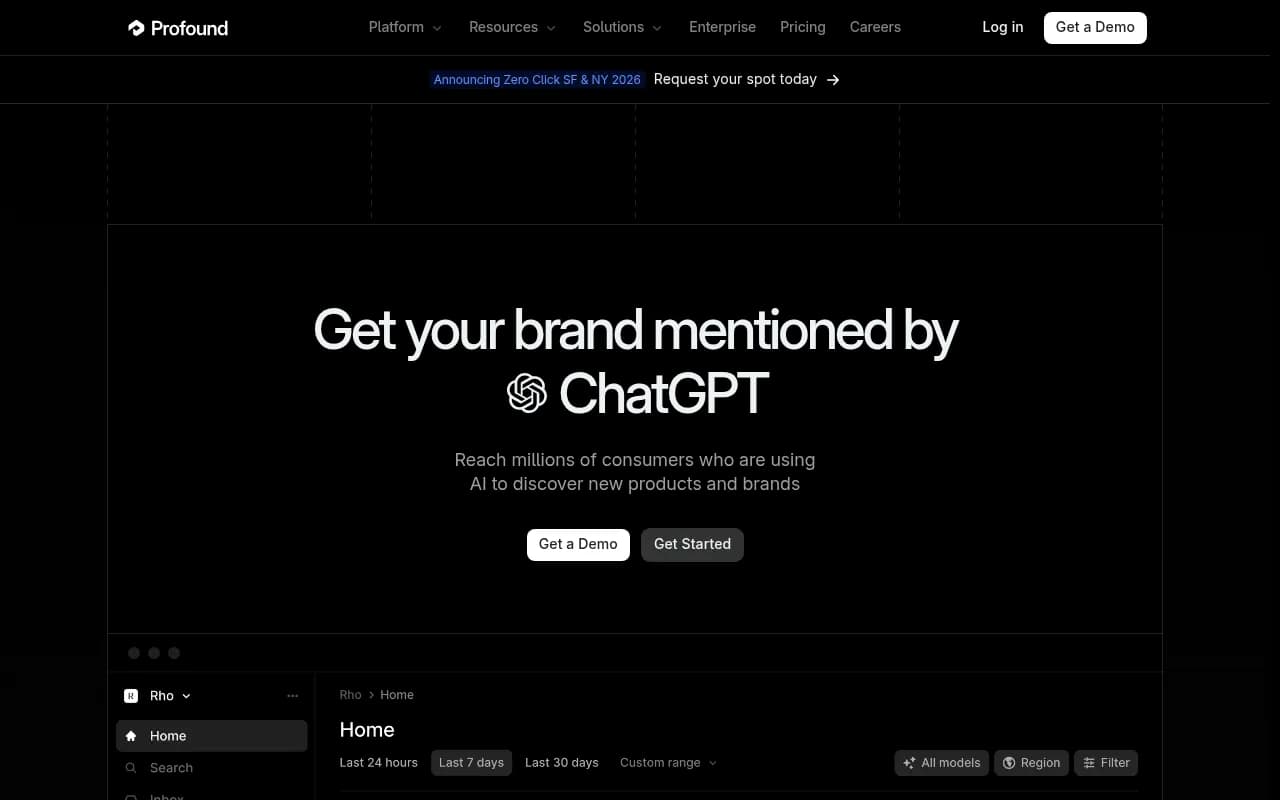
Profound is the usual enterprise comparison, with SSO and server-log integrations listed in its features.
Otterly.AI is the kind of lighter tracker to include if you want a cost floor.

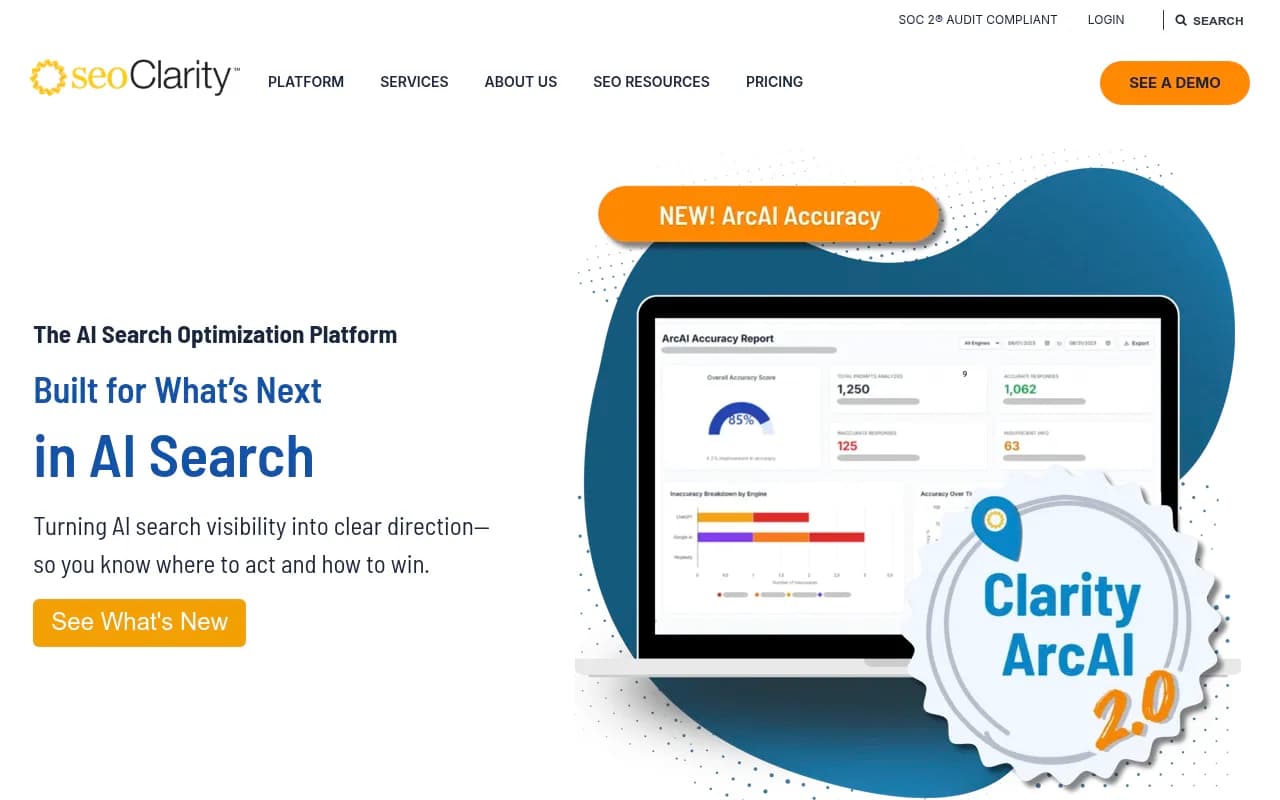
On the enterprise-suite side, seoClarity publishes its own comparison of enterprise platforms and recommends piloting on your own priority prompts before committing, which is the advice this guide is built on.
One caution from the LightSite pilot guide: ownership changes. It states that Scrunch has been a Sitecore company since 3 June 2026. That comes from a competitor's page, so verify it independently, but the habit is right. Ask every vendor for the standalone roadmap and renewal terms in writing.
For wider lists, the GEO software directory at bestgeosoftware.com is a decent place to find candidates you have not heard of.
Negotiating after the pilot
You now have leverage that you did not have before the demo. A few moves that tend to work:
- Ask for a monthly or quarterly term first. Annual billing usually saves around 15 to 20 percent, which is worth it only after the pilot passes.
- Get response, prompt and credit limits in writing, along with what happens at the cap.
- Ask what is excluded from your tier. Some plans leave out content generation, the knowledge base or per-page insights.
- Confirm data export rights and the exit process, which you already tested.
- Put the success criteria from day one into your internal approval memo so the decision is not retold from memory.
Common mistakes
Changing the prompt set midway is the most common. Close behind is judging by a single weekly spike, especially on engines that swing. Letting the vendor pick the test brand or prompts is another. And skipping the manual spot-check, because the dashboard looks convincing, is how teams end up paying for numbers they cannot reproduce.
If you would rather have a specialist run the evaluation for you, agencies that handle GEO work, including 1001 SEO Media, can set up and read a pilot like this alongside your team. It is not required. A careful in-house marketer with a spreadsheet and the plan above can do it.
The short version
Freeze the prompts. Log engine noise. Audit the answers by hand. Make the vendor ship one change. Measure in your own analytics. Then decide, and only then sign for a year.