Key takeaways
- Definition and explainer queries follow a predictable citation pattern: AI models pull from the first 30% of a page, favor structured answers, and heavily favor listicle-style formatting (63% of all LLM citations come from listicles, per Evertune's 400M-citation study).
- Ranking in the top 10 organically is no longer enough. Since Google I/O 2026, only 38% of AI Overview citations come from top-10 results, down from 76% in July 2025. Format and structure now matter more than position.
- The winning template for definition content follows a specific sequence: one-sentence definition, expanded explanation, structured breakdown, examples, and related concepts -- all front-loaded.
- AI models cite content that answers the exact question in the first paragraph, not content that buries the answer after three paragraphs of context.
- Tracking which of your definition pages actually get cited -- and by which models -- is the only way to know if your format is working.
There's a specific type of search query that AI models handle constantly, and most content teams are getting it completely wrong.
"What is [X]?" "How does [Y] work?" "Explain [Z] in simple terms." These are definition and explainer queries, and they make up a huge chunk of what people ask ChatGPT, Perplexity, Google AI Overviews, and every other AI search engine. They're also the queries where format matters most -- because AI models don't just find your page, they extract a specific chunk of it to use as the answer.
Get the format right, and your page gets cited repeatedly across multiple models. Get it wrong, and a competitor with a weaker domain but better structure wins the citation every time.
Here's what actually works in 2026.
Why definition queries are different from other content types
Most SEO content is optimized for humans who scroll. Definition content needs to be optimized for AI models that extract.
When someone asks "what is compound interest?" or "explain machine learning," the AI model isn't reading your whole article. It's looking for a dense, self-contained answer near the top of the page. Evertune's analysis of 400 million LLM citations found that 44.2% of all citations are extracted from the first 30% of a page. For definition queries, that number is almost certainly higher.
This changes everything about how you should structure the page.
Traditional SEO writing often buries the definition. You start with context ("Interest is a concept that dates back to ancient Mesopotamia..."), build up to the definition, then explain it. That's fine for human readers who enjoy narrative. It's terrible for AI citation.
AI models want the answer first. They're essentially running a very fast version of what a researcher does when they skim a source: find the clearest, most direct statement of the answer, extract it, and move on.
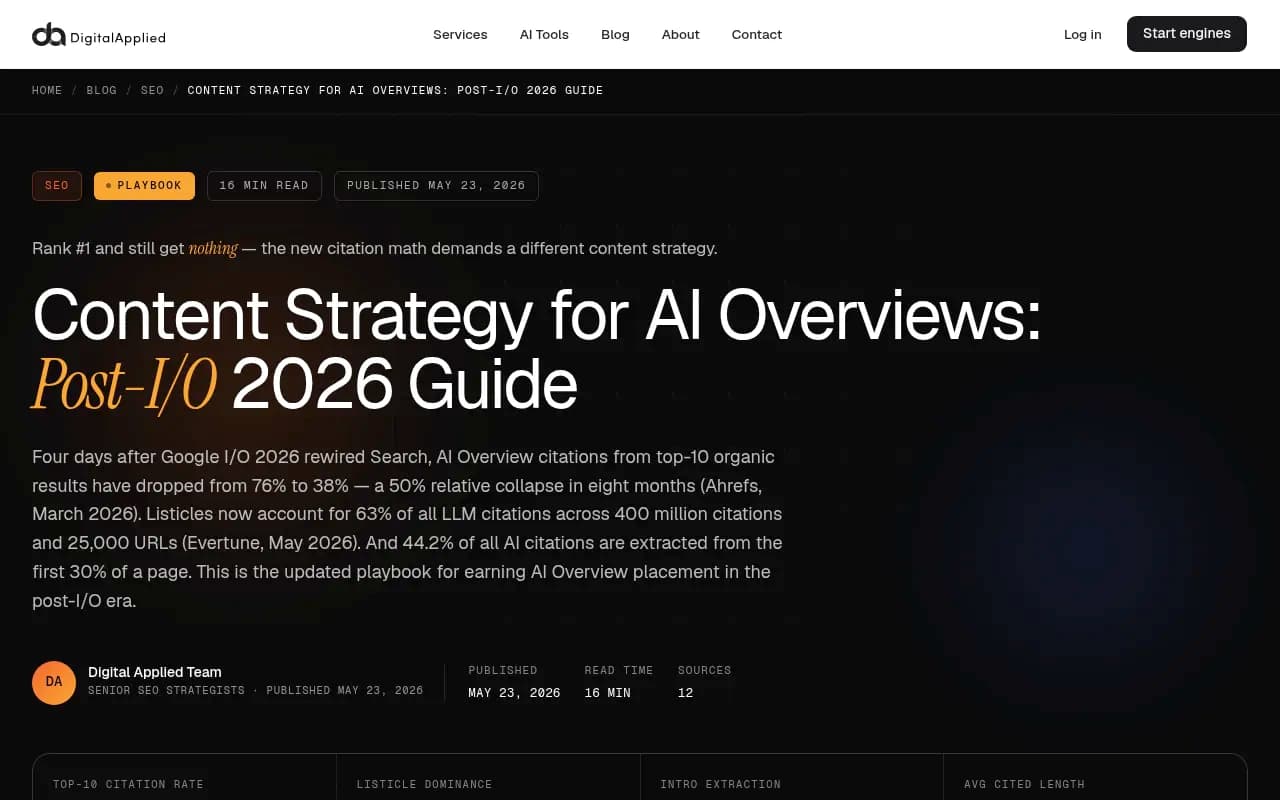
The citation math has changed since Google I/O 2026
Before getting into format specifics, it's worth understanding why this matters more now than it did a year ago.
In July 2025, 76% of Google AI Overview citations came from top-10 organic results. By March 2026, that number had dropped to 38% -- a 50% relative decline in eight months, according to Ahrefs data cited in Digital Applied's post-I/O analysis. Google I/O 2026 also confirmed that AI Mode crossed 1 billion monthly active users and AI Overviews reached 2.5 billion MAU.
What this means practically: a page that ranks #2 organically but has poor structure is now losing citations to pages that rank #15 but are formatted correctly. Domain authority still matters, but it's no longer the deciding factor it once was.
The same pattern holds across ChatGPT, Perplexity, and Claude. These models pull from a much wider source pool than traditional search, and they prioritize clarity and structure over ranking signals. If your definition page is well-structured, it can earn citations from AI models even without strong backlink profiles.
The format that gets cited: a template breakdown
After analyzing citation patterns across AI models, a clear template emerges for definition and explainer content. It's not complicated, but most pages don't follow it.
The one-sentence definition (first paragraph, first sentence)
This is non-negotiable. Your page needs to open with a clean, direct definition of the term. Not a question. Not a teaser. Not "many people wonder what X means." A definition.
Good: "Compound interest is interest calculated on both the initial principal and the accumulated interest from previous periods."
Bad: "When it comes to personal finance, few concepts are as important to understand as compound interest, which is why we've put together this comprehensive guide."
The first version gets cited. The second version gets skipped.
The definition should be one sentence if possible, two at most. AI models extract tight, quotable statements. Long, clause-heavy definitions are harder to extract cleanly.
The expanded explanation (paragraph 2-3)
After the one-sentence definition, spend two short paragraphs expanding it. This is where you add the "why it matters" and "how it works" context. Keep paragraphs short -- three to five sentences maximum. AI models handle dense paragraphs poorly; they prefer discrete, scannable chunks.
This section should answer the implicit follow-up question. If someone asks "what is compound interest," the implicit follow-up is "how is it different from simple interest?" or "why does it matter?" Address that directly.
The structured breakdown (headers or numbered list)
This is where listicle formatting earns its keep. Evertune's 400M-citation study found listicles account for 63% of all LLM citations. That's not because AI models have a preference for bullet points aesthetically -- it's because structured lists make it easy to extract discrete, complete pieces of information.
For a definition page, the structured breakdown might be:
- Key components of the concept
- How it works step by step
- Common variations or types
- What it's not (common misconceptions)
Each item should be self-contained. A bullet point that reads "Frequency of compounding" is useless. A bullet point that reads "Frequency of compounding: interest compounded monthly grows faster than interest compounded annually, because each month's interest is added to the principal before the next calculation" is citable.
Examples (concrete, specific, brief)
AI models love examples. They make abstract definitions concrete, and they give the model something to include when explaining the concept to a user.
One or two examples is enough. They should be specific (use real numbers, real scenarios, real names where appropriate) and brief (two to four sentences each). Vague examples ("imagine you have some money in a bank account") are less useful than specific ones ("if you invest $10,000 at 5% annual interest compounded monthly, you'll have $16,470 after 10 years").
Related concepts (brief, linked)
End the core definition section with a brief mention of related concepts. This helps AI models understand the semantic neighborhood of your content and improves the chance of being cited for related queries. Keep it short -- a sentence or two, or a small list of linked terms.
Front-loading: the most important structural principle
Everything above is about what to include. Front-loading is about where to put it.
The 44.2% first-30%-of-page citation rate means your definition, explanation, and structured breakdown all need to appear before the halfway point of the page. Ideally, the complete answer to the query is visible within the first 500-700 words.
This feels counterintuitive if you're used to writing long-form content that builds toward a conclusion. For definition pages, the conclusion is the opening. Everything after the core answer is supplementary -- useful for human readers who want depth, but not what AI models are primarily extracting.
A practical test: read only the first three paragraphs of your definition page. Does someone who reads only those three paragraphs have a complete, accurate answer to the query? If not, restructure.
Entity signals and topical authority
Format gets you cited once. Entity signals and topical authority get you cited consistently across multiple models and over time.
AI models don't just evaluate individual pages -- they evaluate whether a source is authoritative on a topic. If your site has one definition page on compound interest but no other content about personal finance, you're less likely to be cited than a site with 50 pages covering related concepts.
This is why definition content works best as part of a topical cluster. Each definition page should link to related concept pages, and those pages should link back. The goal is to signal to AI models that your site is a reliable, comprehensive source on the topic -- not just a page that happens to define one term.
Entity signals also matter. Mentioning related entities (people, organizations, standards, frameworks) that AI models associate with the topic improves citation likelihood. If you're writing about compound interest, mentioning the Rule of 72, Warren Buffett's famous quotes about compounding, and the difference between APR and APY all strengthen the entity signal.
Tools like Promptwatch can show you which prompts your competitors are being cited for that you're not -- which is useful for identifying definition topics where you have a gap.

Technical requirements that affect citation
Content format is the biggest lever, but a few technical factors can block citations even when your content is well-structured.
Page speed matters more for AI citation than most people realize. AI crawlers (ChatGPT's GPTBot, Perplexity's PerplexityBot, Claude's ClaudeBot) time out on slow pages. If your server response time is over two seconds, you're losing crawls.
Robots.txt and meta directives are the other common blocker. Some sites have accidentally blocked AI crawlers while trying to block scrapers. Check that GPTBot, PerplexityBot, and ClaudeBot are not blocked in your robots.txt. This is a surprisingly common issue.
Structured data (Schema markup) helps AI models understand what type of content a page contains. For definition pages, DefinedTerm schema is the most relevant. It explicitly tells AI models "this page defines this term," which can improve citation rates.
What to avoid
A few patterns consistently hurt citation rates for definition content:
Interstitials and pop-ups that load before the content. AI crawlers often can't dismiss these, so they never see the actual content.
Definitions buried in FAQs. FAQ sections at the bottom of a page are poorly positioned for citation. If your definition is in a FAQ, move it to the top.
Overly hedged language. "Some experts believe that compound interest could potentially be defined as..." is much less citable than "Compound interest is..." AI models extract confident, direct statements.
Thin definitions with no expansion. A one-sentence definition with no supporting explanation is too thin to cite confidently. AI models prefer sources that demonstrate understanding, not just a dictionary entry.
Tracking whether your format is actually working
Here's the uncomfortable truth: most content teams have no idea which of their pages are being cited by AI models, which models are citing them, or whether a format change improved citation rates.
Without that data, you're optimizing blind. You can follow every best practice in this guide and still not know if it's working.
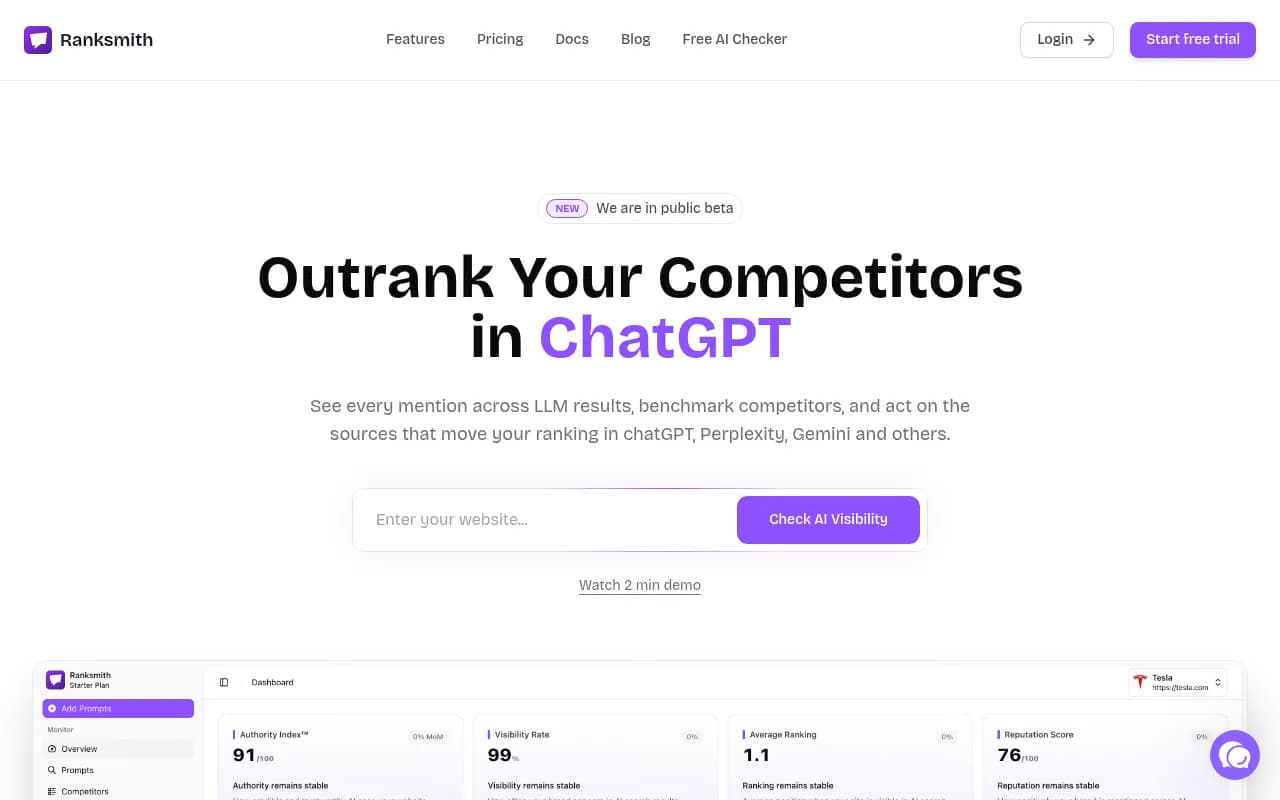
This is where AI visibility tracking becomes necessary rather than optional. Tools like Promptwatch track page-level citations across ChatGPT, Perplexity, Google AI Overviews, Claude, Gemini, and other models -- showing you exactly which pages are getting cited, how often, and by which models. That data tells you whether your definition format is working or whether you need to adjust.
Other tools worth knowing about for tracking AI search visibility:


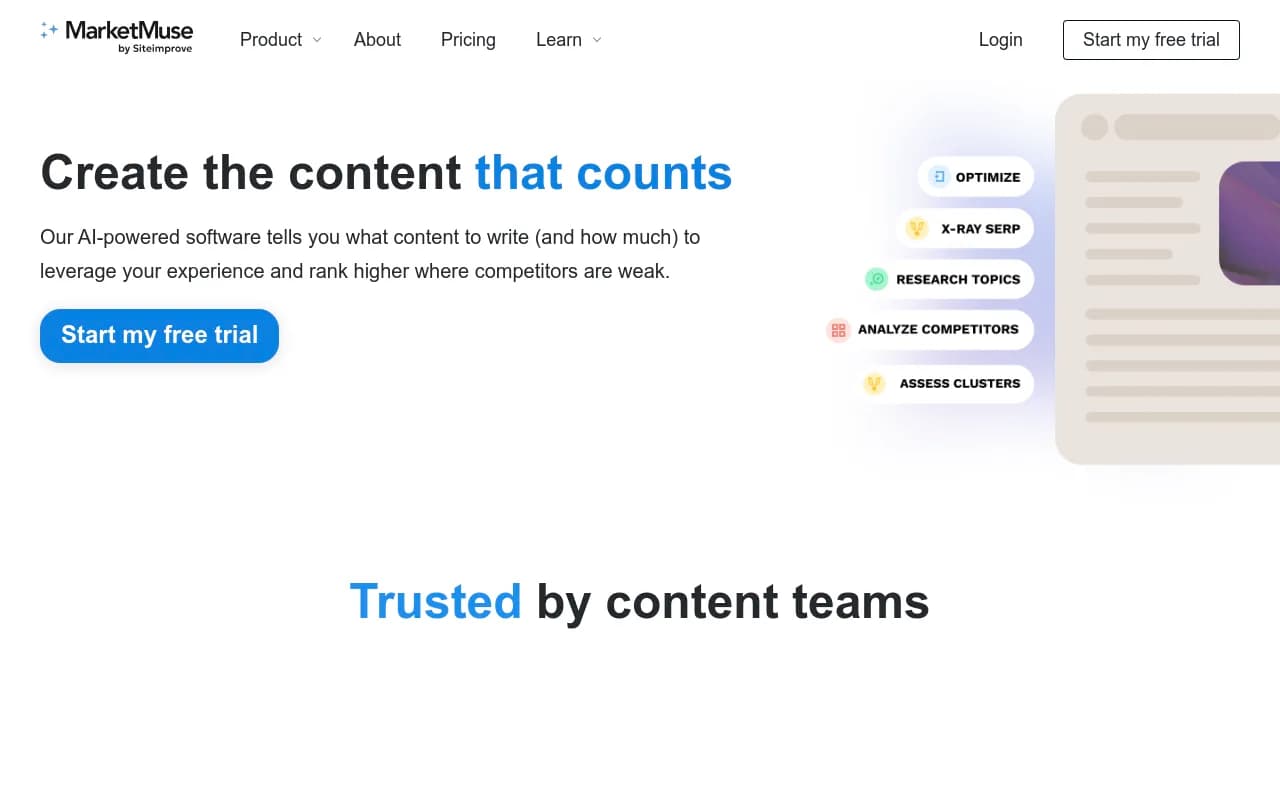
For content optimization specifically -- making sure your definition pages are structured correctly before publishing -- tools like Clearscope and MarketMuse help with semantic coverage and topical completeness.

A comparison of definition page formats
| Format element | Gets cited | Rarely cited |
|---|---|---|
| Definition placement | First sentence of first paragraph | Buried after context/intro |
| Definition length | 1-2 sentences, direct | Multi-clause, hedged |
| Paragraph length | 3-5 sentences | 8+ sentences |
| Structured breakdown | Numbered list or headers with full sentences | Vague bullet points |
| Examples | Specific, with numbers/names | Generic, abstract |
| Page length | 800-1,500 words (complete answer in first 500) | 3,000+ words with answer buried |
| Schema markup | DefinedTerm schema present | No structured data |
| AI crawler access | GPTBot/PerplexityBot allowed | Blocked by robots.txt |
Putting it together: a practical workflow
If you're updating existing definition pages or creating new ones, here's a practical sequence:
First, audit your current definition pages. Read only the first three paragraphs. Is the definition there? Is it direct? If not, restructure.
Second, check your robots.txt and verify AI crawlers aren't blocked. This takes five minutes and can immediately unlock citations you're currently missing.
Third, add DefinedTerm schema to your definition pages. Most CMS platforms support this through plugins or custom fields.
Fourth, expand thin definitions. If your page is under 600 words, add a structured breakdown, one or two examples, and a related concepts section. Aim for 900-1,200 words total, with the core answer in the first 400-500.
Fifth, build topical clusters around your definition pages. Each definition should connect to at least three to five related concept pages.
Finally, set up citation tracking so you know which pages are being cited and by which models. Without measurement, you're guessing.
The format described in this guide isn't a trick or a hack. It's just what AI models need to extract and use your content confidently. Give them a clear, direct answer, structured for extraction, and they'll cite you. Make them work for it, and they'll find someone else who doesn't.