Key takeaways
- A CMO report should fit on one page: four or five numbers, one chart, three competitors, and a short list of actions.
- Combine three data sources: a prompt tracker for ChatGPT and AI Mode answers, Google Search Console and Bing Webmaster Tools for impressions, and your own analytics for AI-referred visits.
- "Rank" in AI answers is not a single position. Report visibility, share of voice, average position within the answer, and citations of your own pages.
- Annotate every chart with model releases. ChatGPT cited roughly 27% fewer sources per response after the GPT-5.3 rollout, and a report that ignores that will blame your content for a platform change.
- Fix the prompt set and the schedule, then compare week against week. Consistency matters more than which tool you pick.
Why a classic rank report fails in AI search
Your CMO forwards a screenshot. Someone asked ChatGPT for the best tools in your category, and three competitors were named. You were not. Search Console says impressions are flat and GA4 says organic sessions are flat, so neither tool explains what happened.
That is the core problem. Classic rank reports assume a stable results page where position 3 means the same thing every week. AI answers do not work like that. The same prompt can return different brands on different days, and a single response often cites many sources. Promptwatch's data on ChatGPT responses from Sep 28 to Oct 4, 2026 found that 47.6% of responses with citations cite 10 or more unique domains, and only 6% cite three or fewer. So "are we cited?" is a weak question. Better ones are how often, how early in the answer, how it describes us, and who shows up next to us.
The second problem is audience. A CMO does not want a spreadsheet of 400 prompts. They want to know whether the trend is up or down, whether competitors are gaining, and what you need from them. Build the report around those three questions.
Supermetrics published a useful walkthrough in August 2026 on combining Search Console, GA4 and citation data into one report. Its core idea matches what follows: a handful of numbers from several places, pulled on a fixed rhythm.
Decide what "rank" means before you report it
The word rank causes arguments in the meeting. Settle it up front, and put the definitions in a footnote on the report itself.
For ChatGPT and Google AI Mode, I would report these four measures:
- Visibility: the share of tracked prompts where your brand appears at all. Report it as a percentage, split by engine.
- Share of voice: your mentions as a share of all brand mentions across the prompt set. This is the competitive number.
- Average position: where your brand lands in the order of brands within an answer. Lower is better. Mention order is the closest thing to a rank that AI answers have.
- Citation rate: how often a response links to your own domain. Being named without being cited usually points to a content or crawlability problem rather than a reputation problem.
A fifth, optional measure is sentiment. Add it only if your brand has a known perception issue, otherwise it becomes noise.
The Promptwatch Academy has plain-language definitions of these metrics if you need something to hand a skeptical stakeholder.
Build the prompt set once, then freeze it
The report is only comparable week to week if the prompts do not change. Spend a real afternoon on this, then lock it.
A workable structure for 40 to 100 prompts:
- Category prompts with no brand name, such as "best project management software for agencies"
- Problem and solution prompts, such as "how do I stop missing client deadlines"
- Comparison prompts naming you and one competitor
- Brand prompts, such as "is [brand] good for small teams"
- A small set of adjacent topics you want to own later
The Searchable AEO workflow suggests asking an LLM to generate about 30 strategic prompts split into category, problem and adjacent queries, and that is a reasonable starting draft. Then cut anything your customers would never type.
Tag every prompt by topic and by funnel stage. Your CMO will eventually ask "how are we doing on pricing questions?" and tags let you answer in one filter instead of a week of rework.
One warning from the data. Prompt types behave differently. In the same Promptwatch report, brand-specific prompts most commonly cite just five domains, while organic prompts without a brand name cite 10 or more more than half the time. Report them separately, because blending them hides what is actually happening.
Track ChatGPT and AI Mode separately
Do not average the two engines into one number. ChatGPT answers come from a search step plus a model that decides what to show, and Google AI Mode draws on Google's index and its own fan-out searches. They cite different kinds of sources. Promptwatch's October 2026 social citation data shows ChatGPT drew 0.46% of citations from social platforms while Google AI Overviews drew 12.2%. A blended score would hide the fact that one engine rewards community content and the other basically ignores it.
I could not find a reliable public method for scraping AI Mode directly, so in practice you need a tracker that collects answers from the real interface rather than an API. That is the main buying criterion below.
Pick your data sources
You need three layers. Skipping any of them leaves a hole your CMO will find.
| Layer | What it answers | Where it comes from | Limits |
|---|---|---|---|
| Prompt tracking | Are we named, where, and who else is? | An AI visibility tracker | Sampled, not the full universe of real prompts |
| Platform impressions | How often does Google or Bing show our pages in AI features? | Search Console, Bing Webmaster Tools | No click, CTR or query data in Google's generative AI report |
| Site analytics | Do AI answers send visits and conversions? | GA4 or an AI-aware analytics tool | Referrer data is patchy |
Google announced Search Console's generative AI performance reports in June 2026. They show impressions for AI Overviews, AI Mode and AI features in Discover by page, country, device and date, but carry no clicks or query data, as noted by Supermetrics and Search Engine Land. Bing launched its AI Performance report in public preview in February 2026 and later added Citation Share.
Treat these as the only first-party numbers in the report. Everything else is sampled, which is fine, as long as you say so.
One more source people forget: your server logs. If AI crawlers cannot read your pages, no amount of content work shows up in the report. Check that robots.txt is not blocking GPTBot, ChatGPT-User or OAI-SearchBot, and submit your sitemap to Bing Webmaster Tools, since ChatGPT leans on Bing-style retrieval.
Tools that can automate the weekly pull
You can build this by hand in a spreadsheet for a month. After that you will want automation. The tools differ mostly in how they collect data, how often they run, and whether they help you act on the findings.
Promptwatch is the one I would start with if the report has to lead to action. It tracks ChatGPT, Google AI Mode, AI Overviews, Gemini, Perplexity and Copilot from the real interfaces by country and language, and reports Visibility Score, Share of Voice, position and sentiment in the same dashboard. It also has IP-verified AI crawler logs and visitor analytics, so the report can show crawls, citations and AI-referred traffic side by side, and scheduled PDF reports go straight to an inbox. Its Action Board turns gaps into a to-do list, which gives the "what we need" section of your report some substance. The 7-day free trial lets you test a monitor before committing, and pricing starts at $95 per month on Essential, so check promptwatch.com/pricing for current plans.

Other options worth knowing:
Otterly.AI is a cheap, simple tracker. It works if all you need is mention monitoring.

Rankscale tracks many engines and lets you schedule per term, though it charges in credits and engines cost different amounts, so budgeting takes some care.
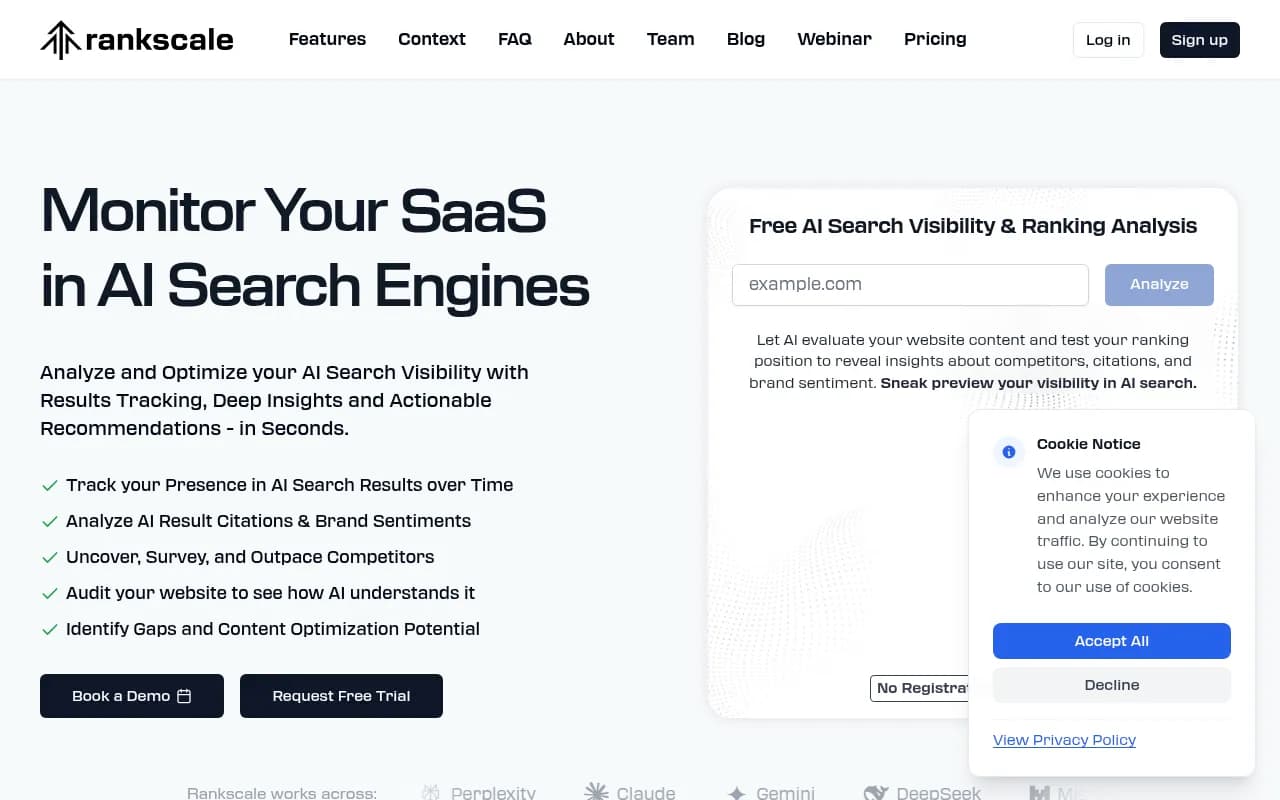
AgencyAnalytics suits agencies that already build client dashboards there. Its AI Tracker runs weekly, which fits this report's rhythm exactly.
Semrush and SE Ranking make sense if you already pay for the suite and want AI tracking next to classic rank data.
Profound and seoClarity target enterprise teams, usually with sales-led pricing.

| Tool | Best fit | Tracking cadence | Goes beyond monitoring? |
|---|---|---|---|
| Promptwatch | Teams that need report plus action | Daily, faster on Business | Yes: content agent, crawler logs, traffic |
| Otterly.AI | Budget mention tracking | Scheduled | Mostly monitoring |
| Rankscale | Many engines, per-term scheduling | Hourly to monthly, credit-based | Monitoring |
| AgencyAnalytics | Agencies reporting to clients | Weekly | Reporting-focused |
| Semrush / SE Ranking | Existing suite users | Varies by plan | Partial |
| Profound / seoClarity | Enterprise buyers | Weekly or daily | Varies |
For wider lists of trackers, the directory at bestgeosoftware.com is a good place to compare more options.
The one-page report layout
Here is the layout I would use. It works as a slide, a PDF or a Slack post.
Block 1: the headline
One sentence with the movement. For example: "Visibility in ChatGPT is 38%, up 4 points on last week. AI Mode is 22%, flat. Competitor B gained 6 points of share of voice." Write it last, but put it first.
Block 2: the scorecard
A small table with this week, last week and four-week average for visibility, share of voice, average position and citation rate, split by ChatGPT and AI Mode.
Block 3: the competitor view
Share of voice for you and your top three competitors, as a single bar chart or a heatmap by topic. Pick the same competitors every week. Auto-discovered competitors are useful for the quarterly review but they make weekly trends jumpy.
Block 4: what changed and why
Three bullets maximum. Name the cause where you can: a page you published, a competitor launch, a crawl error you fixed, or a model change.
Block 5: impact on the business
AI-referred sessions and conversions from analytics, plus Search Console and Bing impressions for AI features. This is the block that gets a CMO to keep reading, because it connects visibility to revenue. If your numbers are small, say so honestly and show the trend.
Block 6: next week
Two or three actions with owners. If you cannot name an owner, the action does not belong on the page.
Separate real movement from platform noise
This is where weekly reports go wrong. Models change, and your numbers move whether or not you did anything.
Promptwatch's data on the GPT-5.3 rollout on March 4, 2026 is the cleanest example. The week before, ChatGPT cited about 6.4 sources per search-enabled response. By late March it settled at 4.7 to 4.9, roughly 27% fewer citation slots, and it did not recover a month later. The shift happened within a day of the rollout. If your visibility dropped that week, the likely cause was fewer citation slots, not worse content. See the ChatGPT citation drop report.
Other shifts of the same kind: ChatGPT began using the site: operator at scale on August 8, 2026, taking it from about 0.4% to about 17% of fan-out queries (report), and Reddit's share of ChatGPT citations fell from about 4% to 0.5% on August 14, 2026 (report). A brand that leaned on Reddit threads would have seen a sudden decline with no change on its own side.
So add three habits:
- Keep a running annotation line on every chart for model releases and product changes.
- Track citations per response across your whole prompt set, so you can tell "we lost visibility" from "everyone lost citation slots."
- Never report a single day. Use weekly averages and look at a four-week trend.
Watch content freshness
If your visibility depends on news-style pages, expect decay. Promptwatch's half-life study, which followed pages cited on July 6, 2026 for 90 days, found news lost half its cited pages within 36 days, while landing pages and docs lasted longest (report). A weekly report that flags pages losing citations gives you a natural refresh list.
Make the report something people read
A few things I have learned about getting executives to open these.
Keep it under a page and a half. If the CMO needs to scroll, they will skim the headline and stop.
Lead with the delta, not the level. "38%" means nothing without "up four" or "down six."
Use one chart per idea. A line for visibility over time and a bar for competitor share is plenty.
Show examples sparingly. One real screenshot of an AI answer where you appear, or fail to, beats a paragraph. CMOs forward screenshots to you; return the favor.
Send it at the same time every week. Monday morning works because it feeds planning. A scheduled PDF removes the human step that makes weekly reports die in week six.
And be honest about the limits. Prompt tracking is a sample. Search Console has no click data for AI features. Referrer data from AI platforms is incomplete, and ChatGPT stopped sending a referrer on October 8, 2026, so tagging links with utm_source=chatgpt.com helps where you control them. Saying this once, in a footnote, builds more trust than overselling.
A simple weekly workflow
- Monday, early: the tracker finishes its weekly collection, and Search Console and Bing numbers are pulled.
- Monday, mid-morning: update the scorecard and check the annotation line for model changes.
- Review the three biggest movers, by prompt and by topic. Open two or three actual answers to see what changed.
- Write the headline and the next-week actions.
- Send by noon, and keep a log of what you shipped so next week's cause-and-effect is easy.
After a month you will have a baseline. After a quarter you will have the first honest answer to "did our content work change anything?" For help setting this up and acting on the findings, an agency like 1001 SEO Media works with GEO platforms such as Promptwatch to run exactly this kind of weekly reporting loop.
Common mistakes
- Changing the prompt set every few weeks, which destroys comparability.
- Averaging ChatGPT and AI Mode into one score.
- Reporting mentions without position or citations.
- Blaming content for dips that come from model releases.
- Packing the report with every metric the tool offers.
- Listing actions with no owner or date.
Final checklist
Before the first send, confirm you have a frozen prompt set tagged by topic and intent, engine-level reporting for ChatGPT and AI Mode, a fixed competitor list, Search Console and Bing impressions, an AI-traffic segment in analytics, a model-release annotation line, and a scheduled delivery. If any of those is missing, fix it first. The report gets read when it is short, consistent and tied to something the CMO can decide.