Key takeaways
- Review sites matter for AI perception, but the numbers vary a lot by who measured them. Vendor studies claim a 3.1x citation lift for top G2 brands. Promptwatch's first-party data shows G2 at 0.73% of ChatGPT software citations.
- Reviews do three jobs: they confirm your category, supply the language AI uses to describe you, and act as a weak tiebreaker. Star averages and raw volume matter less than category placement and what reviewers actually write.
- ChatGPT cites reviews far more when the prompt names a brand (5.6% of citations) than for generic prompts (1.7%). Reputation questions are where review sites carry the most weight.
- Your own site and docs still earn about 3x more software citations than review sites combined. Keep G2 and Capterra complete, but do not treat them as a substitute.
- G2 now owns Capterra, GetApp and Software Advice. Expect one consolidated vendor platform from November 2026, and some glitches on the way.
Why everyone suddenly cares about review sites
A buyer asks an AI assistant for the best help desk tool for a mid-market team. The model maps the question to a category, pulls candidate vendors, and checks whether other sources back them up. Review platforms touch every step of that. They confirm the category, they supply names, and they offer third-party validation.
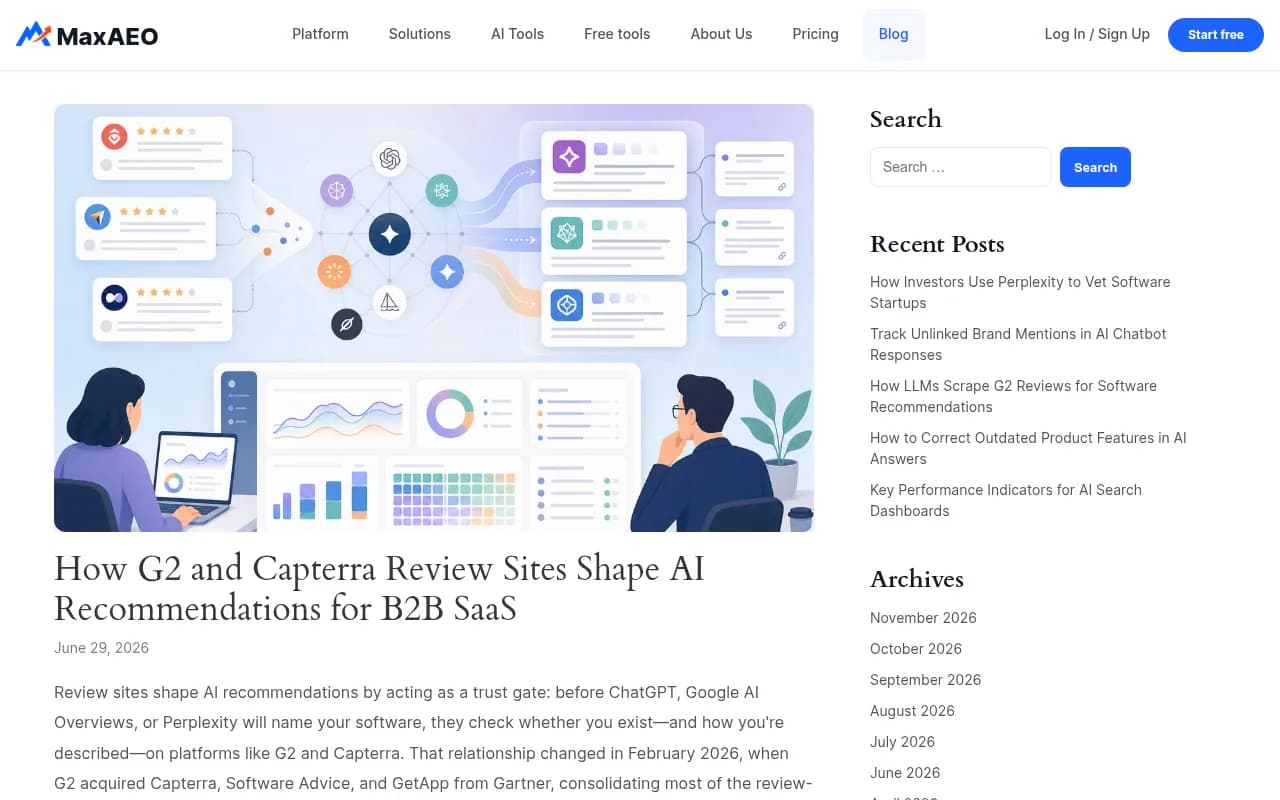
G2's 2025 Buyer Behavior Report, as summarized by MaxAEO, found GenAI chatbots had become the number one source influencing B2B vendor shortlists at 17.1%, just ahead of software review sites at 15.1%. So AI builds the shortlist, and buyers then check it on review sites. Both steps matter.
The trouble is that the data on how much review sites move AI answers is all over the place. I would rather lay out the conflicting numbers than pick the flattering one.
What the studies say, and where they disagree
The vendor-estimate view
Presenc AI's May 2026 research is the most bullish. Across roughly 6,800 procurement-intent queries, it reports that brands in the top 20 on G2 for their category were cited about 3.1 times more often than brands absent from G2. It also reports:
- Profiles with 100 or more reviews are cited about 2.3 times more than profiles under 20 reviews, at equal star ratings.
- A G2 Leader or High Performer badge correlates with a 20 to 35 percent extra lift on ChatGPT and Perplexity.
- Profiles where 40 percent or more of reviews are under 12 months old show a 25 to 40 percent higher Perplexity citation rate.
- Being on Capterra as well as G2 adds an estimated 15 to 22 percent.
Presenc itself calls these estimates directional. I would read them as a hypothesis, not a benchmark. Also note that being in the G2 top 20 for a category correlates with being a big, well-known product, and big products get mentioned for plenty of other reasons.
The first-party citation view
Promptwatch Data gives a more sober picture. In its ChatGPT software prompts report (Sep 28 to Oct 4, 2026), the top cited domains by share of all software citations were:
| Domain | Share of software citations |
|---|---|
| github.com | 1.2% |
| learn.microsoft.com | 0.98% |
| g2.com | 0.73% |
| docs.aws.amazon.com | 0.41% |
| gartner.com | 0.34% |
| capterra.com | 0.32% |
G2 is the most cited review site and ranks third overall, ahead of Gartner and Capterra. Trustpilot did not make the top 23 software domains at all. By source type, docs and help centers earned 2.64%, vendor sites 2.01%, and review sites and analysts combined (G2, Gartner, Capterra, Software Advice) 1.57%. Vendor pages plus docs earn 4.65%, about three times what review sites earn.
So G2 is a real source. It is not the dominant one. Promptwatch's own takeaway is sensible: keep G2 and Capterra profiles complete and current, but treat your own site and docs as the main citation source.
Why the numbers can both be true
They measure different things. Presenc counts how often a brand is named in answers to "best [category]" queries. Promptwatch counts which URLs ChatGPT lists as sources. A model can mention you because review sites shaped its training data or retrieval, and still never cite a review site by name. MaxAEO describes this well: review platforms are near-universal among tools ChatGPT recommends, yet the aggregator is often not the named source. Influence shows up as eligibility and perception, not a clickable link.
Three jobs review sites do for AI
MaxAEO splits the influence into three jobs, and I find this more useful than any single lift figure.
Job 1: the category gate
Before a model names your product for a category, it helps if G2 and Capterra file you in that category. Those pages supply the candidate set. If you are listed under the wrong category, or not at all, you are easier to skip.
Job 2: the descriptor source
This is the most underrated one. When an AI says a tool is "praised for onboarding but criticized for limited reporting," that framing often traces back to aggregated review text. Reviewer phrases like "easy to implement for non-technical teams" tend to travel into answers. Blastra makes the same point: reviews are content, not just ratings.
That is why the words in your reviews matter more than the average. Ask happy customers to describe the specific problem you solved and who they are, not just to leave five stars.
Job 3: the weak tiebreaker
MaxAEO found that review volume had a small negative correlation with ranking position in ChatGPT answers (Capterra -0.21, G2 -0.16), and star average was close to flat. Translation: once you are present and credible, piling on more reviews does little to move you up. Presence, category placement, recency and language matter more than the count.
This partly contradicts Presenc's volume claims. My read: volume helps you cross a credibility threshold (Presenc suggests around 50 reviews), and then returns flatten.
How each AI engine treats review sites
| Engine | How review sites show up | Source |
|---|---|---|
| Google AI Overviews | Visible, frequent citations. Review platforms got 8.5% of links and appeared in 34.5% of analyzed responses | MaxAEO, citing SE Ranking's December study |
| ChatGPT | Background trust and training signal more than inline source; modest citation share in Promptwatch data | MaxAEO, Promptwatch Data |
| Perplexity | Frequently surfaces comparison and review pages | MaxAEO, Presenc |
| Gemini, Claude | Moderate to high for G2, lower for Trustpilot on Claude | Presenc (directional) |
SE Ranking's study, which looked at 22,729 AI Overviews across 30k keywords, found 34.5% cited at least one review platform, with G2 in 23.1% of responses. If you care about visible citations, AI Overviews is where review sites pay off most clearly.
Trustpilot is a different story
Trustpilot's own research, titled "What AI says about you" (2026), says it was the most-cited review platform across ChatGPT, Google AI Mode, Gemini and Perplexity. On ChatGPT it reports Trustpilot at 58% of review-platform citations, then BBB at 15%, G2 at 7%, Capterra at 3% and Yelp at 0%. It also says 63% of ChatGPT responses about brands reference customer service quality.
That looks like a contradiction with the G2-first picture until you notice the scope. Trustpilot's study is about brand reputation queries, mostly consumer-facing. Promptwatch's is about software buying prompts, where Trustpilot barely registers. And Trustpilot is selling a product here, so read its headline numbers with the same caution as Presenc's.
The practical split:
- B2B and enterprise software: G2 first, then Capterra, TrustRadius and Gartner Peer Insights.
- B2C, ecommerce, services and SMB-facing products: Trustpilot earns its place, especially on Perplexity and for reputation prompts.
Reviews matter most when the prompt names your brand
This is the finding I would act on first. In Promptwatch's ChatGPT citation share by content type report (Sep 28 to Oct 4, 2026), reviews were only 1.7% of all citations. For commercial prompts like "best CRM", product pages (26.0%), landing pages (20.6%) and listicles (15.0%) dominate.
But for branded prompts like "is HubSpot good for startups", reviews rise to 5.6%, more than three times their overall share, and social posts rise to 3.0%. People asking about you specifically get answers shaped by what others say about you. So review sites matter less for winning the shortlist and more for what happens once someone checks you out.
Promptwatch's advice from that data is to collect reviews on the sites people trust in your category, and to get listed in the "best of" roundups ChatGPT cites for it.
The G2 and Capterra consolidation
G2 acquired Capterra, Software Advice and GetApp from Gartner Digital Markets, with the deal closing on February 5, 2026. Blastra reports that my.G2 now lists G2, Capterra, GetApp and Software Advice on one Listings page, and that G2 says my.G2 becomes the single vendor platform in November 2026. Review pools stay separate. Blastra also documented glitches in late September: missing Capterra profiles, logins landing on G2, and listings that cannot be claimed.
G2's job postings are telling. It is hiring a VP of Growth responsible for GEO with a stated goal of being the number one citation source in LLMs across software categories, plus a team of SEO specialists. Whether it gets there is open. Promptwatch's current data has it at 0.73% of software citations, which is first among review sites but far from dominant. If G2 succeeds, what G2 reviewers say about your product increasingly becomes what AI says about it. If you manage listings, check that everything is claimed and consistent after the migration.
A practical playbook
| Action | Return | Why |
|---|---|---|
| Claim and complete profiles on G2 and Capterra | High | Category gate and structured facts AI can extract |
| Run an ongoing review request program | High | Reaches the credibility threshold and keeps recency up |
| Prompt reviewers to describe use case and team type | High | Feeds the descriptor job |
| Answer reviews publicly | Moderate | Signals an active profile |
| Write keyword-matched product descriptions on listings | Moderate | Better passage match, rarely done |
| Buy or incentivize fake reviews | Negative | Removal risk and credibility damage |
| Keep your own docs, product pages and landing pages strong | Highest | They out-earn review sites about 3 to 1 |
A few points on execution:
- Aim for a steady flow rather than a burst. Presenc's data favors profiles with at least 40 percent of reviews from the past 12 months, particularly on Perplexity.
- Use traditional review forms. Blastra argues G2's AI-assisted review options produce thinner text, which defeats the point of collecting descriptive language.
- Do not drop other directories. AI answers cite G2, Capterra, TrustRadius, SourceForge and docs together. Spread is a hedge.
- Mixed reviews at volume beat a handful of perfect ones, per Presenc, though an average below about 3.5 stars can lead assistants to hedge or omit you.
One honest caveat: there is a cynical view, voiced on LinkedIn by Toni Hopponen, that it is ironic AI checks website claims against G2 and Capterra, some of the most marketing-managed content on the web. He has a point. It is also a reason to prioritize authentic, specific reviews over volume tactics, because models and platforms both get better at spotting patterns.
Measuring whether it worked
Star averages are not the outcome. The outcome is how AI answers change. Baseline your top buyer prompts across ChatGPT, Gemini, Perplexity, Claude and AI Overviews: are you named, in what position, and with what description? Then re-run after a review push.
Tools like Promptwatch can do this at scale. It tracks prompts in the real interfaces of the AI engines, shows which URLs and source types get cited (including review and directory sites in its citation trends), and has a Brand Narrative view that pulls out the individual claims AI makes about you, which is the closest thing to seeing whether your reviewer language is spreading. Its crawler logs and visitor analytics then show whether any of this sends traffic. Its free AI visibility report is a no-login way to get a first baseline.

Other trackers in this space include Profound and Otterly.AI, and you can browse more options in the GEO software directory at bestgeosoftware.com.

For a visual of how MaxAEO frames the review profile to shortlist flow, here is their write-up:
What I would do first
If I ran marketing for a B2B software company tomorrow, the order would be: fix the basics on G2 and Capterra (category, description, claimed profile), start a steady review request program that asks for specifics, and keep investing in docs and product pages because those still win citations. Then measure branded prompts, where review language shows up most. For a consumer-facing brand, swap in Trustpilot as the first stop.
And treat every lift multiplier you read, including the ones above, as a prompt to test on your own category rather than a promise.