Key takeaways
- MCP gives coding agents like Claude Code and Cursor direct, structured access to SEO data (Ahrefs, Semrush, DataForSEO, Google Search Console) instead of forcing an engineer to copy-paste reports into a chat window.
- Most teams start with one or two servers, not ten. GitHub's own Copilot team cut its tool count from 40 to 13 and saw a 2 to 5 point benchmark improvement plus 400ms lower latency, because tool-metadata bloat eats into the context window before the agent does any work.
- Markdown and docs are an agent-retrieval channel, not an AI-search-citation channel: Promptwatch's data shows HTML pages account for 99.94% of AI search citations versus 0.05% for markdown files, while coding agents like Claude Code and Codex are fetching
.mddocs directly through their own crawlers. These are two different problems that need two different fixes. - A working setup needs three things: a narrow, purpose-built MCP server, a standing instructions file (CLAUDE.md or a Cursor rules file) that defines a repeatable SEO loop, and explicit guardrails so the agent doesn't publish or burn API credits unsupervised.
- Security is not optional. Publicly exposed MCP servers without auth, config files that store API keys in plain text, and the "confused deputy" problem of shared service tokens are all documented risks specific to SEO data access.
Why SEO context inside a coding agent is a different problem than SEO content
For most of the last decade, "SEO tooling" meant a dashboard a marketer opened once a week. In 2026, a chunk of the actual SEO work, catching a blocked robots.txt rule, flagging a missing canonical tag, checking whether a new page cannibalizes an existing one, happens inside the same tool an engineer is already using to ship code: Claude Code, Cursor, Windsurf, or VS Code with Copilot.
The reason this shift is possible is the Model Context Protocol, the open standard Anthropic released in November 2024 and later donated to the Linux Foundation's Agentic AI Foundation in December 2025, with OpenAI and Block as co-founders and AWS, Google, Microsoft, Cloudflare, GitHub, and Bloomberg as supporting members. Before MCP, giving an AI coding assistant access to your SEO data meant a custom integration for each combination of model and data source, the classic N times M problem. One developer writing for The New Stack described spending two weeks building a custom CRM connector, then replacing it with an MCP server built in four hours that worked across every model in the stack. That ratio is the whole argument for doing this through MCP rather than a one-off script.
What "SEO context" actually means to a coding agent
When a product team says their agent has "SEO context," they usually mean access to some combination of:
- Live rank and visibility data (position tracking, competitor share, AI citation share)
- Technical crawl data (broken links, redirect chains, duplicate titles, missing schema)
- Search Console performance data (clicks, impressions, CTR, indexing status)
- Keyword and SERP research (search volume, difficulty, related queries)
- AI search visibility data (which prompts cite the site, in which engines)
An MCP server is what turns any of these into something an agent can query mid-task, instead of something a human has to look up and paste in. A developer working on a new pricing page can ask the agent to check whether the URL structure collides with an existing ranking page, get an answer sourced from live Search Console data, and fix it before opening the pull request.
The SEO MCP server landscape in 2026
A handful of official, production-ready servers now cover most of what a product team needs. None of them replace human judgment, and most vendors are explicit about that.
Ahrefs MCP is a hosted remote server available on any paid Ahrefs plan starting at Lite, connecting over Streamable HTTP with OAuth. It exposes backlink data, keyword research, and competitor analysis, and works with Claude Desktop, Claude Code, Copilot Studio, and several no-code platforms. Ahrefs is explicit that the endpoint is not a general-purpose API and can't be used through custom scripts or bridges.
Semrush MCP ships as a zero-code setup included in Semrush One and SEO Classic plans, or via a Standard API package for teams outside those tiers. It works across ChatGPT, Claude, Gemini, Perplexity, Cursor, and VS Code, and is listed as an official app in the ChatGPT, Claude, and Perplexity directories.
DataForSEO MCP skips subscriptions entirely and runs on pay-per-call pricing, with a $50 minimum deposit and no free-tier card requirement. Individual Google SERP calls run from $0.0006 in standard queue to $0.002 in live mode. At scale it can run 60 to 70 percent cheaper than subscription tools, but you lose the dashboards and historical tracking that come bundled with Ahrefs or Semrush. That's the trade a coding agent is well suited to cover, since it can interpret raw data on demand rather than needing a UI.
Google Search Console MCP is the free, community-maintained option most teams reach for first. Popular implementations like mcp-gsc ship 20 tools spanning quick-win detection (positions 4 through 15), content-decay diagnosis, cannibalization checks, and the Indexing API for submitting URLs and sitemaps. Setup takes about 15 minutes through OAuth. A common failure mode: domain properties need the sc-domain: prefix while URL-prefix properties need the full URL, and mismatches fail silently with no error message.
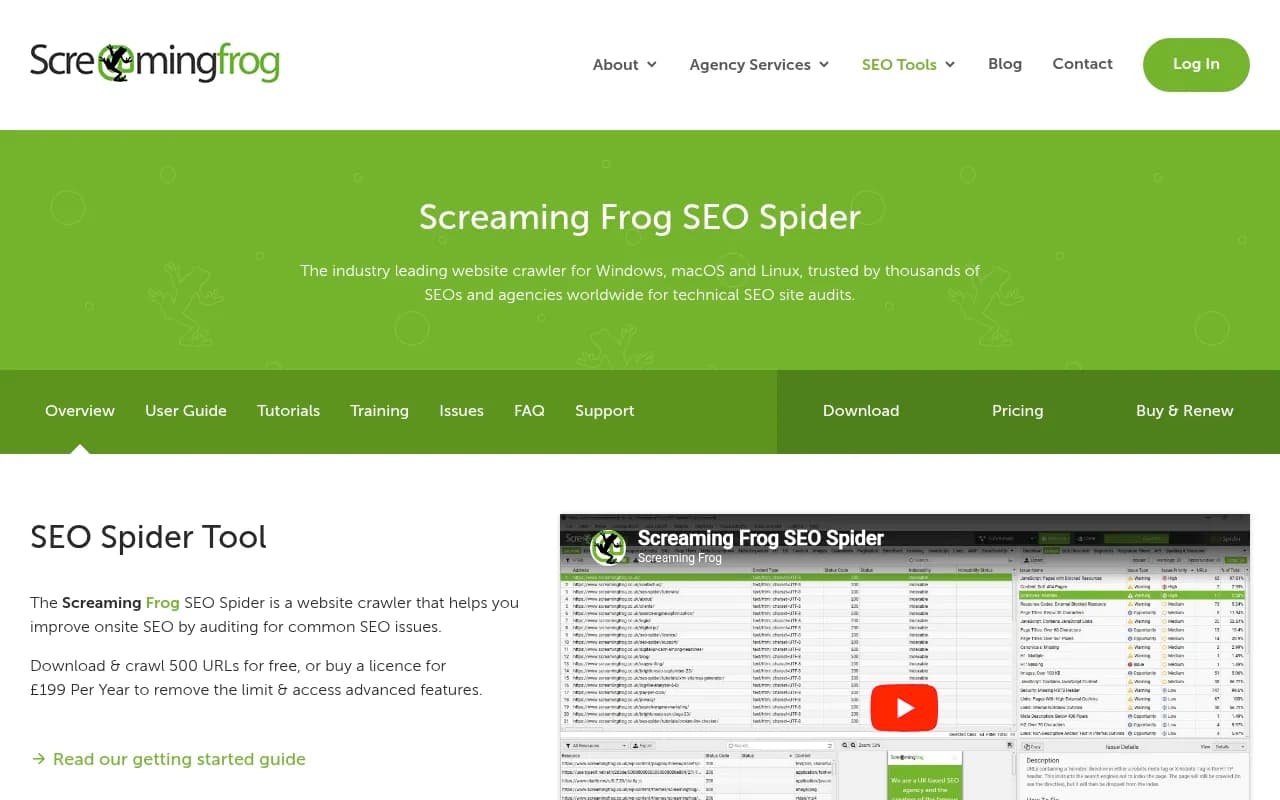
Screaming Frog SEO Spider MCP shipped natively in v24.0 (May 2026), running as a local Node.js process compatible with Claude Desktop, Claude Cowork, Cursor, and LM Studio. It requires a paid license. One agency that crawled a 973-URL production site through it put it plainly: the MCP server does not replace technical SEO judgment, it just gets the crawl data into the same window as the fix.
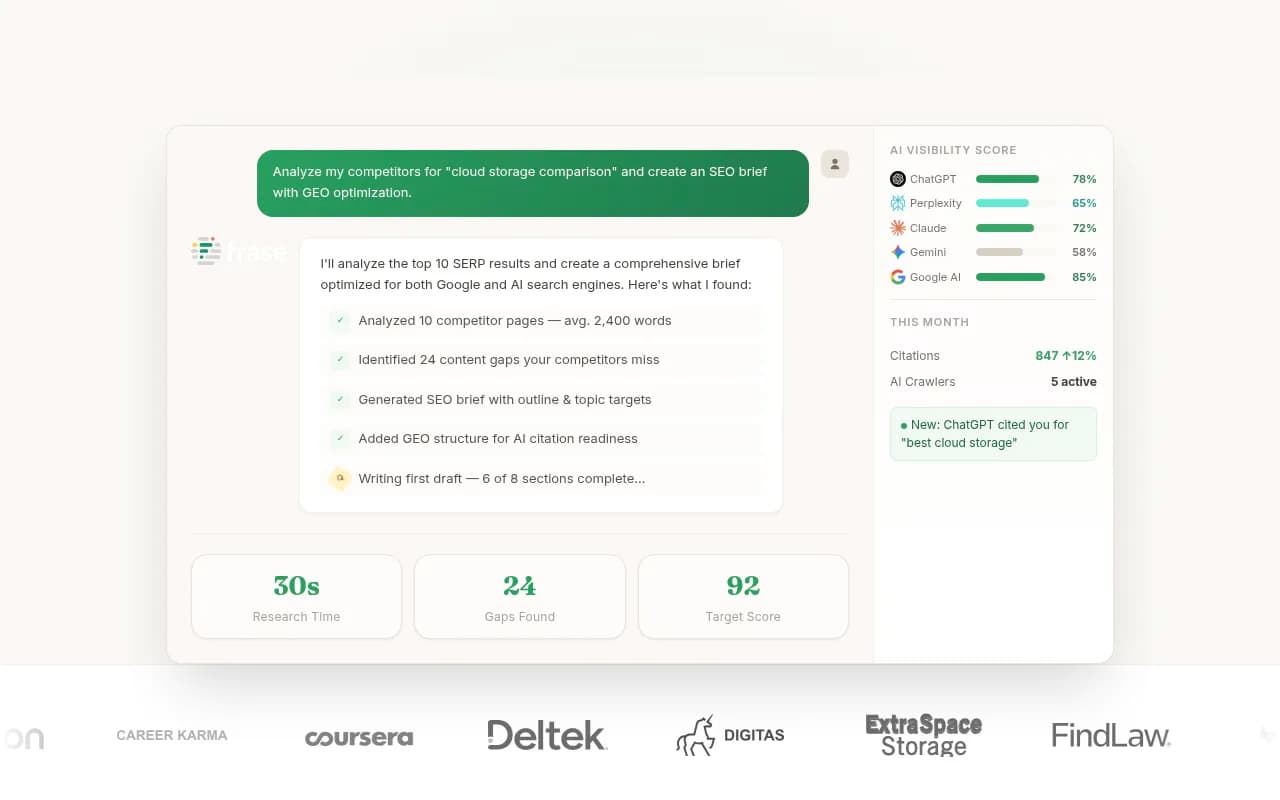
Frase MCP stands out because it's read-write rather than read-only. It can run SERP research, generate briefs, score and rewrite content for SEO and GEO, and check AI visibility, directly inside Claude Code or Cursor, with a single install command. Frase's own documentation recommends pairing the server with a standing instruction file that defines a loop: check the SERP, check AI visibility, draft or score, re-score, report, and it recommends a hard rule along the lines of "never publish without explicit approval."
For AI search visibility specifically
Classic keyword and crawl data answers "will this rank on Google." It doesn't answer "does ChatGPT or Google AI Overviews cite this page." That's a separate data problem, and it's where a platform like Promptwatch fits into the same MCP-connected workflow: it tracks citations, prompt volumes, and crawler behavior across ChatGPT, Claude, Gemini, Perplexity, and AI Overviews, and exposes an MCP server so an agent can pull live visibility scores, competitor citation share, and content gap data into the same coding session it's already using for technical SEO checks. Unlike a pure prompt tracker, Promptwatch also runs Content Agents that can draft and publish GEO-optimized pages, so the agent isn't just reporting a gap, it can hand off the fix.

Comparing the main options
| MCP server | Official? | Cost model | Connection | Best for |
|---|---|---|---|---|
| Ahrefs | Yes | Subscription from $129/mo | Remote | Backlink and competitor research |
| Semrush | Yes | Subscription + API package | Remote | Keyword research, competitive SEO |
| DataForSEO | Yes | Pay-per-call, $50 min deposit | Remote or local | High-volume SERP and keyword data on a budget |
| Google Search Console (community) | No | Free | Local | Indexing, CTR, and cannibalization checks |
| Screaming Frog | Yes (v24+) | Paid license required | Local | Full technical crawl audits |
| Frase | Yes | Any Frase plan | Remote or local | Combined SEO and GEO content scoring |
| Promptwatch | Yes | Plans from $95/mo | Remote | AI search visibility, citations, content gap fixes |
Why more servers usually makes things worse, not better
The instinct on a lot of product teams is to wire up every relevant server at once: Ahrefs, GSC, Screaming Frog, an internal analytics tool, maybe two competing AI visibility platforms. That instinct is backwards.
GitHub's Copilot team ran into exactly this with their own agent: 40 built-in tools produced sluggish responses and frequent misfires in tool selection. Cutting the count to 13 improved SWE-Lancer and SWEbench-Verified benchmark scores by 2 to 5 percentage points and cut 400 milliseconds off response latency. The mechanism is straightforward. Every connected MCP server adds tool descriptions to the context window before the agent does anything. Connect 50-plus tools and you can burn 30,000 to 60,000 tokens on metadata alone, roughly a quarter of a 200K context window, before a single query runs.
The practical fix for a SaaS team is to decide what the agent actually needs for the task at hand and connect only that. A content engineer working on technical audits probably needs Search Console and Screaming Frog, not Ahrefs' backlink API. A growth engineer checking AI visibility before a launch probably needs Promptwatch and nothing else. Some teams route through a single unified integration layer instead of stacking individual servers, which solves the same problem from the other direction, but the underlying rule is the same: fewer, narrower tools beat a big pile of them.
Setting up the loop: config, not just connection
Connecting a server is the easy part. In Claude Code, the pattern is typically one line:
claude mcp add frase -- npx -y @frase/mcp-server
followed by setting an API key as an environment variable and restarting. Cursor uses a JSON config file instead, either global (~/.cursor/mcp.json) or per-project (.cursor/mcp.json), with a mcpServers block specifying the command, arguments, and environment variables.
What actually turns a connected tool into something resembling an SEO agent, rather than a chatbot that happens to have API access, is a standing instructions file. For Claude Code that's CLAUDE.md; for Cursor it's a rules file. Without one, the agent behaves reactively to whatever's typed into a given prompt. With one, you can define a role, a repeatable loop (research the SERP, check AI visibility, draft or score, re-score, report), a fixed project identifier, and an explicit guardrail such as never publishing without a human sign-off.
One open-source project worth knowing about here is claude-seo, a free, MIT-licensed skills framework built specifically for Claude Code, with 25 sub-skills, 18 specialist subagents, and a /seo audit <url> command that coordinates up to 15 agents in parallel and returns a weighted health score. In one real audit it flagged a SaaS site scoring 58 out of 100 partly because GPTBot was blocked in robots.txt, a mistake that's easy to make and easy for a human to miss but trivial for an agent running a checklist to catch.
Markdown, docs, and the gap most teams get wrong
A common mistake is treating llms.txt files and markdown mirrors of blog content as an SEO play for AI search visibility. Promptwatch's citation data tells a clearer story: across a sample of over 1.6 million citations from ChatGPT, Claude, Perplexity, and AI Overviews, HTML pages accounted for 99.94% of citations, markdown files just 0.05%. Building .md versions of your marketing pages for AI search citation purposes has essentially no payoff (see Promptwatch's markdown citation data).
Where markdown does matter is a completely different use case: agent retrieval. Promptwatch's crawler logs show Claude's bot and OpenAI's bot fetching .md documentation, READMEs, and API references directly, with individual doc files logging thousands of requests in a sample window. This is coding agents pulling structured docs to answer a developer's question, not consumer AI search citing a source. If your SaaS product ships API docs, that markdown is for Claude Code and Codex, not for ranking in ChatGPT Search. Conflating the two channels is a good way to spend engineering time on the wrong deliverable.
The crawler mix behind these requests is also shifting quickly. OpenAI's share of verified AI crawler traffic fell from 94.8% in early June 2026 to 79.8% by early September, as Anthropic, Google, Perplexity, and Mistral picked up share, a trend worth checking against your own logs before deciding which bots to allow.
Security: the part teams skip until something breaks
Wiring live SEO and analytics data into an autonomous agent introduces real risk, and the incidents are documented, not hypothetical.
CVE-2025-6514 was an OS command injection vulnerability in mcp-remote, an OAuth proxy with over 437,000 downloads used across Cloudflare, Hugging Face, and Auth0 integrations, where a malicious MCP endpoint could execute a crafted authorization URL directly on the client machine. Separately, researchers found 492 publicly exposed MCP servers with no authentication or encryption at all.
Two patterns are specific to the SEO use case. First, config files like ~/.cursor/mcp.json commonly store API keys in plain text, and the Ahrefs, Semrush, or DataForSEO keys teams paste in there sit exposed the same way SSH keys or other credentials would. Second, the "confused deputy" problem: if an agent runs with a shared service-account token instead of a token scoped to the individual user, it can end up executing actions that specific user shouldn't be allowed to trigger. The fix in both cases is the boring one, per-user scoped tokens with explicit consent screens, not a blanket shared credential, and it's worth doing before connecting anything that touches customer data.
Where this is heading
The teams getting the most out of this aren't the ones connecting the most servers. They're the ones that picked one or two narrow, well-scoped MCP servers, wrote a real instructions file defining the loop, and treated the agent's output as a first draft that still needs a human sign-off. Screaming Frog's own MCP server documentation and multiple agencies running it in production land on the same conclusion: none of this replaces technical SEO judgment, it just moves the data closer to where the fix gets made.
If you're evaluating which AI visibility layer to pair with your coding agent's technical SEO checks, it's worth browsing the broader GEO software directory at bestgeosoftware.com to see how the current crop of tools compares on citation tracking, crawler logs, and content generation before you commit to one.