Key takeaways
- MCP isn't a replacement for APIs. It's a discovery and tool-call layer that sits on top of the same endpoints, built for AI agents rather than deterministic code paths.
- Zapier MCP wins on setup speed and breadth (30,000+ actions per Zapier's own numbers), but it taxes your task quota twice as hard as a normal Zap step, and it's built for the long tail, not core data pipelines.
- Vendor MCP servers are often read-only and gated to pricier API tiers. Ahrefs explicitly bans hitting its MCP endpoint through custom scripts, and DataForSEO's MCP tools route through the costlier /live endpoint, sometimes at 3x the price of the same call made through its Standard queue.
- Most SaaS teams building SEO or AI visibility features end up running two or three integration methods at once, not picking a single winner.
- MCP has a real security surface: tool poisoning is now OWASP's #3 MCP risk, and several AI coding clients auto-execute project-defined MCP servers without a clear warning.
Why this question actually matters now
Every SaaS product with an SEO or content feature in 2026 is wrestling with the same decision: how do you get keyword data, rank data, crawl data, or AI citation data into your app? Three years ago the answer was simple. You picked an API, wrote a client, cached the responses, and moved on. Zapier existed for the no-code crowd who didn't want to write code at all.
That's no longer the whole picture. Since Anthropic donated the Model Context Protocol to the newly formed Agentic AI Foundation under the Linux Foundation in December 2025, and OpenAI, Google, and Microsoft all adopted it, MCP has become a third option sitting between "write your own API client" and "wire it up in Zapier." Ahrefs, Semrush, DataForSEO, and even Screaming Frog now ship official MCP servers. Your AI agent can, in theory, just ask for the data in plain English.
The problem is that MCP, API, and Zapier aren't interchangeable. Each one optimizes for a different consumer of the data: code, agents, or no-code workflows. Picking wrong means either overpaying for data you're pulling constantly, or building something too rigid for the AI features your product roadmap actually needs.
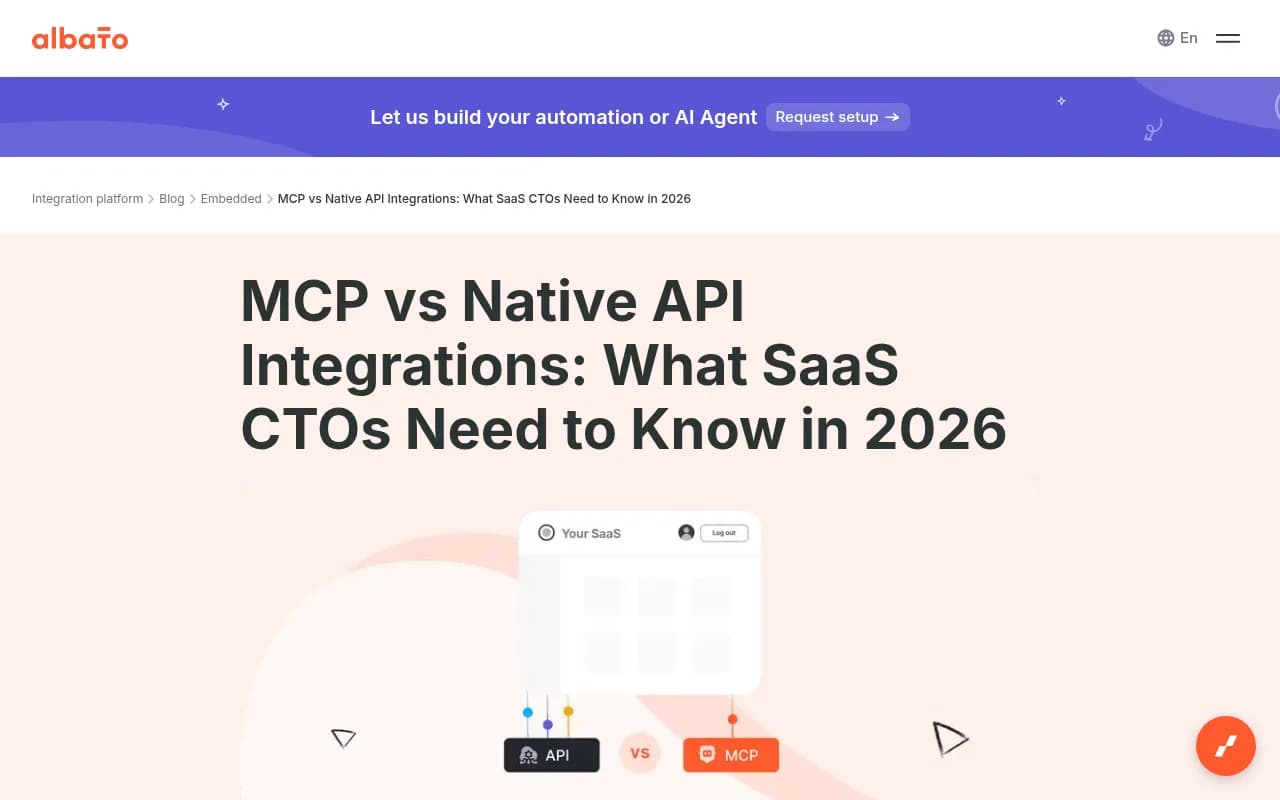
The three methods, in plain terms
Native API: the deterministic workhorse
An API is a contract. You send a structured request, you get a structured response back, every time, the same shape. That predictability is exactly what you want for core data pipelines: nightly rank-tracking jobs, dashboards that need consistent latency, billing-sensitive workflows where a surprise cost spike would be a real problem.
APIs are also where the cheapest pricing tiers usually live. DataForSEO's Standard queue, for example, charges $0.0006 per SERP call versus $0.002 through its Live endpoint, a roughly 3.3x difference that adds up fast if you're pulling thousands of SERPs a night. That gap alone should decide your architecture for high-volume workloads.
MCP: built for agents, not scripts
MCP standardizes how an AI agent discovers and calls external tools, using JSON-RPC 2.0 over HTTP. Since the July 2026 protocol revision it's stateless: every request carries its own version and capabilities instead of relying on a prior handshake. That's a meaningful architectural shift, but it doesn't change what MCP is for. It's an interface for natural-language, agent-driven workflows, not a general-purpose programmatic pipe.
This distinction has teeth. Ahrefs' terms explicitly forbid hitting its MCP endpoint via custom scripts, bridges, or standalone JSON-RPC clients. The company is blunt about it: the MCP server is not a general-purpose API. If you want production-grade programmatic access, Ahrefs pushes you to REST API v3 instead. Its MCP surface is also read-only and retrieval-oriented, Site Explorer, Keywords Explorer, Rank Tracker reads, SERP overviews, batch analysis up to 100 targets per request. Write operations, rate-limit contracts, and pagination controls live only on the API side.
DataForSEO's MCP server is more open (Apache-2.0, runs locally via npx, Docker, or a hosted remote endpoint), and it registers around 90 tools across ten modules. But every one of those MCP tools calls the pricier /live endpoint. The cheaper Standard queue, batching, and full-site OnPage crawls simply aren't exposed through MCP at all. An agent pulling 5,000 SERPs a night through MCP costs about $10; the same job through the Standard API queue costs $3.
Zapier: fast to wire, expensive at agent scale
Zapier's strength has always been breadth. Its own blog now claims access to 30,000+ actions through Zapier MCP, up from the 8,000+ figure some third-party writeups still cite. For a marketing team that wants a Slack alert when a Site Audit finishes, or a Jira ticket auto-created per crawl issue, Zapier remains the fastest path to something working today.
Where it gets expensive is agent workflows. One MCP tool call through Zapier burns two tasks from your plan's quota, not one. On the Professional plan ($19.99/mo annual for 750 base tasks), that halves your effective capacity the moment an AI agent starts calling tools through Zapier instead of a human triggering Zaps manually. And Zaps pause entirely once usage hits 3x the plan's task limit, so a runaway agent doesn't just cost more, it can silently stop your automation altogether.
Named SEO tool MCP servers: what's actually available
| Tool | MCP status | Notable constraint | Pricing note |
|---|---|---|---|
| Ahrefs | Hosted remote MCP, read-only | Custom scripts against MCP endpoint explicitly banned in terms | Requires Lite plan and up (~$129/mo) |
| Semrush | Official MCP, native app in Claude/ChatGPT | No separate MCP fee, rides on plan's API unit allowance | 50,000 API units/mo on qualifying plans, $139-$549/mo |
| DataForSEO | Open-source MCP (Apache-2.0), ~90 tools | MCP tools hit pricier /live endpoint only, no Standard queue access | Pay-as-you-go, $50 minimum deposit |
| Screaming Frog | MCP since SEO Spider v24.0 | Highest complexity rating among SEO MCP servers | Free tier; paid from $279/year |
| Google Search Console | Free community MCP wrapper (mcp-gsc) | Only first-party click/impression/CTR/position source | Free API; hosted MCP wrapper ~$12/mo |
| SE Ranking | 180+ tools in one MCP server | Rated lowest complexity (1/3) among SEO MCP servers | Included with any subscription |
A few of these tools also show up in the AI visibility space, where the same MCP-vs-API tension applies. If your SaaS is tracking how brands show up in ChatGPT, Gemini, or AI Overviews rather than just classic rankings, Promptwatch exposes both an MCP server (compatible with ChatGPT, Claude, and Cursor) and a REST API v2, so you can decide per workflow which interface makes sense rather than being locked into one.

Why this matters more for AI visibility data specifically
AI visibility and citation data changes shape faster than classic rank data, which is itself an argument for treating the integration method as a first-class design decision, not an afterthought. Promptwatch's own data shows just how much this space moves: the AI crawler mix shifted from OpenAI accounting for 94.8% of verified AI crawler requests in the week of June 8-14, 2026, down to 79.8% by the week of August 31-September 6, 2026 (https://promptwatch.com/data/ai-crawler-traffic). A dashboard you check weekly will miss that kind of swing; an automated pipeline pulling data daily through an API or MCP connection won't.
The same logic applies to how many sources AI answers cite. Perplexity holds close to ten sources per answer with real consistency, Google AI Overviews cites roughly double ChatGPT's count and stays fairly steady, while Microsoft Copilot swings from under two sources to nearly seventeen within a few weeks (https://promptwatch.com/data/average-sources-per-response). If your product surfaces "how many times were we cited" metrics, that volatility is exactly why manual dashboard checks stop being good enough and why you need a scheduled, automated pull, whether that's via API cron job or an MCP-driven agent workflow.
A decision framework for your stack
Use native API when
- You need deterministic, high-volume data pulls (nightly rank checks, bulk backlink audits, large SERP batches)
- Cost per call matters at scale, since API-only tiers like DataForSEO's Standard queue are consistently cheaper than the MCP-exposed /live equivalents
- You need write operations, pagination control, or rate-limit guarantees that vendors simply don't expose through MCP
Use MCP when
- An AI agent or in-app assistant needs to answer a natural-language question against live SEO data without you writing custom glue code for every possible question
- You're prototyping an AI feature and want to connect once rather than build bespoke tool-calling logic against a raw API
- Your users are technical SEOs working inside Claude, Cursor, or a similar MCP-compatible client and want to run crawls or pull data conversationally
Use Zapier (or Zapier MCP) when
- The integration is low-frequency, low-stakes, and not worth custom engineering time, alerting on audit completion, creating a ticket per issue, syncing a spreadsheet
- Your team already lives in Zapier and the marginal cost of another Zap is lower than standing up new infrastructure
- You're validating whether a workflow is even worth automating before committing engineering resources to it
| Method | Best for | Cost behavior | Setup speed | Production fit |
|---|---|---|---|---|
| Native API | Core data pipelines, bulk pulls, write operations | Usually cheapest per call, sometimes 3x cheaper than MCP equivalent | Slowest, requires engineering | High |
| MCP | Agent-driven, conversational, natural-language queries | Often gated to pricier tiers or endpoints (e.g. /live only) | Fast for prototyping, moderate for production | Medium, growing |
| Zapier / Zapier MCP | Notifications, ticketing, long-tail low-frequency tasks | Task-based; MCP calls cost 2x a normal task | Fastest | Low to medium |
The security pitfall nobody mentions in vendor docs
MCP's tool-calling model introduces a class of risk that plain APIs don't have: tool poisoning. OWASP now ranks it #3 on its MCP Top 10, where malicious instructions get embedded in tool metadata, invisible to the human user but fully visible to the LLM calling the tool. Once a tool is poisoned, every session that uses it is compromised.
This isn't theoretical. Security researchers documented an exploit chain nicknamed "CurXecute," where a crafted Slack message processed by an approved Slack MCP server contained a prompt-injection payload that rewrote a developer's global Cursor MCP config and inserted a new attacker-controlled server entry, all through remote code execution. Separately, Invariant Labs named Zapier explicitly, alongside Anthropic, OpenAI, and Cursor, as susceptible to tool poisoning attacks.
If you're wiring MCP servers into your SaaS product, treat every tool description the way you'd treat a third-party dependency: review it, pin versions, and don't auto-trust project-defined MCP servers just because a folder-trust prompt approved them. Microsoft's June 2026 security guidance formally classifies MCP tool descriptions as supply-chain assets requiring the same review rigor as production code, and that's a reasonable bar to hold yourself to.
What most SaaS teams actually end up building
In practice, the teams I've seen do this well don't pick one method. They run a hybrid: native API calls for the scheduled, high-volume, cost-sensitive data pipelines (nightly crawls, keyword refreshes, backlink audits), and an MCP layer sitting on top for the AI-assistant features where a user or agent needs to ask a question in plain language and get an answer without engineering having to anticipate every possible query shape. Zapier fills the remaining gaps, the alerts, the tickets, the stuff that's genuinely not worth custom code.
SeoProfy's own recommendation order for building an SEO MCP stack is a reasonable starting template: start with the free Google Search Console MCP wrapper, add one primary keyword tool (Ahrefs or Semrush, both claim under-15-minute setup), then layer in specialty coverage like SE Ranking for AI visibility tracking or Screaming Frog's wrapper for technical audits once you know what you actually need.
If your SaaS is specifically trying to track and act on AI search visibility rather than classic rank tracking, that same layered approach applies, but the platform choice matters more, since a tool that only tracks mentions won't help you close the gap once you find one. Platforms like Promptwatch that expose both a REST API v2 and an MCP server, alongside crawler-log data most competitors don't collect at all, give you the flexibility to build the deterministic pipeline and the agent-facing layer from the same data source rather than stitching two vendors together.
For a broader look at what's available beyond the tools named here, the GEO software directory at bestgeosoftware.com and the agentic SEO tools listed at agenticseotools.com are worth a scan before you commit engineering time to any single integration path.
A closing gut check
Before you write a line of integration code, ask three concrete questions: How often does this data need to refresh? Who's actually consuming it, code, a human, or an agent? And what does it cost if that call runs a thousand times a day instead of ten? Answer those honestly and the MCP-vs-API-vs-Zapier decision usually makes itself. Skip that step and you'll end up rebuilding the integration layer in eighteen months, once the cost or the security exposure catches up with you.