Key takeaways
- Promptwatch Data found ads in a 90-day average of 20.1% of ChatGPT responses that ran a web search (May 20 to Aug 17, 2026). The last 7 days averaged 32.4%.
- The average hides a ramp. No ads showed until May 27, then the rate jumped past 30% on July 1 and mostly stayed there. The daily peak is 43.9%.
- Organic prompts carry about 73% of ad-bearing responses, brand-specific prompts about 18%, and competitor comparisons about 9%.
- Only Free and Go users see ads. Plus, Pro, Business, Enterprise and Edu accounts do not.
- If you care about a set of prompts, track ads on them across several days, not one run.
The short answer
If you ask ChatGPT a question that triggers a web search, there is currently roughly a one in three chance an ad appears under the answer. That is the recent number. The 90-day number, 20.1%, is lower only because ChatGPT started from zero.
The figures below come from Promptwatch Data's report on ChatGPT ad frequency, written by Klaas Foppen on August 18, 2026. It covers May 20 to August 17, 2026, and counts only responses where ChatGPT searched the web, returned at least one citation, and completed ad extraction. Responses that never touched search are not in the denominator.
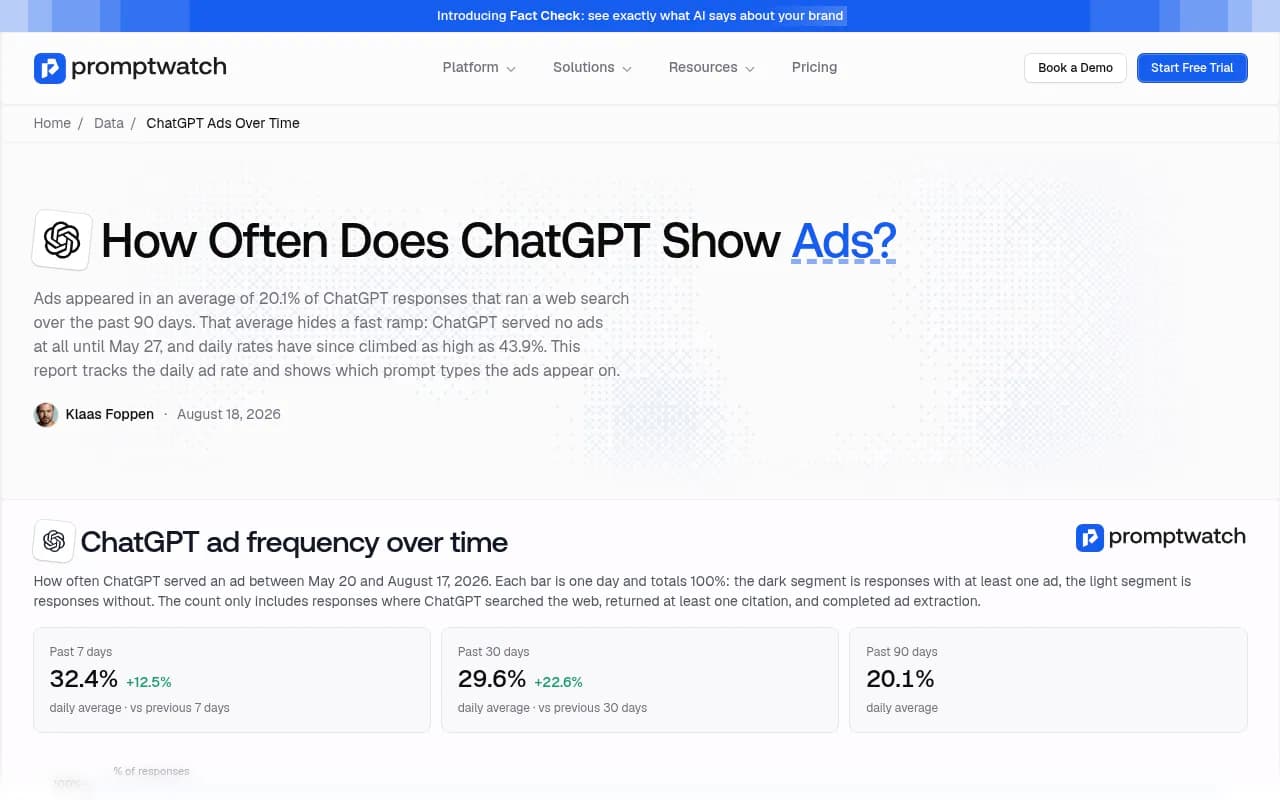
How ChatGPT ads ramped up over 90 days
Here is the timeline from the report.
| Window | Share of responses with an ad |
|---|---|
| Before May 27 | 0% |
| May 27 (first day with ads) | 1.69% |
| Past 90 days (daily average) | 20.1% |
| Past 30 days (daily average) | 29.6% (+22.6% vs previous 30 days) |
| Past 7 days (daily average) | 32.4% (+12.5% vs previous 7 days) |
| Single-day peak | 43.9% |
The curve did not climb smoothly. There was a brief spike on June 25 and 26, then a jump past 30% on July 1 that stuck. Since then the daily rate has mostly bounced between the low 20s and the high 30s.
Two things stand out to me. First, the July 1 step looks like a switch being flipped, not gradual demand from advertisers. Second, the day-to-day swings after that are big enough that any single measurement is close to meaningless. A prompt you test on a 22% day and a colleague tests on a 38% day will look like different products.
The puzzle of the missing first months
OpenAI's help center says ad testing started in the United States on February 9, 2026. Promptwatch's tracked sample shows nothing until May 27. I can't tell you why. The sample, the account type and the region could all play a part, but nobody has published an explanation I can point to, so treat the "zero before May 27" line as a statement about what was tracked, not about when ads first existed anywhere.
Which prompts carry the ads
The second chart in the report splits ad-bearing responses by prompt type.
| Prompt type | Past 7-day share of ad-bearing responses | Average day, full period |
|---|---|---|
| Organic | 73.3% | 73.1% |
| Brand-specific | 18.0% | 17.9% |
| Competitor comparison | 8.6% | 9.1% |
In the early weeks organic swung between 62.71% and 78.32%, and competitor comparisons between 7.24% and 15.60%. Since July 1 the mix has been much steadier.
Read this chart carefully
This is a volume mix. It tells you where ads appeared, not how likely each prompt type is to trigger one. If a monitor holds far more organic prompts than competitor-comparison prompts, organic will dominate the chart even if OpenAI changed nothing. So do not read "73%" as "organic prompts are three times as ad-prone." It means most of the ads that were captured sat on organic, non-branded prompts, which is where people are still forming opinions and shopping around.
For brand teams, the 18% on brand-specific prompts is the number that stings. That is somebody advertising next to answers about a company that is not theirs.
What OpenAI says about how ads work
The OpenAI help center article on ads in ChatGPT lays out the rules.
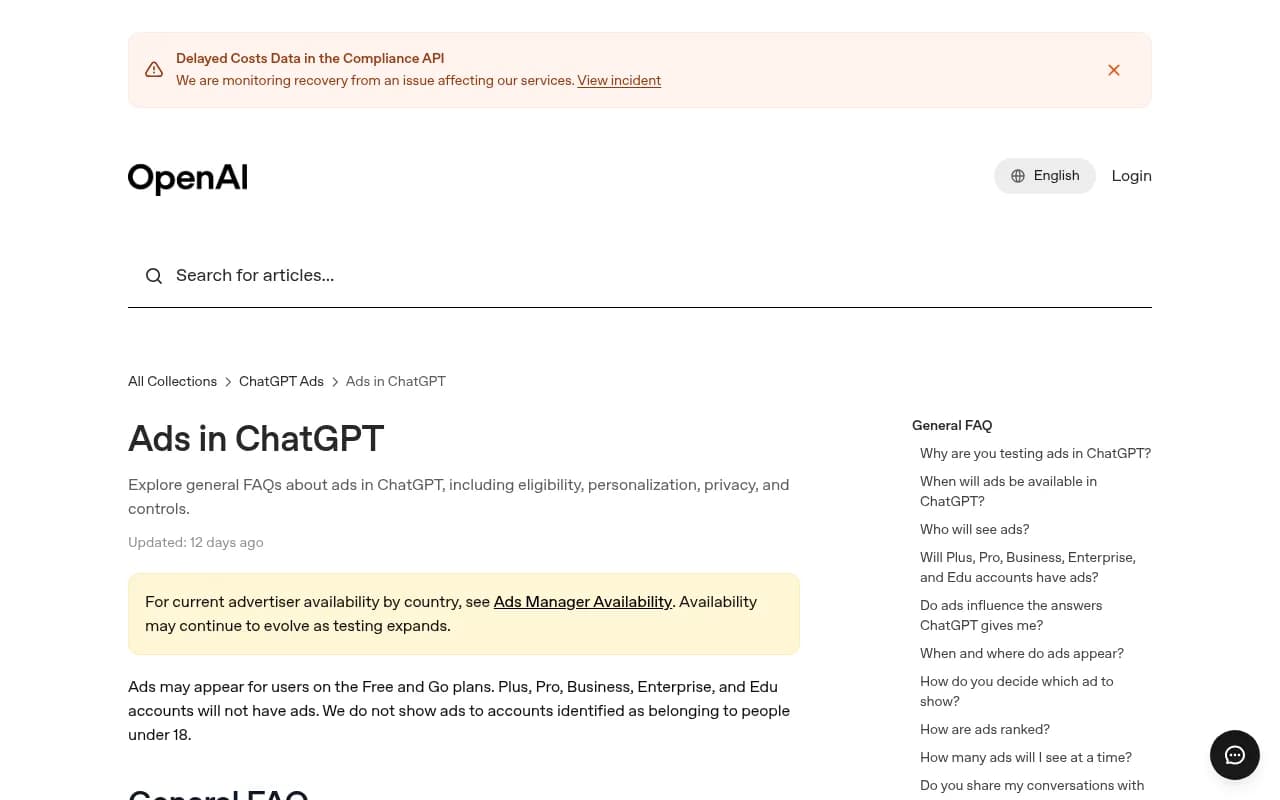
- Ads may appear for Free and Go users. Plus, Pro, Business, Enterprise and Edu accounts have none. Accounts identified as under 18 do not see ads either.
- One ad unit appears below the response, and it can hold one or several images. A multi-image format is being tested during image generation.
- Ads are labeled and separate. OpenAI says they run on separate systems and advertisers cannot shape, rank or alter answers.
- Selection uses the conversation's context and intent, the ad's landing page, title and copy, advertiser targeting hints, and broader signals when personalization is on. When several ads qualify, relevance and bids decide.
- Ads are not eligible near personal health, mental health or politics, and political ads are banned. Health and financial advertisers may qualify under strict criteria.
- Advertisers only get aggregated data like views and clicks, not conversations.
- Users can turn personalization off, dismiss an ad, see why it was shown, and clear ad data in Settings > Ad Controls. Personalized ads are not initially available in the EEA or Switzerland.
That last point on controls matters for measurement. With personalization off, ads still use the current chat's context, so a clean-slate tracking account still sees ads. It just sees fewer tailored ones.
How this compares with other studies
SE Ranking published a separate study on August 10, 2026, running 50,006 commercial prompts across 20 US niches. They report ads on 25.94% of commercial prompts and say roughly 1 in 7 ads has no topical link to the prompt. Their numbers differ from Promptwatch's because the denominators differ: a commercial-prompt set versus all search-powered responses collected from real UI monitoring. I haven't verified their full methodology, so I'd use it as a directional second opinion, not a benchmark to reconcile to the decimal.
SE Ranking also found that in 96.37% of placements the advertiser was not cited among the answer's sources. If that holds up, paying for an ad and earning a citation are close to independent events. That is a strong argument for working on both.
What this means for marketers
If you advertise
The rate is high enough to take seriously and unstable enough to test over weeks. Budget for experiments, not for one-off checks. I could not find reliable public pricing data (CPM or CPC) in the research behind this guide, so confirm costs inside OpenAI's Ads Manager before planning spend.
If you do not advertise
Your organic and brand-specific prompts may already be carrying a competitor's ad. Brand-specific prompts at 18% of ad-bearing responses means branded queries are not safe ground. Find out who is bidding on your name.
If you run an agency
Clients will ask whether they are "in ChatGPT." The honest answer has two halves now: are you cited in the answer, and who is paying to sit below it.
How to monitor ChatGPT ads on your own prompts
The report itself gives the tracking advice that I'd follow.
- Check across several days before drawing conclusions. A single run can land on an outlier day, like the June 25-26 spike.
- Record which advertisers and landing pages appear on the prompts you care about. The rate tells you how often a slot appears. The ad details tell you who wins it.
- Compare advertisers per prompt segment: organic, brand-specific, competitor comparison.
- Keep your prompt mix stable. Adding organic prompts will raise the organic share of your chart without any change on OpenAI's side.
- Pair ad data with citation data, so you can see where you are cited, where you are only advertised against, and where you are neither.
Tools that can do it
Promptwatch has an Ads Radar that shows which advertisers bid on your prompts, their ad copy, claims and landing pages, viewed by ad or by prompt. It sits next to citation tracking, crawler logs and visitor analytics, so you can connect ads to what AI actually cites. Ads Radar is on the Business plan ($579/mo), every agency plan and Enterprise. Check current pricing before you buy.

If you want to compare other AI visibility trackers first, the directories at bestgeosoftware.com and ai-rank-tools.com list a lot of options. Check whether a tool captures ads at all, since plenty of trackers only record the answer text.
For a quick baseline with no commitment, the free AI visibility report shows how ChatGPT, Gemini and Perplexity talk about your brand today.
Caveats worth keeping in mind
- The data is a sample of tracked prompts, not every ChatGPT conversation.
- It covers search-powered responses with citations, so the real rate across all chats is lower.
- The rate is moving fast. The numbers here run to August 17, 2026, so check the live report for the current trend.
- Rates will differ by country, plan and prompt set. Your own prompts matter more than any industry average.
Related Promptwatch Data
Ads are one part of how ChatGPT builds answers. These reports cover the rest:
- Most cited content types in ChatGPT: product pages lead at 22.4% of citations (Sep 28 to Oct 4, 2026).
- Unique domains per ChatGPT response: almost half of responses cite 10 or more domains.
- ChatGPT query fanouts: how many web searches each response triggers, which decides whether an ad can show at all.
- The full Promptwatch Data hub lists every report.
Bottom line
ChatGPT went from no tracked ads on May 26 to roughly one in three search-powered responses carrying one by mid-August 2026. Most sit on organic prompts, nearly one in five sit on brand-specific ones, and the daily rate swings enough that single checks mislead. Measure over weeks, record who is advertising on your prompts, and treat being cited and being advertised as two separate problems.