Key takeaways
- Otterly.AI has the lowest entry price at $29/month, but Claude, Google AI Mode, and Gemini are paid add-ons on every tier below Standard ($189/month) — the "cheap" plan gets more expensive fast if you need full model coverage.
- Finseo's Starter plan (€84/month, ~$91) tracks 50 prompts but caps you at only 3 concurrent models even though 10+ are technically available — full concurrency requires a demo-gated Enterprise quote.
- Promptwatch Essential ($95/month) includes 4 concurrent models, the API, and MCP access from day one, with no add-on fees for extra engines.
- None of these three tools has independently verified data proving that more AI citations translate into more traffic or revenue — treat visibility scores as a leading indicator, not gospel.
- "Prompts tracked" is a misleading metric on its own. What matters is prompts x models x responses per month, since a single prompt fans out into multiple underlying AI searches.
Why this comparison even matters
Every AI visibility vendor wants you to believe their pricing page tells the whole story. It doesn't. I spent time actually reading the fine print on Finseo, Otterly.AI, and Promptwatch, and the differences are less about "cheap vs expensive" and more about what you're locked out of at the entry tier.
This matters because AI search behaves nothing like Google. ChatGPT triggers somewhere between 3 and 8 separate web searches for a single prompt (a "fan-out"), and the average number of fan-outs per response has actually dropped, from 2.15 in December to exactly 1.0 by April 2026, according to Promptwatch's own fan-out tracking data. Query length has also collapsed from roughly 117 characters to about 53, meaning ChatGPT is searching more like someone typing keywords than asking a full question (source: ChatGPT Query Fanouts, Promptwatch Data).

Why does that matter for a budget tool comparison? Because the number of "sources" available per response varies wildly by engine. ChatGPT surfaces around 5 sources per web-search response, Google AI Overviews about 10, and Perplexity a remarkably consistent 10 sources day after day. Microsoft Copilot, meanwhile, has swung from under 2 to nearly 17 sources per response within a matter of weeks, evidence that Microsoft is still rebuilding its retrieval pipeline (source: Average Sources Per Response, Promptwatch Data). If a cheap plan only lets you watch 3 models instead of 4 or more, you're not just losing "an engine" — you're losing access to a completely different citation pattern.
The three tools, side by side
| Tool | Entry price | Entry prompts | Models tracked concurrently | Gate that bites you |
|---|---|---|---|---|
| Otterly.AI Lite | $29/mo ($25 billed annually) | 15 | 4 base engines (ChatGPT, AI Overviews, Perplexity, Copilot) | Claude, Google AI Mode, and Gemini are paid add-ons; no API/MCP below $189/mo |
| Finseo Starter | €84/mo (~$91) | 50 | 3 (of 10+ available) | Full concurrency and Business+ tiers are demo-quoted, not self-serve |
| Promptwatch Essential | $95/mo | 50 | 4 (of 8+ available) | AEO article generation and crawler logs require Professional ($245/mo) |
On paper, Otterly.AI wins on price. In practice, the price you see isn't the price you pay once you need the engines that actually matter for your category.
Otterly.AI: the real entry point, with real caveats
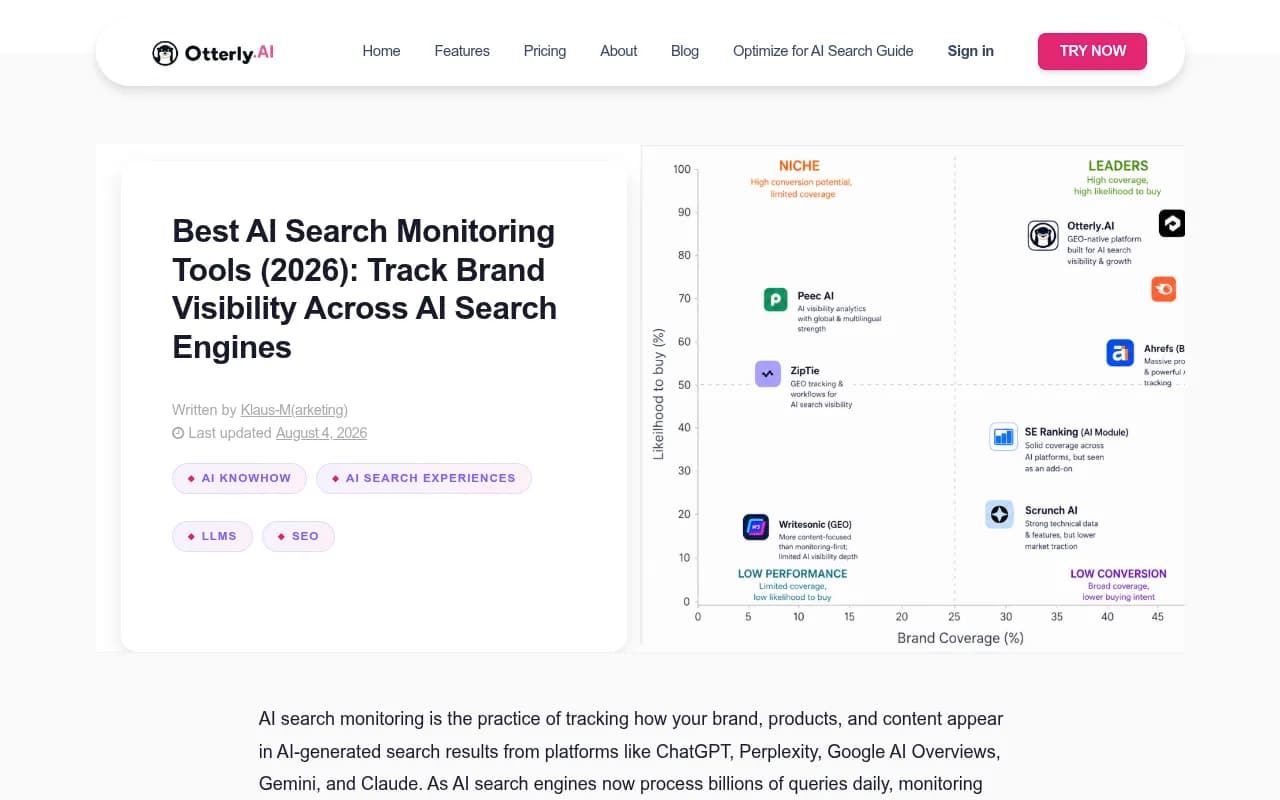
Otterly.AI has been the go-to "cheap" recommendation in nearly every 2026 roundup I found, and for good reason. At $29/month, Lite gives you 15 prompts tracked daily across ChatGPT, Google AI Overviews, Perplexity, and Microsoft Copilot, plus unlimited team members and unlimited brand reports. Otterly also won a G2 Winter 2026 "High Performer" award in the Answer Engine Optimization Tools category.

But the fine print matters. Claude, Google AI Mode, and Gemini aren't included at any price point below the Standard plan, and even then they show up as separate add-ons ranging from roughly $9 to $149 per month depending on the tier, according to an independent review from AI Peekaboo. If your brand gets discussed primarily in Gemini (Google's own research pegs Gemini at 18% of AI search referral traffic) or Claude, the $29 plan simply won't show you that.
The bigger jump is from Lite to Standard: $29 to $189 per month, a 6.5x increase, just to unlock API access, MCP integration, and Agent Analytics. G2 reviews (54 total) are broadly positive on price-to-value, but a recurring complaint is telling: "At this price point, I would expect more concrete guidance... rather than just reporting and tracking." That's the core tension with Otterly at the low end. You get a clean dashboard telling you what happened. You don't get much help deciding what to do about it.
Finseo: prompt volume without full model access
Finseo positions itself as going "beyond measurement," with GEO/AIO audits, claim verification, JSON-LD schema generation, and AEO-optimized article writing baked into the product. Its Starter tier runs €84/month (about $91, or €70/month billed yearly) and includes 50 tracked prompts generating roughly 4,500 AI answers per month, plus 300 trial agent credits and unlimited team seats.
The catch: even though Finseo supports 10+ models total (ChatGPT, Gemini, Google AI Overviews, Google AI Mode, Claude, Perplexity, Copilot, Grok, DeepSeek, Mistral, and regional engines like Qwen and Naver), Starter, Business, and Growth plans all cap you at just 3 concurrent models. Full multi-model tracking is Enterprise-only, and Enterprise pricing on Finseo is demo-gated, not published. A third-party comparison from a competitor, LLM Pulse, pegs a typical Finseo Business quote at $3,500 to $6,000 per year, and notes that anything above Starter requires a sales call rather than a self-serve checkout.
There's also a data-consistency wrinkle worth flagging: some third-party trackers list an older, cheaper Finseo "Creator" tier around $19-$29/month that doesn't appear on Finseo's current official pricing page. That tier looks retired. If you're pricing this out yourself, go straight to Finseo's own pricing page rather than trusting a secondhand listing.
Finseo's differentiator is content production layered onto tracking, useful if you want one vendor to both diagnose and write the fix. But at the budget tier, you're diagnosing with one eye closed, since 3 concurrent models means picking which two-thirds of the AI search landscape to ignore.
Promptwatch: fewer dollars per extra engine, more of the loop closed
Promptwatch Essential is $95/month and includes 4 models tracked concurrently (chosen from ChatGPT, Perplexity, Google AI Overviews and AI Mode, Claude, Gemini, Meta, DeepSeek, and Grok), 50 prompts, 6,000 responses per month, country-level tracking, and both API and MCP access included from day one. No engine costs extra at any tier, which is the opposite of Otterly's add-on structure and a notable improvement over Finseo's concurrency cap.
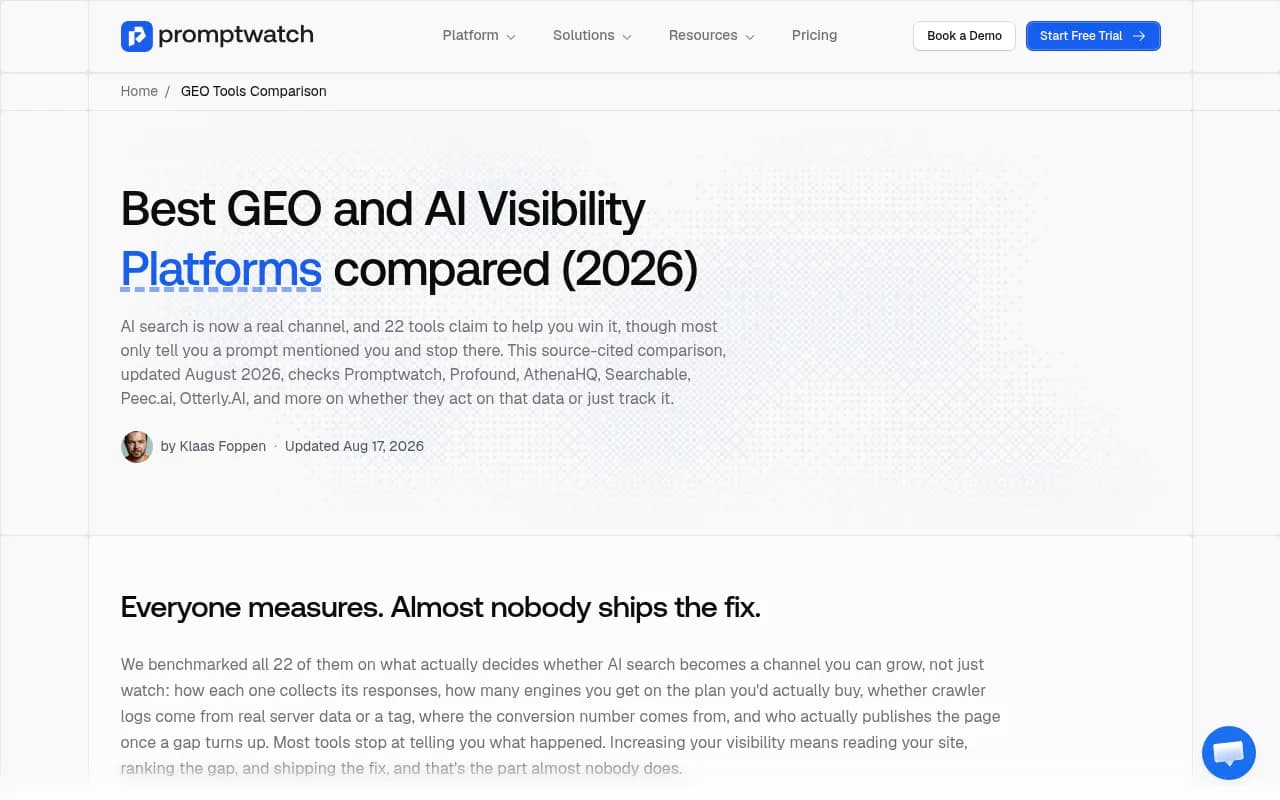
What separates Promptwatch from the other two at this price isn't just model access, it's what happens after a visibility gap shows up. Essential already includes visitor analytics (tracking real AI-referred traffic and conversions, not just mentions) and content gap analysis. Move up to Professional at $245/month and you add Agent Analytics, which is server-level crawler logs showing exactly when ChatGPTBot, ClaudeBot, PerplexityBot, and 400+ other crawlers hit your site, what they read, and whether they hit errors. Neither Otterly nor Finseo offers anything comparable to real crawler-log data at a similar price point, and Otterly has no direct website connector at all, meaning AI-driven site visits stay invisible inside the tool according to its own G2 reviews.
Promptwatch also tracks Reddit and YouTube citations specifically, ChatGPT Shopping recommendations, and AI ad placements, areas most budget and mid-tier competitors skip entirely. Its own comparison of 22 GEO platforms claims to be the only one scoring full marks across prompt tracking, citation trends, crawler logs, visitor analytics, content gap analysis, and offsite mentions simultaneously.
Worth noting: Promptwatch's own 8 trackable engines only apply 4 at a time per plan, similar in structure to Finseo's cap, just set higher (4 vs 3). It's not unlimited access either, it's a more generous ceiling.
So which one actually wins on budget?
It depends on what "budget" means to you.
If your definition of budget is literally the smallest possible monthly invoice and you only care about ChatGPT, Otterly.AI Lite at $29 is hard to beat, and it stays that way for as long as your brand conversation stays inside ChatGPT, AI Overviews, Perplexity, and Copilot.
If you need Gemini or Claude coverage without add-on fees, and want the API and content-gap tooling included rather than gated behind a 6x price jump, Promptwatch's $95 Essential tier does more per dollar than either competitor, without Otterly's per-engine surcharges or Finseo's concurrency ceiling.
If you specifically want AEO content production bundled with tracking and you're prepared to get on a sales call for anything past the entry tier, Finseo is worth a look, but budget-conscious teams should expect the real cost to land closer to Promptwatch's Professional tier than its own advertised Starter price once you need more than 3 models.
A caveat that applies to all three
None of these tools, on their own marketing pages or in independent reviews, has proven a consistent link between rising AI citation counts and actual traffic or revenue. A Reddit-sourced user test cited in an AI Peekaboo review of Otterly specifically found no consistent correlation between increased brand mentions in AI answers and measurable traffic lift. That's not a knock on any single vendor, it's a reminder that this whole category is still maturing. Treat visibility scores as directional, not as a KPI you report to the board unchallenged.
If you want to keep exploring beyond these three, the GEO software directory at bestgeosoftware.com lists dozens of alternatives across price points, and surferstack.com covers broader SEO and content tooling if AI visibility is only one piece of what you're trying to fix.