Key takeaways
- ChatGPT recommends products in response to non-shopping queries ("best gifts for hikers", "what should I use for sensitive skin") -- and most e-commerce brands have no strategy for this
- AI models cite sources based on authority, content structure, and how well your pages answer specific questions -- not on ad spend or product feeds
- Getting cited requires a different approach than traditional SEO: you need content that directly answers the questions your customers are already asking AI
- Structured data, review signals, and third-party mentions (Reddit, YouTube, listicles) all influence whether ChatGPT recommends your products
- Tracking your AI visibility -- which prompts trigger your brand, which don't, and why -- is the only way to know if your strategy is working
The shopper behavior shift happening right now is easy to underestimate. Someone doesn't open Google and type "best moisturizer for oily skin." They open ChatGPT and ask: "I have combination skin that gets oily by noon -- what skincare routine should I follow and what products do you recommend?" That's a non-shopping query. It's a conversation. And ChatGPT answers it with specific product recommendations.
If your brand isn't in that answer, you've lost a sale you never knew was possible.
This guide is specifically about the non-shopping query problem: the conversational, advice-seeking, problem-framing questions that make up the majority of how people actually use ChatGPT -- and how to get your products recommended in them.
Why non-shopping queries matter more than shopping queries
There's a meaningful difference between someone asking "buy trail running shoes" and someone asking "I'm training for my first 10K -- what gear do I actually need?" The second person is earlier in their journey, more open to influence, and more likely to remember the brand that helped them.
ChatGPT's dedicated Shopping Research feature handles explicit product searches. But the more interesting opportunity -- and the less competitive one -- is the advisory layer: the "what should I use," "what do experts recommend," "what's the best approach for X" queries that happen constantly.
According to G2's 2025 Buyer Behavior Report, generative AI chatbots are now the #1 influence over vendor shortlists, ahead of review sites and peer recommendations. That's not just B2B software. It applies to skincare, outdoor gear, kitchen equipment, supplements, and anything else where people want a recommendation from something that sounds like it knows what it's talking about.
The brands winning in these non-shopping queries aren't necessarily the biggest or the ones with the best Google Shopping rankings. They're the ones whose content gives ChatGPT something to cite.
How ChatGPT actually decides what to recommend
Before optimizing anything, it's worth understanding the mechanism. ChatGPT doesn't have a product catalog it browses. When it recommends products in response to a conversational query, it's drawing on:
- Web content it has indexed (via its browsing capability or training data)
- Third-party sources like Reddit discussions, YouTube reviews, and editorial listicles
- Structured product data where available
- Domain authority signals -- sites with more referring domains get cited more often
Research from SE Ranking found that sites with over 32,000 referring domains are roughly 3.5x more likely to be cited by ChatGPT than lower-authority sites. That's a significant gap, and it means pure content quality isn't enough if your domain authority is thin.
But here's the more actionable insight: ChatGPT heavily favors content that directly answers a question in a clear, structured format. A page that says "Who should use this product and why" in plain language will outperform a product page with specs and bullet points, even if the latter has better SEO.
The model is looking for content that sounds like a knowledgeable person giving advice -- because that's what it's trying to produce.
The content gap: what most e-commerce sites are missing
Most product pages are optimized for conversion, not for answering questions. They describe features, list specs, show reviews, and push toward "Add to Cart." That's fine for someone who already knows they want the product. It's useless for ChatGPT trying to answer "what's the best option for someone who..."
The gap is advisory content. Content that:
- Explains who the product is for and who it isn't for
- Compares it to alternatives honestly
- Addresses specific use cases and scenarios
- Answers the "but what about..." follow-up questions
- Includes real user language from reviews and forums
This is the content ChatGPT can actually use. And most e-commerce brands don't have it -- or have it buried in blog posts that aren't connected to product pages.
Practical steps to get your products recommended
1. Map the questions your customers ask AI
Start by thinking like your customer. What would they type into ChatGPT before they'd ever search for your product by name? For a camping cookware brand, that might be:
- "What do I need to cook meals while backpacking?"
- "Is titanium or stainless steel better for camping pots?"
- "What cookware works on a camp stove?"
These are the prompts you need to be visible for. Write them down. Then actually run them in ChatGPT and see who's being recommended. That tells you who you're competing against in AI search -- and it's often not who you'd expect.
Tools like Promptwatch are built specifically for this: tracking which prompts trigger your brand, which ones surface competitors instead, and identifying the exact content gaps you need to fill.

2. Build "answer-first" content around those questions
Once you have your target prompts, create content that directly answers them. Not blog posts that vaguely touch on the topic -- pages that are structured as clear answers.
A few formats that work well:
- Comparison guides ("Titanium vs. stainless steel camping cookware: which is right for you?")
- Use-case pages ("The best cookware for ultralight backpacking")
- Buyer guides structured as Q&A
- FAQ sections on product pages that address specific scenarios
The key is that the answer should be self-contained. ChatGPT needs to be able to read your page and extract a clear recommendation. If your content requires the reader to piece together information from multiple sections, the model will skip it.
3. Use structured data -- but go beyond the basics
Schema markup helps AI models understand what your page is about. For e-commerce, the obvious ones are Product, Review, and AggregateRating. But for advisory content, you should also consider:
FAQPageschema for Q&A contentHowToschema for guides and tutorialsArticleschema with clear author and date signals
The FAQPage schema is particularly valuable for non-shopping queries because it maps directly to the conversational format ChatGPT uses. If your FAQ answers "who is this product for?" and "what's the difference between X and Y?", you're giving the model exactly what it needs.
4. Get your products into third-party sources
ChatGPT doesn't just cite your website. It cites Reddit threads, YouTube reviews, editorial roundups, and comparison sites. These third-party sources often carry more weight than your own pages because they're seen as independent.
This means:
- Actively pursue editorial coverage in "best of" listicles in your category
- Encourage detailed reviews on Reddit communities relevant to your niche
- Work with YouTube reviewers who cover your product category
- Get listed in comparison sites and buying guides
A single mention in a well-trafficked Reddit thread can drive more ChatGPT recommendations than a dozen optimized product pages. This isn't new -- it's PR and earned media -- but the target has shifted from Google's algorithm to AI models.
5. Optimize your review content for AI readability
Reviews are one of the most powerful signals for AI recommendations, but only if they're structured in a way models can parse. Generic 5-star reviews ("Great product! Fast shipping!") don't help. Detailed reviews that mention specific use cases, comparisons to alternatives, and outcomes do.
You can influence this by:
- Asking customers specific questions in post-purchase emails ("What problem were you trying to solve?" "How does it compare to what you used before?")
- Surfacing the most detailed reviews prominently on product pages
- Creating a "customer stories" section that expands on use cases
Platforms like Trustpilot aggregate reviews in a format that AI models can read and cite.
6. Build domain authority through topical depth
The 3.5x citation advantage for high-authority domains isn't just about backlinks -- it's about topical authority. A site that covers every angle of camping cookware (materials, use cases, care guides, comparisons, recipes) will be treated as a more authoritative source than one with a few product pages and a thin blog.
This is where content strategy matters. Build out the full topic cluster around your product category. Not just to rank in Google -- but to signal to AI models that you're a genuine expert in this space.
Tools like Topical Map AI can help you map the full topic space and identify gaps.
7. Make your pages technically accessible to AI crawlers
AI models crawl your site differently than Google. Some things that matter:
- Clean HTML with clear heading hierarchy (H1, H2, H3 in logical order)
- Fast load times -- slow pages get crawled less frequently
- No JavaScript-only content that AI crawlers can't render
- Clear internal linking between advisory content and product pages
- An up-to-date sitemap
If you're running a headless e-commerce setup, this is worth auditing carefully. AI crawlers are less sophisticated than Googlebot and will miss content that requires JavaScript execution.
The non-shopping query content playbook
Here's a practical content framework for e-commerce brands targeting non-shopping queries:
| Content type | Target query format | What to include | Schema type |
|---|---|---|---|
| Buyer guide | "What's the best X for Y?" | Comparison, use cases, who it's for | Article + FAQPage |
| Problem-solution page | "How do I solve X?" | Diagnosis, options, recommendation | HowTo + FAQPage |
| Comparison page | "X vs Y -- which is better?" | Side-by-side, honest trade-offs | Article |
| Use-case page | "What do I need for X activity?" | Product list with context, why each item | Article |
| Category explainer | "What is X and do I need it?" | Education first, product second | Article + FAQPage |
The pattern across all of these: lead with the question, answer it directly, then introduce your product as the solution. Don't bury the recommendation at the bottom after 800 words of preamble.
Tracking whether it's working
This is where most e-commerce brands fall short. They create content, maybe add some schema, and then have no idea whether ChatGPT is actually recommending them. The only way to know is to track it.
That means:
- Running your target prompts regularly in ChatGPT and logging the results
- Tracking which of your pages are being cited and how often
- Monitoring competitor visibility to see if you're closing the gap
- Connecting AI visibility to actual traffic and revenue
Doing this manually is tedious and doesn't scale. Platforms built for AI visibility tracking make this systematic. Promptwatch, for example, tracks your brand across 10 AI models simultaneously, shows you which prompts you're winning and losing, and connects that data to actual site traffic through its crawler log integration.
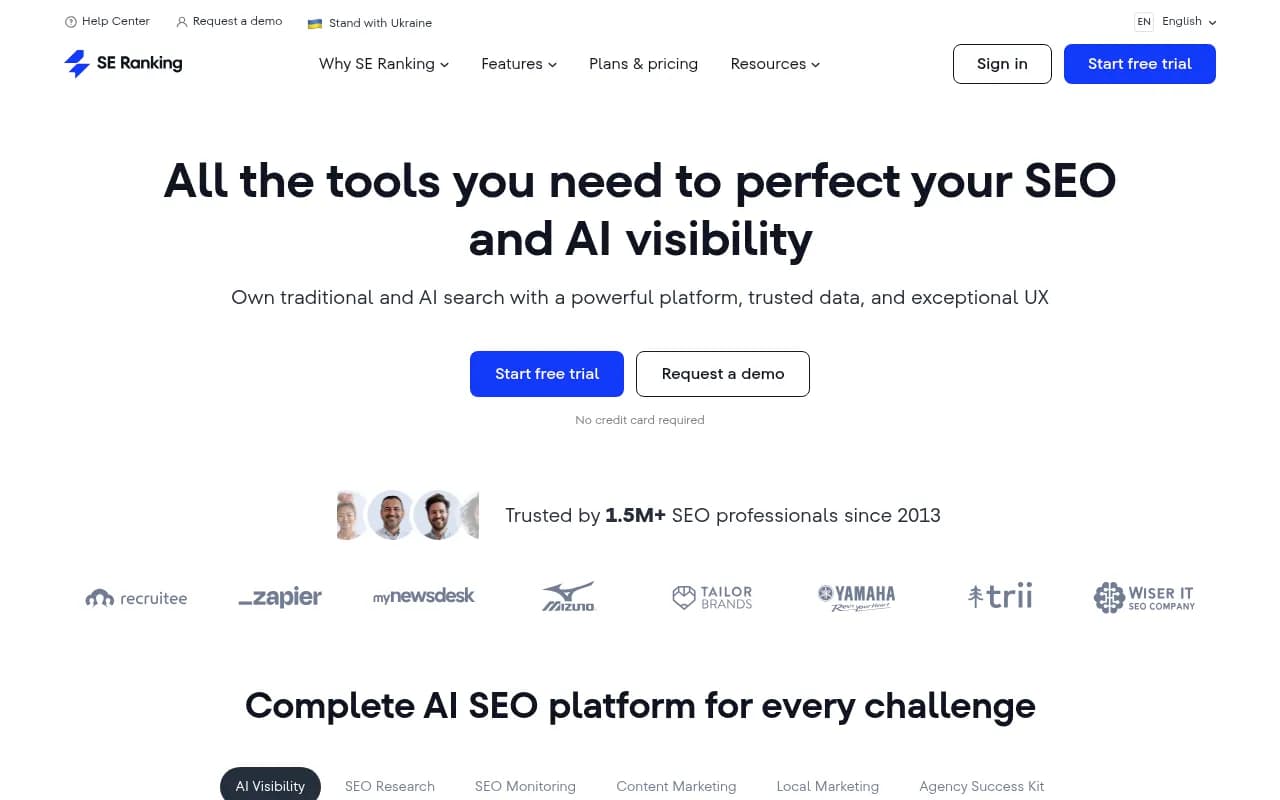
For e-commerce teams that want something more focused on product-level tracking, there are other options worth considering:


What the competitive landscape actually looks like
Most e-commerce brands are not doing this yet. That's the honest reality. The brands that are showing up consistently in ChatGPT recommendations for non-shopping queries tend to share a few traits:
- They have strong editorial content (buyer guides, comparison articles, use-case pages) that predates the AI search shift
- They have genuine third-party coverage -- real reviews, real Reddit mentions, real YouTube presence
- Their domain authority is solid, typically built through years of content and PR
The good news: you don't need to match the biggest players to start appearing. ChatGPT recommendations are not winner-take-all. A well-structured answer page on a mid-authority domain can outperform a thin page on a high-authority domain if it answers the question more directly.
The window to build this advantage is open right now. Gartner predicted a 25% decline in traditional search volume by 2026 -- that traffic is going somewhere, and a lot of it is going to AI. The brands that build AI visibility now will have a compounding advantage as that shift accelerates.
A realistic timeline
Getting your products recommended in ChatGPT non-shopping queries is not a quick win. Here's a rough timeline based on what's working in 2026:
- Weeks 1-2: Audit your current AI visibility. Run your target prompts, see who's being cited, identify the content gaps.
- Weeks 3-6: Build the first wave of answer-first content. Focus on your highest-value use cases and the questions with the most search intent.
- Weeks 7-12: Build third-party presence. Pursue editorial coverage, engage with relevant Reddit communities, work with YouTube reviewers.
- Month 3+: Track visibility changes, iterate on content, expand to more prompts.
The content you create now will compound. A buyer guide that gets ChatGPT citations in month three will keep generating them as long as it stays accurate and the page maintains its authority.
The bottom line
ChatGPT is already a product discovery channel. The question isn't whether to optimize for it -- it's whether you do it before or after your competitors do. Non-shopping queries are where the real opportunity sits: conversational, advisory, problem-framing questions where your product is the right answer but nobody knows it yet.
The brands that win here won't be the ones with the biggest ad budgets. They'll be the ones with the clearest, most helpful content -- the ones that give AI models something worth citing.