Key takeaways
- ChatGPT rank trackers get their data either by scraping the consumer interface or by sending prompts through the OpenAI API. The two methods do not return the same answers.
- Vendor research from Surfer (which sells a scraping-based product) found the API named 13.8 brands per ChatGPT answer against 7.9 in the interface, and cited 3.1 sources against 12.1 in the interface.
- API tracking is cheaper, faster and easier to build. That is why many new tools use it, and it is also why their numbers can drift from what buyers see.
- Interface-only elements such as shopping cards, ads and the exact citation list are invisible to an API.
- Before buying, ask three questions: where does the data come from, how often is it collected, and can I read the raw responses?
Why the data source matters more than the dashboard
Two ChatGPT rank trackers can show you a clean line chart and a confident "visibility score" while measuring completely different things. One reads the answer a person sees in ChatGPT. The other reads whatever a developer endpoint returned for the same words.
That difference rarely shows up on a pricing page. It shows up months later when you have optimized for brand mentions that no real buyer ever saw.
This guide explains both collection methods, what the available research says about how far apart they are, where each one still makes sense, and how to check a vendor in about ten minutes.
The two ways tools collect ChatGPT data
Real interface scraping
A scraper opens the consumer product, submits a prompt, waits for the answer to render, and then parses the text, the brand mentions and the citation links. Whatever the product applies to a real user comes along for free: web retrieval, ranking of sources, safety filtering, personalization and answer shortening.
The cost is effort. Interfaces change, rendering is slower than an API call, and the scraper has to be repaired whenever the UI moves. Anyone who has maintained a browser-based scraper knows the drill: a selector breaks on a Tuesday and your data has a hole in it by Wednesday. Good vendors monitor extraction itself, not just the output.
API calls
The API route sends a prompt to a model endpoint and gets back structured JSON. It is clean, fast, cheap at scale and open to anyone with a key. That is a real advantage, and the reason a lot of newer entrants take this path.
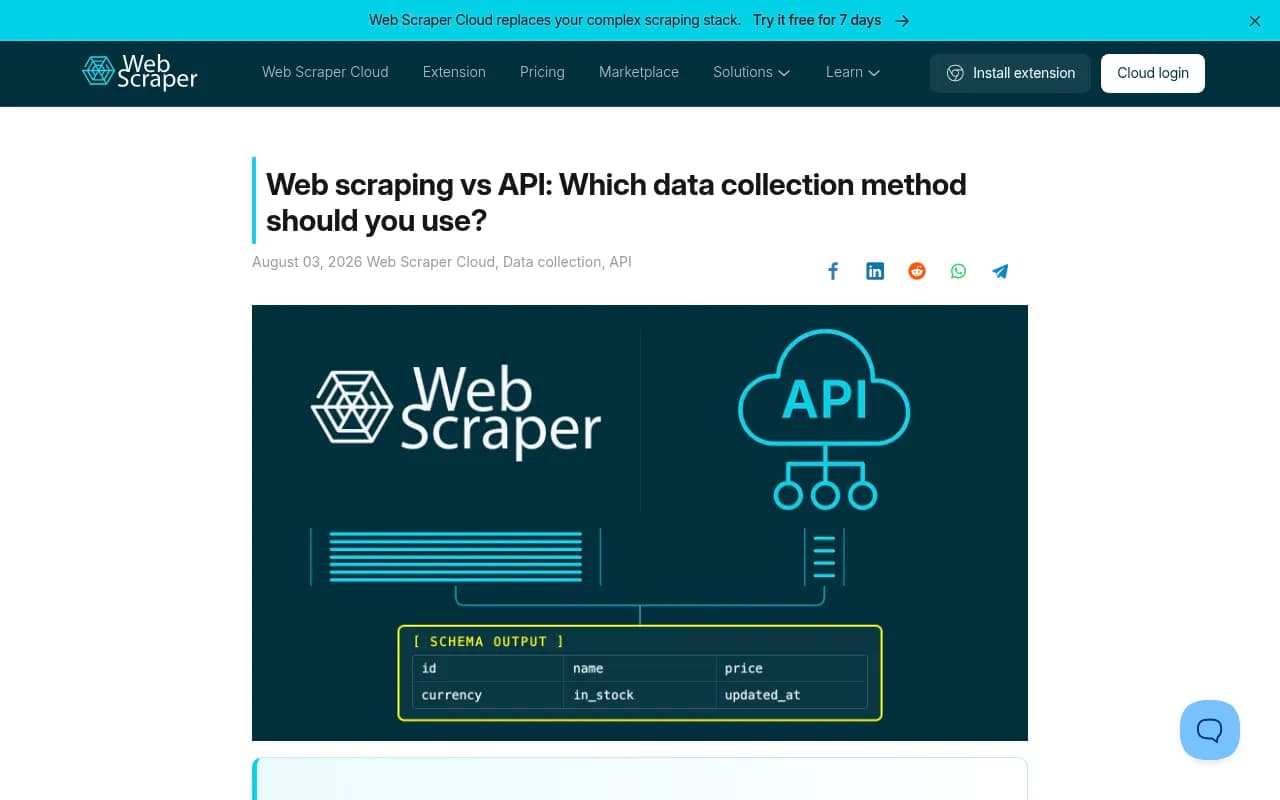
The catch is simple. An API returns what the provider chose to expose. The Web Scraper team puts it well in their general comparison of APIs and scraping: beautifully formatted JSON does not make an omitted field appear, it only makes the omission easier to parse. In ChatGPT's case the omitted part is a large share of the product people actually use.
A third thing that gets confused with both
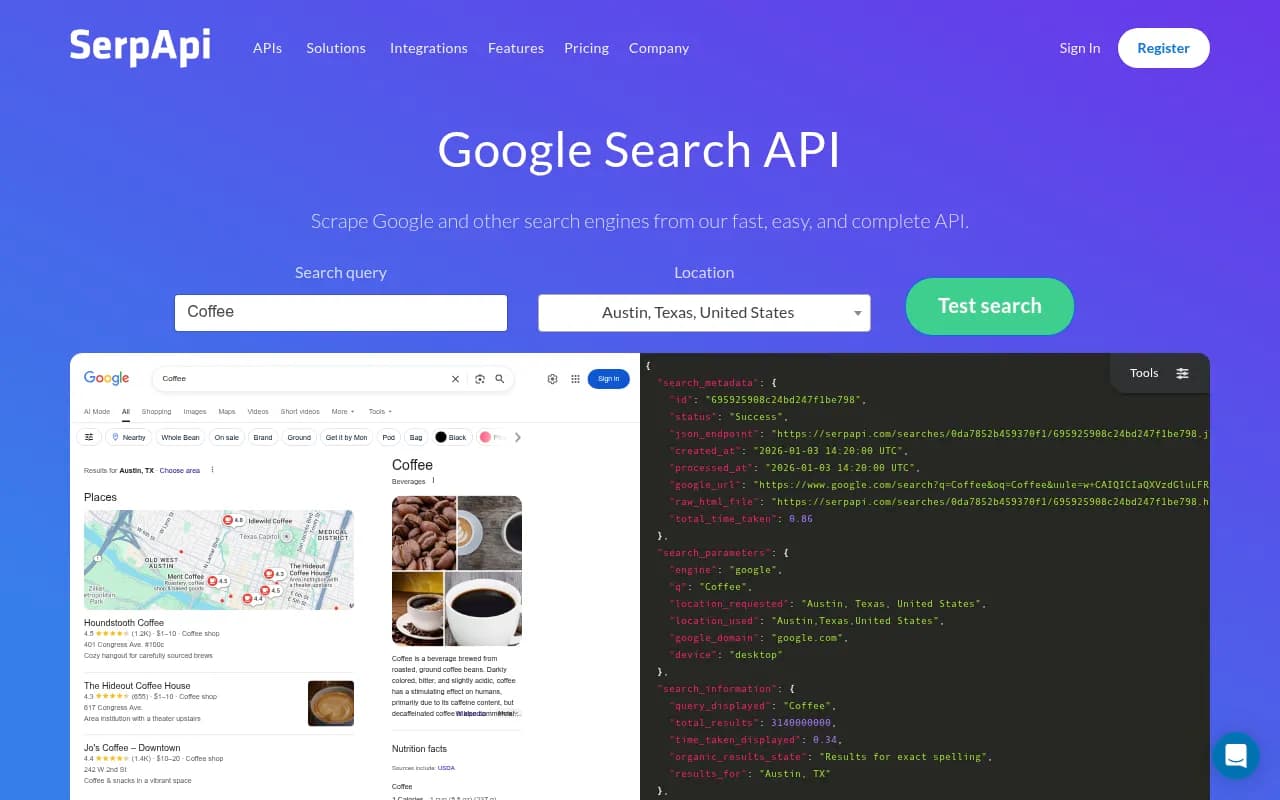
There is also a distinction between a source API and a scraping API. A source API returns data the site owner chose to supply. A scraping API is a service that does the browser work for you and hands back the page. SERP and AI-search APIs from vendors such as SerpApi or DataForSEO sit in that second family: they are developer infrastructure, and some trackers are built on top of them. If a vendor says "we use an API," ask which kind.
What the comparison research shows
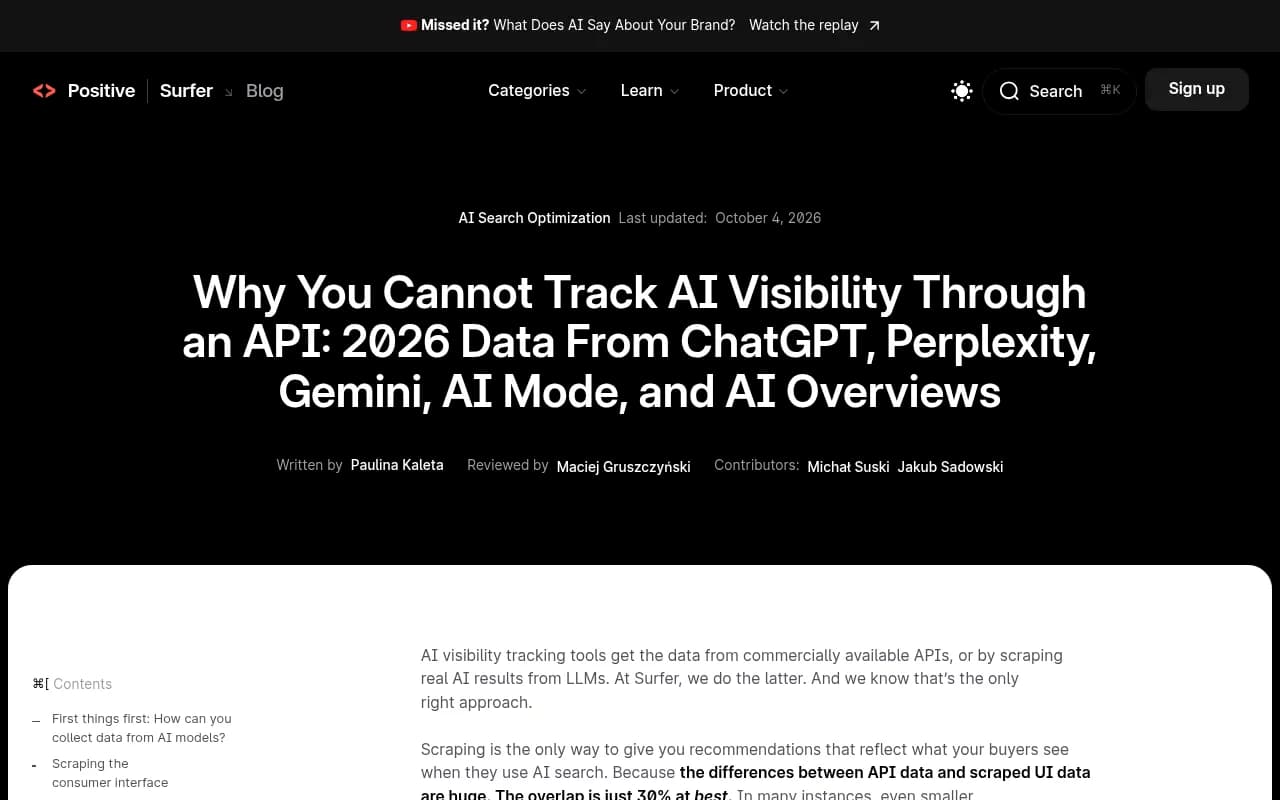
The most detailed public comparison I found is from Surfer, which ran 1,000 prompts across ChatGPT, Perplexity, Gemini, Google AI Mode and AI Overviews, once through the scraped consumer interface and once through an API, collecting 13,779 answers. Treat it as vendor research: Surfer sells scraped data, so it has a stake in the result. Still, the gaps are large enough that the direction is hard to wave away. Note too that Surfer's AI Overviews "API" is borrowed from AI Mode, since no standalone model is sold for it.
| Measure (ChatGPT) | Scraped interface | API |
|---|---|---|
| Brands named per answer | 7.9 | 13.8 |
| Answer length | Baseline | About 2.05x longer |
| Cited sources per answer | 12.1 | 3.1 |
| Web search triggered | 88% of prompts | 83% of prompts |
A few readings of that table:
- The API overreports brands. If your tool says you were mentioned, the real interface may not have shown you at all.
- Longer API answers mean the consumer product trimmed content. The trimmed part might be exactly your page.
- Citation counts go in different directions depending on the model. On ChatGPT the interface cites far more sources. On Perplexity the API cited 19.5 sources against 10.27 in the app. A tracker that does not match the interface cannot even tell you which way the error runs.
- Search behavior itself differs. Scraped interfaces triggered a web search on 88% of ChatGPT prompts and 100% of the other four products, while only Perplexity's API did so every time.
A second write-up reporting on the same study (from ZeroRank, another scraping-based vendor) cites a ChatGPT sample with 406 words per API answer against 743 scraped, roughly 7 sources against 16, and only 24% brand overlap. Different excerpts of the same research report slightly different figures, so use these as an order-of-magnitude guide, not a spec.
A caution about mixing numbers
Surfer's 12.1 cited sources per ChatGPT answer is much higher than the roughly 5 sources per web-search answer in Promptwatch Data's average sources per response report. That is not a contradiction. The prompt sets, definitions and collection periods differ, and ChatGPT's average drifts with model and retrieval updates. Never compare one vendor's absolute number with another's. Compare methods against the same prompts.
What an API cannot see
The interface layer contains things that simply do not exist in a JSON response:
- The exact citation list and its order as shown to the user.
- Shopping carousels and product cards. Promptwatch Data tracks how often ChatGPT shows shopping features, and those cards live in the interface.
- Sponsored placements. ChatGPT ads data covers May 20 to August 17, 2026, and none of it is reachable from an API.
- Query fan-outs, the web searches ChatGPT runs behind the scenes. Promptwatch's fan-out report shows average fan-outs per response falling from 2.15 in early December to about 1.84 by early March, with query length shrinking too. Behavior moves in steps with product updates, and only a tracker reading the real interface sees those steps.
Product changes are not small either. Promptwatch Data recorded ChatGPT jumping from about 0.4% to about 17% of fan-out queries using the site: operator overnight on August 8, 2026, and average citations per response dropped around the GPT-5.3 rollout on March 4, 2026. An API pinned to a model version will not necessarily reflect a product-level change like that.
Where API-based tracking still makes sense
I do not think APIs are useless here. A few honest uses:
- Checking what a model believes from training data, without live search. Some platforms deliberately run API models alongside interface data for this reason.
- High-volume, low-cost experimentation where you need thousands of runs and directional signals.
- Developers building their own internal tooling who want predictable JSON and documented rate limits.
- Cases where the official API is the only authorised route, since scraping carries terms-of-service and compliance questions that vary by site and jurisdiction. I did not verify OpenAI's current policy, so check it yourself before building anything.
The mistake is treating API output as a stand-in for what customers see, and reporting it that way.
Side-by-side comparison
| Factor | Interface scraping | API calls |
|---|---|---|
| What it captures | Full user-facing answer, citations, shopping, formatting | Model text, sometimes sources |
| Match to real users | High | Lower, sometimes very different |
| Cost and speed | Slower, more resource-heavy | Faster, cheaper at scale |
| Maintenance | High, breaks when UI changes | Low, versioned and documented |
| Brand and citation accuracy | Reflects live behavior | Can overreport brands, misreport sources |
| Interface-only features | Yes | No |
| Best for | Visibility and citation tracking | Training-data checks, bulk testing, builders |
How to vet a ChatGPT rank tracker
Ask these before you pay.
- Where does ChatGPT data come from? "The real interface, per country and language" is a good answer. "Our API integration" means you should adjust how much you trust the numbers.
- Can I read the raw responses? You should be able to open an individual answer, see the citations and compare it to what you get by typing the same prompt yourself.
- How many times is each prompt sampled? Answers shift with phrasing, session and day, so one check says little. Look for repeated runs and a trend line.
- Does it separate interface data from API-model data? Mixing the two in one score hides the problem.
- Can it connect to your own site data? Knowing whether AI crawlers can read a page, and whether AI traffic converts, tells you whether a visibility change matters.
A quick sanity test: run ten of your tracked prompts by hand in ChatGPT, then compare brands and sources to the tool's stored responses. If they diverge consistently, you have your answer.
Tools by approach
The catalog splits roughly like this. Vendor claims about collection method change, so verify each on the vendor's site.
Promptwatch collects from the actual user interfaces of ChatGPT, Google AI Overviews, Google AI Mode, Gemini, Perplexity, Copilot and others in each country and language, and tracks API models such as Claude and DeepSeek separately to show what models believe from training data. It goes beyond tracking: IP-verified AI crawler logs, visitor analytics and a Content Agent let you act on gaps and measure whether the fix worked. See how Promptwatch collects data for the method in detail. It has a 7-day free trial on monthly plans and a free AI visibility report; confirm current pricing at promptwatch.com/pricing.

ZeroRank states that it runs prompts against the live models and scrapes the answers as users see them.

Surfer SEO publishes the scraped-versus-API research above and says its AI tracking runs on scraped data.
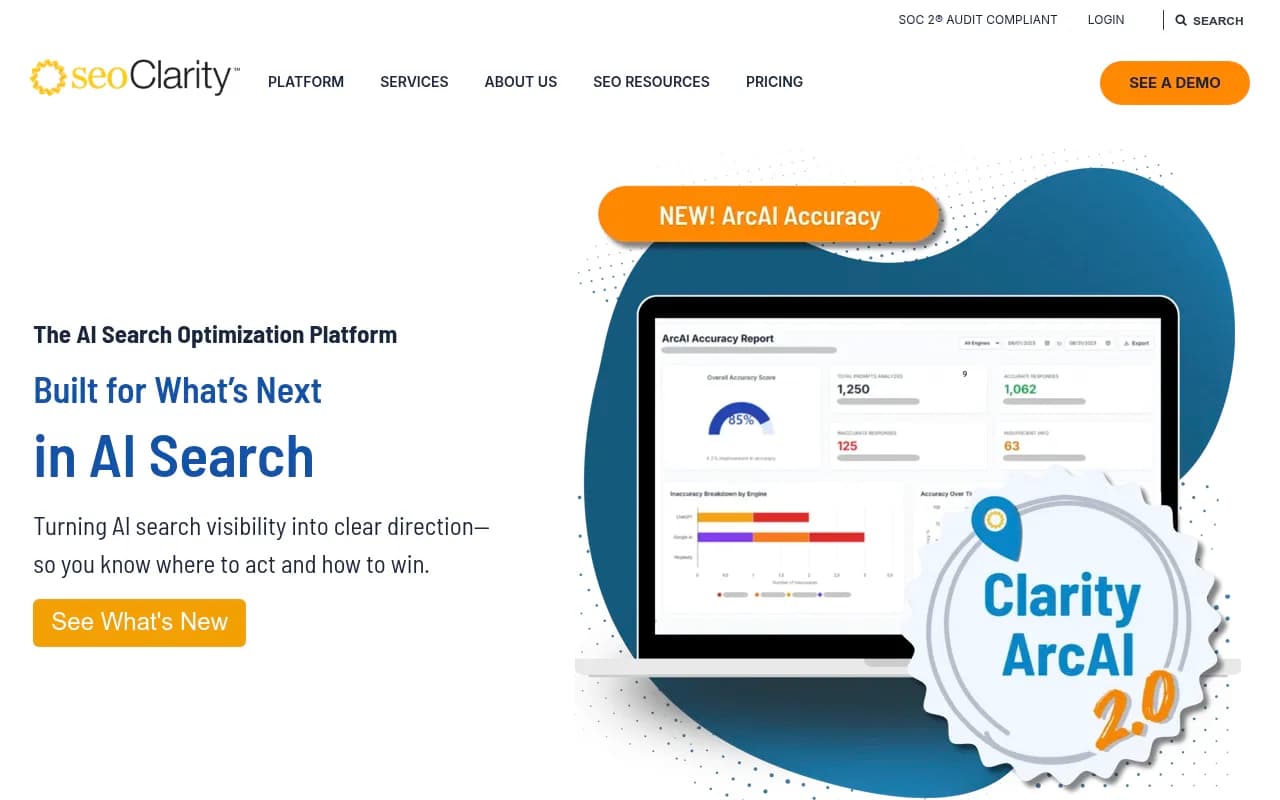
seoClarity makes the same argument, describing UI scraping as the way to capture citations, shopping results and formatting.
For monitoring-focused alternatives, Otterly.AI and Peec AI are often shortlisted. I would put the vetting questions above to each rather than assume.


If you are comparing the wider category, the directories at bestgeosoftware.com and ai-rank-tools.com list more options.
A practical setup
If you are choosing today, this is the combination I would trust:
- Interface-based tracking for ChatGPT, AI Overviews, AI Mode, Gemini and Perplexity, because that is where your buyers are.
- API-model tracking as a secondary signal for training-data perception.
- Crawler logs and visitor analytics on your own site, so a visibility change can be tied to access, citation and traffic. Promptwatch's guide to attributing AI traffic covers the second part.
- A monthly manual spot check of ten prompts against the tool's stored answers.
What to remember
API data is easier to collect, and that is not the same as being right. The research available, limited and vendor-sourced as it is, shows large gaps in brands, sources and answer length for ChatGPT, and some of ChatGPT's most commercially important surfaces exist only in the interface. Pick the tool whose collection method you can inspect, then check it against your own screen.