Key takeaways
- Brandwatch's core product measures social and web mentions across roughly 100 million sources. That is a different data problem than tracking what ChatGPT, Perplexity, or Google AI Overviews actually cite and say about your brand.
- Brandwatch now has an AI search layer, but it isn't native. It comes through a partnership with Trajaan, a third-party search intelligence vendor, surfaced inside Brandwatch's Consumer Research dashboards.
- Promptwatch's data shows social platforms barely register in AI citations overall (Reddit 3.36%, YouTube 2.94%, everything else under 1.2%), and even Reddit's share inside ChatGPT collapsed from roughly 3.8% to 0.5% in a single week in August 2026. Social listening volume does not predict AI search visibility.
- Brandwatch runs $800 to $15,000+ per month depending on tier, while dedicated AEO/AI-visibility tools start around $29 to $495 per month. Several enterprise buyers now run both, treating them as complementary rather than substitutes.
- If your mandate is specifically "are we visible in ChatGPT and AI Overviews," a dedicated AI visibility platform will get you there faster and cheaper than retrofitting a social listening contract.
Why this question even needs asking
Brandwatch has spent close to two decades building the most thorough social listening product on the market. It tracks sentiment, themes, and brand health across something like 100 million online sources, and it just picked up Social Listening Solution of the Year at the 2026 MarTech Breakthrough Awards. That's a real accomplishment. Worth noting, though: in the actual analyst rankings that matter more than vendor-run award shows, Forrester's Q4 2024 Wave for Social Suites placed Brandwatch as a "Strong Performer," not a Leader — Sprinklr and Emplifi took those spots. Brandwatch's own marketing badges the Forrester mention without clarifying that distinction, which is a small thing but worth knowing before you read any vendor's self-description too literally.
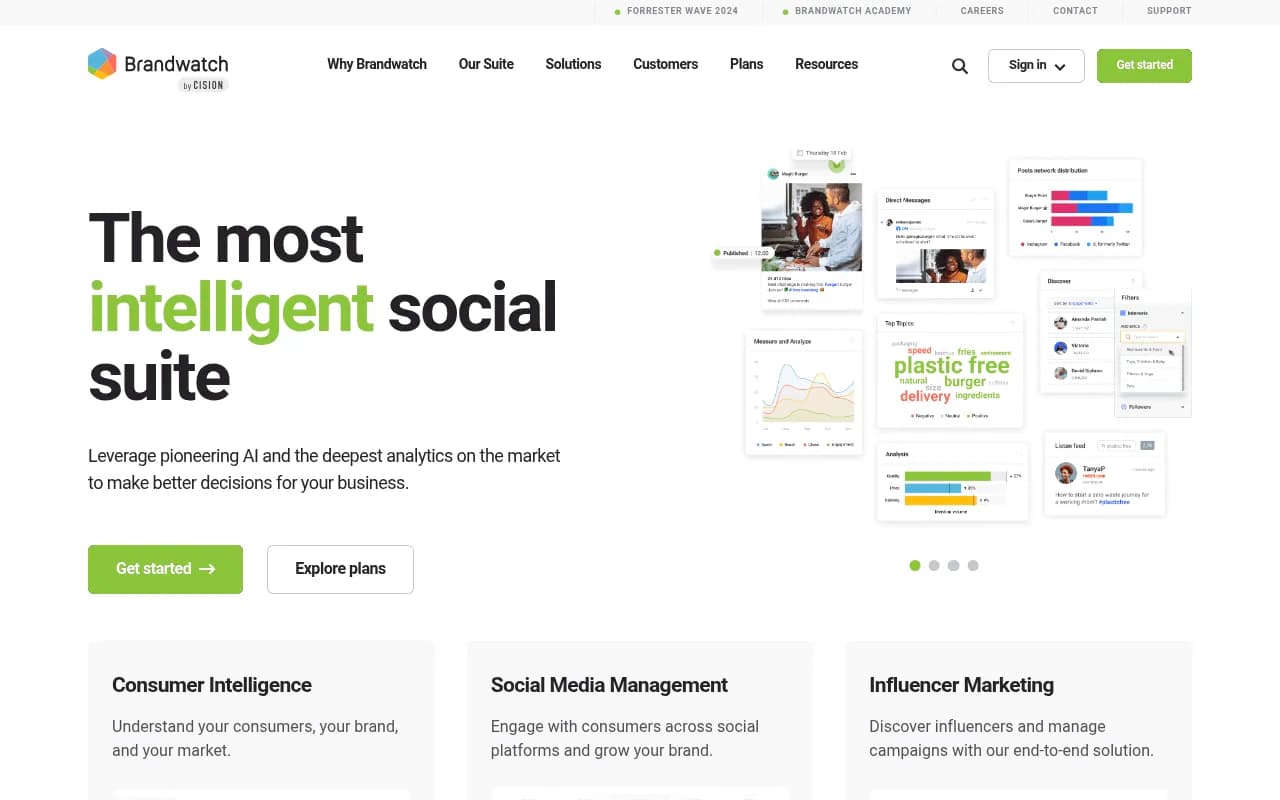
None of that is really the point of this guide, though. The point is: marketing teams buying Brandwatch today increasingly ask it to do something it wasn't originally built for, tell them how they show up when someone asks ChatGPT or Gemini a question about their category. And that's a genuinely different job than counting mentions on X or classifying sentiment in Reddit threads.
Social listening and AI search visibility are not the same discipline
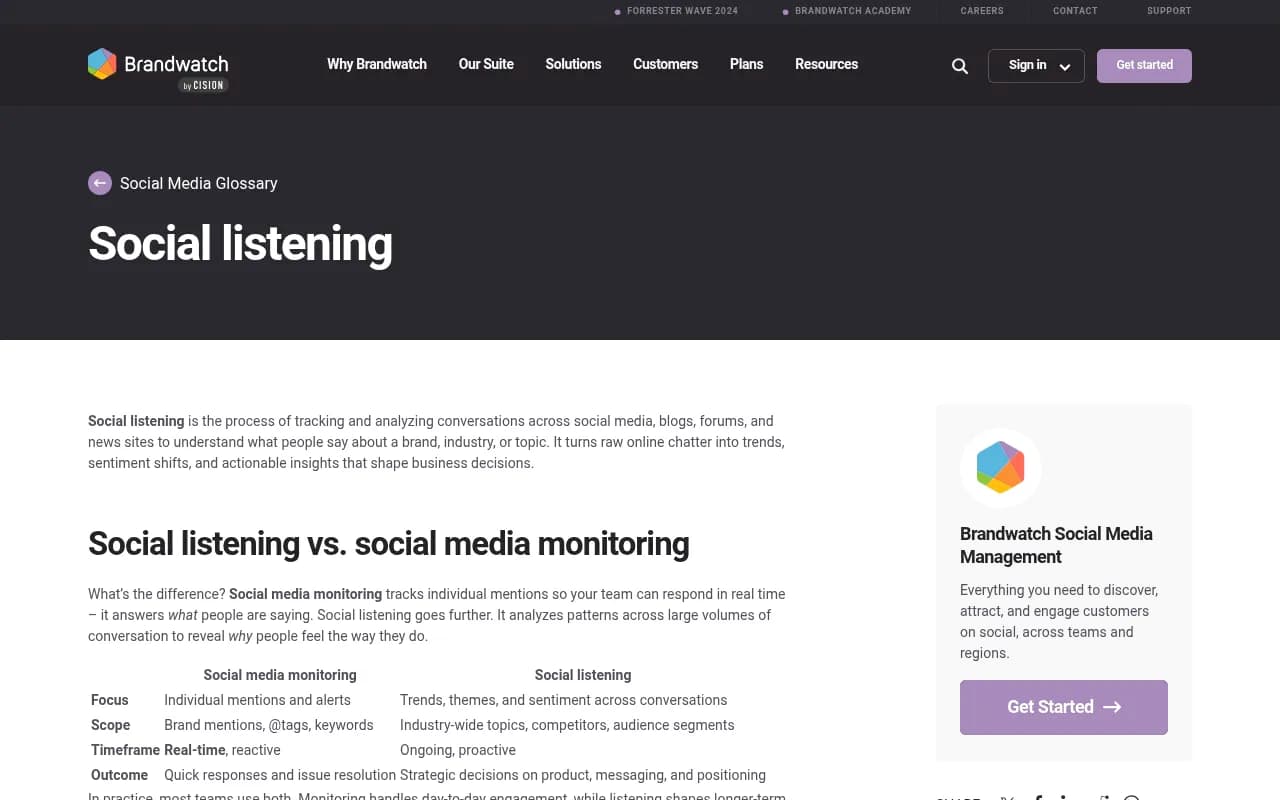
Brandwatch's own glossary defines social listening as tracking conversations across social media, blogs, forums, and news sites to surface trends, sentiment shifts, and "actionable insights." That's a solid definition of what the product does. It says nothing about what ChatGPT cites when someone asks "what's the best project management tool for a 10-person startup."
Here's the actual gap, laid out with numbers. Promptwatch's social media citation data shows that across AI engines, social platforms make up a tiny slice of what gets cited: Reddit 3.36%, YouTube 2.94%, Facebook 1.15%, LinkedIn 0.74%, Instagram 0.65%, TikTok 0.13%, and X at a practically invisible 0.07%. ChatGPT is something of a Reddit specialist, at 5.19% of its citations, more than 20 times its next best social source. But that's still a small minority of total citations. Most of what AI engines cite is not social content at all.
And even that small slice is volatile in a way raw mention-counting tools don't capture. Promptwatch's Reddit citation tracking found Reddit's share of ChatGPT Search citations fell from a steady ~3.8% in late July 2026 to just 0.5% by August 17, an 86% relative drop in about a week. Google AI Overviews and AI Mode saw smaller, slower declines over the same period. If your "AI visibility" strategy was built on the assumption that Reddit volume matters a lot to ChatGPT, that assumption aged badly inside of ten days.
This is really the crux of the "does it go far enough" question. A brand can dominate share of voice on social, have glowing sentiment scores, and still be functionally invisible when someone asks an AI assistant to recommend a product in its category. The two measurements answer different questions. Brandwatch answers "what are people saying about us." AI visibility platforms answer "what does the AI say about us, and why."
What Brandwatch actually offers for AI search today
To be fair to Brandwatch, it hasn't ignored this. In 2026 it partnered with Trajaan, a search intelligence vendor, to surface AI search data inside Brandwatch's Consumer Research dashboards. The pitch is that Trajaan monitors how LLMs cite a brand and its competitors across thousands of prompts, in more than 150 countries, blending traditional search engines (Google, Bing, Baidu), generative AI engines (Gemini, Claude, OpenAI, DeepSeek), and even shopping and video signals.
Brandwatch's own content acknowledges the limits of a citations-only view. A company blog post from April 2026 puts it plainly: "LLM tools can point you to some of the places you're cited, but they won't show you what narratives are actually shaping the AI's view of your brand." Alistair Wheate, Brandwatch's Principal Solution Strategist, frames the shift this way: "The search landscape is becoming increasingly fragmented. More and more people are searching in different places to get their information." The same post cites a telecom brand that used search-intent data to build FAQ and troubleshooting content, cutting call-center contact volume by 25%. That's a real, tangible outcome, and it's the kind of result worth paying attention to regardless of which vendor delivers it.
Still, independent comparison sites keep flagging the same thing: Brandwatch's native AI search tracking is thin relative to dedicated tools, and the Trajaan layer is a bolted-on integration rather than something built from the ground up for LLM citation monitoring. One market landscape write-up categorizes Brandwatch under "brand monitoring tools" broadly, noting that these platforms "monitor mentions, not the answer-engine layer specifically... you'll see when AI-generated content mentions you, but not what the AI engines say in real-time when prompted." That same piece recommends pairing Brandwatch with a dedicated AEO tool like Profound for regulated enterprise stacks, treating the two as complements rather than either/or.
The content type mismatch nobody talks about
Here's a detail that matters more than it sounds. Promptwatch's ChatGPT citation type breakdown for August 2026 shows product pages at 28.7% of citations, listicles at 10.1%, how-tos at 6.3%, news at 5.6%, and social posts at just 2.0%. Social posts' share actually fell from 4.4% to under 1% after August 14, the same week Reddit's citation collapse happened. Meanwhile how-to content more than doubled over the month, from 4.3% to 9.1%, and documentation rose from 3.3% to 8.2%.
A social listening platform is built to understand conversation, sentiment, and themes across exactly the content type that's shrinking in AI citations. The content AI engines increasingly reward, product pages, comparison pages, how-tos, documentation, is marketing and content-team output, not conversational chatter. This is not Brandwatch's fault exactly. It's just evidence that the skillset and infrastructure needed to win AI search citations (structured product content, comparison pages, FAQ-style how-tos) is a different muscle than the one social listening tools flex.
Citation scarcity makes the stakes higher than they look
One more wrinkle worth understanding before you decide how much to invest here: AI engines don't cite very many sources per answer. Promptwatch's sources-per-response data shows ChatGPT typically cites around 5 sources per web-search response, Perplexity sits consistently near 10, Google AI Overviews averages roughly 10 as well, and Microsoft Copilot swings wildly, from under 2 to nearly 17 sources within weeks, evidence that Copilot's retrieval system is still being rebuilt.
Five citation slots is a lot tighter than a ten-blue-links SERP. If you're not in the mix, a social listening dashboard showing strong sentiment won't tell you that, or why. That's the real functional gap: not that Brandwatch's social data is wrong, but that it was never designed to answer "why weren't we one of the five sources ChatGPT picked."
Pricing: a very different cost structure
Brandwatch doesn't publish pricing publicly, but third-party procurement data gives a reasonable picture.
| Tier | Estimated monthly cost | Notes |
|---|---|---|
| Small team | $800-$1,500 | Entry-level Brandwatch configuration |
| Mid-market | $2,000-$5,000 | Broader source coverage, more seats |
| Enterprise | $5,000-$15,000+ | Fortune 1000 territory; averages ~$50,000/year in actual transactions, per buyer data |
| Influencer module (add-on) | $5,000-$15,000+ | Separate from core listening spend |
Compare that to the dedicated AI-visibility category:
| Tool | Entry price | What you get |
|---|---|---|
| Otterly.AI | $29/mo | 15 prompts, ChatGPT/Perplexity/AI Overviews/Copilot |
| Profound | $99/mo | ChatGPT tracking; enterprise tier adds SOC 2, SSO |
| Peec AI | $95/mo | Unlimited seats on every tier |
| AthenaHQ | Free tier available | 300 credits free, 9 models on paid plans |
| Promptwatch | $95/mo (Essential) | 50 prompts, 6,000 responses, all major LLMs tracked, AEO content generation |
That's a wide gap. A brand paying $3,000 a month for Brandwatch's mid-market tier could run a full dedicated AI visibility stack for a fraction of that and still have budget left for content production.
So does Brandwatch go far enough?
Honestly, it depends on what "far enough" means for your team. If social listening is your formal operating function, PR, comms, brand research, crisis monitoring, Brandwatch's depth is hard to beat, and the Trajaan integration gives you a reasonable first look at AI search behavior without adding a new vendor relationship. If your mandate is narrower and more urgent, specifically proving and improving your brand's presence in ChatGPT, Gemini, Perplexity, and AI Overviews, bolting that onto a social listening contract is slower and more expensive than going to a platform built for exactly that job.
The honest answer from the market itself: several analysts recommend running both. Pair Brandwatch (or Meltwater or Brand24, similar enterprise listening tools) for the social and media intelligence layer, with a dedicated AI visibility platform for the citation layer.
For that second layer, I'd point to Promptwatch, which goes further than most monitoring tools by not just tracking where you're cited but showing you why, through AI crawler logs that reveal when bots from OpenAI, Anthropic, and Google actually visit your pages, and then acting on the gaps through automated content generation, CMS publishing, and a prioritized action list rather than leaving you to figure out the fix on your own.

Promptwatch tracks ChatGPT, Gemini, Claude, Perplexity, Grok, Copilot, and Google AI Overviews and AI Mode, with Reddit and YouTube citation tracking, ChatGPT Shopping monitoring, and content gap analysis that maps your existing pages against what AI engines actually answer. Essential plans start at $95/month, roughly the same order of magnitude as the cheapest end of Brandwatch's range, for a tool purpose-built around the exact problem Brandwatch is still retrofitting.
A practical checklist before you decide
- If you're already paying enterprise rates for Brandwatch, ask your rep for a live demo of the Trajaan integration specifically, not the general product tour, and check whether it tracks the models your buyers actually use.
- Don't assume high social share of voice translates into AI visibility. Pull a sample of prompts in your category and check manually in ChatGPT and Perplexity before committing budget either way.
- Watch content type, not just mention volume. If your content library is thin on comparison pages, how-tos, and documentation, that's likely a bigger lever than any monitoring tool purchase.
- Treat any AI citation snapshot as perishable. Promptwatch's data shows citation shares for specific sources can swing by double digits within a single week, so one-time audits are much less useful than continuous tracking.
For teams exploring the wider category of AI visibility tools, the directory at bestgeosoftware.com is a reasonable place to compare options side by side before signing anything.