Key takeaways
- Brandlight and Bluefish are both enterprise-only, demo-gated platforms with no published pricing. Neither is a realistic option for mid-market teams.
- Brandlight ($30M Series A, SOC 2 Type 2) leans into breadth: visibility, commerce, content, partnerships, and technical modules under one roof.
- Bluefish ($68M raised, ~10% of the Fortune 500 as customers) leans into brand safety: its AI Accuracy module is arguably the strongest hallucination detection in the category right now.
- Both platforms have weak attribution stories. Brandlight's attribution module is still "coming soon"; Bluefish has no GA4 or conversion attribution layer.
- Neither offers content generation or publishing. If you want a platform that closes the loop from insight to action, you'll need to look elsewhere.
What you're actually buying when you buy an AI visibility platform
Before comparing the two, it helps to understand what these tools measure, because the marketing around "AI visibility" is fuzzier than the underlying reality.
AI visibility is how often, and how favorably, your brand shows up when someone asks ChatGPT, Gemini, Perplexity, or Google AI Overviews a question in your category. The catch is that the inventory is tiny and volatile. Per Promptwatch's data on average sources per response, ChatGPT cites roughly 5 sources per web-search-enabled response, while Google AI Overviews and Perplexity cite around 10. Microsoft Copilot swings wildly between under 2 and nearly 17.
That matters for evaluating any vendor's claims. A platform that reports a "visibility percentage" without engine-specific context can mislead you, because the number of available citation slots differs by 2x or more between engines and isn't stable on Copilot.
Citation share is also far more volatile than classic SEO rankings. Promptwatch's ChatGPT citation share data for June 2026 shows Reddit's share of ChatGPT Search citations fell from 6.11% in May to 3.71% in June, a drop of roughly 40% in a single month. No single domain holds even 4% of citations. This is a long-tail, fast-moving ecosystem, which is why monthly tracking matters and why one-time "visibility audits" from vendors deserve skepticism.
Brandlight's own framing on this is honest and worth repeating: "No tool can promise AI citations." Keep that in mind when any vendor, including these two, shows you a case study with a 7x visibility jump.
Brandlight at a glance
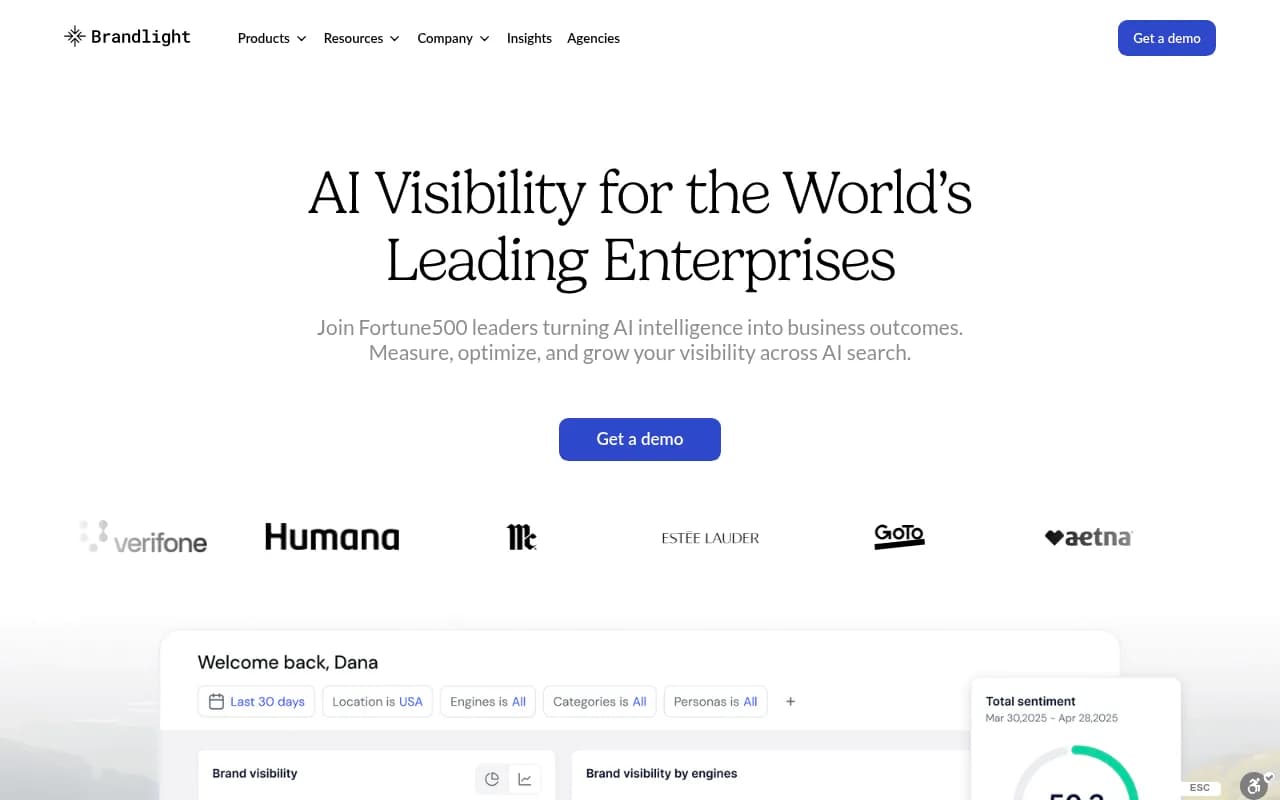
Brandlight raised a $30M Series A and has positioned itself, in CEO Imri Marcus's words, as "an operating system for AI as a marketing channel." The customer list reads like a Fortune 500 roll call: Volkswagen, LG, TD Bank, Estée Lauder, Kimberly-Clark, Humana, Samsung. CB Insights named it a leader in its Emerging Service Provider ranking for GEO monitoring platforms in December 2025.
The platform is organized into five modules: Commerce (SKU and marketplace ranking), Content, Partnerships (publisher-level content performance), Technical (AI crawl and indexability tracking), and Visibility & Insights (cross-engine visibility with competitive benchmarking). It tracks ChatGPT, Gemini, Perplexity, Copilot, and Grok.
On the enterprise checklist, Brandlight is ahead of Bluefish on one point that matters to regulated buyers: it claims SOC 2 Type 2 compliance, while Bluefish's SOC 2 audit was still in progress as of mid-2026, with only "SOC 2-aligned controls" and Google Workspace SSO.
What reviewers like
Independent reviews on G2 (4.7/5, though from a small pool of 19 verified reviews) praise the dashboard usability and exportable visualizations, with one reviewer calling them "great for CMO-level reporting." Customer support gets consistent praise. The competitive benchmarking tables get named as genuinely useful for enterprise SEO teams.
What reviewers complain about
- Pricing opacity. The pricing page reportedly 404s; third-party estimates range from $199/mo to $15K/mo for enterprise contracts, but nothing is published.
- Onboarding takes 30 to 90 days to full productivity.
- The attribution/ROI module is still "coming soon."
- It's monitoring-heavy. As one review summary put it, Brandlight "surfaces what AI engines say but can't directly change source content."
- No self-serve option. Everything goes through sales.
Bluefish at a glance
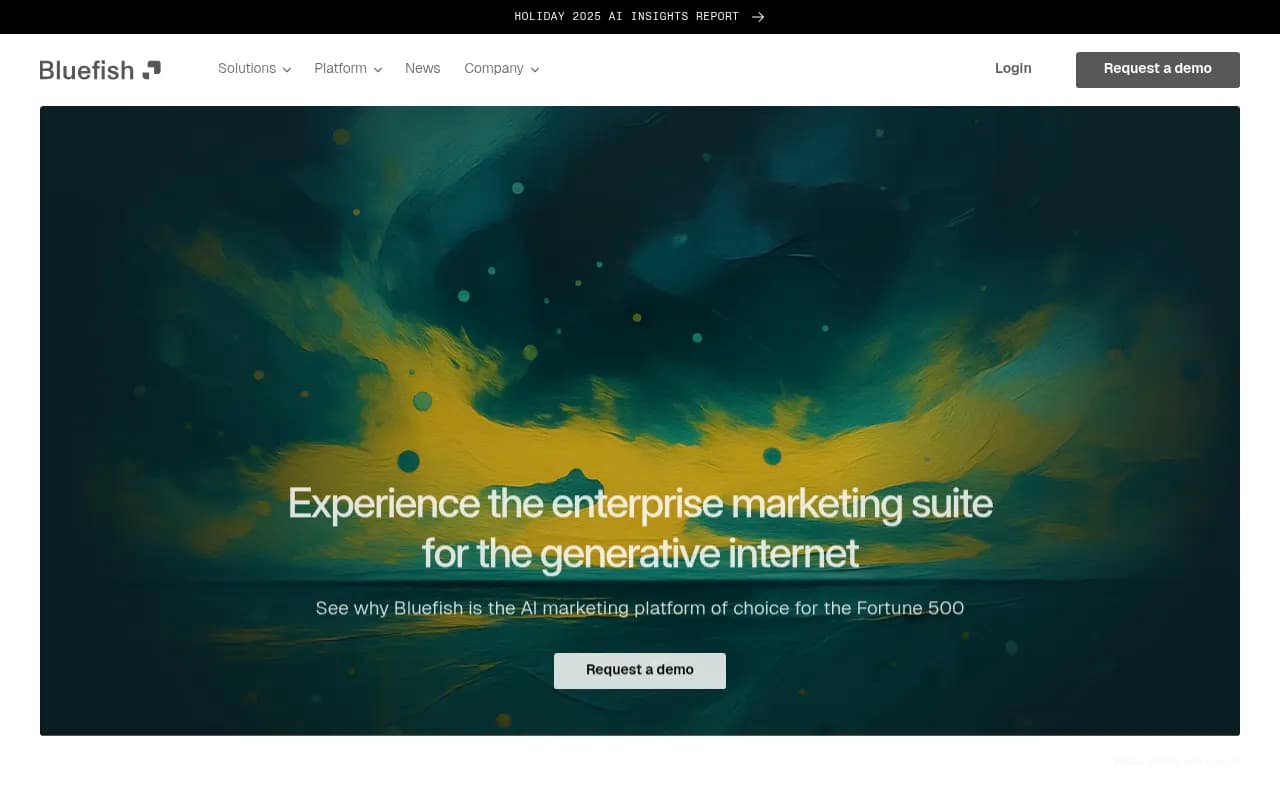
Bluefish was founded in 2024 by a team that previously built marketing platforms acquired by Microsoft and Meta. It raised $20M in August 2025 and another $43M in April 2026, bringing total funding to $68M. Its named customers include Adidas, American Express, Hearst, LVMH, and Ulta Beauty, and the company claims roughly 10% of the Fortune 500 uses it.
The product is organized around AI Monitoring, AI Optimization (GEO), GEO Measurement, AI Commerce, and, since May 2026, AI Accuracy.
The standout feature: AI Accuracy
Bluefish's AI Accuracy module, launched May 5, 2026, extracts and verifies every factual claim AI channels make about a brand in real time: wrong specs, incorrect pricing, outdated leadership info, fabricated compliance claims. One independent practitioner comparison called it "the strongest hallucination detection capability in the AEO category right now," and as of mid-2026 no other major platform had shipped comparable depth. For a pharma or financial services brand, this alone could justify the evaluation.
Alongside it sits Brand Vault, which ingests your first-party content into a continuously updated "verified source of truth" that can be shared with LLMs as training material. It's a genuinely interesting idea, and it's the kind of thing a brand safety or legal team would care about more than an SEO team.
Where Bluefish falls short
- No page/URL-level citation breakdown. Bluefish's Impact Score and Influence Rank work at the domain level, which limits content-optimization utility.
- No content generation, optimization, or publishing pipeline. It offers daily impact-ranked recommendations and content briefs, but you do the work.
- Prompt configuration is managed by Bluefish's professional services team, with no self-serve interface to edit prompts and no disclosed methodology.
- No real user prompt-volume dataset.
- No GA4 or conversion/revenue attribution.
- SOC 2 audit in progress, not certified, despite serving regulated Fortune 500 clients.
- Export and BI integration are limited to basic CSV and some API access.
One independent review sized up the ideal Bluefish buyer as a "Fortune 500 brand with 50+ marketing headcount, dedicated brand and PR teams, and a six-figure annual budget for AI search tooling." That's a fair summary.
Head-to-head comparison
| Dimension | Brandlight | Bluefish |
|---|---|---|
| Founded/funding | $30M Series A | $68M total, founded 2024 |
| Named customers | Volkswagen, LG, TD Bank, Samsung | Adidas, Amex, LVMH, Ulta Beauty |
| Core strength | Breadth: commerce, content, partnerships, technical, visibility | Brand safety: AI Accuracy hallucination detection |
| Engine coverage | ChatGPT, Gemini, Perplexity, Copilot, Grok | ChatGPT, Google AI, Claude, Perplexity, Amazon Rufus |
| SOC 2 | Type 2 compliant (claimed) | Audit in progress, aligned controls |
| Citation granularity | Query-level source breakdowns | Domain-level only (Impact Score, Influence Rank) |
| Content creation | Content engine module, but no publishing pipeline | Briefs and recommendations, no generation or publishing |
| Attribution | "Coming soon" | None (no GA4 layer) |
| Pricing | Not published, sales-only | Not published, sales-only |
| Onboarding | 30-90 days | Long sales cycle, complex implementation |
| G2 rating | 4.7/5 (19 reviews) | Unclear, conflicting data across sources |
A note on that last row: Bluefish's G2 presence is genuinely murky. Different sources report 4.1/5 from 51 reviews, 4.6/5 from 322 reviews, and "zero reviews for the AI product," likely because a different, unrelated product called "Bluefish" exists on G2. I'd treat any specific star rating for Bluefish AI with suspicion until you verify it directly.
Which one fits which buyer
Choose Brandlight if you want breadth across commerce and content use cases, need SOC 2 Type 2 for procurement, and have a CMO-level reporting mandate. The competitive benchmarking and multi-brand, multi-region support in one platform are real strengths for large portfolio brands.
Choose Bluefish if brand safety and factual accuracy in AI channels are your primary concern, especially in a regulated industry. AI Accuracy is a genuine differentiator, and Brand Vault is a forward-looking idea for feeding LLMs verified information about your brand.
Skip both if you're mid-market. Both are demo-gated with opaque pricing, long onboarding cycles, and org structures sized for companies most of us don't work at.
What neither platform does: close the loop
Here's the structural gap in both products. They're monitoring platforms. Brandlight surfaces insights; Bluefish surfaces insights plus hallucination alerts. Neither generates, optimizes, or publishes content, and neither attributes AI visibility to revenue.
That's not a small gap, because visibility data without an action loop tends to become a dashboard nobody opens after month three. If you want a platform that both tracks visibility and helps you fix it, with content gap analysis, automated content generation, CMS publishing, and crawler logs showing exactly when AI systems visit your pages, Promptwatch covers that end-to-end stack at a fraction of the enterprise price point.

Promptwatch's crawler logs (Agent Analytics) show which pages AI crawlers read, what errors they hit, and the crawl-to-citation path per page, which is data neither Brandlight nor Bluefish exposes. Its Content Agents plan, write, and publish GEO-optimized content directly to Webflow, Framer, or WordPress. And it tracks Reddit and YouTube citations, which matter given how heavily AI engines lean on both sources.
If you're evaluating the broader market rather than just these two, the GEO software directory at bestgeosoftware.com covers the full range of options, and our comparison of 21 GEO platforms goes deeper on the monitoring-versus-optimization distinction than this piece can.
Questions to ask in your demo
Whichever platform you evaluate, bring these to the sales call:
- How are prompts selected and configured, and can your team edit them without going through the vendor?
- Do you get page/URL-level citation data or only domain-level scores?
- What's the attribution story, concretely, and when does it ship?
- Is SOC 2 certified or just "aligned"? Get the report, not the marketing claim.
- What does onboarding actually cost in internal hours, not just license fees?
- Can the platform show you when AI crawlers hit your site and what they read?
That last question tends to be the quiet differentiator. Knowing that ChatGPTBot or ClaudeBot visited a specific page and hit an error tells you why you're invisible. A visibility score alone tells you only that you are.
The bottom line
Brandlight and Bluefish are both credible enterprise platforms with real customers and real funding, and both have genuine strengths: Brandlight in breadth and compliance posture, Bluefish in hallucination detection and brand safety. But both share the same structural limitations: opaque pricing, no self-serve, weak attribution, and no execution layer. For a Fortune 500 brand team that needs CMO-ready dashboards and has the headcount to act on insights, either can work. For everyone else, the enterprise packaging is a cost without a corresponding benefit, and platforms that combine monitoring with execution will get you further.