Key takeaways
- Brandlight built a credible enterprise AI visibility monitoring platform with real Fortune 500 traction and a $30M Series A in 2026
- Its research on challenger brands outperforming incumbents in AI search was genuinely useful and data-backed
- The core limitation: Brandlight is primarily a monitoring and measurement tool -- it shows you where you stand but offers limited help with what to do about it
- Teams that needed content gap analysis, AI content generation, or crawler-level diagnostics consistently looked elsewhere
- If you're evaluating Brandlight against alternatives in 2026, the comparison comes down to whether you need a dashboard or an optimization loop
How Brandlight positioned itself in 2025
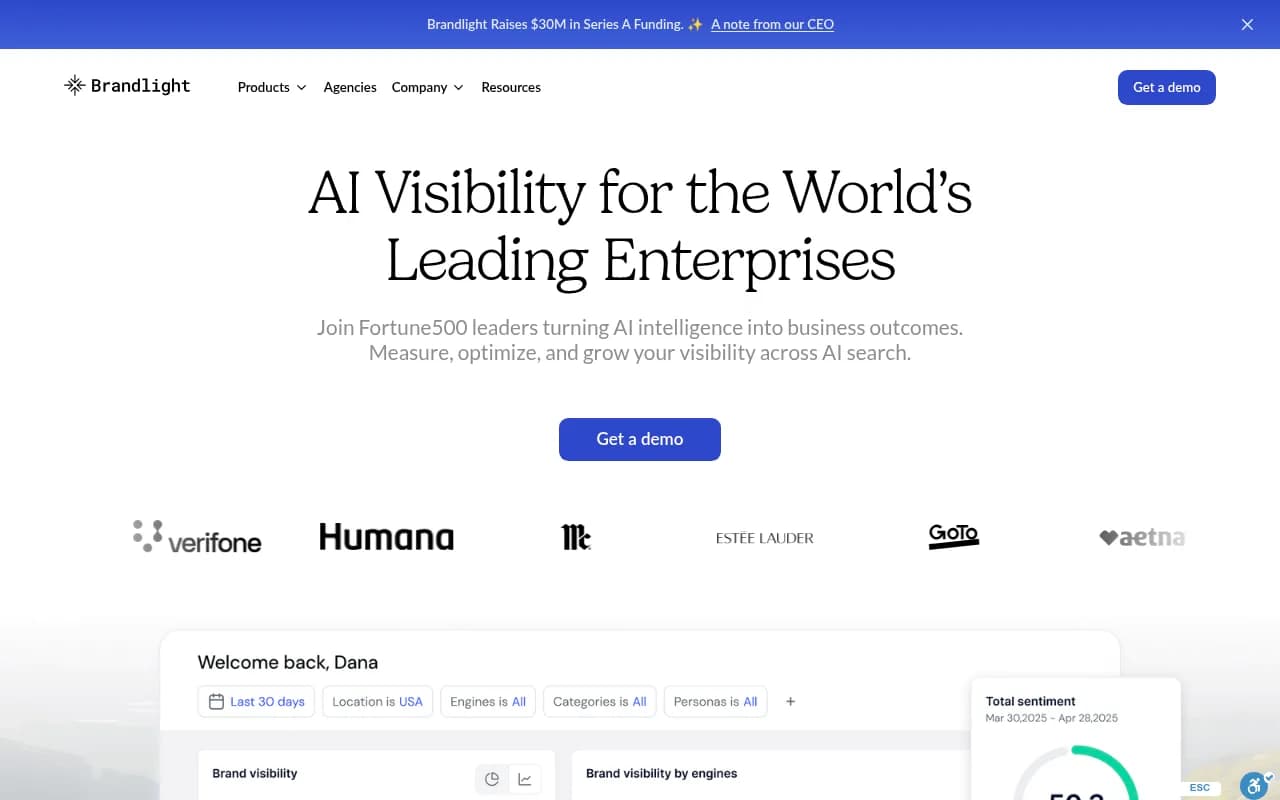
Brandlight came out of 2024 with a clear pitch: enterprise brands needed a dedicated platform to measure how they appeared across AI search engines like ChatGPT, Google AI Overviews, and Gemini. That pitch landed. By 2025, the company had signed clients including Humana, Aetna, Kimberly-Clark, and Verifone -- names that don't sign software contracts lightly.
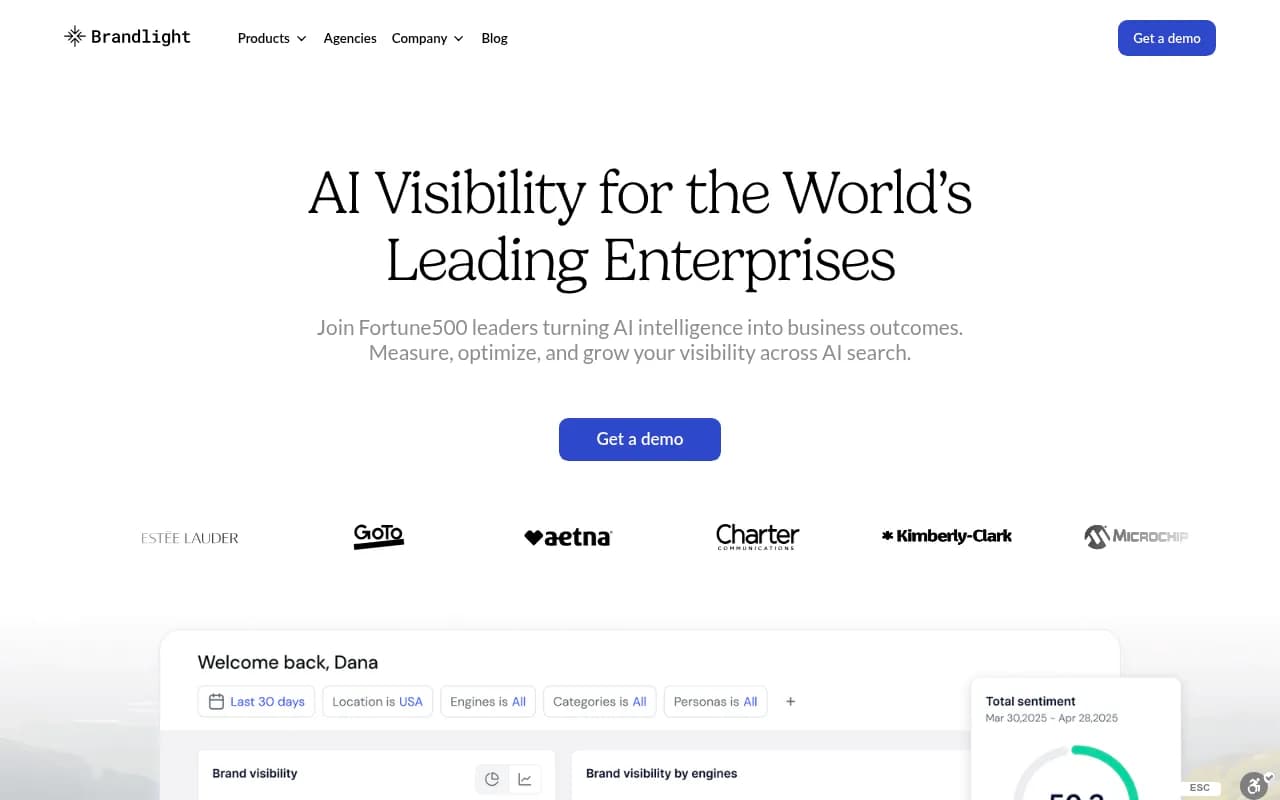
The platform's core value proposition was measurement: track your brand's visibility across AI surfaces, benchmark against competitors, and understand where you're winning or losing in the new discovery layer. For enterprise marketing teams that had no visibility into how AI engines were representing their brands, this was genuinely useful.
The company also published research that got real attention. Their analysis showing ShipStation outperforming UPS and USPS across 1,500 unbranded logistics prompts was the kind of finding that made CMOs stop scrolling. The data was specific, the methodology was clear, and the implication was uncomfortable: historical brand equity doesn't automatically transfer to AI search.
What Brandlight got right
The enterprise framing was smart
Most early AI visibility tools were built for SEO practitioners -- small dashboards with a handful of prompts and a simple share-of-voice metric. Brandlight went upmarket from the start. They built for the CMO conversation, not the SEO analyst conversation. That meant framing AI visibility as a business risk and a revenue opportunity, not just a technical curiosity.
This was the right call. By mid-2025, AI traffic had climbed over 1,000% across major search engines, and enterprise marketing teams were getting questions from leadership they couldn't answer. Brandlight gave them a framework.
Their research was genuinely good
The challenger brand analysis -- showing that smaller, more agile companies were outperforming billion-dollar incumbents in AI search -- was backed by real data across five AI surfaces. Ally Bank outperforming major competitors in consumer banking prompts. ShipStation outperforming UPS. These weren't vague observations; they were specific, verifiable findings.
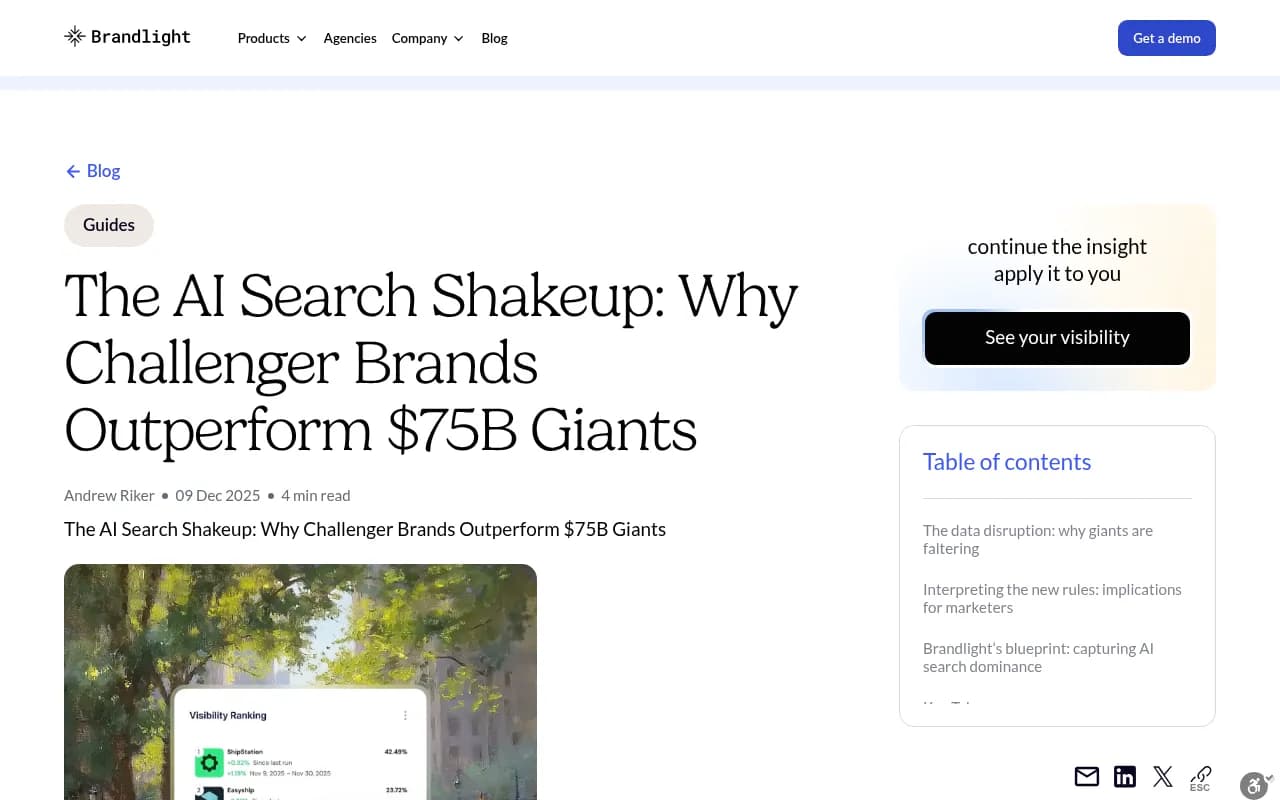
The core insight -- that AI models reward clarity and relevance over domain authority and budget -- was correct and important. Traditional SEO moats don't translate directly to AI visibility. That's a real finding that changed how some teams thought about their content strategy.
The $30M raise validated the market
In early 2026, Brandlight announced a $30M Series A led by Pelion Ventures. The announcement also signaled where the company was heading: beyond visibility monitoring into AI Ads and AI Commerce. The thesis is that discovery, consideration, and conversion are collapsing into a single conversational surface, and brands need infrastructure to operate inside that surface.
That's a reasonable thesis. Whether Brandlight executes on it is a separate question.
What Brandlight missed
Monitoring without optimization has a ceiling
Here's the honest problem with Brandlight's 2025 offering: it told you where you were invisible but didn't help you fix it. You could see that a competitor was appearing in 40% of relevant prompts while you appeared in 12%. You could see which AI models were citing them. What you couldn't do inside the platform was understand exactly what content gaps were causing that gap, generate content to close it, or track whether new content was getting crawled and cited.
For teams that wanted to move from insight to action, this created friction. They'd pull data from Brandlight, then hand it off to content teams who had no structured way to turn it into a prioritized content plan. The loop wasn't closed.
No content generation or gap analysis
The absence of content gap analysis was a real gap. Knowing your share of voice is 12% doesn't tell you which specific questions AI models are answering for your competitors that they can't answer from your site. That prompt-level gap analysis -- the kind that shows you "here are 23 questions your competitors rank for that you have zero content addressing" -- wasn't part of Brandlight's toolkit.
Content generation was similarly absent. Teams that wanted to act on their visibility data had to use separate tools, which meant context got lost in translation.
Crawler-level diagnostics weren't there
Understanding why AI models aren't citing your content requires more than share-of-voice data. You need to know whether AI crawlers are even reaching your pages, how often they return, what errors they encounter, and how long it takes from crawl to citation. Brandlight didn't offer this level of technical visibility. Teams dealing with indexing issues had no way to diagnose them inside the platform.
Pricing and accessibility
Brandlight's enterprise positioning came with enterprise pricing. For mid-market teams or agencies managing multiple clients, the cost structure was a barrier. The platform wasn't built for the team that needs to track 50 prompts across three clients -- it was built for the Fortune 500 brand tracking its own presence at scale.
Why teams switched (or added alternatives)
The teams that moved away from Brandlight in 2025 generally fell into a few categories.
Some needed to act on their data, not just report on it. Monitoring dashboards are useful for quarterly business reviews, but they don't help a content manager know what to write next week. Teams that needed a closed loop -- find gaps, create content, track results -- found that Brandlight covered only the first part of that loop.
Others needed more granular technical data. AI crawler logs, page-level citation tracking, and error diagnostics were missing from Brandlight's offering. Teams with technical SEO resources who wanted to understand the mechanics of AI indexing needed something more.
Some teams were simply priced out. The enterprise focus meant the platform wasn't accessible to smaller teams or agencies that needed multi-client management at a reasonable cost.
How Brandlight compares to the broader market
The AI visibility space in 2025 split into roughly three categories: monitoring-only tools, hybrid monitoring-plus-optimization tools, and full-stack GEO platforms. Brandlight sat firmly in the first category, which was fine for pure measurement use cases but limiting for teams that wanted to improve their position.
| Platform | Monitoring | Content gap analysis | Content generation | Crawler logs | Enterprise focus | Pricing |
|---|---|---|---|---|---|---|
| Brandlight | Strong | No | No | No | Yes | Enterprise |
| Profound | Strong | Limited | No | No | Yes | Enterprise |
| Otterly.AI | Basic | No | No | No | No | Affordable |
| AthenaHQ | Strong | No | No | No | No | Mid-market |
| Promptwatch | Strong | Yes | Yes | Yes | Yes | $99-$579/mo |
| Scrunch | Moderate | No | No | No | No | Mid-market |
Promptwatch is worth calling out specifically because it covers the parts of the loop that Brandlight left open. Where Brandlight shows you your visibility score, Promptwatch adds answer gap analysis (which specific prompts competitors rank for that you don't), content agents that generate articles and briefs grounded in real prompt data, and AI crawler logs that show you exactly which pages are being read and cited. It's the difference between a measurement tool and an optimization platform.

That said, Brandlight's enterprise relationships and the depth of their Fortune 500 data are real. If your primary need is executive-level reporting and competitive benchmarking -- and you have separate content and technical teams to act on the data -- Brandlight does that job well.
Other tools worth knowing
If you're evaluating the space more broadly, a few other platforms are worth understanding.
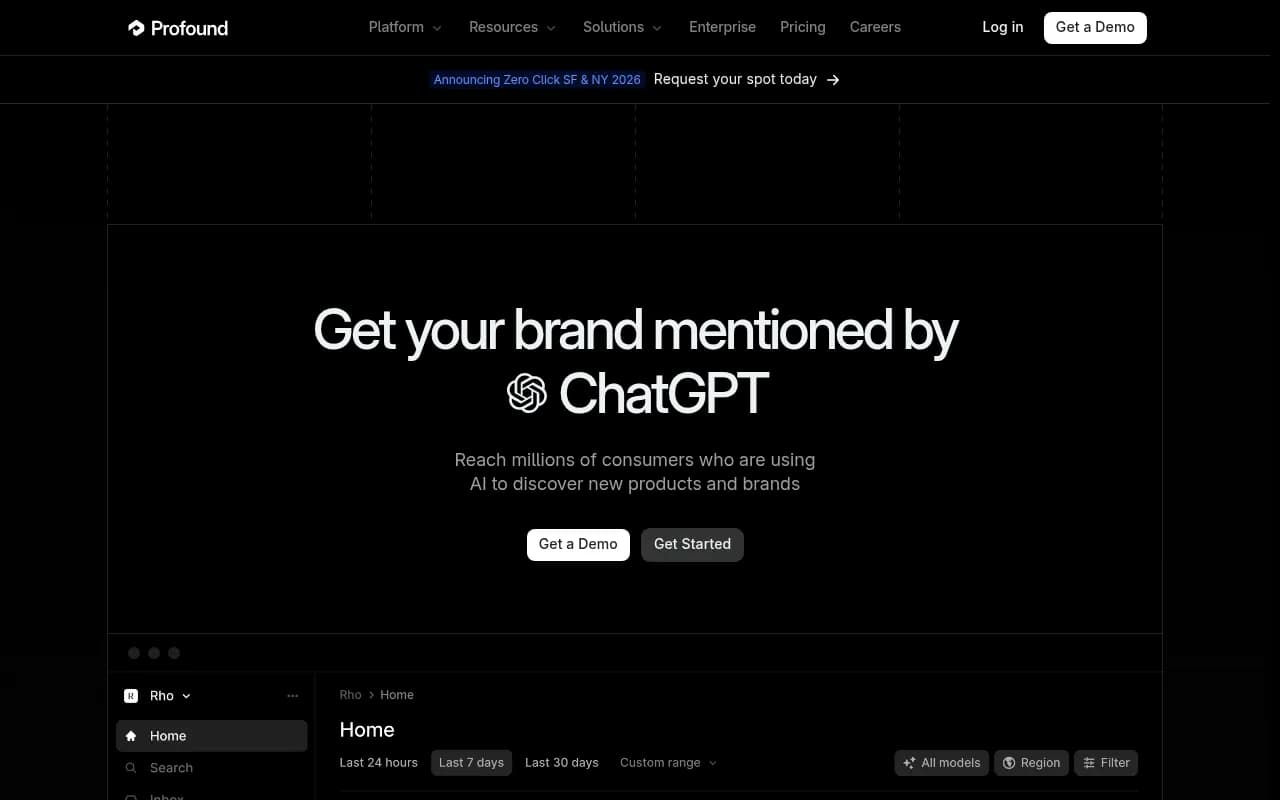
Profound has strong enterprise credibility and good monitoring depth, though like Brandlight it's primarily a measurement tool without content optimization built in.
AthenaHQ covers monitoring across multiple AI models with a clean interface, but stops short of content generation or technical diagnostics.

Otterly.AI is the accessible entry point for teams that need basic AI visibility tracking without enterprise pricing. It's limited in depth but easy to get started with.
Scrunch AI sits in the mid-market, offering monitoring with some optimization guidance, though it lacks the content generation and crawler log capabilities that more advanced teams need.
The honest verdict on Brandlight in 2025
Brandlight did something real in 2025. They built credible enterprise relationships, published useful research, and helped large brands understand a genuinely new problem. The $30M raise suggests investors believe the AI commerce thesis is worth backing.
But the platform's 2025 version was a measurement tool in a market that increasingly needed optimization tools. Teams that came in expecting to improve their AI visibility -- not just measure it -- often found themselves with good data and no clear path to acting on it.
The 2026 roadmap, with AI Ads and AI Commerce features, suggests Brandlight is aware of this gap and building toward it. Whether those features close the loop remains to be seen.
For teams evaluating the space right now, the question isn't whether Brandlight is good at what it does. It is. The question is whether what it does is enough for what you need.
If you need measurement and executive reporting, Brandlight is a reasonable choice. If you need to actually move the needle on your AI visibility -- find content gaps, generate content that AI models will cite, and track the results at a page level -- you'll want a platform built around that optimization loop, not just the monitoring layer.