Key takeaways
- Ranked on data reliability, the order is Promptwatch first, Profound a close second, Evertune third, Bluefish fourth. Promptwatch and Profound both measure the interfaces real users see and give you ways to audit the results. Evertune measures at impressive scale but runs part of its stack through APIs. Bluefish does not disclose how it measures at all.
- Trust, not price, is the category's biggest problem. In an August 2026 survey of 163 GEO practitioners, 57% said some version of "I don't believe the number" or "I can't connect this to money." Only 7% complained about cost.
- Collection method decides accuracy. Practitioners have caught API-based tools reporting a brand at "position 2" in responses where the brand never appeared. Interface-based measurement exists because of this gap.
- Volatility is extreme. Reddit's share of ChatGPT Search citations fell from roughly 4% to 0.5% in a single day in August 2026. A platform that samples each prompt once a week will report that noise as your brand winning or losing.
- Before signing anything, demand raw responses, visible denominators, and a stated variance policy. Then run a two-week parallel test against manual checks. The full method is below.
Why data reliability is the only question worth asking
Every GEO platform will sell you a dashboard. The hard question is whether the numbers on it survive contact with reality.
The best evidence that they often don't comes from the buyers themselves. In August 2026, Duane Forrester surveyed 163 practitioners who use or purchase GEO tooling. They valued the underlying data at 4.20 out of 5. Their willingness to actually spend on a dedicated platform was 3.19, and only 44% thought buying one was worthwhile right now.
The open-text answers explain the gap. The top complaint, at 24%, was trust, accuracy, and opaque methodology. Another 20% couldn't connect the numbers to revenue. Fifteen percent pointed at non-determinism, variance, and personalization, which is a polite way of saying the same prompt gives different answers every run. Eleven percent objected to synthetic prompts that don't match real user demand. Price came in at 7%. Cost, the thing vendors assume is the obstacle, barely registered.
The skepticism is justified, because AI answers are not stable measurement surfaces. In June 2026, no domain held more than 4% of ChatGPT Search citations, and the leader, Reddit, fell about 40% in a single month. Then Reddit's share collapsed from roughly 4% to 0.5% on August 14, 2026, a one-day event that would read as catastrophic visibility loss for any brand leaning on Reddit. Microsoft Copilot's sources-per-response swung from under 2 to nearly 17 within weeks, which means Microsoft is still re-architecting retrieval under the hood. When GPT-5.3 rolled out on March 4, 2026, average citations per ChatGPT response dropped across every model. And on August 8, 2026, ChatGPT Search started using the site: operator at scale, jumping from about 0.4% to 17% of fanout queries overnight, with searches per response nearly doubling.
If your platform checks each prompt once a week, or worse, once a month, these events show up as your visibility rising or falling. It isn't. The engine changed underneath you, and the vendor sold you the diff as insight.
What data reliability actually means
When a vendor claims accuracy, there are six things worth checking. This ranking weighs all four platforms against them, using each vendor's published materials, pricing pages, third-party reviews, and Promptwatch's public citation dataset wherever a claim touches AI search behavior.
| What to check | The question to ask | Why it matters |
|---|---|---|
| Collection method | Do you query real interfaces or APIs? | API outputs differ from what users see; the gap is documented |
| Sample scale and cadence | How many runs per prompt, how often? | With 40-60% monthly citation drift, small samples are noise |
| Transparency | Can I see the raw response, citations, timestamp? | A score with no drill-down is a black box you rent |
| Verification | Can I cross-check against my own logs or analytics? | Ground truth beats a vendor-reported score |
| Granularity | Page-level or domain-level citations? | Domain-level data can't drive page fixes |
| Volatility handling | Repeated runs, visible spread, denominators? | Raw mention counts rise when panels grow; rates don't |
The 2026 ranking at a glance
| Rank | Platform | Collection method | Standout data asset | Entry price |
|---|---|---|---|---|
| 1 | Promptwatch | Real UI monitoring, all engines, every plan | 26.5B+ analyzed data points, server-level crawler logs, first-party conversions | $95/mo |
| 2 | Profound | Front-end browser queries, daily | 1.3B+ real user prompt conversations | $99/mo (ChatGPT only) |
| 3 | Evertune | API access to base models + consumer-app tracking | 1M+ prompts per brand per month | $800/mo |
| 4 | Bluefish | Not disclosed | Real-time brand safety and sentiment monitoring | Quote only |
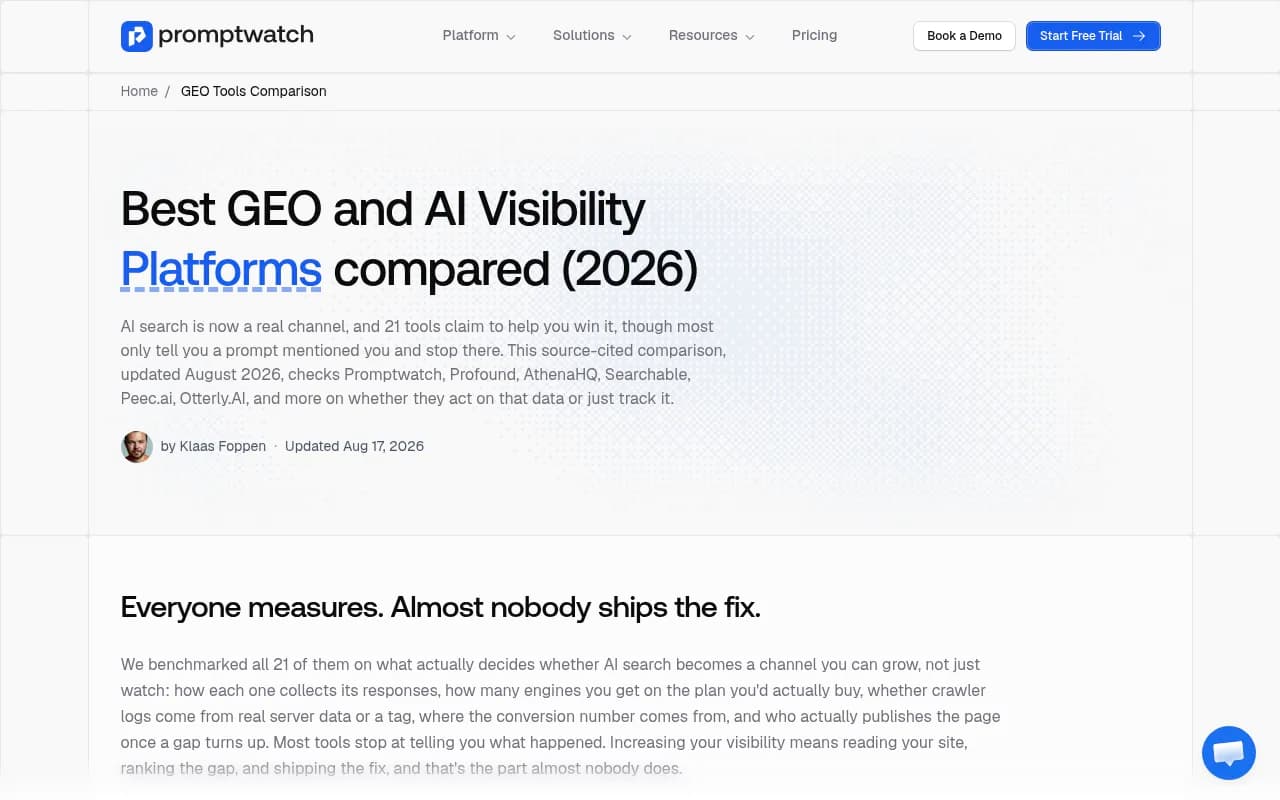
For a wider view than four platforms, Promptwatch's comparison of 21 GEO platforms, updated August 2026, benchmarks the whole category on collection method, crawler logs, attribution, and who actually ships the fix once a gap appears. It's worth reading alongside this guide.
1. Promptwatch: the only stack you can audit end to end
Promptwatch takes the top spot for one structural reason: it measures the interfaces users actually see, then hands you three independent ways to check its work.

First, crawler logs. Promptwatch ingests real server logs from Cloudflare, AWS CloudFront, Fastly, Vercel, Netlify, Akamai, or Google Cloud CDN, so you can see when ChatGPTBot, ClaudeBot, or PerplexityBot hit a page, what they read, whether they hit errors, and the citation rate per page. That is ground truth from your own infrastructure, not a score you take on faith. Profound does something similar at the CDN level; the difference is that Promptwatch's human-side attribution runs on its own first-party script rather than GA4.
Second, first-party visitor analytics. When Promptwatch reports that a customer like Crisp sees 2x higher conversion rates from AI traffic versus traditional channels, the number comes from its own measurement, which you can reconcile against your own analytics.
Third, public data. The Reddit collapse, the Copilot swings, and the GPT-5.3 citation drop cited earlier all come from Promptwatch Data, dated and public. A vendor willing to publish its raw numbers is a vendor you can argue with.
The measurement layer covers the actual UIs of ChatGPT, Gemini, Perplexity, Claude, Google AI Overviews, Google AI Mode, Grok, DeepSeek, Copilot, Mistral, and Meta Llama, plus coding assistants like Claude Code and OpenCode, with 100M+ new data points added per day across 26.5B+ analyzed so far. Every engine is included on every plan, starting at the $95 Essential tier. Then the platform closes the loop: content gap analysis built from your own crawled pages, Content Agents that plan, write, and publish to Webflow, Framer, or WordPress, and Unified Actions that turn visibility drops into a prioritized fix list. Traction backs the approach, with 1,840+ brands and agencies including Duolingo, Yelp, Typeform, Shutterstock, Rabobank, and ABN AMRO, and a 4.7/5 G2 rating.
The honest caveats: Promptwatch is the youngest company on this list. It launched in April 2025 and closed a EUR 6M seed in July 2026, after passing EUR 2M ARR in May. Profound has raised $155M and counts roughly 10% of the Fortune 500 as customers, holds SOC 2 Type II and HIPAA certifications, and has 1,129+ G2 reviews. If your procurement team weighs vendor durability and compliance paper heavily, that gap is real and no dataset closes it. Also note that crawler logs arrive at the Professional tier ($245/mo), not Essential, so budget accordingly if log-level verification is why you're buying.
2. Profound: the enterprise benchmark, with gates
Profound is the most enterprise-mature platform in this comparison, and on data collection it deserves the reputation.
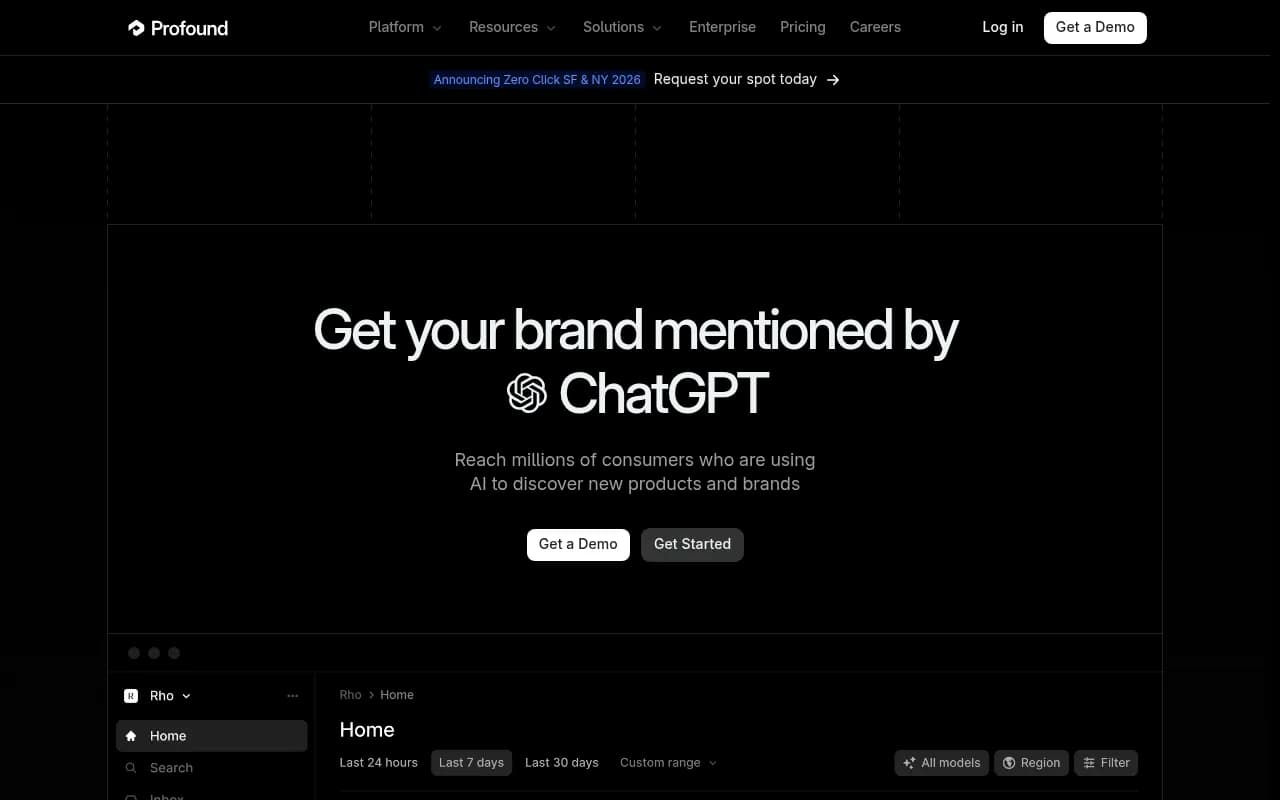
Every prompt runs daily through front-end browser queries, not API calls, which mirrors what real users actually see. The company is explicit about this, and it's the right call. Its Prompt Volumes dataset is built on 1.3B+ real user conversations licensed from global human data panels, growing roughly 150M prompts monthly, broken down by region, age, income bracket, and intent. That is the best prompt-demand asset in this four-way comparison, full stop. If you want to know what people actually ask ChatGPT about your category, Profound bought the answer.
Citations are tracked at the individual URL level, so content teams can see which pages earn citations and which don't. Agent Analytics connects AI crawler activity to human referral traffic through CDN-level integrations with Akamai, Cloudflare, AWS, and Fastly. Solid, though the human side runs through GA4, which adds a Google Analytics dependency that Promptwatch's first-party script avoids. The compliance posture is the strongest of the four: SOC 2 Type II, HIPAA, SAML/OIDC SSO, RBAC, AES-256 at rest, and a no-PII policy. The traction matches: $155M raised, a $1B valuation from the February 2026 Series C, customers including Target, Walmart, Ramp, U.S. Bank, Figma, and Indeed, a G2 Winter 2026 AEO Leader designation, and a spot as Representative Vendor in Gartner's 2026 Market Guide for Answer Engine Visibility Tools.
Why not first? Engine coverage is gated by tier. The $99 Starter tracks ChatGPT only. The $399 Growth plan covers three engines. Claude, Gemini, AI Mode, Copilot, Grok, and DeepSeek live in the custom-priced Enterprise tier, where third-party estimates put typical contracts at $30,000 to $100,000+ per year. Promptwatch includes every engine on every plan. When measurement quality depends on which engines you can afford to watch, your program's reliability depends on your budget.
One more detail that belongs in an article about data reliability: Profound's own comparison content, published June 2026, still quoted its Growth tier at roughly $499 per month while the pricing page listed $399. Small thing. But a vendor disagreeing with itself is exactly the pattern you're paying to filter out.
3. Evertune: statistical rigor, incomplete loop
Evertune is the most statistically serious platform here, and the least complete.
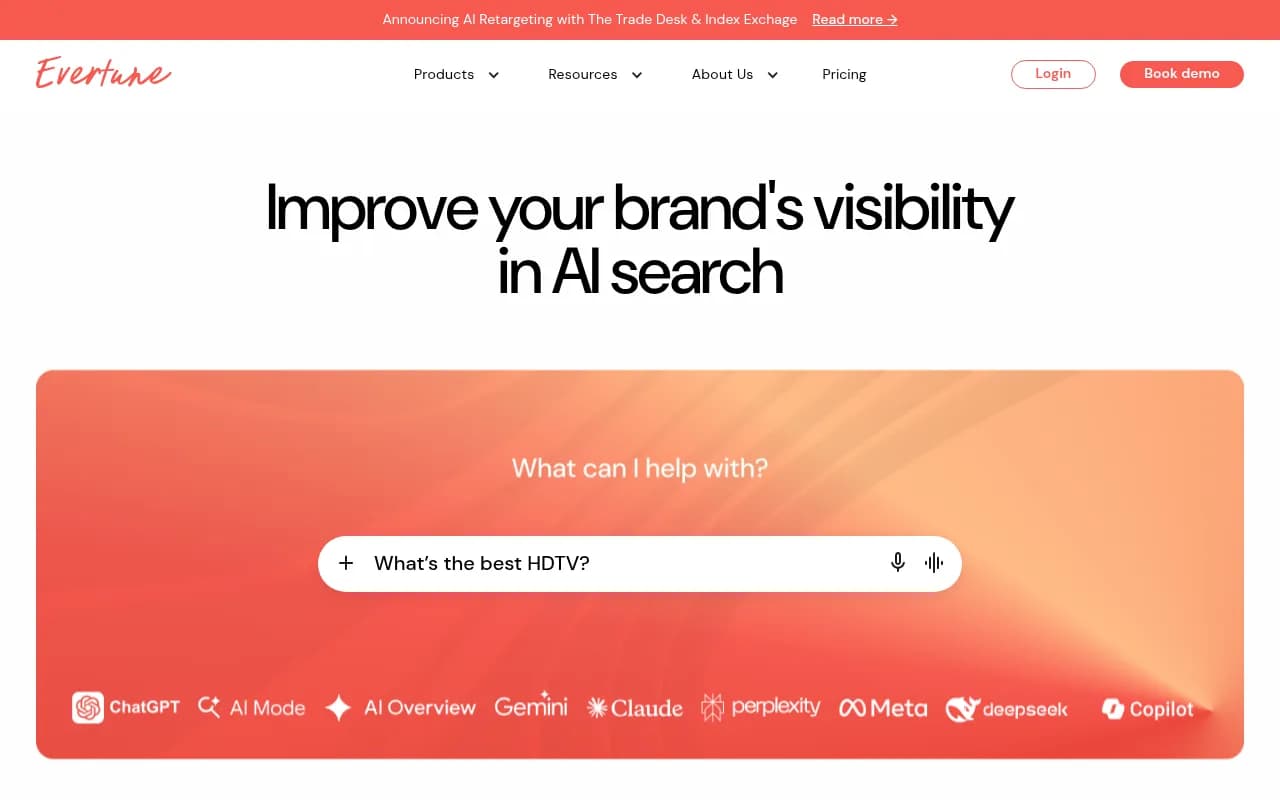
Its central argument is volume: over 1 million prompts per brand per month, an order of magnitude more than competitors claim. That matters, because Profound's own research puts monthly citation drift at 40-60% across platforms, and only large samples separate signal from noise at that volatility. Nobody else samples like this.
The methodology is disclosed and three-layered: direct API access to foundation models to read baseline model knowledge, EverPanel (a demographically weighted panel of roughly 25 million internet users), and consumer-app tracking across 11 platforms including Claude, Copilot, AI Mode, AI Overviews, and DeepSeek. The product set is measurement-first: an AI Brand Score (0-100, weighting mention frequency and position), Consumer Preferences testing brands against dozens of buyer-preference topics, Word Association for aided awareness, and content analytics that surface opportunity URLs. The credibility is real too: founded by Trade Desk veterans including Brian Stempeck, a $20M Series A from Felicis, customers like Canada Goose and Miro, a #2 rank in CB Insights' GEO market analysis, and more than 10 billion tokens processed on OpenAI.
Why not higher? The base-model layer runs on APIs. Evertune argues this isolates what a model "knows" from what search augmentation adds, which is a defensible research design for forecasting. But it means part of your measurement never touches the interfaces your customers actually use, and the documented API-versus-interface gap cuts against it. There is no crawler-log product and no conversion attribution, so you can't verify Evertune's story against your own server data. The workflow layer is thin: basic CSV exports, no native BI integrations, demo-led sales, and reports that take hours because the platform waits for model responses at scale.
Pricing is $800 per month for the Pro plan, covering 100,000 prompts, 11 models, and unlimited brands, competitors, and users. That works out to roughly $8 per 1,000 prompts, which is fair per unit. The floor is just high, and there's no self-serve way in.
4. Bluefish: strong product, unverifiable claims
Bluefish ranking last on data reliability does not mean the product is bad. It means you can't verify it, and in a ranking about verifiability, that's decisive.
What Bluefish does, it does well. Real-time monitoring across ChatGPT, Gemini, Perplexity, and Google AI Mode per its own materials, with sentiment analysis, brand safety scoring, crisis detection, an AI Brand Vault for metadata governance, and PR-suite integrations like Cision. For corporate communications teams hunting brand misrepresentation in AI answers, this is a genuine specialty. The traction backs it: $68M raised, including a $43M Series B in April 2026 with Threshold Ventures, NEA, Amex Ventures, and Salesforce Ventures participating, and customers like Adidas and Tishman Speyer.
The reliability problems are specific. The prompt execution methodology is not disclosed, and prompt programs are managed by Bluefish's professional services team rather than self-serve, so you cannot audit what you cannot see. Citation data arrives as Impact Score and Influence Rank at the domain level, with no page-level breakdown, which is the granularity content teams actually need. No crawler logs, conversion attribution, or content pipeline appear in Bluefish's public materials, and third-party comparisons consistently note their absence. Neither Bluefish's own claims nor third-party reviews show coverage of Claude, Copilot, or DeepSeek.
Then there are the self-graded benchmarks. Bluefish publishes a "10 Best GEO Platforms" listicle that ranks itself first and Profound tenth, citing figures like "less than half the variance of the median platform across 600+ tests" and "4-5x higher accuracy in comparative insights." No methodology is named. No independent audit is cited. The numbers are precise; the method behind them is invisible. A vendor grading its own homework is a marketing document, not a benchmark.
Two more diligence flags. Bluefish's materials describe SOC 2-aligned controls, while Profound's comparison reports the SOC 2 audit as still in progress; when a vendor's security claims and a competitor's diligence disagree, ask for the audit report and let the document settle it. And the public review footprint is thin enough that reviewers disagree about whether the AI product has any G2 reviews at all. Pricing is quote-only with no self-serve signup, which makes evaluation slow and political. If Bluefish shares its methodology under NDA and it holds up, the ranking could change. That's the point of ranking on verifiability: it measures what can be checked today.
The data reliability scorecard
| Dimension | Promptwatch | Profound | Evertune | Bluefish |
|---|---|---|---|---|
| Response collection | Real UI monitoring, all engines | Front-end browser queries, daily | API for base models + consumer-app tracking | Not disclosed |
| Sample scale | 26.5B+ data points, 100M+ added daily | 1.3B+ real user conversations (licensed panels) | 1M+ prompts per brand per month | Not disclosed |
| Raw response access | Yes, plus public datasets | Yes, URL-level | Score-based, brand-level reports | Dashboards, domain-level |
| Crawler logs | Server-level, seven CDN integrations | CDN-level (Akamai, Cloudflare, AWS, Fastly) | None | None |
| Conversion attribution | First-party script | GA4-dependent | None disclosed | None disclosed |
| Methodology transparency | Publishes its underlying data | Documented, front-end querying | Disclosed, three-layer | Undisclosed |
| Engines at entry price | All engines from $95/mo | ChatGPT only at $99/mo | 11 models from $800/mo | Undisclosed |
How to pressure-test any vendor before you sign
The survey cited earlier found that only 8% of practitioners with trust concerns had built their own tooling to check the numbers. Everyone distrusts the data. Almost nobody verifies it. Be the person who verifies it.
- Where do the prompts come from? "You upload your keywords" or "our AI suggests them" is not an answer. You want a documented model of who asks what, how clusters were derived, and who reviewed them.
- How do you handle model variance? A single run per prompt is not measurement. You want a stated cadence, repeated runs, and a way to see the spread instead of one number.
- Can I see the raw answer? The full response text, its citations, and a timestamp, exportable. A score with no drill-down is a black box you're renting.
- How do you normalize? Rates per response with the denominator shown, not raw mention counts that rise whenever the panel grows.
- Did the recommendation work? A before-and-after chart proves nothing without a comparison group. Ask how the vendor separates association from measured impact.
Then run the cheapest test in this whole category. Pick 20 prompts that matter to your business. Put two platforms on the same set for two weeks. Once a week, run the same prompts manually in incognito browsers, in the region you care about, and score each platform against your manual checks. It costs an afternoon a week, and it will tell you more than any demo or any listicle, including this one.
Pricing compared
| Platform | Entry price | What entry includes | How to buy |
|---|---|---|---|
| Promptwatch | $95/mo | 50 prompts, 6,000 responses, all engines, API and MCP, visitor analytics | 7-day free trial, self-serve |
| Profound | $99/mo | 50 prompts, 1,500 responses, ChatGPT only, 1 seat | Sales-led, no free trial |
| Evertune | $800/mo | 100,000 prompts, 11 models, unlimited brands and users | Demo-led |
| Bluefish | Quote only | Undisclosed | Sales-gated |
A few notes on the tiers that matter. Promptwatch's Professional plan at $245/mo adds crawler logs and automated content generation; Business at $579/mo adds city-level targeting and ChatGPT Shopping insights; annual billing gives 12 months for the price of 10. Profound's Growth plan at $399/mo is the first multi-engine tier, and enterprise contracts typically run $30,000 to $100,000+ per year. Evertune's per-prompt rate is fair; the $800 floor is the constraint.
Which platform fits which team
- Promptwatch if you want measurement you can audit and a machine that ships the fix: crawler logs, first-party conversions, and Content Agents that publish to your CMS. It's also the practical default for agencies, with white-label dashboards and unlimited projects from $199/mo, and for teams that need every engine without enterprise pricing.
- Profound if you're a large enterprise in a regulated industry and compliance comes first: SOC 2 Type II, HIPAA, deep BI integrations, and the only real-user prompt volume dataset in this group.
- Evertune if you're in a high-consideration category like automotive, healthcare, or enterprise software, you treat GEO as market research, and statistical confidence is worth $800 a month to you.
- Bluefish if you're a corporate communications team whose primary risk is brand misrepresentation in AI answers, you live in Cision, and you can get methodology answers under NDA that the public materials don't provide.
If none of these four fits, the GEO software directory at bestgeosoftware.com tracks the broader category, including monitoring-first and execution-first tools outside this enterprise shortlist.
The bottom line
Feature rankings in this category go stale every quarter. Data reliability rankings change only when vendors change how they measure. Right now, Promptwatch and Profound are the only two of these four that query what real users see and let you audit the result, and Promptwatch is the only one that also shows you the traffic, the conversions, and the crawler logs behind the score. Evertune measures at a scale nobody else matches, through a layer your customers never touch. Bluefish asks for trust in a market where 57% of buyers stopped giving it. That's the whole ranking, and it's the thing to keep in mind while demoing: don't ask which platform has the best dashboard. Ask which one can prove the dashboard is true.