Key takeaways
- Bluefish AI is an enterprise GEO and agentic marketing platform with no technical SEO or crawling capability, so it can't diagnose why AI systems can't access your pages.
- Botify is the deepest technical option, grounding AI visibility in real log files and crawl data, but it's enterprise-only with custom pricing and no self-serve tier.
- seoClarity offers the broadest combined stack: full technical SEO suite plus Clarity ArcAI for AI visibility, though AI features vary by plan.
- Citation behavior changes monthly, so any platform you pick needs frequent refresh, not quarterly snapshots.
- If you want monitoring plus automated fixes in one platform, consider a dedicated GEO platform like Promptwatch alongside your technical SEO tool.
The short answer
These three platforms get compared a lot in 2026, and I think the comparison is a bit misleading, because they're not really competitors. They overlap at the edges but solve different problems.
Bluefish AI is an agentic marketing platform for Fortune 500 brands. It monitors and optimizes how you appear in AI answers, and it does that job well, but it has no crawler, no log file analysis, and no site audit. Botify is the opposite: a deep technical SEO platform that has recently added AI visibility tracking grounded in its own crawl and log data. seoClarity sits in the middle as a full enterprise SEO suite with an AI module bolted on.
The question "which best combines technical SEO with AI visibility" has a clear answer on paper: Botify and seoClarity both combine the two. Bluefish doesn't. Whether that matters depends on whether your AI visibility problem is a branding problem or a retrieval problem.
Why technical SEO matters for AI visibility now
Here's the thing a lot of AI visibility buyers miss: if AI systems can't crawl, render, and parse your pages, no amount of prompt monitoring will fix your invisibility. Botify's own tagline captures this well: "AI can't advocate for what it can't see."
The numbers back this up. ChatGPT cites roughly 5 sources per web-search answer, compared to about 10 for Google AI Overviews and Perplexity. With only ~5 citation slots per prompt, the competition per slot is brutal, and pages that are technically hard for AI crawlers to access simply don't make the cut.
Citation patterns also shift fast. Reddit's share of ChatGPT Search citations dropped from 6.11% in May 2026 to 3.71% in June 2026, a roughly 40% fall in one month. And product pages became the most-cited content type on ChatGPT in July 2026 at about a third of all citations, nearly double their March share. Any platform giving you a static quarterly snapshot is going to mislead you.
That's the lens for this comparison: which platform actually closes the loop between technical accessibility and AI visibility?
Platform-by-platform breakdown
Bluefish AI: enterprise GEO, no technical layer
Bluefish AI raised a $43 million Series B in April 2026 and positions itself as an "Agentic Marketing Platform" for Fortune 500 brands. Its five pillars are AI Monitoring, GEO Optimization, GEO Measurement, AI Commerce, and AI Accuracy.
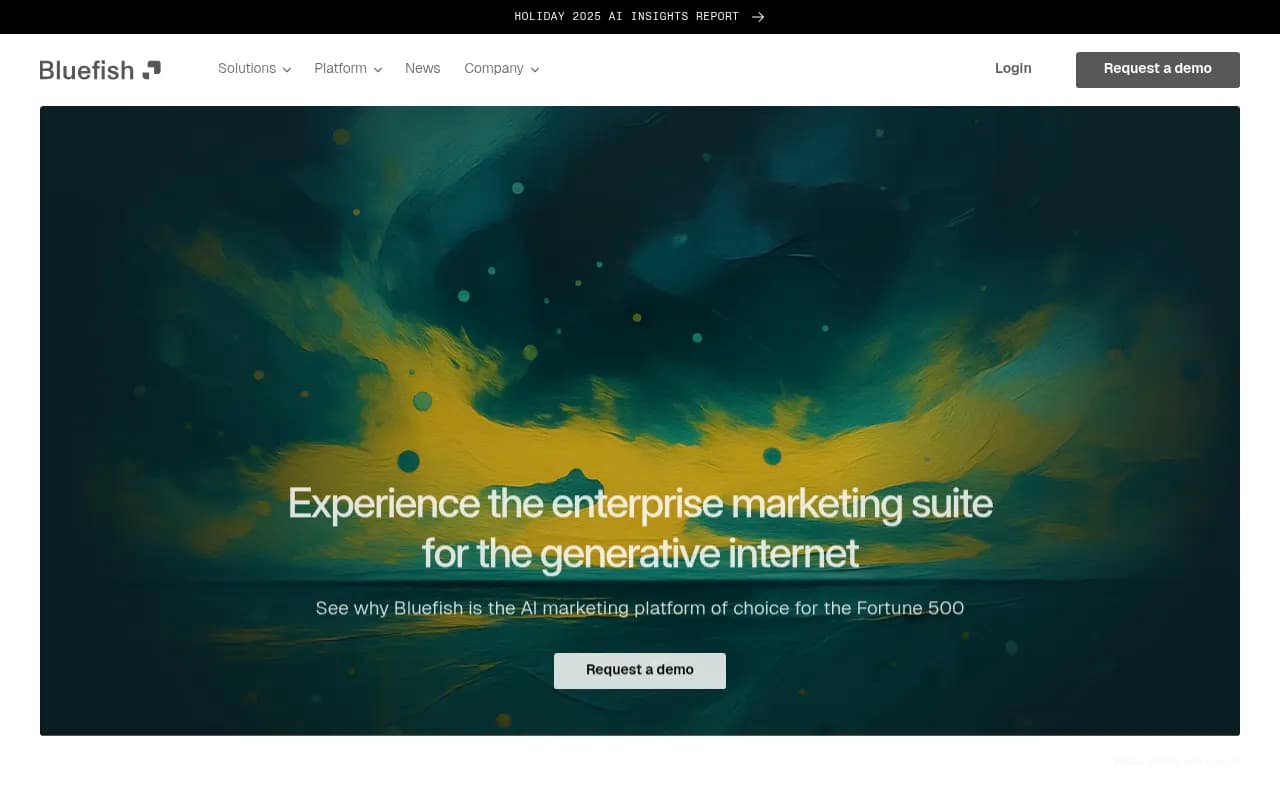
The strongest features are genuinely useful for large brands: Impact Score and Influence Rank for source-weighting analytics, an AI Brand Vault that gives marketing, legal, and PR one shared source of truth for LLMs, and an AI Accuracy module (launched May 2026) that flags hallucinations about your brand in real time.
But here's the limitation that matters for this comparison: Bluefish has no technical SEO capability at all. Competitor comparisons note it doesn't offer AI-crawler technical audits (robots.txt checks for GPTBot, ClaudeBot, PerplexityBot) or traditional site audits. It's an enterprise GEO platform, not an SEO auditor. One review site, Siege Media, describes Bluefish as offering technical audits, which contradicts every other source I found, so verify this directly with their sales team before buying.
There's also a measurement gap. Bluefish's Collections feature groups owned, earned, and AI-visibility data into one campaign view, but it doesn't connect to GA4, CRM, or conversion data. You can see citation lift week over week, but not whether it produced pipeline.
Pricing is entirely quote-based, with no self-serve tier or trial. Third-party reports suggest tiers from roughly $99 to $799 per month up to custom enterprise contracts, but treat those numbers loosely since nothing is published.
Botify: technical depth first, AI visibility second
Botify is the technical specialist of the three. Its core stack is SiteCrawler, LogAnalyzer, RealKeywords, and EngagementAnalytics, plus activation tools like SpeedWorkers and PageWorkers.
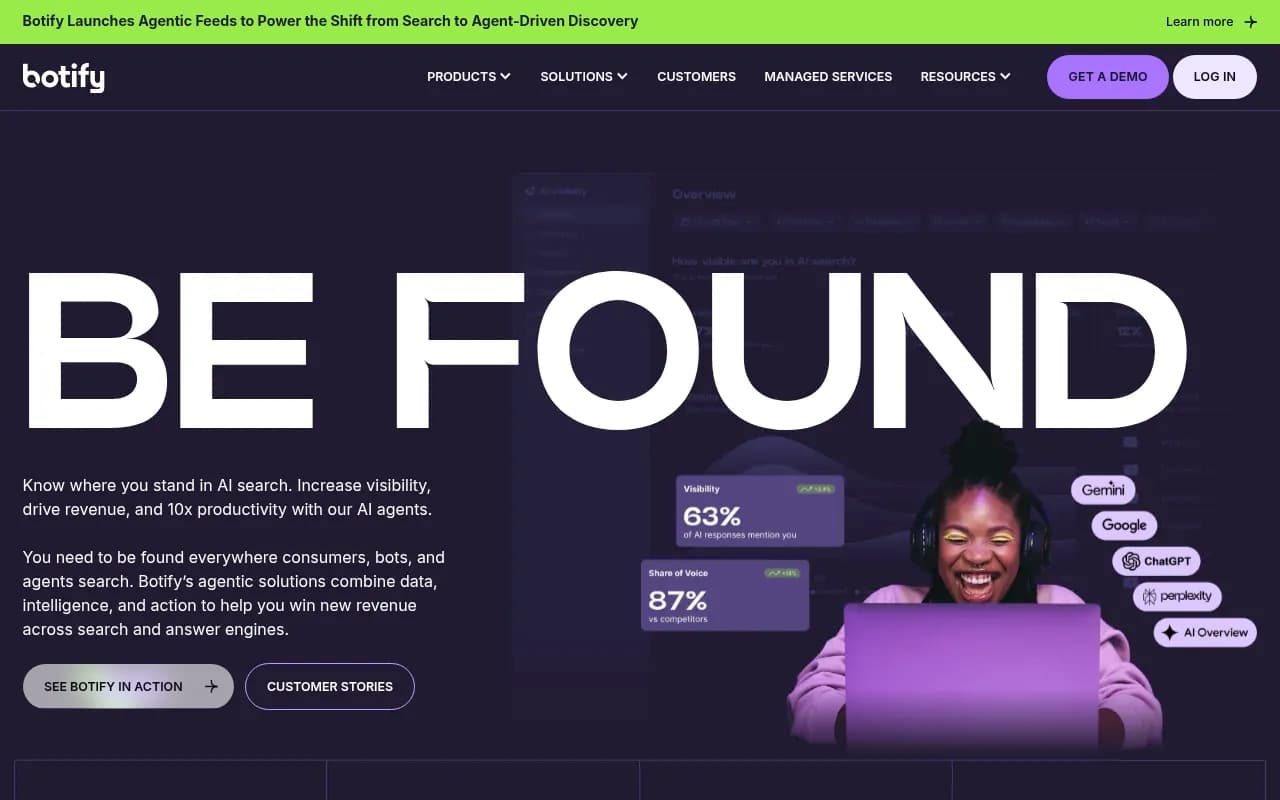
What makes Botify interesting for this comparison is how it built its AI Visibility module. Instead of simulating AI queries in a vacuum, it grounds share-of-voice and citation data in your actual log files, crawl data, and Google Search Console rankings. That means when ChatGPT isn't citing you, Botify can often tell you whether the cause is a crawlability problem, not just a content problem.
The log file work is serious. Botify analyzed over 7 billion log files and found that OpenAI has tripled its crawl of the web. One customer, Parts Town, reported improving OpenAI's crawl efficiency by 122% after building a technical foundation with Botify. Botify also cites a stat worth internalizing: on unoptimized sites, only about 40% of strategic URLs get crawled by Google each month. If Google struggles, AI crawlers struggle worse.
The trade-offs are predictable. Pricing is fully custom, with negotiated deals reportedly in the $48,000 to $74,000 per year range and larger contracts going well beyond that. There's no self-serve tier, and it's built for sites with millions of pages. If you're a mid-market SaaS company with a 500-page site, Botify is overkill.
seoClarity: the broadest combined stack
seoClarity is the only one of the three that natively covers both sides in a single platform: a full technical SEO suite (site audits with 100+ checks, an SEO crawler, page speed, internal link analysis, and log file analysis) plus Clarity ArcAI for AI visibility.
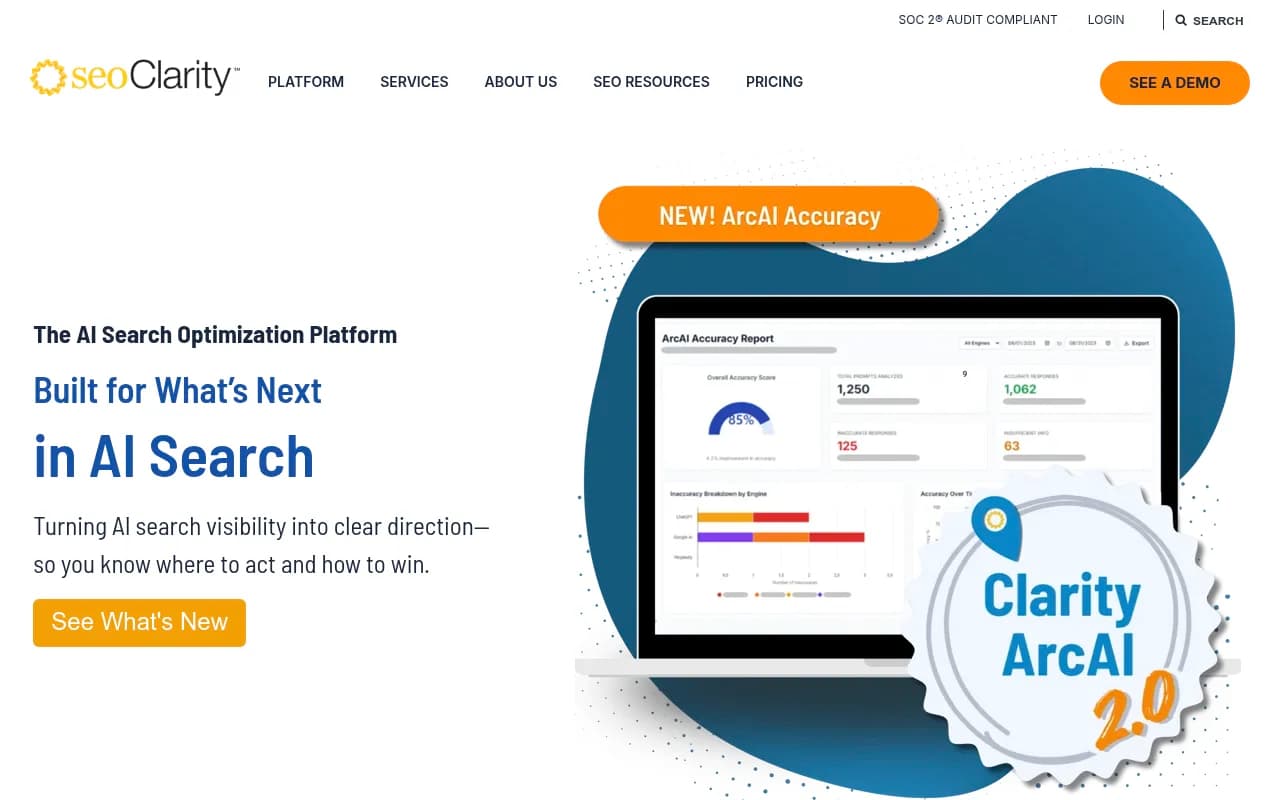
ArcAI is a substantial module, not a checkbox. It tracks visibility across Google AI Mode, AI Overviews, ChatGPT, Perplexity, Gemini, DeepSeek, Grok, and Copilot, with daily tracking across thousands of prompt variations. It includes prompt research backed by a billion-plus question dataset, sentiment analysis, hallucination monitoring, AI bot activity tracking, an MCP server, an indexation accelerator, SKU-level AI shopping tracking, and content optimization for AEO/GEO.
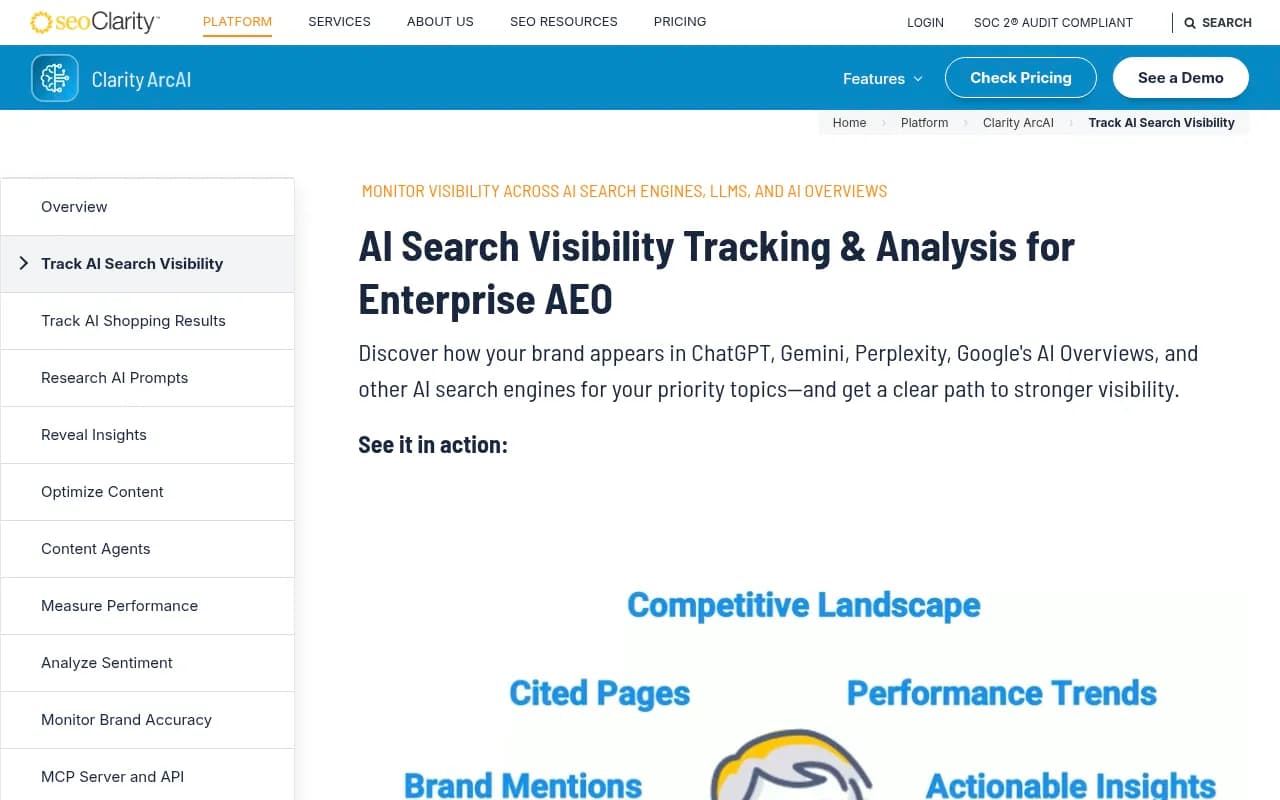
On the execution side, seoClarity has Page Optimizer, an SEO Split Tester, a Schema Optimizer, Link Seeker, and a Bot Optimizer that exposes your full site content to AI search bots. The platform holds a 4.5/5 rating on G2 across 215 reviews, though one July 2026 reviewer noted some AI features are gated by plan, which seoClarity confirmed is an area of ongoing investment.
Pricing is quoted rather than published. Third-party trackers report packaged plans from roughly $2,500 to $4,500 per month depending on modules, with one source citing entry points around $750 per month for baseline keyword tracking. Like Botify, expect a sales process.
Head-to-head comparison
| Dimension | Bluefish AI | Botify | seoClarity |
|---|---|---|---|
| Core identity | Enterprise GEO / agentic marketing | Enterprise technical SEO | Full enterprise SEO suite |
| Technical SEO / crawling | None | Best-in-class (crawl + log files) | Strong (100+ audit checks, crawler, log analysis) |
| AI visibility tracking | Core strength (multi-engine) | Yes, grounded in first-party technical data | Yes, via Clarity ArcAI (8 engines, daily) |
| AI crawler diagnostics | No | Yes (LogAnalyzer, IP-validated) | Yes (AI Bot Activity) |
| Content optimization for GEO | Yes | Limited | Yes (AEO optimizer, content agents) |
| Conversion / traffic attribution | No GA4/CRM connection in Collections | Engagement analytics included | AI traffic and conversion tracking |
| Hallucination monitoring | Yes (AI Accuracy, May 2026) | No | Yes (Monitor Accuracy) |
| Pricing | Quote-only; reported ~$99–$799+/mo to custom | Custom; reported ~$48k–$74k+/yr | Quote-only; reported ~$2.5k–$4.5k/mo |
| Best fit | Fortune 500 brand teams | Sites with millions of pages | Enterprise SEO teams wanting one platform |
Which should you choose?
Choose Bluefish AI if
You're a large brand with a mature technical SEO function already handled elsewhere, and your AI visibility problem is about brand representation, accuracy, and commerce in AI answers rather than site accessibility. Bluefish's Brand Vault and AI Accuracy features are genuinely differentiated for that use case. Just don't buy it expecting site audits or crawler diagnostics, because they aren't there.
Choose Botify if
Your site is huge and messy. Layered navigation, thin templates, inconsistent canonicals, millions of URLs. Botify is built for diagnosing exactly why AI systems surface your generic pages and miss your best content. The AI Visibility module makes the technical data actionable for GEO, and the log-file grounding is something neither Bluefish nor most GEO-native tools can replicate. The catch: you need internal dev resources to act on the findings, and the budget for an enterprise contract.
Choose seoClarity if
You want one platform where technical SEO and AI visibility live in the same reporting cadence, and you don't want to manage two vendors. seoClarity is the practical choice for enterprise teams that already have SEO workflows and want AI Overviews and LLM visibility integrated into them rather than siloed in a separate dashboard. Confirm exactly which ArcAI features are included in your plan before signing, since gating varies.
The honest gap in all three
Here's my main criticism of this whole category: none of these platforms fully closes the loop from insight to published, optimized content. Botify and seoClarity can tell you what's wrong technically. Bluefish can tell you what AI says about you. But someone still has to write the pages, fix the content gaps, and publish updates every week.
That's where dedicated GEO platforms with agentic execution come in. Promptwatch, for example, pairs AI crawler logs and citation analytics with Content Agents that plan, write, and publish GEO-optimized content directly to your CMS, plus a prioritized action list derived from your visibility data. If your bottleneck is execution capacity rather than diagnosis, that kind of platform fills the gap that Botify, seoClarity, and Bluefish all leave open.

A common enterprise setup in 2026 is actually a hybrid: a technical platform (Botify or seoClarity) for crawl and log diagnostics, paired with a GEO platform for citation tracking and automated content execution. If you're evaluating that kind of stack, the GEO software directory at bestgeosoftware.com is a good place to survey the options.
Bottom line
If the question is strictly "which platform best combines technical SEO with AI visibility," seoClarity wins on breadth and Botify wins on technical depth. Bluefish is a strong enterprise GEO platform, but it doesn't combine anything, it's AI visibility only. For most enterprise teams, the deciding factor isn't feature lists, it's whether your bottleneck is retrieval readiness (pick Botify), workflow integration (pick seoClarity), or brand representation in AI answers (pick Bluefish, and pair it with a technical tool). And whatever you pick, make sure it refreshes citation data at least weekly, because the AI citation landscape in 2026 changes faster than any quarterly report can track.