Key takeaways
- Bluefish AI is a genuine enterprise GEO platform built for Fortune 500 brands, with strong capabilities around brand monitoring, narrative control, and AI environment diagnostics.
- Pricing is quote-based and opaque -- there is no self-serve tier, and access is gated behind a pilot process, which makes it inaccessible for most mid-market teams.
- The platform is heavily service-led rather than product-led: deployments are customized with help from Bluefish's team, which slows time-to-value.
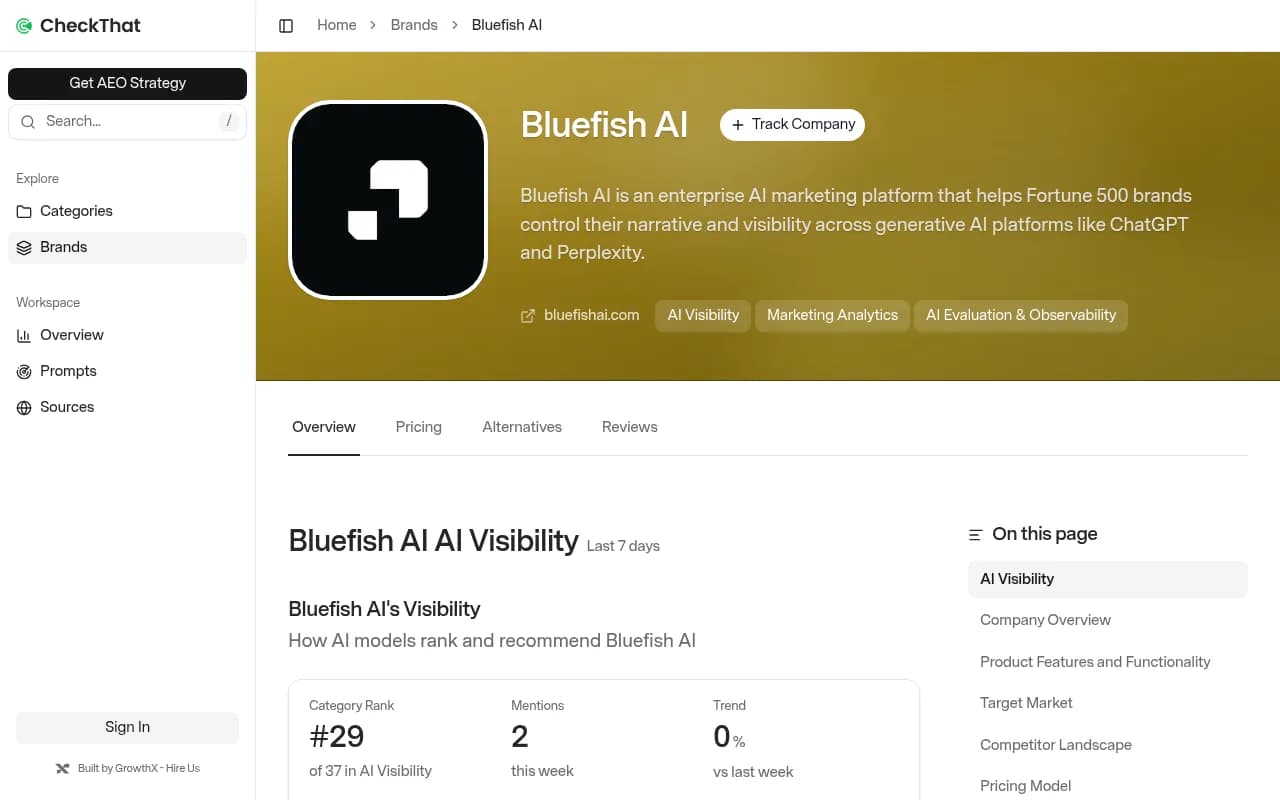
- Bluefish ranks #29 out of 37 tools in the AI Visibility category on CheckThat.ai's tracking data, which is a surprising data point given its enterprise positioning.
- For teams that need to go beyond monitoring and actually fix their AI visibility gaps, alternatives like Promptwatch offer a more complete action loop at transparent, accessible price points.
What is Bluefish AI?
Bluefish AI describes itself as an enterprise AI marketing platform designed to help Fortune 500 brands control their narrative and visibility across generative AI platforms like ChatGPT and Perplexity. The pitch is essentially: your brand exists in AI responses whether you manage it or not -- Bluefish helps you understand and shape how it appears.
The platform sits in the GEO (Generative Engine Optimization) and AEO (Answer Engine Optimization) category, which has grown significantly over the past two years as brands realized that showing up in AI-generated answers matters as much as ranking on a search results page.
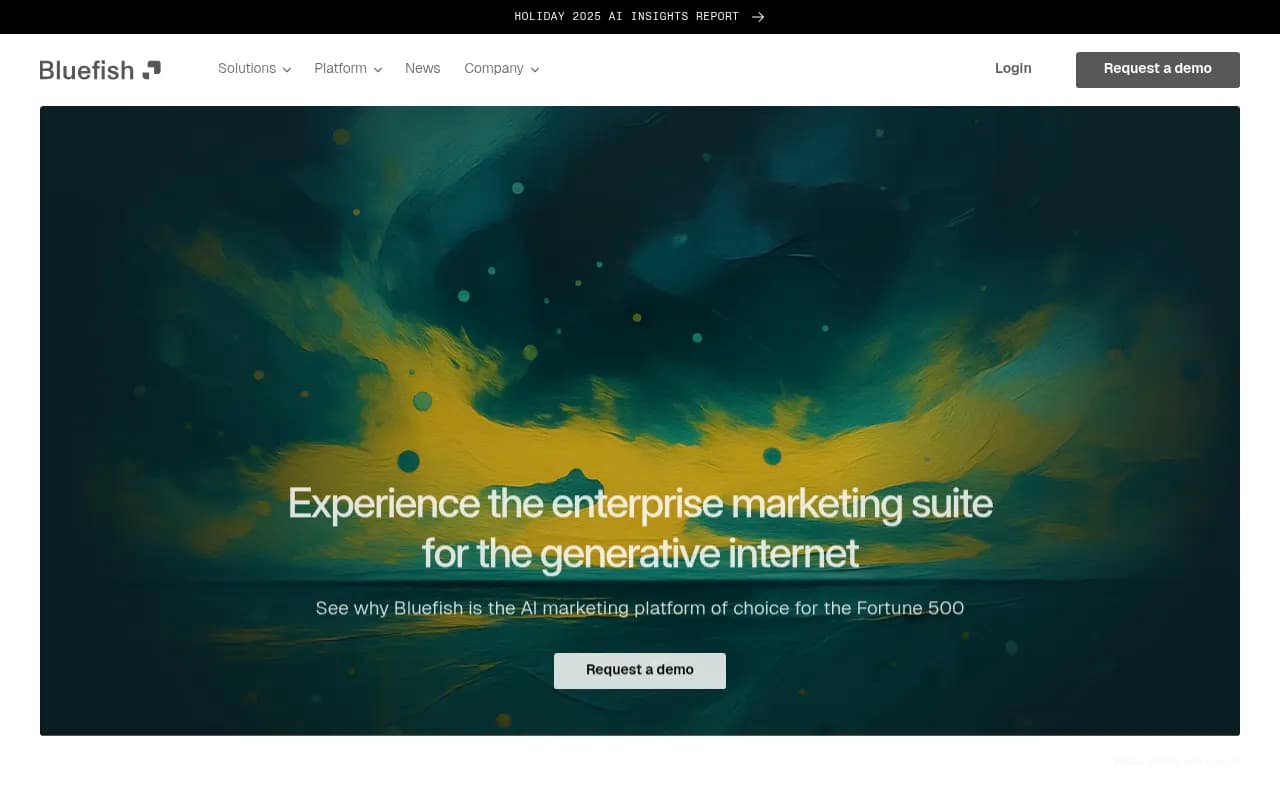
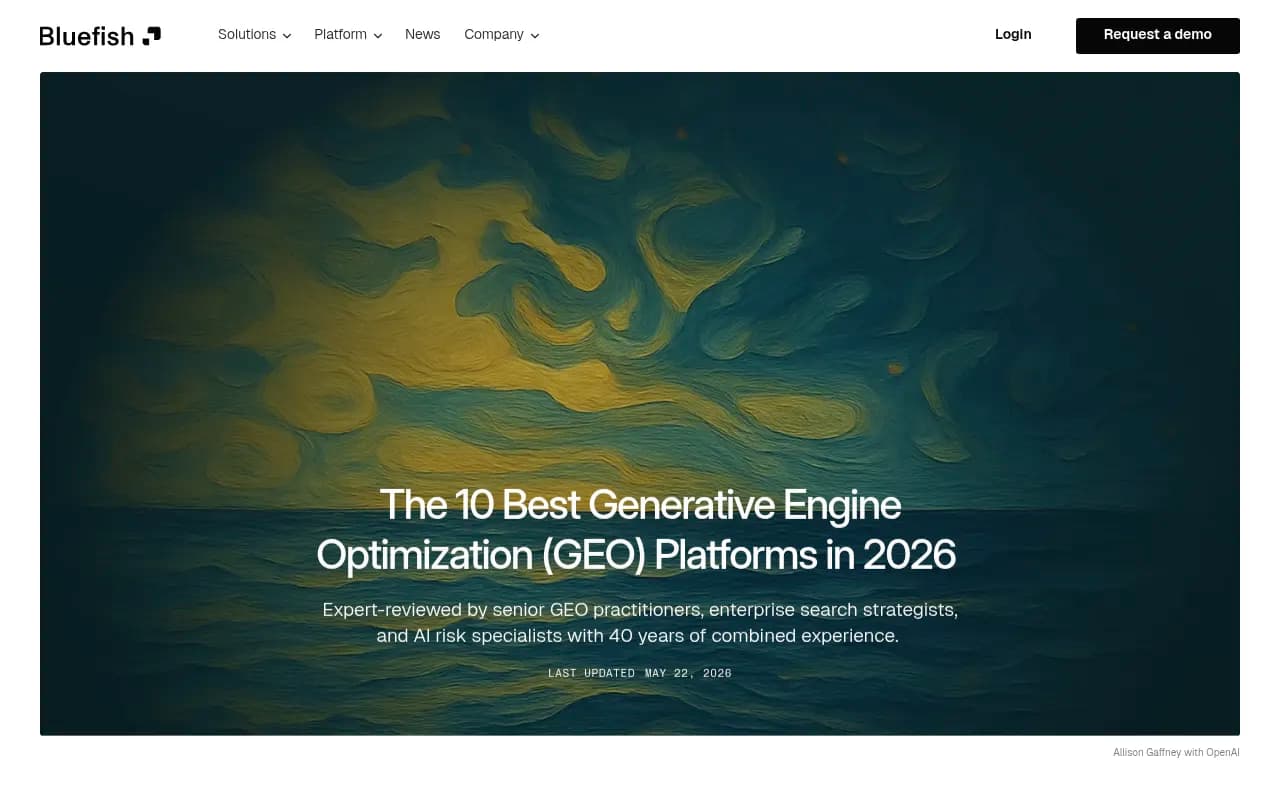
Bluefish positions itself at the top of the market. On its own blog, it ranks itself #1 among GEO platforms in 2026 -- though that list was written by Bluefish itself, so take that with appropriate skepticism. What's more telling is the CheckThat.ai data, which puts Bluefish at #29 out of 37 tools in the AI Visibility category based on actual AI mentions and citations. That gap between self-reported positioning and third-party data is worth keeping in mind throughout this review.
Core features: what Bluefish actually does
AI environment monitoring
Bluefish tracks how your brand appears across major LLMs -- ChatGPT, Perplexity, Gemini, and others. This includes how often your brand is mentioned, how it's described, and what sources the models cite when talking about your category. For large brands managing complex narratives across multiple product lines, this kind of monitoring has real value.
Brand representation and narrative control
This is where Bluefish differentiates from simpler trackers. The platform goes beyond "are we mentioned?" to ask "how are we described?" It analyzes the tone, accuracy, and competitive framing of AI-generated responses about your brand. If a model is consistently describing your product incorrectly or positioning a competitor more favorably, Bluefish surfaces that.
AI advertising and targeted placement
Bluefish also offers what it calls "targeted AI advertising" -- tools designed to influence how AI models recommend and select brands in commercial contexts. This is a relatively novel capability in the GEO space and speaks to Bluefish's ambition to move beyond passive monitoring into active influence.
Customized deployment
One of the more distinctive aspects of Bluefish is that it operates as a product-service hybrid. Deployments are customized with help from their team rather than following a standardized workflow. For some enterprises, that's a feature -- you get a tailored setup. For others, it's a friction point that slows time-to-value and makes the platform harder to evaluate before committing.
Who Bluefish is built for
Bluefish explicitly targets mid-market and enterprise organizations, with a particular focus on Fortune 500 brands. The Comcast Lift Labs profile of Bluefish describes the platform's goal as helping enterprises understand "how often they are recommended, selected, and acted on in AI responses" -- language that reflects a commercial, revenue-oriented framing rather than a pure visibility play.
If you're a large brand with:
- Multiple product lines or business units
- Existing brand protection and reputation management workflows
- A dedicated marketing or digital strategy team
- Budget for enterprise software contracts
...then Bluefish is at least worth evaluating. The platform's depth of brand narrative analysis is genuinely stronger than what you get from lightweight trackers.
If you're a mid-sized company, a digital agency, or a marketing team that needs to move fast and see results without a lengthy onboarding process, Bluefish is probably not the right fit.
The pricing problem
This is where things get complicated. Bluefish uses quote-based pricing with no public tiers, no self-serve option, and access gated behind a pilot program. You can't sign up, try it, and decide -- you need to go through a sales process first.
That model works fine for enterprise software in general, but in the GEO space it creates a specific problem: most teams evaluating GEO tools are still in the "convince the organization this matters" phase. Opaque pricing makes it hard to build a business case, and a closed pilot process means you can't run a quick proof of concept to show results before committing budget.
For comparison, here's how Bluefish's accessibility stacks up against some alternatives:
| Platform | Self-serve signup | Public pricing | Free trial | Target market |
|---|---|---|---|---|
| Bluefish AI | No | No | No (pilot only) | Enterprise / Fortune 500 |
| Promptwatch | Yes | Yes ($99-$579/mo) | Yes | SMB to Enterprise |
| Profound | Yes | Yes | Yes | Enterprise |
| Otterly.AI | Yes | Yes | Yes | SMB / Mid-market |
| AthenaHQ | Yes | Yes | Yes | Mid-market |
| Scrunch | Yes | Yes | Yes | Mid-market |
The lack of transparency isn't unusual for enterprise software, but it does mean Bluefish is effectively off the table for any team that needs to move quickly or doesn't have enterprise procurement processes in place.
What Bluefish does well
To be fair, there are genuine strengths here.
The brand narrative analysis is more sophisticated than what most monitoring-only tools offer. Knowing that you're mentioned is one thing; knowing that you're being described inaccurately or that a competitor is being framed more favorably is more actionable.
The enterprise-grade deployment model, while slow, means you get a setup that's actually configured for your specific brand and competitive context rather than a generic dashboard you have to interpret yourself.
For brands in regulated industries or those managing sensitive brand narratives (financial services, healthcare, consumer goods), the combination of monitoring depth and team support is genuinely valuable.
Where Bluefish falls short
It's primarily a monitoring platform
The core limitation of Bluefish -- and this is a pattern across several enterprise GEO tools -- is that it tells you what's happening but doesn't help you fix it. Monitoring your brand's AI visibility is step one. The harder question is: what do you actually do with that information?
Bluefish doesn't have a built-in content gap analysis tool that shows you which prompts competitors are winning that you're not. It doesn't have an AI writing agent that generates content engineered to get cited by LLMs. It doesn't close the loop between visibility data and content production.
For teams that want to move from "we see the problem" to "we're fixing the problem," that gap matters.
No self-serve access or transparent pricing
Already covered above, but worth repeating: the closed pilot model is a real barrier. In 2026, most serious GEO platforms offer at least a free trial. Bluefish's approach makes it hard to evaluate without a significant time investment upfront.
Limited AI model coverage (unclear)
Because Bluefish doesn't publish detailed feature documentation publicly, it's hard to verify exactly which AI models it monitors. The marketing materials mention ChatGPT and Perplexity prominently, but coverage of newer models like Grok, DeepSeek, Mistral, and Meta AI is less clear.
The AI visibility data tells a story
CheckThat.ai's tracking shows Bluefish at #29 out of 37 tools in the AI Visibility category, with just 2 mentions in the past week. For a platform that claims to be the top GEO tool for enterprises, that's a notable data point. It suggests that AI models themselves aren't citing Bluefish as a leading solution in this space -- which is either a marketing problem or a signal about the platform's actual market penetration.
How Bluefish compares to key alternatives
Bluefish vs. Promptwatch
Promptwatch is the clearest contrast to Bluefish. Where Bluefish is monitoring-focused and service-led, Promptwatch is built around a full action loop: find content gaps, generate content that gets cited by AI models, and track the results.
Promptwatch monitors 10 AI models (including ChatGPT, Claude, Gemini, Perplexity, Grok, DeepSeek, Copilot, Mistral, Meta AI, and Google AI Overviews), has transparent pricing starting at $99/month, and includes a built-in AI writing agent that generates content grounded in 880M+ citations analyzed. It also has AI crawler logs, Reddit and YouTube source tracking, and ChatGPT Shopping monitoring -- capabilities Bluefish doesn't appear to offer.
For most marketing teams, Promptwatch's combination of depth and actionability is more useful than Bluefish's monitoring-heavy approach. The pricing difference is also significant: Promptwatch's Business plan at $579/month covers 5 sites and 350 prompts with content generation included. Bluefish's enterprise pricing is likely multiples of that.

Bluefish vs. Profound
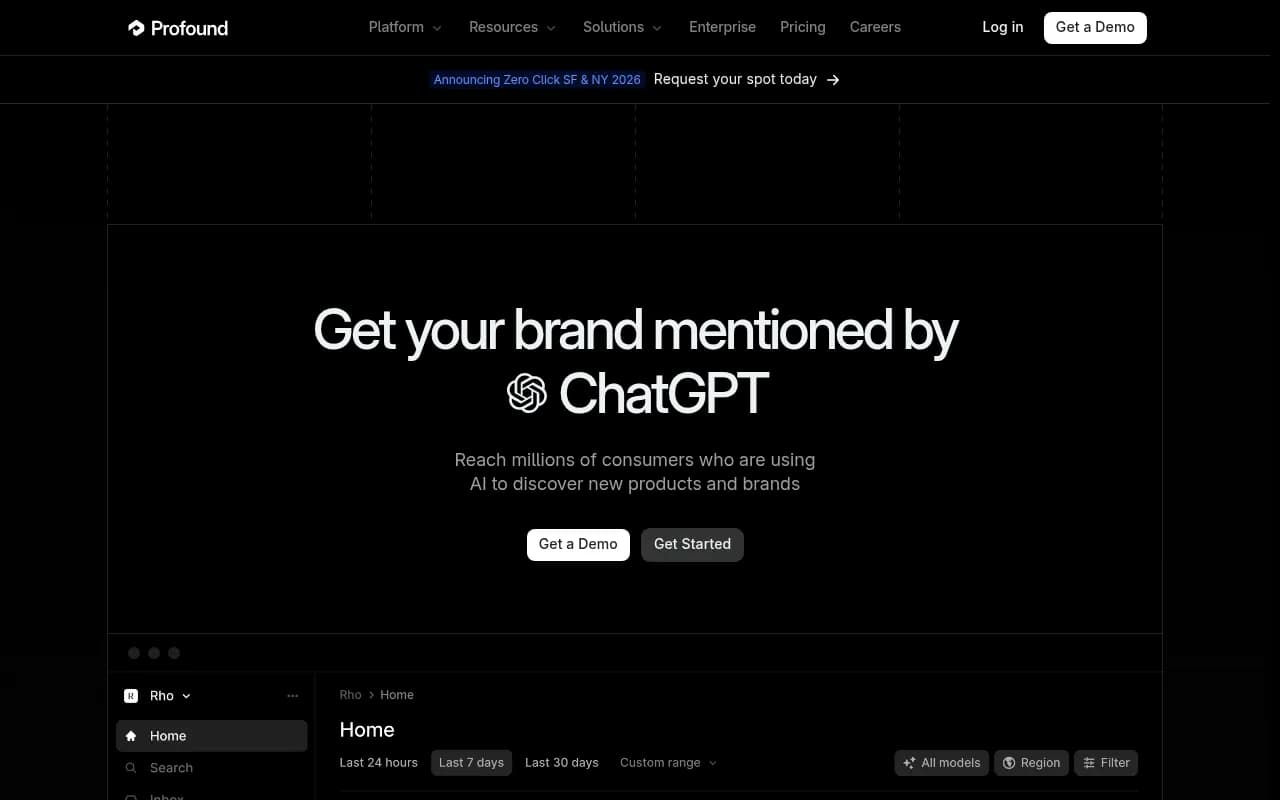
Profound is another enterprise-focused GEO platform with strong analytics. The key difference: Profound is more productized and accessible than Bluefish, with a self-serve option and published pricing. Profound's strength is in analytics depth; Bluefish's is in brand narrative control and the service layer. If you want analytics without the service dependency, Profound is worth a look.
Bluefish vs. Scrunch
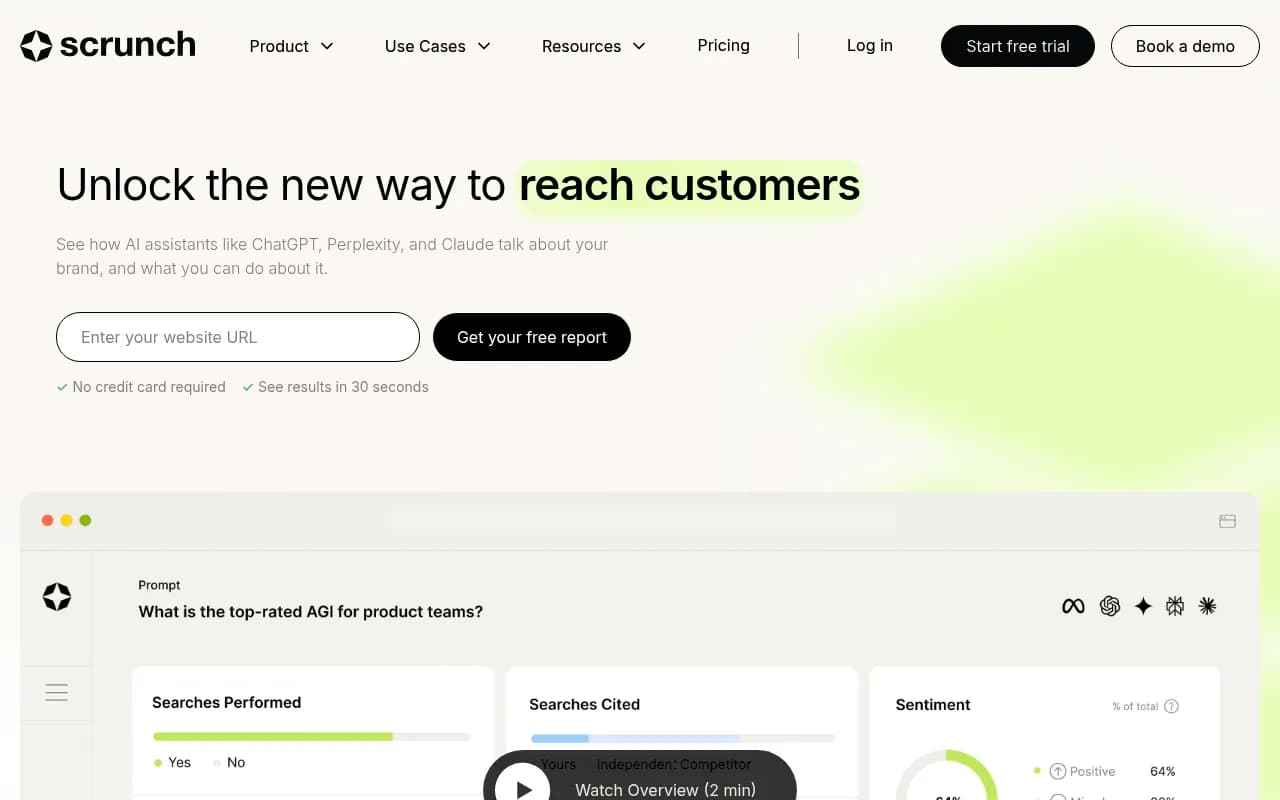
Scrunch is more mid-market focused and offers standardized workflows that Bluefish explicitly avoids. If you want a platform you can deploy yourself without a lengthy onboarding process, Scrunch is more accessible. The trade-off is less customization depth.
Bluefish vs. Otterly.AI
Otterly.AI is a lightweight monitoring tool at the opposite end of the complexity and price spectrum. It's good for basic visibility tracking but doesn't have the brand narrative analysis depth that Bluefish offers. The right choice depends entirely on what you actually need.

Feature comparison: Bluefish vs. top alternatives
| Feature | Bluefish AI | Promptwatch | Profound | Scrunch | Otterly.AI |
|---|---|---|---|---|---|
| AI brand monitoring | Yes | Yes | Yes | Yes | Yes |
| Brand narrative analysis | Yes | Partial | Yes | Partial | No |
| Content gap analysis | No | Yes | Partial | No | No |
| AI content generation | No | Yes | No | No | No |
| AI crawler logs | Unknown | Yes | No | No | No |
| Reddit/YouTube tracking | No | Yes | No | No | No |
| ChatGPT Shopping tracking | No | Yes | No | No | No |
| Transparent pricing | No | Yes | Yes | Yes | Yes |
| Self-serve signup | No | Yes | Yes | Yes | Yes |
| Number of AI models tracked | Unclear | 10 | ~6 | ~6 | ~5 |
| Free trial | No | Yes | Yes | Yes | Yes |
The verdict: is Bluefish worth it in 2026?
Bluefish is a real platform with real capabilities, and for the right enterprise customer -- a Fortune 500 brand with a dedicated team, complex brand narrative requirements, and budget for a premium service-led deployment -- it can deliver genuine value.
But for most organizations evaluating GEO tools in 2026, Bluefish has three problems that are hard to get past:
First, the monitoring-only approach. Knowing where you're invisible is useful. Knowing what to do about it and having the tools to act on it is more useful. Bluefish doesn't close that loop.
Second, the access model. No self-serve, no public pricing, no free trial. In a category where most serious platforms let you sign up and see results within an hour, Bluefish's closed pilot process is a friction point that will cost it deals.
Third, the AI visibility data. A platform ranked #29 in AI Visibility on CheckThat.ai, with 2 mentions in a week, is not winning the AI search game itself -- which is at minimum an irony worth noting.
If you're a large enterprise with specific brand protection needs and a team that can manage a service-led deployment, Bluefish deserves a conversation. If you're a marketing team that needs to move fast, see results, and actually improve your AI search visibility rather than just measure it, you'll get more done with a platform that combines monitoring with content gap analysis and content generation.
The GEO category has matured enough in 2026 that "we show you the data" is no longer a sufficient value proposition. The platforms winning right now are the ones that show you the data and help you act on it.