Key takeaways
- Brand-level GEO tracking is a trap for multi-product-line companies. If a tool can't break visibility down by product, category, or SKU, you're flying blind on the thing that actually drives revenue.
- ChatGPT cites roughly 5 sources per response versus ~10 on Google AI Overviews and Perplexity, per Promptwatch data on average sources per response. Fewer slots means more competition for every product page you own.
- Product pages are now the single biggest citation type on both ChatGPT (28.7% in August 2026) and Google AI Overviews, but how-to and comparison content is growing fastest, so a PDP-only strategy leaves real visibility on the table.
- Flat per-prompt pricing breaks down fast once you're tracking hundreds of SKUs across five AI engines. Look for bulk intent clustering, not per-keyword billing.
- Third-party marketplaces and review sites frequently out-cite brand-owned pages, even on commercial queries, so your GEO stack needs off-site source management, not just an on-site content plan.
Why multi-product-line brands need a different GEO approach
Most GEO tools are built and priced around a single question: does ChatGPT mention my brand? That's a fine starting point if you sell one thing. It falls apart fast once you're running fifteen product lines, forty SKUs per line, and three regional storefronts.
I've looked at a lot of these platforms, and the pattern is consistent: the dashboards look impressive until you ask "okay, but which of my 40 handbag SKUs actually shows up when someone asks ChatGPT to compare leather totes?" Most tools can't answer that. They'll tell you your domain got cited 340 times last month, which is nice, but useless if you can't tell whether that's your flagship product or a discontinued line from two years ago.
The scale problem is real too. Research on catalog-heavy brands found that average ecommerce catalog sizes have grown from around 12,000 to 31,000 SKUs for large retailers recently, with some B2B catalogs exceeding 50,000 items. Testing a single generic brand prompt against that kind of catalog tells you almost nothing.
The citation math has changed
It helps to understand what you're actually competing for. Promptwatch's data on average sources per response shows ChatGPT typically cites around 5 sources per web-search answer, while Google AI Overviews and Perplexity cite closer to 10 each. Microsoft Copilot is wilder still, swinging from under 2 to nearly 17 sources depending on the query.
With only five citation slots on ChatGPT, every product-line page you own is fighting a much smaller battlefield than it would on Google AI Overviews. That changes the math on content prioritization. You can't optimize all 50,000 SKUs for ChatGPT visibility. You have to pick the hero products and category pages that matter most and concentrate effort there.
Promptwatch's query fan-out data adds another wrinkle. ChatGPT breaks a single prompt into multiple targeted web searches, and the queries it generates have gotten shorter over time, down from around 117 characters to roughly 53 characters. It's searching more like someone typing keywords than full sentences. That matters for how you title and structure product and category pages: front-load the entity and category name instead of burying it in a marketing headline.
On August 8, 2026, ChatGPT Search also started using the site: operator at scale, jumping from about 0.4% to 17% of all fan-out queries almost overnight, according to Promptwatch's data on the shift. If you run separate subdomains or subfolders per product line, this is worth auditing. ChatGPT may be running targeted site: searches against specific sections of your domain, and you want those sections crawlable and well-structured.
Product pages lead, but the mix is shifting
Product pages are the single most-cited content type on ChatGPT right now, at 28.7% of citations in August 2026, and Google AI Overviews made the same shift to product-page-first citations in late July. That's good news if your PDPs are solid.
But look closer at the trend lines. How-to content more than doubled its citation share over the same month (4.3% to 9.1%), and documentation content climbed from 3.3% to 8.2%. Social post citations collapsed from 4.4% to under 1% after a Reddit-specific drop on August 14. The lesson for a multi-product-line brand: don't build your GEO strategy around PDPs alone. Pair each product line with buying guides and comparison content, because that's where the growth is happening, and where Reddit used to fill the gap, it increasingly won't.
What to actually look for in a GEO tool
Before comparing specific platforms, here's the checklist that matters for catalog-heavy brands:
- SKU or product-level tracking, not just domain or brand-level mentions
- Multi-engine coverage across ChatGPT, Perplexity, Gemini, Claude, and Google AI Overviews/AI Mode, since buyers increasingly ask comparison questions directly inside chat interfaces
- Bulk intent clustering so you can group category-level informational queries separately from SKU-level transactional queries, rather than lumping everything into one generic report
- Multi-brand or multi-workspace support if you manage sub-brands, regional storefronts, or private labels
- Pricing that scales sanely. Flat per-prompt billing across a 50,000-SKU catalog adds up fast; one analysis found standard prompt-search APIs running around $25 per 1,000 queries, which gets expensive quickly at scale
- Off-site citation visibility, since marketplaces and review sites frequently beat brand-owned pages in AI answers even for commercial queries
- Content generation or action tooling, not just dashboards, so visibility gaps actually turn into published fixes
The single best diagnostic question, borrowed from an ecommerce GEO buyer's guide I came across: does this tool track individual SKUs, or just the brand? If the answer is "just the brand," that's an immediate red flag for anyone running more than one product line.
The automotive example that explains the problem
It's worth looking at a vertical where this plays out clearly. In automotive, Promptwatch's August 2026 citation data shows Autotrader.com leading ChatGPT citations at 5%, with Cars.com close behind at 4.6%. Seven of the top eight cited domains in that category are marketplaces or research sites, not manufacturer sites. Chevrolet.com was the only OEM domain to crack the top four, at 2.62%.
Marketplaces and listings account for roughly 14.65% of all automotive citations combined, versus just 7.92% for manufacturer sites. Even a single local dealer site made the top 31 list.
That's the pattern multi-product-line brands need to internalize: third-party sources often out-cite you even on your own products. A GEO strategy that only optimizes owned pages is incomplete. You need visibility into what's being said about your products on marketplaces, review sites, and forums, and a plan to influence that, not just your own PDPs.
Comparing the tools
| Tool | Multi-product / SKU tracking | Engines covered | Starting price | Best for |
|---|---|---|---|---|
| Promptwatch | Page-level tracking, content gap analysis, Content Agents | ChatGPT, Gemini, Claude, Perplexity, Grok, DeepSeek, Copilot, AI Overviews, AI Mode and more | $95/mo (Essential) | Brands that want monitoring and automated content fixes in one platform |
| Goodie AI | SKU-level agentic-commerce visibility | 8 engines incl. ChatGPT Shopping, Amazon Rufus, Perplexity | ~$495-$999/mo | Ecommerce brands needing SKU-level shopping visibility |
| Scrunch AI | Multi-brand workspaces, up to 5 competitors tracked | ChatGPT, Perplexity, AI Overviews, Copilot (Core); adds Claude/Gemini/Meta AI/Grok at Enterprise | $250/mo (Core) | Multi-brand/global deployment across markets and product lines |
| Peec AI | Multiple sub-brand tracking in one account | 3 of 6 engines at Pro, more at higher tiers | ~$245/mo | Agencies and brands managing several sub-brands |
| WorkDuo | Product-level visibility and hero-product benchmarking | Multi-platform shopping answers | from $33/mo | Catalog-heavy ecommerce needing competitor product benchmarking |
| Ahrefs Brand Radar | Domain and prompt-level, add-on model | 6 AI indexes (bundled add-on) | ~$828-$1,148/mo realistic total | Teams already on Ahrefs wanting the largest prompt database |
| Semrush Enterprise AI Optimization | Explicit "multi-brand, multi-product" tier | Custom large-scale prompt tracking | $139/mo entry; custom Enterprise | Enterprises wanting ROI attribution across multiple product lines |
| GEOforge | Per-brand add-on pricing | Not specified at this tier | $1,250/mo + $900/mo per additional brand | Brands that want transparent per-brand scaling costs |
A few of these deserve more detail.
Promptwatch
Promptwatch is built around a different question than most of the tools above. Instead of just answering "was my brand mentioned," it tries to answer why you're visible or not, where AI actually finds your content, and what to do about it.

For multi-product-line brands specifically, a few features matter. Page tracking lets you see citation performance down to individual product and category pages rather than just the domain level, which is the exact gap most brand-level trackers leave open. Content gap analysis maps your catalog against what AI is actually citing in your category and scores the coverage, so you can see which product lines are under-represented before a competitor's listicle eats your lunch. The Content Agents feature then goes a step further: it plans, writes, and publishes GEO-optimized content (buying guides, comparisons, category pages) directly to Webflow, Framer, or WordPress on a schedule, which matters a lot when you're trying to cover dozens of product lines with a content team that can't realistically write 40 comparison guides by hand.
It also tracks ChatGPT Shopping and ads, which is directly relevant given how step-changed and unpredictable shopping-feature trigger rates have been (they roughly doubled overnight in late May 2026, then fell back weeks later, according to Promptwatch's shopping usage data). If your product lines are shopping-eligible, you want to know when that feature is actually firing for your category, not just assume it's stable.
Pricing starts at $95/mo for Essential (1 site, 50 prompts), scaling to $245/mo for Professional (2 sites, 150 prompts, shopping insights, automated content) and $579/mo for Business (5 sites, 350 prompts, 30 AEO articles). For a brand with several product lines or regional sites, the Professional or Business tier is the realistic starting point.
Goodie AI
Goodie is worth calling out specifically because it's one of the only platforms built around SKU-level visibility rather than brand-level. Its "Agentic Commerce Suite" tracks and optimizes product visibility across ChatGPT Shopping, Amazon Rufus, Perplexity, and AI Mode, and ships PDP or feed fixes directly. Pro plan pricing runs around $999/mo annually, which is steep, but if your business lives and dies by individual SKU visibility in shopping surfaces, it's purpose-built for exactly that problem.
Scrunch AI
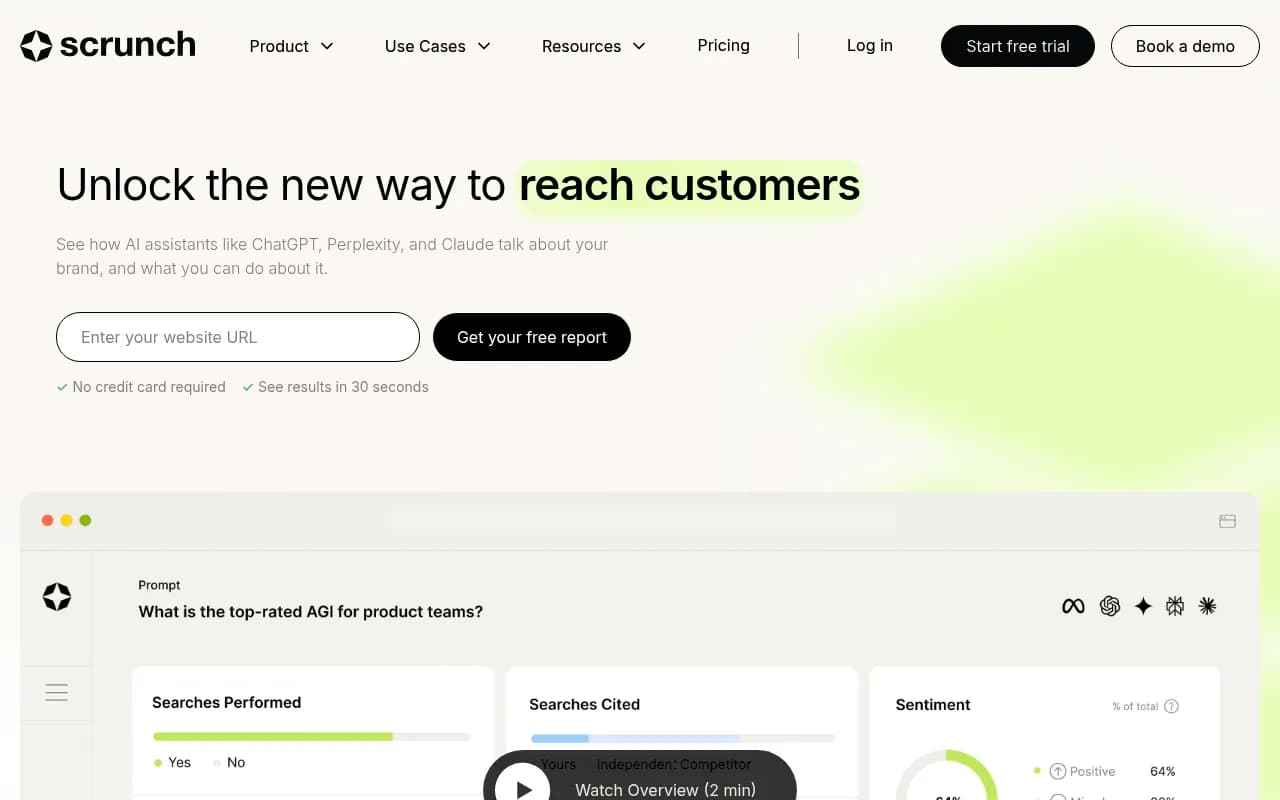
Scrunch explicitly markets its Enterprise tier around scaling "across markets, product lines, and teams," which is unusual candor in a space where most vendors just say "enterprise-grade" and leave it at that. One pricing quirk worth knowing: tracking a single query across four engines (ChatGPT, Claude, Gemini, Perplexity) consumes four credits, not one. For a multi-product-line brand running hundreds of prompts across multiple engines, that adds up fast, so model it out before you commit to a tier.
WorkDuo and Zoovu for pure ecommerce
If your "multiple product lines" problem is specifically a shopping/catalog problem, WorkDuo and Zoovu are worth a look even though they're narrower tools. WorkDuo benchmarks your hero products against competitors' hero products across AI shopping answers, while Zoovu focuses on guided selling, matching shopper intent to the right SKU inside catalog-heavy retail. Neither replaces a full GEO monitoring stack, but they fill the product-matching gap that generic brand trackers miss.
A practical framework for rolling this out
A few principles that come up repeatedly across the research, worth adapting into your own process:
First, stop monitoring generic brand-name prompts and start clustering by catalog structure. Group prompts by category (informational, "best X for Y") separately from SKU-level transactional prompts ("price of X model Y"). Lumping them together in one report hides which pages are actually driving revenue.
Second, map individual product pages directly to citations. This turns visibility from a vague brand health metric into a product-level KPI you can tie to pipeline. If product line A gets cited twice as often as product line B, that's a prioritization signal for your content team, not just a vanity stat.
Third, budget for prompt caps running out. Lower-tier, self-serve plans impose strict prompt limits that diverse product lines burn through quickly, often pushing you toward a custom-priced tier faster than the sales page suggests. Model your actual prompt volume (roughly: number of product lines x number of comparison/informational query types x number of engines) before picking a tier.
Fourth, don't ignore off-site sources. Given how often marketplaces and review sites out-cite brand pages, pair your GEO tool's on-site content recommendations with some kind of digital PR or citation outreach effort aimed at the third-party sites your category actually relies on.
Fifth, treat the data as directional, not static. Average citations per ChatGPT response dropped across every model around the GPT-5.3 rollout in March 2026, a platform-wide shift that had nothing to do with any individual brand's content quality. Expect 40-60% monthly swings in citation volume as a baseline, and read your GEO dashboard as a trend line, not a scoreboard.
If you're comparing a wider set of GEO and AI visibility platforms beyond what's covered here, the directory at bestgeosoftware.com breaks down more options by category, and agenticseotools.com is useful if you're specifically looking for tools that go beyond tracking into automated execution.