Key takeaways
- A pet product brand and a single-location vet clinic need different GEO tools. Brands need citation and shopping data across countries. Clinics need local targeting, listings, and review management.
- Qwairy's April 2026 guide reports that 80% of AI pet product recommendations go to Chewy and PetSmart, and that 36.8% of Pets & Animals searches trigger a Google AI Overview (citing Ahrefs). Those are secondhand figures, but the direction is clear: AI answers are concentrated.
- Monitoring-only tools tell you that you are missing. Platforms that also write content, track crawlers, and measure AI traffic tell you why and help you fix it.
- For clinics, listings and review tools (Birdeye, Yext, Synup, BrightLocal) matter as much as any AI tracker, because AI engines lean on directory data for local answers.
- Start with a free visibility check, pick one tracker, and spend the rest of your budget on content and listings.
Why pet brands and vets need their own GEO approach
Picture it: 11 PM, a dog is limping, and the owner types "should I go to the emergency vet?" into ChatGPT. The answer names three local hospitals. Yours, two miles away with after-hours care, is not one of them. You never find out you lost that client.
That scenario is from Qwairy's pet care GEO guide, dated April 1, 2026. The same guide passes along a few numbers that are worth knowing but should be treated as secondhand, since they come from Vetcelerator and other third parties: a 1,278% year-over-year rise in ChatGPT referral traffic to vet clinics, vet accounts receiving ChatGPT traffic rising from 22% to 73%, and 21% of pet owners using ChatGPT for pet health advice.
The pet category has a few quirks that change how you pick tools:
- Pet health queries blend medical advice and purchase intent. The vet is a trusted authority in the owner's decision, and AI engines seem to treat it that way.
- Corporate platforms dominate. 5W Research's veterinary AI visibility index found Banfield leading vet AI citations at 11.5%, with VCA and BluePearl close behind. Independent practices are competing against chains with huge domain footprints.
- Product recommendations are lopsided. If Chewy and PetSmart take about 80% of AI pet product recommendations, a mid-size food or accessories brand has to find the narrow gaps: breed-specific, diet-specific, and condition-specific prompts.
- Local intent is everything for clinics, groomers, and trainers. "Near me" answers depend on location handling that most generic trackers do poorly.
One honest caveat. Promptwatch Data has no report specific to pet or veterinary prompts. The closest is its healthcare citation report (Sep 9 to Oct 8, 2026), which covers human health. In it, government and public health sites earned the largest share of citations (7.06% of all healthcare citations), with NIH alone at 5.46%, and hospitals and clinics at only 0.89%. It is a proxy, not pet data. But the pattern suggests ChatGPT favors authoritative bodies over individual clinics for medical questions, so a vet site that cites and agrees with AVMA, AAHA, or Merck Vet Manual guidance probably has a better shot. That last part is an inference, not a measured result.
What to look for in a GEO tool for the pet industry
Before the list, here is the checklist I would use. Not every item matters for every business.
For pet product brands
- Tracking in the real interfaces of ChatGPT, AI Overviews, Perplexity, and Gemini, since answers differ from API outputs.
- Shopping visibility. Product pages are the most cited content type in ChatGPT, at 22.4% of citations in Promptwatch's Sep 28 to Oct 4, 2026 data, so product carousels and product page citations matter.
- Competitor benchmarking against Chewy, PetSmart, and the direct competitors in your niche.
- Multi-country and multi-language monitoring if you ship internationally.
- Content tooling, because gaps in prompts like "best grain-free food for a senior beagle" are closed with pages, not dashboards.
For veterinary clinics and local pet services
- Location-aware tracking, ideally pinned to your actual neighborhood.
- Listings and review management. Reviews and directory profiles feed local AI answers.
- Schema and structured data for services, hours, and emergency availability.
- A budget that fits a practice, not an enterprise contract.
For both
- Sentiment and claim tracking. If an AI engine says your clinic is "expensive" or your food "causes allergies," you want to see it.
- AI crawler visibility. If GPTBot or ClaudeBot cannot read your site, nothing else matters.
Best GEO and AI visibility platforms
Promptwatch
Promptwatch is the option I would put first for pet brands that want to act on the data rather than just watch it. It tracks ChatGPT, Gemini, Claude, Perplexity, Google AI Overviews, AI Mode, Copilot, and others from their real interfaces, then traces which of your pages get cited and which content gaps keep you out of answers. Its Content Agent writes and publishes pages to WordPress, Webflow, or Framer, and IP-verified crawler logs and visitor analytics show whether the pages get read, cited, and clicked.

For pet use cases specifically:
- ChatGPT Shopping insights show which products AI recommends and which competitors it picks instead (Business plan).
- Local GEO/SEO targeting pins a monitor to exact coordinates, so a clinic can see how ChatGPT and AI Overviews answer from its own street (Business plan).
- Brand Narrative pulls the individual claims AI makes about you, which is useful when the topic is pet health and a wrong claim can hurt.
- Personas let you prompt like a new puppy owner versus a senior-dog owner.
Pricing is $95/mo for Essential (50 prompts), $245/mo for Professional, and $579/mo for Business, which is where the Content Agent, local targeting, and Shopping start. Confirm current numbers at promptwatch.com/pricing. A single-location clinic will likely find Business heavy. A multi-location group or a national pet brand will not. You can start with the free AI visibility report or the 7-day trial.
Profound and Scrunch
Both are strong monitoring platforms aimed at larger organizations.


They suit a national pet food company with an enterprise budget and a dedicated team. Compared with Promptwatch, they cost more and lack agentic content execution, Reddit tracking, and ChatGPT Shopping coverage. See Promptwatch vs Profound for the side-by-side.
Otterly.AI and Peec AI


Simple, affordable prompt trackers. They answer "was I mentioned?" and not much else: no crawler logs, no visitor analytics, no content generation. That is fine for a solo groomer who wants a weekly check, and not enough for a brand that wants to change the outcome.
Qwairy
Qwairy publishes some of the better pet-specific GEO writing, and its platform covers monitoring and optimization. Worth a look if its pet content matches how you think about the problem.
Temso AI
A Frizerly blog roundup of AEO tools for veterinary clinics highlights Temso for managing content at scale, with schema, citation tracking, and optimization across multiple AI engines. I did not verify pricing or features independently, so treat that as a lead to check, not a verdict.
Tibly

Positioned for local businesses. Worth evaluating if you are a single clinic or grooming shop and want something scoped to your size.
Local visibility tools for clinics and pet services
AI engines answering "vet near me" borrow heavily from listings, reviews, and map data. A GEO tracker tells you how you look. These tools fix the underlying data.
| Tool | What it does | Best for |
|---|---|---|
| Birdeye | Reviews, messaging, and reputation across locations | Multi-clinic groups |
| Yext | Listings and knowledge graph sync | Multi-location brands |
| Synup | Listings, reviews, and local visibility | Clinics wanting one agent for listings |
| BrightLocal | Local rank tracking and citation audits | Agencies and single practices |
| Moz Local | Listing sync and management | Small practices |
| NiceJob | Review requests and referrals on autopilot | Solo vets and groomers |
If you do one thing here, make your Google Business Profile, your directory listings, and your reviews consistent. That is dull advice, and it works because AI engines read the same sources people do.
Technical and structured data tools
Before you pay for tracking, check whether AI crawlers can read your site at all.
- Schema App handles structured data for services, locations, and FAQs. [tool:schema-app]
- Promptwatch's free Agentic Readiness Check shows which AI crawlers can access your site, and the Robots.txt Generator for AI helps if you have blocked them by accident.
- Screaming Frog is still the quickest way to find broken pages and orphaned content. [tool:screaming-frog-seo-spider]
- Google Search Console is free and tells you which queries already send traffic. Pet owners search in questions, so the query report is a decent source of prompts to track. [tool:google-search-console]
AI crawler activity is also shifting fast. Promptwatch's crawler traffic data shows Meta-WebIndexer going from about 2% to nearly 38% of tracked AI crawler requests between mid-July and August 9, 2026. If your robots.txt blocks bots by name, review it regularly.
Comparison table
| Tool | Type | Strength for pet businesses | Watch out for |
|---|---|---|---|
| Promptwatch | End-to-end GEO platform | Content Agent, Shopping, local targeting, crawler logs | Local targeting and Shopping need Business plan |
| Profound | Enterprise monitoring | Deep tracking for national brands | Higher price, no agentic execution |
| Scrunch | Enterprise monitoring | Brand-level monitoring | Same trade-offs as Profound |
| Otterly.AI | Basic tracker | Cheap weekly checks | No content or crawler data |
| Peec AI | Basic tracker | Simple monitoring | Monitoring without optimization |
| Qwairy | GEO platform | Pet-specific guidance | Verify features against your needs |
| Temso AI | Vet-focused AEO | Content at scale, schema | Claims unverified here |
| Tibly | Local AI visibility | Sized for local shops | Check depth of coverage |
Which setup fits which business
Independent vet clinic or groomer
Skip the enterprise tools. Run a free AI visibility check, clean up listings with Synup, Moz Local, or BrightLocal, set up a review request flow with NiceJob, and track a small prompt set (20 to 50) around your city and services. Promptwatch Essential or a lighter tracker like Otterly covers the monitoring side.
Multi-location clinic group
You have the local complexity of a chain and no brand dominance yet. Combine Birdeye or Yext for listings and reviews with a platform that has location-pinned tracking and content execution. Promptwatch Business fits here, and its Fact Check feature helps catch wrong claims AI makes about your services.
Direct-to-consumer pet brand
Your fight is against Chewy and PetSmart for product answers. Track prompts by breed, life stage, and condition, watch ChatGPT Shopping, and publish content that answers those narrow prompts better than a retailer's generic category page. The GEO for D2C academy guide is a good starting point.
Pet agency or consultancy
If you manage several pet clients, look at agency plans. Promptwatch's Kick-off, Growth, and Scale plans start at $199/mo with unlimited projects and seats. See the agencies page.
Should you hire a GEO agency instead?
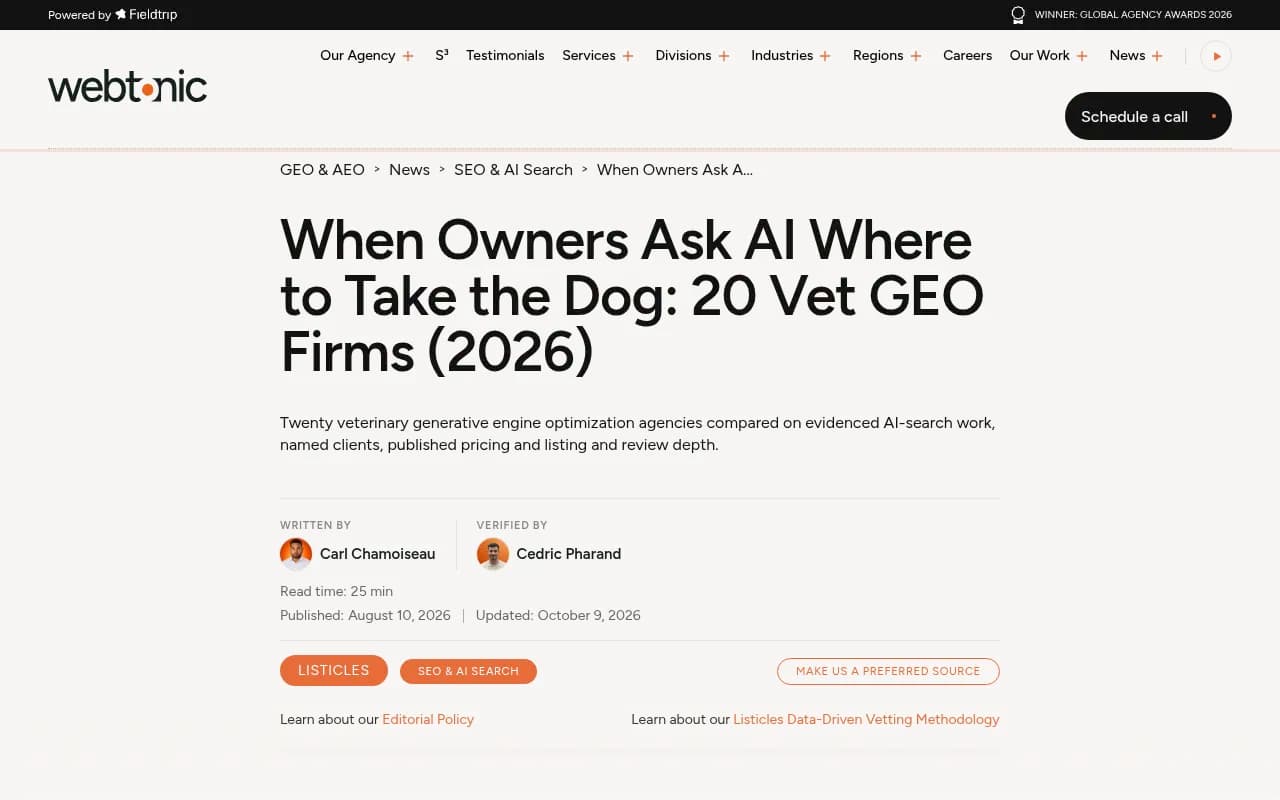
Sometimes. Web Tonic published a list of 20 veterinary GEO agencies (August 10, 2026, updated October 9), but note that Web Tonic ranks itself second, so treat the order with suspicion. Most entries are quote-based.
Onely's research on pet SEO agencies makes a more useful point: AI answers to "best SEO agencies for pet brands" treat a dog food company and a vet clinic as the same buyer, and every engine they checked included at least one vet-focused agency. Onely itself says it fits international product brands and not single clinics. That is the right way to frame any agency decision: match the agency to whether you win customers across a country or within a few miles.
If you want a general GEO and SEO partner, 1001 SEO Media is a full-service agency that works with Promptwatch for AI visibility. The same filter applies: ask whether they have handled local-service businesses or product brands like yours.
A simple 30-day starting plan
- Week 1: Run a free AI visibility report. Write down 25 prompts a real pet owner would ask, including emergency, cost, breed, and "near me" variants.
- Week 2: Check crawler access and fix robots.txt, schema, and your Google Business Profile.
- Week 3: Pick the pages AI should cite (service pages, condition explainers, product pages) and make them agree with AVMA or AAHA guidance. Link to the sources.
- Week 4: Re-run your prompts. Note which competitors appear, and which sources AI cites for them.
For more tools in the category, the GEO software directory at bestgeosoftware.com lists many more options.
Final take
No tool will make ChatGPT recommend a clinic that has thin pages, patchy reviews, and a blocked crawler. Fix those first. Then choose based on what you are: a local practice needs listings plus a lightweight tracker, a national brand needs shopping and citation data, and anyone who wants the gaps closed rather than charted should favor a platform with content execution and crawler visibility built in.