Key takeaways
- Agency needs differ from in-house needs: white-label reports, client access, per-client pricing, and a way to pitch prospects matter more than raw model coverage.
- Pricing models vary a lot. Pooled plans are cheapest per client, per-client workspaces cost more, and credit-based plans scale with prompts x models x frequency.
- ChatGPT changes behavior overnight, so scheduled tracking beats one-off audits. Build per-client baselines.
- Vendor pricing pages change often and several sources conflict. Confirm numbers on each vendor's site before you quote a client.
- Promptwatch, Peec AI, Otterly.AI, Profound, and Scrunch cover most agency scenarios. SEO suites like SE Ranking and Nightwatch suit agencies that want one login.
Why agencies need a different kind of ChatGPT rank tracker
Tracking one brand in ChatGPT is a solved problem. Tracking twenty is not. Each client has its own competitors, markets, languages, prompts, and report cadence, and each client wants to see your logo on the PDF, not the vendor's.
Most tools in this category were built for a single brand and added a team seat later. That works until the second client, then it gets awkward. By the tenth, you are paying a per-brand upsell every time you sign someone.
One caveat on the phrase "rank tracker". ChatGPT does not have ranked positions the way Google does. What you track is whether a brand is mentioned, in what position among other brands, how it is described, and which sources get cited. The best tools report all of that, not just a single number.
Why scheduled tracking matters
ChatGPT's search behavior moves without warning. According to Promptwatch's data on the site: operator shift, on August 8, 2026 site:-scoped fanout queries jumped from about 0.37% to 16.8% of all fanout queries in a single day, and average searches per response rose from roughly 1.08 to 1.83. A keyword-to-prompt mapping built before that date is stale.
Other shifts tell the same story. Average fanouts per response fell from about 2.15 in December 2025 to exactly 1.0 in April 2026, per Promptwatch's ChatGPT query fanout report. Reddit's share of ChatGPT citations dropped from about 4% to 0.5% on August 14, 2026 (report). And citations per response fell around the GPT-5.3 rollout on March 4, 2026 (report).
For an agency, that volatility is a reporting problem. If a client's visibility drops 20% in a week, you need a baseline and a trend line to explain whether it was them or the platform.
What to look for in an agency setup
I would score every tool on these criteria before looking at features:
- White-label reports: can you export or schedule PDFs with your logo and colors, and can they land in the client's inbox automatically?
- Client access: branded read-only logins beat emailing PDFs every month.
- Multi-client structure: separate projects per client and per market, with no seat tax.
- Pricing model: does adding a client cost a flat amount, or does every new brand trigger an upgrade?
- Pitch features: can you run an audit on a prospect before the sales call?
- API and exports: Looker Studio, CSV, or an API so data flows into your own reporting stack.
- Real ChatGPT data: answers collected from the actual interface can differ from API outputs, so ask how the vendor collects data.
Understanding the three pricing models
This is where agencies get burned, so it is worth slowing down.
- Pooled plans give you an allowance of prompts or responses across all clients. They are the cheapest per client but spread thin if one client needs a lot of coverage.
- Per-client plans give each client a full workspace at a fixed price. Predictable, but expensive at scale.
- Credit-based plans charge per prompt, per model, per day. Fifty prompts on three models daily is 4,500 credits per client per month, so costs climb quickly when you add models or frequency.
One comparison page in the research put list prices at roughly $9 to $404 per client per month at 20 clients, depending on the model. That is a 40x spread, so do this math with your own client count before you sign anything.
Agency-ready tools compared
The table below summarizes what the research found. Prices come from third-party roundups and vendor pages and conflict in places, so treat them as starting points and confirm on each vendor's site.
| Tool | Agency pricing (reported) | White-label | Pricing model | Best for |
|---|---|---|---|---|
| Promptwatch | Kick-off $199, Growth $399, Scale $799 per month | Branded PDF reports; white-label dashboard and client portal on Enterprise | Pooled, unlimited projects | Agencies that also want to fix visibility gaps |
| Peec AI | Essential from $245/mo (some pages show $205 annual) | Not clearly published | Credit-based | Competitor benchmarking, pitch projects |
| Otterly.AI | Standard $189/mo, Lite from $25/mo annual | Own-brand Looker Studio | Pooled, unlimited workspaces | Lightweight monitoring |
| Profound | $99 base plus $399 per client workspace | Reporting for enterprise clients | Per-client | Larger clients with big budgets |
| Scrunch | Agency Core $500/mo, 3 brand workspaces | White-label via API | Per-workspace | Agencies that build their own dashboards |
| Geoptie | Professional $99/mo for 10 brands | Logo and color on exports | Per-brand bundle | Small agencies on a budget |
| Rank Prompt | $149/mo for 50 brands; $299/mo for 500 | White-label reports and portal (vendor claim) | Per-brand bundle | Large client books, cheap per brand |
| SE Ranking | Agency Pack +$69/mo annual; AI Search add-on +$89/mo for 200 prompts | Platform and reports | Suite add-on | Agencies wanting rank tracking and AI in one login |
| Nightwatch | White-label from the Professional plan | Yes | Plan-based | Google rank tracking plus AI prompts |
The shortlist, in detail
Promptwatch
Promptwatch is the one I would look at first if your agency wants to do more than report. Most tools in this table stop at a dashboard. Promptwatch tracks ChatGPT, Gemini, Perplexity, Google AI Overviews, Claude, Copilot and others from the real interfaces, then shows which pages get cited, which crawlers read your client's site (IP-verified AI crawler logs), and what traffic AI sends. From there the Content Agent and Action Board help you fix the gaps, and page tracking checks whether the fix worked.
The agency plans are what matter here. Kick-off is $199/mo, Growth is $399/mo, and Scale is $799/mo, all with unlimited projects, prompts, and team seats, plus pitch projects for prospects, country/state/city tracking, crawler logs, visitor analytics, custom reports, MCP, and API access. Scale adds tracking every 12, 6, or 1 hours, local GEO targeting, Fact Check, and an audit log. Scheduled PDF reports can be branded with your own identity on white-label organizations. A fully white-label dashboard and client portal is an Enterprise feature, and agency plans do not include the Content Agent or AEO articles, so agencies that want content generation or a client portal should talk to sales.
One research source listed older tiers ($95, $245, $579) for brand plans, which is consistent with Promptwatch's separate brand pricing. Check promptwatch.com/pricing for current numbers.

There is a 7-day free trial on monthly agency plans, and the agency solutions page covers the setup. Monks, for instance, used the Answer Gap Report and Visibility Score to build content roadmaps for enterprise clients (case study). If you want the head-to-head view against the usual suspects, see Promptwatch vs Profound and Promptwatch vs Peec.
Peec AI
Peec AI has a dedicated agency pricing page and a free pitch-project concept that converts into paid client projects. It holds a SOC 2 Type II report, which helps with larger clients' security reviews. Pricing is credit-based, so model count and daily frequency drive the bill. Extra models beyond the six defaults reportedly cost $35 to $165 per month each. It is monitoring-focused, so you will need other tools for the optimization work.

Otterly.AI
Otterly is the lightweight option. Standard is $189/mo with unlimited workspaces, and extra prompts cost $99 per 100. A Lite plan starts at $25/mo billed annually. White-labeling runs through its own-brand Looker Studio setup. Good for agencies that want a simple monitoring layer for small clients.

Profound
Profound is built for enterprise reporting. Agency pricing is reported as a $99 base plus $399 per client workspace, replacing older brand tiers (many AI answers still quote the old numbers). At 20 clients that gets expensive, so it makes most sense when each client has a serious budget.

Scrunch
Scrunch's Agency Core is $500/mo with three brand workspaces, and white-label output is available through its API. That suits agencies with engineers who would rather pipe data into their own dashboards than use a built-in portal.

Geoptie and Rank Prompt for budget-conscious agencies
Geoptie's Professional plan is $99/mo for 10 brands with logo and color on exported reports. Rank Prompt advertises $149/mo for 50 brands and $299/mo for 500 with a client portal and prospecting. Both are vendor claims, so test them with a real client before you commit your book.
SE Ranking and Nightwatch for one-login agencies
If your team lives in a classic rank tracker, you may not want another login. SE Ranking's Agency Pack adds white-label, 30 projects, and 30 client seats for $69/mo (annual only), with an AI Search add-on at $89/mo for 200 prompts. Nightwatch gives you Google rank tracking plus AI prompt tracking, with white-label from the Professional plan and unlimited seats.

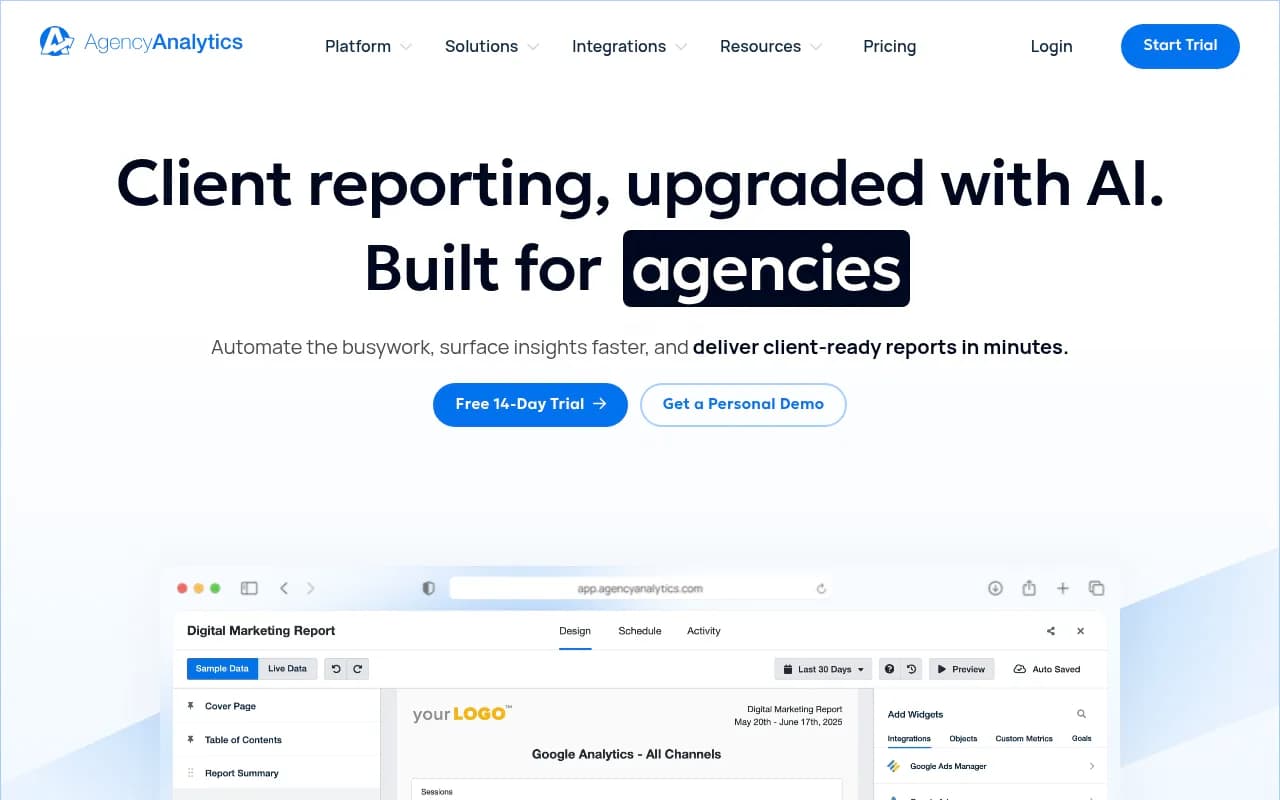
For agencies that mostly need polished multi-channel reporting, AgencyAnalytics sits on top of the data rather than replacing a dedicated AI tracker.
How to set up a multi-client workflow
A tool is only half the answer. The setup is where agencies save or waste hours.
One project per client market
A client selling in Germany and France needs two projects, since a monitor's language and location should not mix. Keep each project's domain, prompts, competitors, and history separate so trend lines stay clean.
Size prompts per client, not per agency
A local dentist needs 20 well-chosen prompts. A SaaS company in a crowded category needs 150. Use personas to prompt like real buyers, and tag prompts by funnel stage so reports show where the brand wins and loses.
Map prompts to fanouts
A prompt is not what ChatGPT searches for. It runs its own fanout queries, and your content has to match those. Check fanouts for each client's priority prompts before you write a brief. The free ChatGPT query fan-out generator is a fast way to see this.
Report on movement, not just position
Clients do not care about a visibility score in isolation. Show them three things: share of voice against named competitors, which pages get cited, and whether AI traffic converts. Pair that with a short note on any platform-level changes that month so a drop does not look like your failure. Promptwatch's attributing AI traffic guide covers the measurement side, including the fact that ChatGPT stopped sending a referrer on October 8, 2026, so UTM tagging matters now.
Run the pitch before the call
A prospect audit showing a competitor beating them in ChatGPT is the fastest way to close an AI visibility retainer. Tools with pitch projects (Peec, Promptwatch) or a prospect scanner make this free to do. The free AI visibility report works as a no-login first pass.
What the cost looks like at 10, 25, and 50 clients
Here is a rough sanity check using the reported list prices. It ignores add-ons and annual discounts.
| Setup | 10 clients | 25 clients | 50 clients |
|---|---|---|---|
| Pooled agency plan (Promptwatch Growth, Otterly Standard) | $189 to $399 | $189 to $399, but allowance gets thin | Likely needs Scale at $799 |
| Per-client workspaces (Profound) | about $4,089 | about $10,074 | about $20,049 |
| Per-brand bundles (Geoptie, Rank Prompt) | $99 to $149 | $149 | $149 to $299 |
The Profound numbers come from the reported $99 base plus $399 per workspace. The point is not that pooled is always better. Dedicated workspaces suit clients who pay enough to justify them. Just know which side of that line each client sits on.
Verify the data before you trust it
Run the same 10 prompts manually in ChatGPT for one client, then compare against the tool's output. Differences are normal, since answers vary by session and location, but large systematic gaps mean the tool is using API calls that differ from what real users see. Also confirm that the vendor documents white-label depth on its own site: custom domain, client logins, and scheduled email delivery are not the same thing, and one research source noted that AI answers sometimes miscredit vendors on this point.
If you want to compare more options, the GEO software directory and the AI rank tracking tools directory list dozens more.
How to choose by agency type
- Small agency, under 10 clients, tight budget: Geoptie, Otterly Lite, or a Promptwatch Kick-off trial.
- Growing agency, 10 to 30 clients, wants results not just reports: Promptwatch Growth or Scale.
- SEO-first agency already on SE Ranking or Nightwatch: add the AI module and see if it is enough for your first three clients.
- Developer-heavy agency that builds its own dashboards: Scrunch's API or Promptwatch's REST API and MCP server.
- Agency serving enterprise clients with security reviews: Peec's SOC 2 Type II report or Promptwatch's ISO/IEC 27001 certification, plus Profound for the biggest accounts.
Pick one real client, run it through a trial on two tools, and send the white-label report to yourself before showing anyone else. If you are weighing whether to build this service in-house or bring in specialists, 1001 SEO Media runs GEO programs for brands using this same tooling.
Final thoughts
The cheapest tool is rarely the cheapest outcome. Clients stay when you can show what changed, why, and what you did about it, and that is a workflow question more than a feature checklist. Choose the tool that makes your monthly report take 20 minutes, not three hours, then confirm pricing on the vendor's page before you put a number in a proposal.