Key takeaways
- Most AI visibility platforms stop at monitoring -- they show you data but don't help you do anything with it. Promptwatch is the exception.
- Profound is the strongest option for large enterprises that need deep analytics and can absorb a $499+/month price tag.
- Peec AI is worth considering if you operate in multiple languages or regions -- 115+ language support is genuinely rare.
- Otterly.AI is the cheapest entry point at $29/month, but you'll outgrow it fast if you need more than basic tracking.
- The platform you pick should match where you are: if you're just starting to monitor AI visibility, cheaper tools work fine. If you're trying to actually improve it, you need something with content and optimization built in.
AI search is no longer a trend worth watching from a distance. ChatGPT, Perplexity, Claude, and Google's AI Overviews are now part of how millions of people find products, services, and brands every day. If your company isn't showing up in those responses, you're invisible to a growing slice of your market.
The category of tools built to track and improve this visibility has exploded in the past two years. There are now dozens of platforms claiming to help you "dominate AI search" -- and most of them look similar on a features page. But they're not.
This guide focuses on four platforms that come up most often in real evaluations: Promptwatch, Profound, Peec AI, and Otterly.AI. I'll cover what each one actually does well, where it falls short, who it's built for, and how the pricing stacks up.
What to look for in an AI visibility platform
Before getting into the tools, it's worth being clear about what separates a good platform from a mediocre one. There are a few things that actually matter:
Monitoring vs. optimization. A lot of platforms will tell you how often your brand appears in AI responses, what sentiment looks like, and how you compare to competitors. That's useful. But it's table stakes. The harder problem -- and the one most tools don't solve -- is telling you why you're not appearing and what to do about it. Look for platforms that go beyond the dashboard.
Coverage across AI models. ChatGPT gets the most attention, but Perplexity, Claude, Gemini, Grok, and others each have meaningful user bases. A tool that only tracks one or two models gives you an incomplete picture.
Prompt intelligence. Not all prompts are equal. Some have high search volume, some are easier to win than others. A platform that surfaces prompt difficulty and volume helps you prioritize instead of guessing.
Traffic attribution. Knowing you appeared in an AI response is nice. Knowing that appearance drove actual website visits and revenue is what justifies the budget. Very few platforms close this loop.
Content generation. If a platform identifies gaps in your AI visibility, can it help you create the content to fill them? Or does it hand you a list of problems and leave you to figure out the rest?
Keep these criteria in mind as you read through each tool below.
The platforms, ranked
Promptwatch
Promptwatch is the platform I'd recommend for most marketing and SEO teams that are serious about AI visibility -- not just tracking it, but improving it.

The core difference from most competitors is that Promptwatch is built around a full action loop. It starts with Answer Gap Analysis, which shows you the specific prompts your competitors are appearing for that you're not. Not vague topic clusters -- the actual questions AI models are answering where your content is missing. From there, a built-in AI writing agent generates articles, listicles, and comparisons grounded in real citation data. The content isn't generic; it's engineered around what AI models actually cite.
Then you track results. Page-level tracking shows which pages are being cited, how often, and by which model. Traffic attribution connects that visibility to real sessions and revenue, either through a code snippet, Google Search Console integration, or server log analysis.
A few capabilities that stand out beyond the core loop:
- AI Crawler Logs: Real-time logs of when ChatGPT, Claude, Perplexity, and others crawl your site, which pages they read, and any errors they hit. Most competitors don't offer this at all.
- Prompt Intelligence: Volume estimates and difficulty scores for each prompt, plus query fan-outs that show how one prompt branches into related sub-queries.
- Reddit and YouTube tracking: Surfaces discussions and videos that directly influence AI recommendations -- a channel most platforms ignore entirely.
- ChatGPT Shopping tracking: Monitors when your brand appears in ChatGPT's product recommendations and shopping carousels.
- Competitor heatmaps: Side-by-side visibility comparison across LLMs, showing who's winning for each prompt.
Coverage spans 10 AI models: ChatGPT, Perplexity, Google AI Overviews, Google AI Mode, Claude, Gemini, Meta/Llama, DeepSeek, Grok, Mistral, and Copilot.
Pricing starts at $99/month (Essential: 1 site, 50 prompts, 5 articles), $249/month (Professional: 2 sites, 150 prompts, 15 articles, crawler logs), and $579/month (Business: 5 sites, 350 prompts, 30 articles). Agency and enterprise pricing is available on request.
The honest caveat: Promptwatch is more platform than some teams need. If you just want to check whether your brand shows up in ChatGPT responses once a week, you're paying for capabilities you won't use. But for teams that want to actually move the needle on AI visibility, it's the most complete option in the market right now.
Profound
Profound is the enterprise play. It's built for large brands and agencies that need deep analytics, sophisticated reporting, and the ability to manage multiple brand configurations at once.
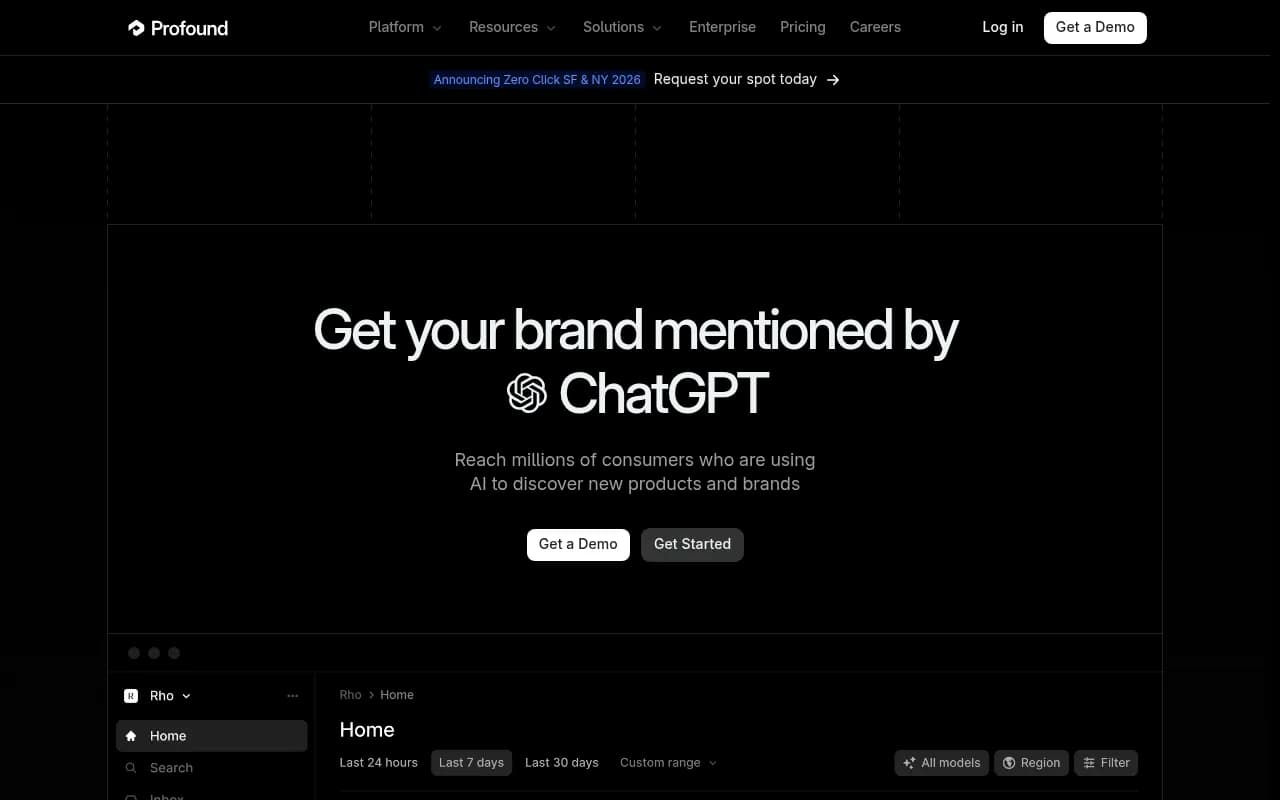
The platform covers AI visibility tracking across major models, offers strong competitive benchmarking, and has an Agency mode with pitch environments and brand configurations that agencies find useful for client work. The data quality is generally good, and the dashboards are polished.
Where Profound struggles is on the action side. It's primarily a monitoring and analytics platform. It shows you what's happening, but it doesn't have built-in content generation, crawler logs, or the kind of gap analysis that tells you exactly what to create. For a team that already has strong content operations and just needs visibility data to inform them, that's fine. For a team that wants the platform to help them execute, it's a gap.
Pricing starts at $499+/month, which makes it one of the more expensive options in the category. That price point makes sense for enterprise teams with dedicated analytics resources, but it's hard to justify for smaller teams or agencies with tight margins.
Peec AI
Peec AI's main differentiator is language coverage. With support for 115+ languages, it's the strongest option for brands operating in non-English markets or running campaigns across multiple regions.
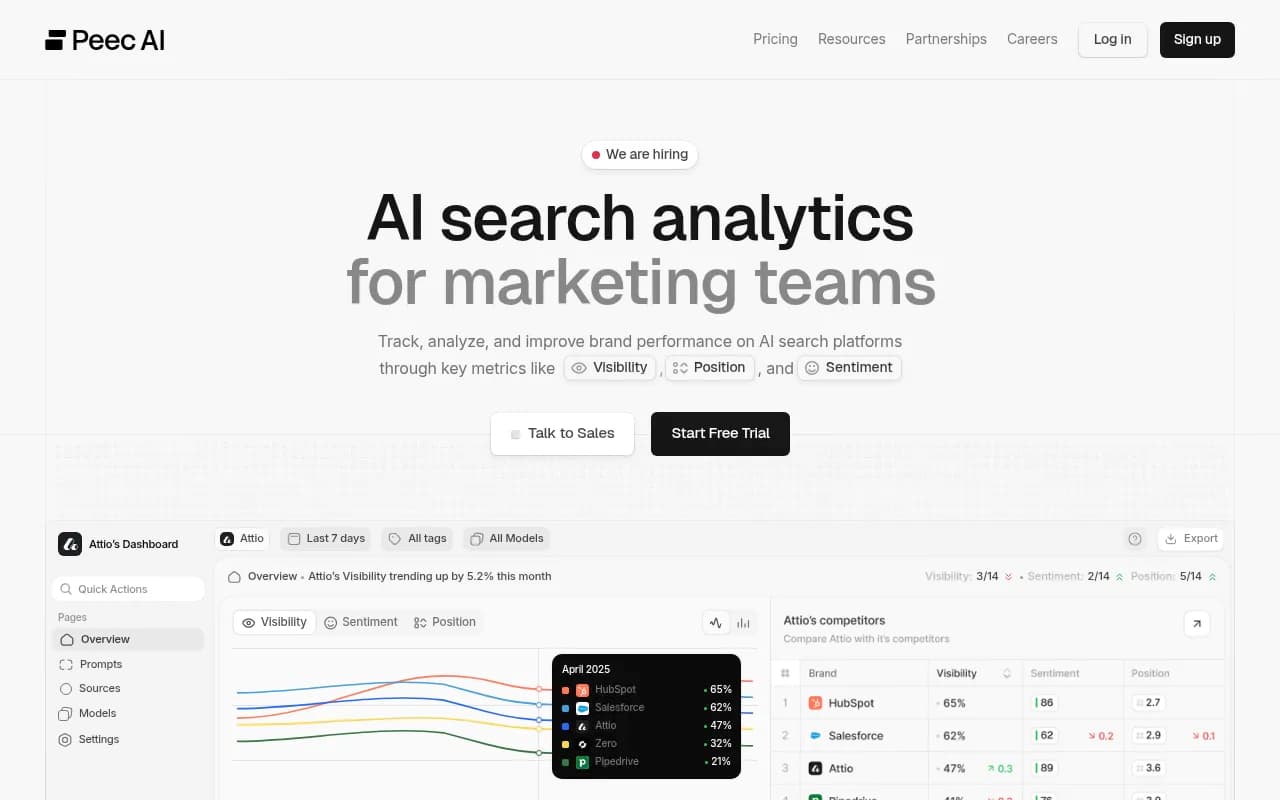
The platform offers clean AI visibility reporting, sentiment tracking, and competitor comparisons. Agencies and smaller teams tend to like it because the interface is straightforward and the reporting is easy to share with clients.
The limitations are real, though. Peec AI is a reporting tool. There's no content generation, no crawler logs, no traffic attribution, and no prompt volume data. You can see where you stand, but the platform doesn't help you change it. At $89/month, the price is reasonable for what you get -- but "what you get" is monitoring, not optimization.
If your primary need is tracking AI visibility across multiple languages and regions, Peec AI is worth a serious look. If you need to actually improve your visibility, you'll need to pair it with other tools.
Otterly.AI
Otterly.AI is the budget option. At $29/month, it's the cheapest way to get started with AI visibility tracking, and it does the basics well enough for teams that are just beginning to explore the space.

The standout feature is a GEO Audit tool that gives you a structured assessment of how AI-friendly your content is. For teams that haven't thought about this before, it's a useful starting point. The platform also covers the major AI models and gives you brand mention tracking and basic competitor comparisons.
The ceiling is low, though. Otterly.AI doesn't have prompt volume data, crawler logs, content generation, or traffic attribution. It's a monitoring dashboard with a GEO audit bolt-on. That's genuinely useful at $29/month, but most teams will outgrow it within a few months of taking AI visibility seriously.
Think of Otterly.AI as a starting point, not a destination.
Head-to-head comparison
| Feature | Promptwatch | Profound | Peec AI | Otterly.AI |
|---|---|---|---|---|
| AI models covered | 10 | 6-8 | 8+ | 5-6 |
| Content generation | Yes (built-in) | No | No | No |
| Answer gap analysis | Yes | Limited | No | No |
| AI crawler logs | Yes | No | No | No |
| Traffic attribution | Yes | No | No | No |
| Prompt volume & difficulty | Yes | No | No | No |
| Reddit & YouTube tracking | Yes | No | No | No |
| ChatGPT Shopping tracking | Yes | No | No | No |
| Multi-language support | Yes | Limited | Yes (115+) | Limited |
| GEO audit | No | No | No | Yes |
| Agency/multi-brand | Yes | Yes (strong) | Yes | Limited |
| Starting price | $99/mo | $499+/mo | $89/mo | $29/mo |
| Free trial | Yes | Yes | Yes | Yes |
| Best for | Teams wanting to improve AI visibility | Large enterprises | Multi-language brands | Beginners / budget |
How to choose
The right platform depends on what you're actually trying to do.
If you're just getting started and want to understand whether your brand appears in AI responses before committing to a bigger budget, Otterly.AI at $29/month is a reasonable entry point. You'll learn the basics without overcommitting.
If you operate in multiple languages or need to track AI visibility across different regions and markets, Peec AI's language coverage is hard to match. Just know you'll need other tools to act on what you find.
If you're an enterprise team with a dedicated analytics function, a big competitor set, and the budget to match, Profound's depth and polish make sense. It's built for that context.
If you want to actually improve your AI visibility -- not just measure it -- Promptwatch is the most complete option. The combination of gap analysis, content generation, crawler logs, and traffic attribution means you're not just watching a dashboard; you're running a repeatable process for getting cited more often by AI models.
The monitoring-only tools have their place, but there's a real difference between knowing you're invisible and having a system to fix it.
Other tools worth knowing about
The four platforms above aren't the only options. A few others come up regularly in evaluations:
Scrunch focuses on monitoring how AI assistants like ChatGPT and Claude represent your brand, with solid competitive analysis.
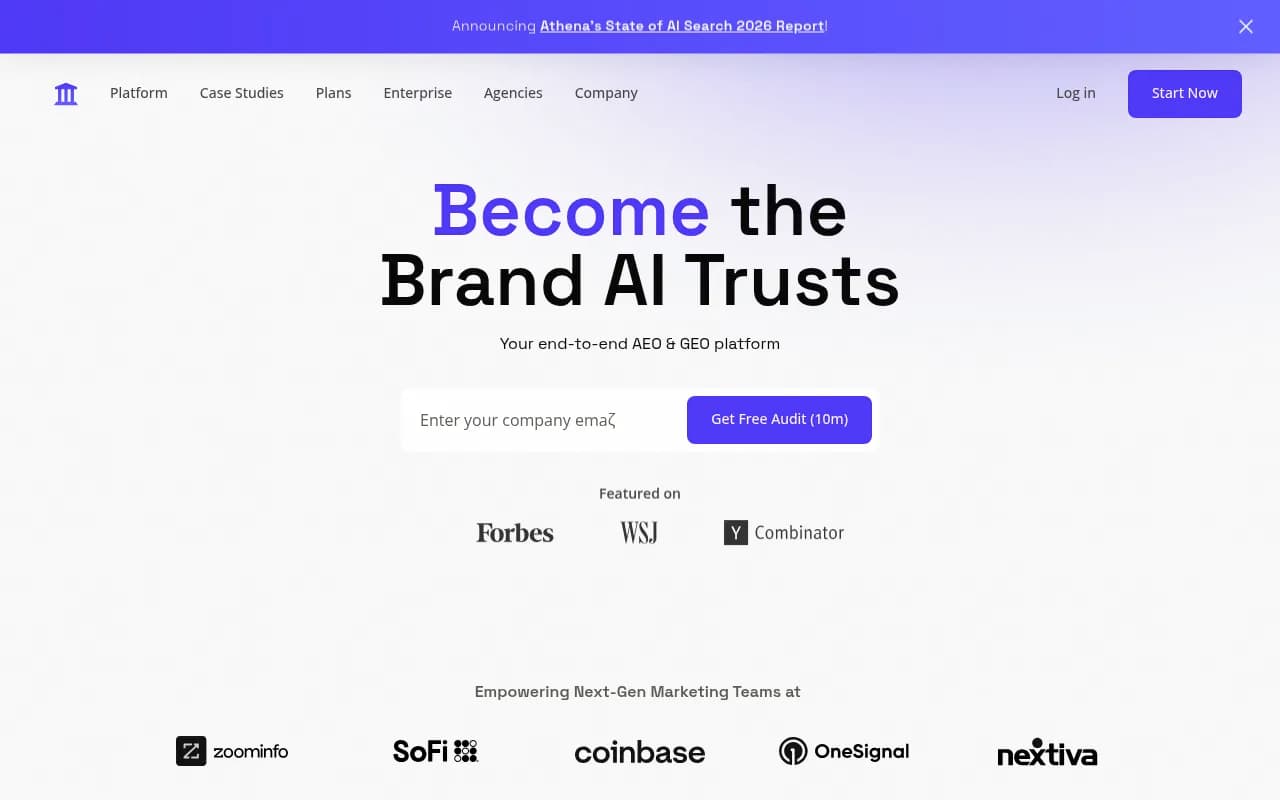
AthenaHQ covers 8+ AI search engines and is monitoring-focused, similar to Peec AI in scope.
Search Party is more agency-oriented and focuses on AI implementation rather than pure visibility tracking.
Search Party
Semrush and Ahrefs Brand Radar both have AI visibility features now, but they're built on top of traditional SEO infrastructure. Semrush uses fixed prompts, and Ahrefs Brand Radar has fixed prompts with no AI traffic attribution -- useful if you're already in those ecosystems, but not purpose-built for this problem.
The bigger picture
The AI visibility category is still young, and the tools are evolving fast. What's true today about feature sets and pricing will look different in 12 months.
What won't change is the underlying problem: AI models are increasingly the first stop for product research, brand comparisons, and purchase decisions. If you're not in those responses, you're losing ground to competitors who are.
The platforms that will matter most aren't the ones with the prettiest dashboards. They're the ones that help you close the loop between "here's where you're invisible" and "here's content that gets you cited." That's a harder problem to solve, and right now, very few tools are actually solving it.
Pick the platform that matches your current stage. But if you're serious about AI search as a channel, start thinking about optimization -- not just monitoring -- sooner rather than later.