Key takeaways
- Most AI visibility tools only monitor — they show you where you're invisible but don't help you fix it. A small number of platforms (Promptwatch, Relixir, AirOps) close the loop with content generation and optimization.
- AI model coverage varies wildly. Some tools track 4 models; others cover 10+. If you care about ChatGPT, Perplexity, Gemini, Claude, and Google AI Overviews, check coverage before committing.
- Pricing ranges from $29/month for basic monitoring to $500+ for enterprise-grade platforms with crawler logs, content agents, and competitor analysis.
- For most marketing teams in 2026, the right question isn't "which tool tracks the most models?" — it's "which tool helps me actually improve my visibility?"
- Promptwatch is the only platform in this comparison rated as a leader across monitoring, optimization, and content generation — making it the strongest choice for teams that want to move beyond dashboards.
The GEO tools market has exploded. Two years ago, there were maybe a handful of platforms tracking brand mentions in AI responses. Today there are dozens, and they vary enormously in what they actually do. Some are glorified alert systems. Others are full optimization platforms. A few are somewhere in between, with impressive dashboards that ultimately leave you wondering what to do next.
This guide cuts through the noise. I've looked at 12 of the most-discussed platforms in 2026 — from enterprise heavyweights to scrappy newcomers — and compared them on what actually matters: how many AI models they cover, whether they help you create content that ranks, how deep their analytics go, and what you'll pay.
Why AI visibility matters more than ever in 2026
ChatGPT now handles roughly 20% of global search traffic, according to multiple third-party estimates. Google's AI Overviews appear in nearly half of all searches. Perplexity, Claude, Gemini, Grok, and Copilot are all eating into the traditional "type a query, click a blue link" behavior that SEO has been optimized for since the late 1990s.
The shift matters because AI models don't just rank pages — they synthesize answers. If your brand isn't mentioned in those answers, you don't exist for that user at that moment. There's no position 2 to fall back on.
Generative Engine Optimization (GEO) is the discipline of making sure AI models know about your brand, understand what you do, and cite you when answering relevant questions. AI visibility platforms are the tools that make GEO measurable and actionable.
The 12 platforms compared
Here's a quick overview before we go deeper:
| Platform | AI models tracked | Content generation | Crawler logs | Starting price | Best for |
|---|---|---|---|---|---|
| Promptwatch | 10+ | Yes (Content Agents) | Yes | $99/mo | Full-cycle GEO: monitor, optimize, create |
| Profound | Up to 10 | No | No | $99/mo | Enterprise prompt research |
| Otterly.AI | 4-6 | No | No | $29/mo | Budget monitoring |
| Peec AI | Up to 10 | No | No | €85/mo | Flexible model selection |
| AthenaHQ | 8+ | No | No | Custom | Monitoring-focused enterprise |
| Search Party | Varies | No | No | Custom | Agency implementations |
| Scrunch | 5+ | Limited | No | Custom | Mid-market monitoring |
| Brandlight.ai | 5+ | No | No | Custom | Brand sentiment tracking |
| Bluefish AI | 5+ | No | No | Custom | Enterprise GEO |
| Semrush AI Toolkit | 5 | No | No | Bundled | Existing Semrush users |
| Ahrefs Brand Radar | Limited | No | No | Bundled | Existing Ahrefs users |
| Relixir | 5+ | Yes | No | Custom | GEO with content generation |
The monitoring-only problem
Before diving into individual tools, it's worth naming the core issue with most platforms in this space: they stop at step one.
They'll show you a dashboard with your brand mention rate, share of voice across models, and maybe a sentiment score. That's useful. But then what? Most tools leave you staring at a gap with no clear path to closing it.
The platforms that stand out in 2026 are the ones that complete the loop: find the gap, generate content to fill it, then track whether that content actually improved your visibility. That's a fundamentally different product than a monitoring dashboard.
Platform-by-platform breakdown
Promptwatch
Promptwatch is the most complete GEO platform available in 2026. It's used by 1,480+ brands and agencies — including Booking.com and Center Parcs — and covers 10 AI models: ChatGPT, Perplexity, Google AI Overviews, Google AI Mode, Claude, Gemini, Meta/Llama, DeepSeek, Grok, Mistral, and Copilot.
What separates it from every other tool in this list is the action loop. Most platforms show you where you're invisible. Promptwatch shows you why and then helps you fix it.
The Answer Gap Analysis identifies exactly which prompts competitors are being cited for that you're not. You see the specific content your site is missing — not vague recommendations, but the actual topics and questions AI models are already answering from competitor pages. From there, Content Agents generate articles, listicles, and comparisons grounded in real prompt data, citation patterns, and competitor analysis. Then page-level tracking shows whether those new pages are being crawled, cited, and driving traffic.
A few capabilities that most competitors don't have at all: AI Crawler Logs (real-time visibility into when ChatGPT, Claude, and Perplexity crawl your pages and what errors they hit), ChatGPT Shopping tracking, Reddit and YouTube citation analysis, and prompt volume and difficulty scoring so you can prioritize winnable opportunities.
Pricing starts at $99/month for one site and 50 prompts. The Professional tier ($249/month) adds crawler logs, city/state tracking, and 15 content articles per month. Business is $579/month for five sites.

Profound
Profound is a strong enterprise option, particularly for teams that need deep prompt research and share-of-voice data across a large prompt set. It tracks up to 10 AI models at the enterprise tier and has built a solid reputation for data quality.
The limitation is that Profound is primarily a monitoring and research tool. There's no content generation, no crawler logs, and no direct path from "here's the gap" to "here's the content that fills it." For teams with a dedicated content operation that just needs the data layer, that's fine. For teams that want an end-to-end platform, it's a meaningful gap.
Starting price is $99/month, though meaningful enterprise features require higher tiers.
Otterly.AI
Otterly.AI is the most affordable entry point in the market at $29/month. It tracks brand citations across ChatGPT, Perplexity, Google AI Overviews, AI Mode, Gemini, and Microsoft Copilot — six models at the base tier.
It's a clean, straightforward monitoring tool. Good for small teams or individuals who want to know whether their brand is being mentioned without spending hundreds per month. The trade-off is depth: no content generation, no crawler logs, no prompt volume data, no competitor heatmaps. It tells you what's happening but not much about why or what to do about it.

Peec AI
Peec AI offers flexible model selection — you can choose which AI models to track rather than being locked into a fixed set — and covers up to 10 models. It's priced at €85/month at entry level, which is competitive.
The "smart suggestions" positioning is accurate: Peec AI does surface some optimization recommendations, which puts it a step above pure monitoring tools. But it doesn't have content generation capabilities, and the suggestions tend to be directional rather than execution-ready.

AthenaHQ
AthenaHQ covers 8+ AI search engines and has built a reputation as a solid enterprise monitoring platform. The UI is clean, the data is reliable, and it handles multi-brand and multi-region setups reasonably well.
The core limitation is that it's monitoring-focused. There's no content optimization workflow, no content generation, and no crawler logs. For enterprise teams that already have a content team and just need visibility data piped into their existing workflow, AthenaHQ works. For teams that want the platform to help them act on the data, it falls short.
Search Party
Search Party is agency-oriented and positions itself more as an AI implementation partner than a pure monitoring tool. It's useful for agencies building custom AI visibility workflows for clients.
The limitations in a GEO context: prompt metrics are limited, there's no content gap analysis, and the platform isn't built around the monitor-optimize-create loop that defines the best tools in this category. It's a different kind of product serving a different kind of need.
Search Party
Scrunch
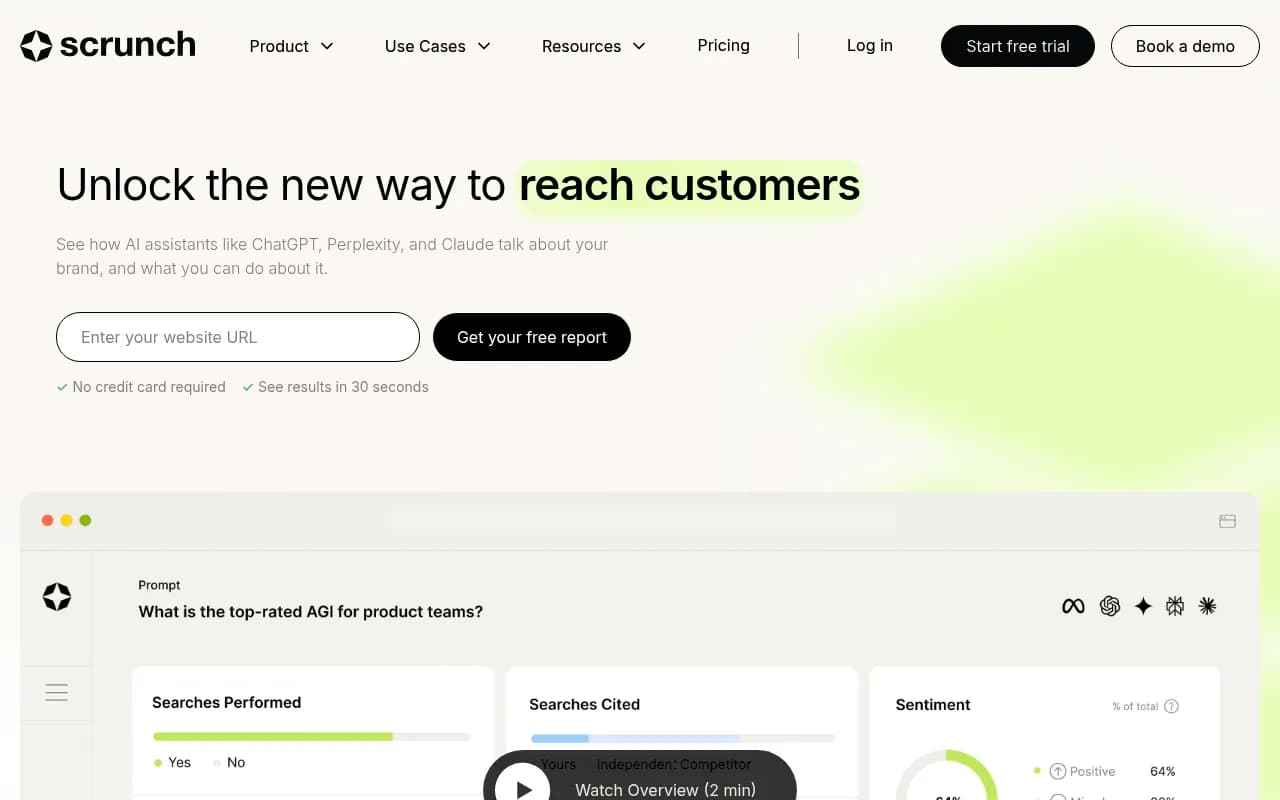
Scrunch tracks AI responses across multiple models and provides share-of-voice and citation data with a reasonably polished interface. It has some content optimization features, though they're more limited than what Promptwatch offers.
It's a mid-market option — more capable than Otterly.AI, less comprehensive than Promptwatch or Profound. Pricing is custom, which makes direct comparison tricky.
Brandlight.ai
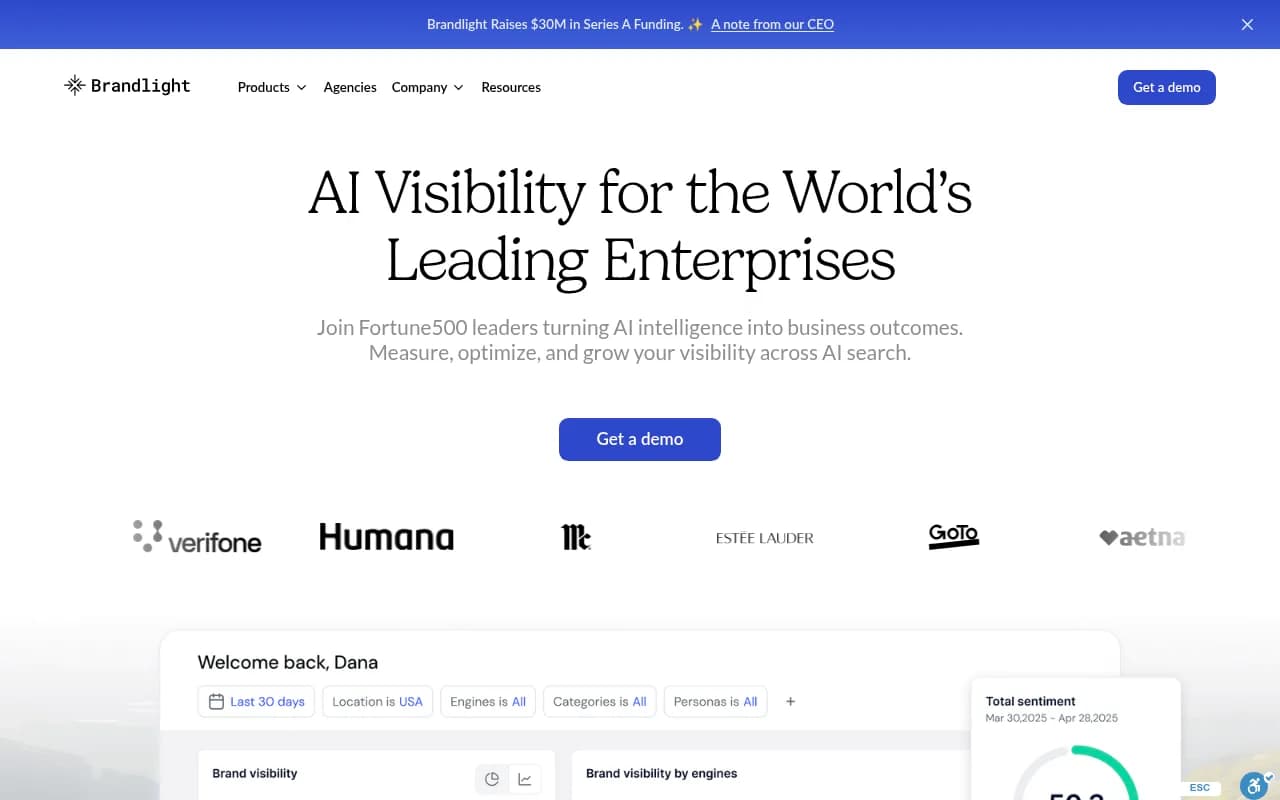
Brandlight.ai focuses on brand sentiment and citation tracking across AI models. It's particularly useful for teams that care about how their brand is being portrayed in AI responses, not just whether it appears.
The sentiment analysis is a genuine differentiator. The gap is on the optimization side — there's no content generation, no crawler logs, and limited actionability beyond the monitoring data.
Bluefish AI
Bluefish AI positions itself as an enterprise GEO platform and covers multiple AI models with solid citation and share-of-voice tracking. It's built for larger organizations with complex multi-brand needs.
Like several enterprise tools in this space, it's strong on data and weak on the "now what?" question. No content generation, no crawler logs. Custom pricing means you'll need to talk to sales to understand what you're actually getting.
Semrush AI toolkit
Semrush added AI visibility tracking to its existing platform, which makes it a natural choice for teams already paying for Semrush. The AI toolkit covers five models and integrates with the broader Semrush keyword and competitor data.
The catch: Semrush uses fixed prompts rather than letting you define your own prompt set, which limits how precisely you can track the queries that matter to your specific business. There's no AI traffic attribution, no crawler logs, and no content generation for AI search specifically. It's a useful add-on for existing Semrush users, not a reason to choose Semrush over a dedicated GEO platform.
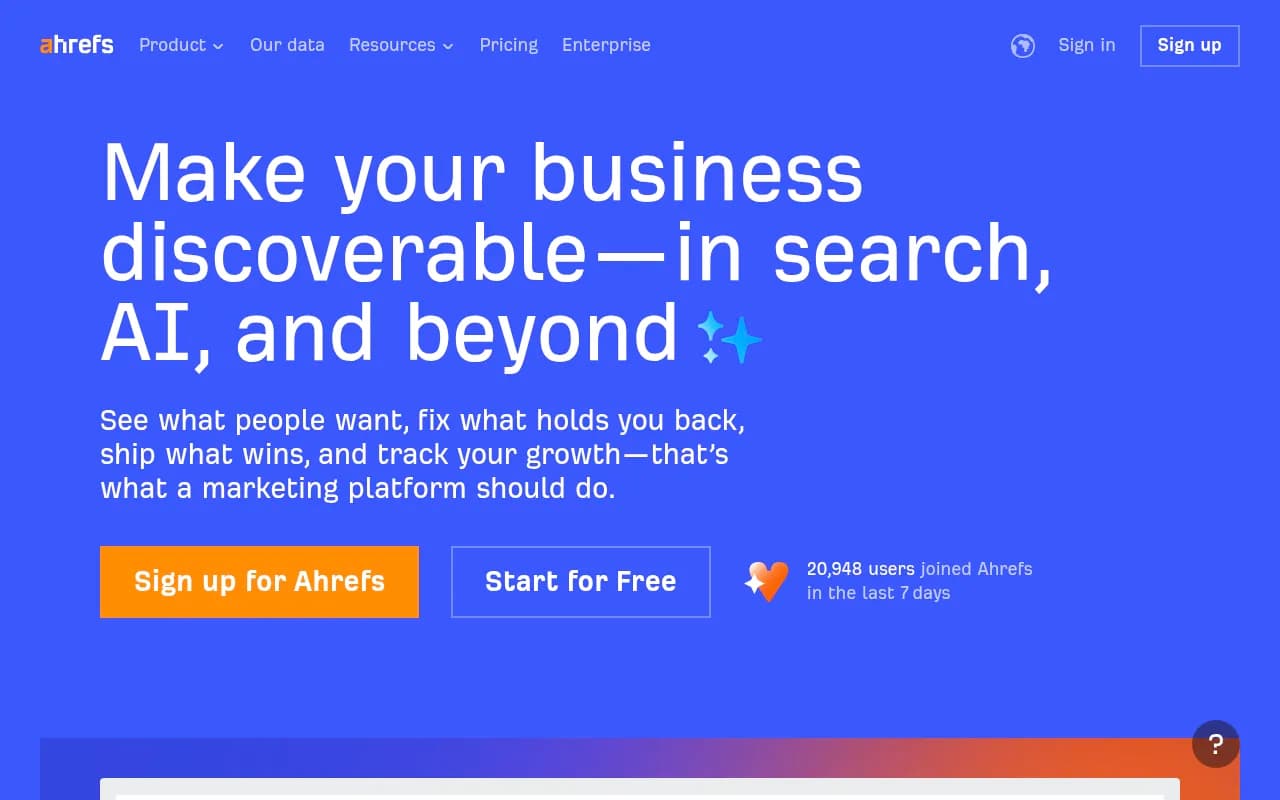
Ahrefs Brand Radar
Ahrefs Brand Radar is similar to Semrush's offering in that it's an add-on to an existing SEO platform rather than a purpose-built GEO tool. Fixed prompts, limited model coverage, no AI traffic attribution.
If you're an Ahrefs power user, it's worth turning on. If you're evaluating platforms specifically for GEO, it's not a serious contender.
Relixir
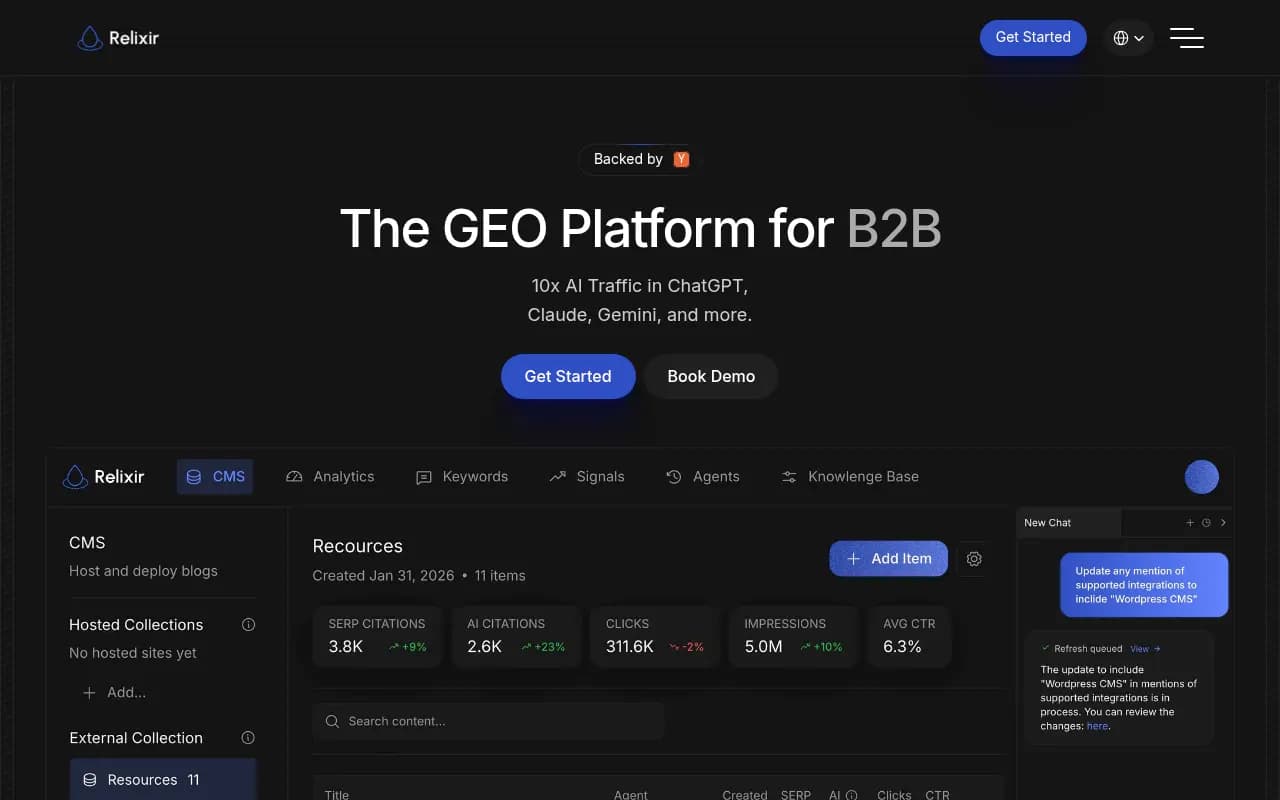
Relixir is one of the few platforms besides Promptwatch that includes content generation alongside monitoring. It tracks multiple AI models and can generate content based on gap analysis — which puts it in a different category from pure monitoring tools.
The platform is newer and less proven at scale than Promptwatch, and the breadth of features (crawler logs, Reddit/YouTube tracking, ChatGPT Shopping, prompt volume scoring) isn't there yet. But for teams that want the monitor-and-create loop without the full enterprise price tag, it's worth evaluating.
How to choose the right platform
The right tool depends on where you are in your GEO journey and what you actually need.
If you're just starting out and want to understand your baseline: Otterly.AI at $29/month is a reasonable starting point. You'll see whether your brand is being cited and across which models. Don't expect to do much with the data beyond knowing the score.
If you need enterprise-grade monitoring with deep prompt research: Profound is the most established option. Strong data quality, good model coverage, and a solid track record with larger organizations.
If you want to actually improve your AI visibility, not just measure it: Promptwatch is the clear choice. The combination of Answer Gap Analysis, Content Agents, AI Crawler Logs, and page-level citation tracking is the most complete GEO workflow available. It's the only platform in this comparison that covers the full cycle from "here's what's missing" to "here's the content that fixes it" to "here's proof it worked."
If you're an agency managing multiple clients: Promptwatch's agency/enterprise tier handles multi-site setups with custom pricing. Search Party is worth a look if your clients need custom AI workflow implementations rather than a SaaS monitoring tool.
If you're already deep in the Semrush or Ahrefs ecosystem: Turn on their AI features as a baseline, but don't mistake them for a GEO strategy. They're add-ons, not platforms.
What to look for beyond the feature list
A few things that don't always show up in comparison tables but matter a lot in practice:
Real UI monitoring vs. API-only. Some platforms query AI models through their APIs, which can return different results than what users actually see in ChatGPT or Perplexity's interface. Shopping recommendations, citation carousels, and featured responses often differ between API and UI. Platforms that monitor real user-facing interfaces give you more accurate data.
Prompt volume and difficulty scoring. Not all prompts are worth chasing. A platform that tells you "you're not visible for this prompt" without telling you how many people are actually asking it — or how hard it is to rank for — is giving you incomplete information. Promptwatch's prompt intelligence layer includes volume estimates and difficulty scores, which lets you prioritize.
Crawler log access. This is a big one that most teams overlook. Knowing that AI models are crawling your pages (and which pages they're hitting, how often, and what errors they encounter) is different from knowing whether you're being cited. Crawler logs let you diagnose technical issues before they become visibility problems. Very few platforms offer this — Promptwatch is one of them.
Offsite citation tracking. Your AI visibility isn't just about your own website. Reddit threads, YouTube videos, third-party listicles, and review sites all influence what AI models say about you. Platforms that only track your own domain are missing a significant part of the picture.
The market in 2026: what's changed
A year ago, most GEO platforms were in "monitoring only" mode because the underlying data was hard to collect at scale and the optimization playbook wasn't established. That's changed.
The platforms that have pulled ahead are the ones that figured out what to do with the data. Citation tracking is table stakes now. The differentiation is in answer gap analysis, content generation grounded in real prompt data, and the ability to connect visibility improvements to actual traffic and revenue.
The other shift is that AI search traffic is converting. Multiple studies in 2025 and 2026 found that AI-referred visits convert at 3x to 9x the rate of traditional organic traffic. That makes the ROI case for GEO investment much easier to make internally — and it raises the stakes for choosing a platform that can actually move the needle, not just report on it.
Bottom line
The GEO tools market has matured enough that you can now make a meaningful distinction between platforms that monitor and platforms that optimize. Most tools in this list are in the first category. A handful are in the second.
If your goal is to understand your AI visibility baseline, any of the monitoring tools will get you there. If your goal is to systematically improve how often AI models cite your brand — and connect that to revenue — you need a platform built around the full optimization loop.
Promptwatch is the most complete option for that. It's not the cheapest, but it's the only platform that covers monitoring, gap analysis, content generation, crawler logs, and traffic attribution in a single workflow. For teams serious about AI search in 2026, that's the combination that matters.