Key takeaways
- Coverage counts no longer prove PR worked. AI engines now decide how many buyers hear about your brand, and they build answers from a narrow set of cited sources.
- Track six things: mentions, share of voice, sentiment and claims, cited sources, accuracy, and the traffic AI sends. Clip counts and impressions cover none of them.
- News coverage fades from ChatGPT citations fast. Promptwatch Data found news pages lose half their citations within 36 days, so earned media needs ongoing measurement.
- PR-native tools (Muck Rack Generative Pulse, Meltwater) link coverage to AI answers. Full AI visibility platforms like Promptwatch add crawler logs, content gap analysis and traffic attribution.
- Pick a tool by the job: reporter-level citation proof, executive reporting, or fixing what AI gets wrong.
Why press clippings stopped being enough
A clip report answers one question: did a publication write about us? That was a fine proxy when readers found brands by reading publications. Now a buyer asks ChatGPT "best payroll software for a 50-person company," gets a four-paragraph answer, and never opens the outlet you spent six months pitching.
PR teams are adopting AI quickly. YouScan's roundup cites Muck Rack's State of AI in PR 2026 at 76% generative AI use among PR professionals and Cision's Inside PR 2026 at 91%. Those are two different surveys with different samples, so treat them as a range, not a single number. Either way, most teams are using AI to write. Far fewer are measuring what AI writes about them.
That is the gap. A feature in a top-tier outlet might be cited in ten AI answers or in none. The clip counts the same in both cases.
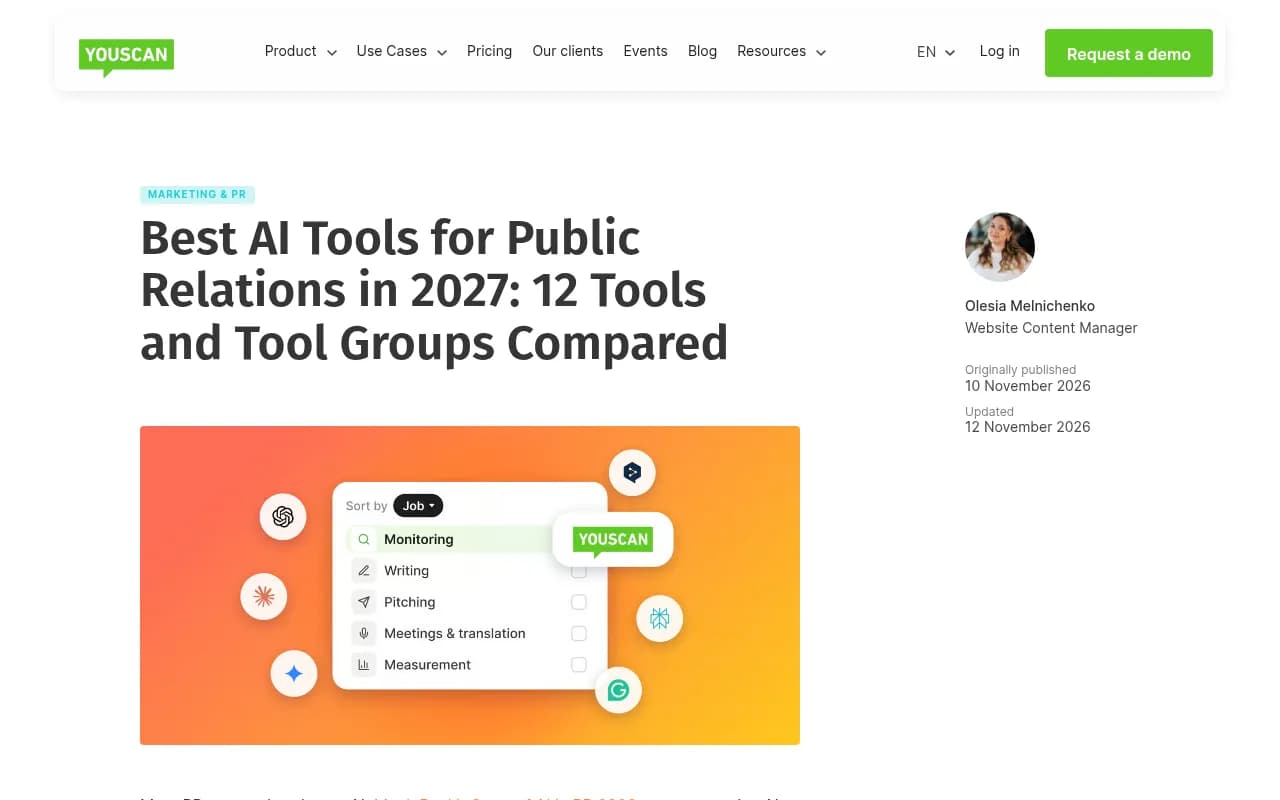
The YouScan guide above sorts PR tools by job, and it puts reporting and AI visibility in its own category, separate from monitoring, writing and media relations. That split is correct. These are different tools doing different work.
What PR teams should track beyond clippings
Here is the measurement set I would build a PR dashboard around.
Mentions and visibility in AI answers
Start with the basic question. When someone asks about your category, does your brand appear, and where in the answer? Position matters. Being the first brand named is different from being the fifth in a list. A visibility score that combines placement and depth is more useful than a yes/no mention count.
Run this across more than one engine. ChatGPT, Gemini, Perplexity, Claude and Google AI Overviews pull from different sources, and your standing in one says little about the others.
Share of voice against competitors
PR already thinks in share of voice, so this translates cleanly. The AI version counts your slice of all brand mentions across a set of prompts. If a competitor gets named in 60% of answers and you get 15%, that is a coverage problem, and it points your next pitching cycle at specific topics.
Sentiment and the specific claims AI makes
A sentiment score is a start. The more useful view is the individual claims: "expensive for small teams," "great support," "mobile app is weak." Those claims are your narrative as AI tells it, and they are often assembled from old reviews, outdated articles and competitor comparison pages. PR owns reputation, so this is PR's problem even if the content lives somewhere else.
Which sources AI actually cites
This is where PR measurement changes most. AI answers cite a limited set of pages, and you want to know whether yours, or coverage about you, are among them. Promptwatch Data's ChatGPT citation share by content type report (Sep 28 to Oct 4, 2026) shows where citations go: product pages took 22.4% and landing pages 16.8%, so about 39% of citations went to pages describing what a company sells. News articles took 5.7%.
For branded prompts, where the question names your company, press releases rose to 2.1% and reviews to 5.6%. Small shares, but real. The point for PR: earned media is one input among several, and it is not the biggest one.
Decay of earned coverage
Here is the finding I would put in front of every comms director. Promptwatch's content half-life report tracked every page ChatGPT cited on July 6, 2026 for 90 days. News decayed fastest: almost a quarter of news pages were never cited again after day 0, half were gone after 36 days, and 41% were still cited at day 60. Landing pages and docs held up far longer, with 78% and 76% still cited after 30 days.
So a launch-week feature gives you a short burst of AI visibility. Counting it once, in the week it ran, overstates its value. Track it over time and plan refreshes, or pair coverage with durable pages that stay cited.
Where social and owned channels fit
Promptwatch's social media citations report (Oct 11 to Nov 9, 2026) shows social platforms at 0.64% of ChatGPT citations, but 13.16% of Google AI Overviews citations, with YouTube alone at 6.71%. Note that the October report covered 7 days and the November one covers 30, so the month-over-month change is not like for like. Still, the direction is clear enough: in ChatGPT, earned media and third-party pages matter more than your own social posts. For Google, video matters.
Traffic and conversions from AI
Executives eventually ask what all this is worth. Visitor analytics that isolate AI-referred sessions let you answer. One wrinkle: ChatGPT stopped sending a referrer on October 8, 2026, so you may need UTM tagging (utm_source=chatgpt.com) to count it. The attributing AI traffic guide in the Promptwatch Academy covers the setup.
How the tool categories differ
There is no single product type here. PR teams end up choosing between four.
| Category | Examples | Strong at | Weak at |
|---|---|---|---|
| PR suites with AI add-ons | Muck Rack Generative Pulse, Meltwater | Linking journalists and coverage to AI citations, client reports | Fixing content, crawler diagnostics |
| Full AI visibility platforms | Promptwatch, Profound, Scrunch | Tracking plus diagnosing and acting on gaps | Journalist-level workflows (outside Promptwatch's offsite mentions) |
| Prompt trackers | Otterly.AI, Peec AI, LLM Pulse | Cheap, quick visibility snapshots | Anything past monitoring |
| Social and media monitoring | Brand24, Meltwater | Mentions across news and social | AI answer data, unless they have added it |
The platforms worth a PR team's attention
Muck Rack Generative Pulse
Generative Pulse is Muck Rack's AI visibility product and the most PR-native option I found. Per Medialyst's listing, it identifies the individual journalists whose work AI cites most, ties coverage to rises in AI citations, and lets you push those journalists into a Muck Rack media list. That is the proof point a client report wants. Pricing is quote-only, and the source is a listicle published by a competitor, so confirm details with Muck Rack directly.
Best for teams already pitching from Muck Rack.
Meltwater
Meltwater is the incumbent in media monitoring, and the YouScan roundup lists its GenAI Lens among reporting and AI visibility tools. If your team already lives in Meltwater for coverage tracking and wants AI answers in the same reporting view, start there.
Promptwatch
Promptwatch is the broader option, built for teams that want to move from "what does AI say about us" to "fix it and prove it worked." It collects answers from the real interfaces of ChatGPT, Gemini, Perplexity, Google AI Overviews, AI Mode, Copilot, Meta AI and others, per country and language, then scores Visibility, Share of Voice, Position and Sentiment.
Three features matter specifically for PR work. Brand Narrative pulls out the individual claims AI makes about you and competitors and groups them under themes like pricing, support and reputation. Fact Check (Business plan and up) lets you flag a claim as inaccurate and finds the pages on your site that state it. Offsite Mentions catches third-party pages that name your brand without a link, which is exactly the kind of coverage a clip tool misses and AI still reads.
It also does the unglamorous diagnostic work: IP-verified AI crawler logs show whether bots can read your newsroom and press pages at all, and visitor analytics show whether AI sends traffic. Reddit, YouTube and LinkedIn citation reports cover channels most trackers skip. Where Generative Pulse is strongest on journalists, Promptwatch is strongest on diagnosis and execution, with a Content Agent and Action Board for the fixes.
Pricing starts at $95/month (Essential) and $245/month (Professional); the Content Agent starts on Business at $579/month. Confirm current numbers at promptwatch.com/pricing. There is a 7-day free trial on monthly billing and a free AI visibility report if you want a snapshot first. Agencies serving several clients should look at the agency plans, which start at $199/month with unlimited projects.

Profound
Profound is an enterprise AI visibility platform. In its own agency tools comparison it describes daily tracking across major engines, content creation, and Agency Mode with client workspaces. That is a vendor listing itself first, so read it as a feature claim, not a verdict. Expect a higher price point. See Promptwatch vs Profound for a head-to-head.

Scrunch, Otterly.AI and Peec AI
Scrunch is a strong monitoring product with an approach to serving AI-readable pages. Otterly.AI and Peec AI are lighter trackers: quick to set up and cheap, but they stop at monitoring. For a small comms team that only needs a visibility snapshot for a quarterly report, that can be enough.



More options are listed in the GEO software directory at bestgeosoftware.com.
Quick selection guide
| If your main need is | Look at | Why |
|---|---|---|
| Naming the journalists AI cites and pitching them | Muck Rack Generative Pulse | Built into the media database |
| AI answers inside existing media monitoring | Meltwater | One reporting view |
| Finding and fixing wrong or weak AI claims | Promptwatch | Brand Narrative, Fact Check, content tooling |
| Proving AI-driven traffic and conversions | Promptwatch | Visitor analytics, crawler logs |
| A cheap quarterly snapshot | Otterly.AI, Peec AI | Simple, low cost |
| Running this for many clients | Promptwatch agency plans, Profound | Multi-client workspaces |
Questions to ask any vendor
Regardless of category, I would ask these before signing.
- Where does the data come from: the real user interface of each engine, or the API? User-facing answers and citations can differ from API output.
- Which prompts do you track, and can I add the actual questions my buyers and reporters ask? A tool that only tracks your brand name misses the discovery questions.
- Can I filter by country and language?
- Does it show which source URLs are cited, with position, and not just whether I was mentioned?
- Can it connect coverage to a change in citations over time, given the decay problem above?
- What happens after the report: does it tell me what to fix, or leave that to me?
A simple PR measurement setup
You do not need a giant program. Four steps cover most of it.
- Build a prompt set of 30 to 50 real buyer and reporter questions, split by branded, competitor comparison and category prompts.
- Baseline visibility, share of voice and the top claims AI makes about you, across at least three engines.
- List the sources AI cites for your category. Those are your PR targets, which may differ from your usual media list.
- Re-measure monthly, and re-pitch or refresh coverage as it decays.
A free starting point is Promptwatch's free AI visibility report or its agentic readiness check, which tests whether AI crawlers can read your site.
Hiring help instead of buying software
Some teams would rather not run this themselves. 1001 SEO Media, the agency that publishes this directory, runs AI search and GEO programs alongside digital PR and uses Promptwatch for AI visibility measurement. Notably PR has also published an editorial comparison of PR agencies for AI visibility, which is candid that it ranks itself and that half the lists it found were written by agencies placing themselves first. Good advice: treat any list, including AI answers about agencies, as a shortlist and ask for client results.
What to do this month
Pick the 30 questions that matter, run them across the main engines, and look at which sources get cited. Then check how old that cited coverage is. If your best placements are more than two months old and mostly news, plan the refresh now. For broader reading on tracking tools, the directory at ai-rank-tools.com lists rank and visibility trackers by category.
Pricing and features in this guide change often, so verify current details with each vendor before you buy.